
Homework Answers
(A)Saving rate: A saving rate is the amount of money saved as a percentage, that a person deducts from his/her personal income.
A higher saving rate does not permanently affect the growth rate in the Solow model (model which has been discussed below). A higher saving rate does result in a higher steady-state capital stock and a higher level of output. The shift from a lower to a higher steady-state level of output causes a temporary increase in the growth rate. In some newer theories of growth, a higher saving rate may permanently raise the rate of economic growth
Rate of Depreciation: It is the rate at which the value of the asset is reduced every year. It helps in determining the current value of the asset by its each passing year.
Rate of population Growth: The rate at which the number of individuals in a population increases at a given point of time.
In the Solow model, an increase in the population growth rate raises the growth rate of aggregate output but has no permanent effect on the growth rate of per capita output. An increase in the population growth rate lowers the steady-state level of per capita out
Rate of technological progress: In simple words it means larger quantities of output.
Technical progress, which in turn stimulates growth of the capital stock.
This has been clearly explained below “The Solow Growth Model” developed by Robert Solow.
SOLOW GROWTH MODEL
Start with a Constant Returns to Scale (CRTS) production function: Y = f (K,L). CRTS implies that by multiplying each input by some factor “z”, output changes by a multiple of that same factor: zY = f ( zK, zL)
In this case, let z = 1/L. That means:
Y * 1/L = f (K * 1/L, L * 1/L)
or
Y/L = f (K/L, 1)
define y = Y/L and k = K/L, so that the production function can now be written as
y = f (k),
where y is output per worker and k is capital per worker.
A graphical depiction of the production relation is:
The production function shows the production of goods. We now look at the demand for goods. The demand for goods, in this simple model, consists of consumption plus investment:
y = c + i
where y = Y/L; c = C/L; and i = I/L.
Investment, as always, creates additions to the capital stock.
The consumption function in this simple model is: C = (1 – s) Y,
which can be rewritten as c = (1 – s) y, where “s” is the savings rate and 0 < s < 1.
Going back to the demand for goods, y = c + i, we can rewrite this as
y = (1 – s) y + i
y = y – sy + i
so, y – y – sy = i
which means that sy = i: savings equals investment.
We can now put our knowledge to use by looking at a simple model of growth.
Investment adds to the capital stock (investment is created through savings):
i = sy = s f(k)
The higher the level of output, the greater the amount of investment:
Assume that a certain amount of capital stock is consumed each period: depreciation takes away from the capital stock. Let “d“be the depreciation rate. That means that each period d*k is the amount of capital that is “consumed” (i.e., used up):
We can now look at the effect of both investment and depreciation on the capital stock:
Dk = i – dk, which is stating that the stock of capital increases due to additions (created by investment) and decreases due to subtractions (caused by depreciation). This can be rewritten as Dk =s* f(k) – dk.
The steady state level of capital stock is the stock of capital at which investment and depreciation just offset each other: Dk = 0:
if k < k* then i > dk , so k increases towards k*
if k > k* then i <dk , so k decreases towards k*
Once the economy gets to k*, the capital stock does not change.
The Golden Rule level of capital accumulation is the steady state with the highest level of consumption. The idea behind the Golden Rule is that if the government could move the economy to a new steady state, where would they move? The answer is that they would choose the steady state at which consumption is maximized. To alter the steady state, the government must change the savings rate.
Since y = c + i,
then c = y – i
which can be rewritten as c = f(k) – s f(k)
which, in the steady state, means c = f(k) – dk. This indicates that to maximize consumption, we want to have the greatest difference between y and depreciation.
Since we want to maximize c = f(k) – dk, we take the first derivative and set it equal to zero:
Since we are looking at incremental changes in k, dk = 1, which leaves us with
the result that at the Golden Rule, the marginal product of capital must equal the rate of depreciation: MPK =d.
Introducing Population Growth
Let “n” represent growth in the labor force. As this growth occurs, k = K/L declines (due to the increase in L) and y = Y/L also decines (also due to the increase in L).
Thus, as L grows, the change in k is now:
Dk = s*f(k) – d*k – n*k,
where n*k represents the decrease in the capital stock per unit of labor from having more labor. The steady state condition is now that s*f(k) = (d+n) * k:
In the steady state, there’s no change in k so there’s no change in y. That means that output per worker and capital per worker are both constant. Since, however, the labor force is growing at the rate n (i.e., L increases at the rate “n”), Y (not y) is also increasing at the rate “n”. Similarly, K (not k) is increasing at the rate n.
Introducing Technological Progress
We shall assume that technological progress occurs because of increased efficiency of labor. That idea can be incorporated into the production function by simply assuming that each period, labor is able to produce more output than the previous period:
Y = f (K, L*E)
where E represents the efficiency of labor. We will assume that E grows at the rate “g”. Still assuming constant returns to scale, the production function can now be written as:
y = Y / L*E = f ( K/L*E , L/L*E ) = f (k), where k = K/L*E
We are now looking at output per efficiency unit of labor and capital per efficiency unit of labor.
Since k = K / L *E, we can see how k changes over time:
where, the sign of the first term on the right, kdis negative because capital is being consumed by depreciation (dK/K <0).
The steady state condition is modified to reflect the technological progress:
Dk = s*f(k) – (d+g+n)*k,
when Dk = 0 (i.e., at the steady state), s*f(k) = (d+g+n)*k.
At the steady state, y and k are constant. Since y = Y/L*E, and L grows at the rate n while E grows at the rate g, then Y must grow at the rate n+g. Similarly since k = K/L*E, K must grow at the rate of n+g.
The Golden Rule level of capital accumulation with this more complicated model is found by maximizing consumption at a steady state, which yields the following relation:
,
which simply indicates that the marginal product of capital net of depreciation must equal the sum of population and technological progress.
Example:
Let Y = K1/3(LE)2/3
with s = .25, n = .01, d=.1, and g = .015
The production function, because it exhibits CRTS, can be rewritten as
To find the steady state, recall that D?k = 0, so s*f(k) = (d+n+g) k
which can be rewritten as:
s/ (d+n+g) = k / f(k)
Since f(k) = k1/3, this can be rewritten as:
With this value for k*, we can find y* = (k*)1/3 = 1.41, and c* = y* - s y* = 1.06.
To find the Golden Rule level of capital accumulation, recall that at the GR,
MPK =(d+n+g).
Since Y = K1/3(LE)2/3 then
Since, at the Golden Rule, the above calculated MPK must equal (d+n+g),
Since k** = 4.35,
y** = k1/3 = 1.63
c** = y** - .125k** = 1.088
s** = 1 – (c**/y**) = .333
(C) Concept of Human Capital:-Human Capital is a measure of the skills, education, capacity and attributes of labour which influence their productive capacity and earning potential.
According to the OECD, human capital is defined as:
“the knowledge, skills, competencies and other attributes embodied in individuals or groups of individuals acquired during their life and used to produce goods, services or ideas in market circumstances”.
- Individual human capital – the skills and abilities of individual workers
- Human capital of the economy – The aggregate human capital of an economy, which will be determined by national educational standards.
Factors that determine human capital
- Skills and qualifications
- Education levels
- Work experience
- Social skills – communication
- Intelligence
- Emotional intelligence
- Judgement
- Personality – hard working, harmonious in an office
- Habits and personality traits
- Creativity. Ability to innovate new working practices/products.
- Fame and brand image of an individual. e.g. celebrities paid to endorse a product.
- Geography – Social peer pressure of local environment can affect expectations and attitudes.
Human capital in primary and secondary sector
In agriculture and manufacturing, human capital was easier to measure. The human capital of an assembly line worker could be measured in simple terms of productivity – e.g. the number of widgets produced per hour. In mining, human capital may be strongly related to physical strength and quantity of coal produced per day.
Human capital in tertiary sector/knowledge economy
The tertiary/service sector has a greater variety of jobs, which require different skills. These skills and qualities are often more difficult to measure regarding output. For example, the human capital of a teacher, cannot be measured by university degree and A-Levels. The best academics may lack some teaching skills – like empathy, the ability to inspire and command a class.
In a job, such as management, important characteristics will be factors such as interpersonal skills, ability to work in a team and the creativity to problem solve.
In other words, as the economy has developed the concept of human capital has also broadened to include a greater variety of skills and traits of capital.
T
Add Answer to:
EC2010-3 Q8. (a) Explain how the savings rate, the rate of depreciation, the rate of population...
Consider an economy with population growth n, depreciation rate δ and technological progress g. With the...
Consider an economy with population growth n, depreciation rate δ and technological progress g. With the aid of graphs, explain what happens to the steady-state capital per effective worker and income per effective worker in response to each the following: (a) Local events causes a shift in consumer preferences, leading to a decline in the saving rate (b) Greater access to birth control leads to a reduction in the rate of population growth
4. Suppose an economy has capital share of half, a savings rate of 12%, depreciation rate...
4. Suppose an economy has capital share of half, a savings rate of 12%, depreciation rate of 2%, population growing at 2% and labor-augmenting technological change of 2% yearly. a) What is the steady-state level of capital per efficiency unit of labor? b) Is this economy at the golden rule level of savings/investment? Fully detail your reasoning. c) If the economy decides to transition to Golden Rule, what will happen to consumption, capital per efficiency unit of labor and output...
5. (15%) Consider an economy at the long-run steady state. Population grows at rate gy and...
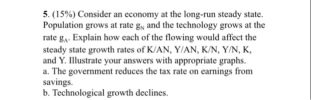 5. (15%) Consider an economy at the long-run steady state. Population grows at rate gy and the technology grows at the rate ga. Explain how each of the flowing would affect the steady state growth rates of K/AN, Y/AN, K/N, Y/N, K, and Y Illustrate your answers with appropriate graphs. a. The government reduces the tax rate on earnings from savings. b. Technological growth declines.
Consider an economy at the steady state. Labor force grows at the gN and technology grows at the ...
 Consider an economy at the steady state. Labor force grows at the gN and technology grows at the rate gA. Consider the effects of three shocks: (a) A higher rate of population growth; (b) An increase in the rate of technological change; (c) A decline in the rate of savings. i. Explain and illustrate how each shock would affect the steady-state of the 3. change from the initial to the new steady state? What are the rates of growth of...
Suppose an economy experiences technological change at rate g A, depreciation at rate g, and population...
Suppose an economy experiences technological change at rate g A, depreciation at rate g, and population growth at rate g N. Furthermore, the economy saves at a constant rate s. If the economy is in steady state, we would expect capital to grow at a rate of g N capital to grow at a rate of gA + gN capital to grow at a rate of g + gA + gN capital to grow at a rate of gA capital...
3. Many demographers predict that the US will have zero population growth in the 21st century,...
 3. Many demographers predict that the US will have zero population growth in the 21st century, in contrast to the population growth of about 1% in the 20th century. (a) Use the growth model (assuming that there is no technological progress) to forecast the effect of this decrease in the population growth rate on i. The long run level of output per worker () (ie. the standard of living) ii. The long run growth rate of output per worker ()...
3 Technological Growth Suppose that production is given by Y = K (AN) The savings rate...
 3 Technological Growth Suppose that production is given by Y = K (AN) The savings rate is s = 0.16 and the rate of depreciation is 8 = 0.1. Suppose further that the number of workers grows at 2% per year and that the rate of technological progress is 4% per year. 1. Find the steady-state values of the the following variables: capital per effective worker, output per effective worker, the growth rate of output per effective worker, the growth...
If the marginal product of capital net of depreciation equals 7 percent and the rate of...
If the marginal product of capital net of depreciation equals 7 percent and the rate of population growth equals 2 percent, then this economy will be at the Golden Rule steady state if the rate of technological progress equals ______ percent. 2 9 5 4
In the Solow model with a positive rate of population growth n and technological progress z,...
In the Solow model with a positive rate of population growth n and technological progress z, the steady state level of total real output Y grows at the rate: a. n. b. zero. c. z. d. n + z. In the Solow model with a positive rate of population growth n and technological progress z, the steady state level of per worker real output y grows at the rate: a. n. b. zero. c. z. d. n + z. In...
2) Slowdown in productivity growth Consider the following two scenarios: i) The rate of technological progress...
 2) Slowdown in productivity growth Consider the following two scenarios: i) The rate of technological progress drops permanently. i The savings rate drops permanently. a) Analyse graphically, what is the impact of each of these scenarios on economic growth in the next five years (short run)? b) Over the next five decades (long run)? Discuss the effects on both growth rates and output levels.
 5. (15%) Consider an economy at the long-run steady state. Population grows at rate gy and the technology grows at the rate ga. Explain how each of the flowing would affect the steady state growth rates of K/AN, Y/AN, K/N, Y/N, K, and Y Illustrate your answers with appropriate graphs. a. The government reduces the tax rate on earnings from savings. b. Technological growth declines.
 Consider an economy at the steady state. Labor force grows at the gN and technology grows at the rate gA. Consider the effects of three shocks: (a) A higher rate of population growth; (b) An increase in the rate of technological change; (c) A decline in the rate of savings. i. Explain and illustrate how each shock would affect the steady-state of the 3. change from the initial to the new steady state? What are the rates of growth of...
 3. Many demographers predict that the US will have zero population growth in the 21st century, in contrast to the population growth of about 1% in the 20th century. (a) Use the growth model (assuming that there is no technological progress) to forecast the effect of this decrease in the population growth rate on i. The long run level of output per worker () (ie. the standard of living) ii. The long run growth rate of output per worker ()...
 3 Technological Growth Suppose that production is given by Y = K (AN) The savings rate is s = 0.16 and the rate of depreciation is 8 = 0.1. Suppose further that the number of workers grows at 2% per year and that the rate of technological progress is 4% per year. 1. Find the steady-state values of the the following variables: capital per effective worker, output per effective worker, the growth rate of output per effective worker, the growth...
 2) Slowdown in productivity growth Consider the following two scenarios: i) The rate of technological progress drops permanently. i The savings rate drops permanently. a) Analyse graphically, what is the impact of each of these scenarios on economic growth in the next five years (short run)? b) Over the next five decades (long run)? Discuss the effects on both growth rates and output levels.
Most questions answered within 3 hours.
-
Where is the error in this code sequence?
String s1 = "Hello";
String s2 = "ello";...
asked 10 months ago -
Financial data for Joel de Paris, Inc., for last year
follow:
Joel de Paris, Inc.
Balance...
asked 10 months ago -
Consider this reaction:
Al2(SO4)3 (aq)+ BaCl3
(aq) Al2Cl6 (aq)- +
3BaSO4(s) . What is the...
asked 10 months ago -
Suppose that Savneet is considering increasing her
recent random sample from 20 car rentals to 40...
asked 10 months ago -
Trucks arrive at an unloading terminal at an average rate of 120
per hour.
Trucks arrive...
asked 10 months ago -
Why are methanol and ethanol completely soluble in water while
octanol is not very little soluble....
asked 10 months ago -
A facilities manager at a university reads in a research report
that the mean amount of...
asked 10 months ago -
When the CuSO4 is rehydrated by adding water to the anhydrous
compound, is this an endothermic...
asked 10 months ago -
A ray of sunlight is passing from diamond into crown glass; the
angle of incidence is...
asked 10 months ago -
A block of mass 0.249 kg is placed on top of a light, vertical
spring of...
asked 10 months ago -
how do the kidneys compensate in the presences of acidosis
a) trigger hyperventilate
b) reserve acid...
asked 10 months ago -
Question 501 pts
The rental rate of capital to the firm increases. Which of the
following...
asked 10 months ago