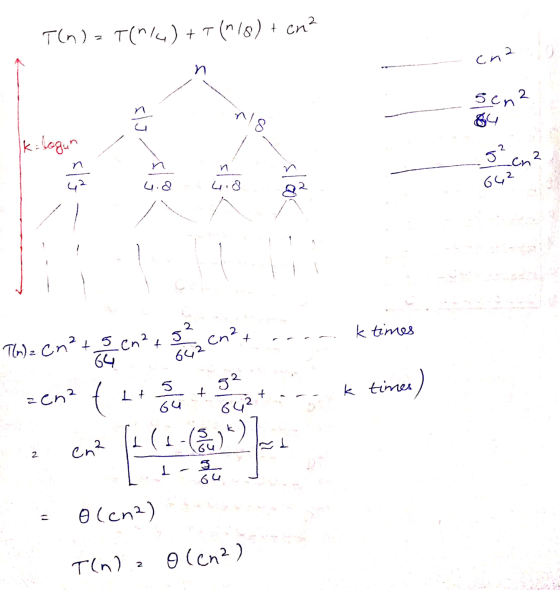
What is the time complexity of T(n) = cn^2 + T(n/4) + T(n/8) in θ ?...
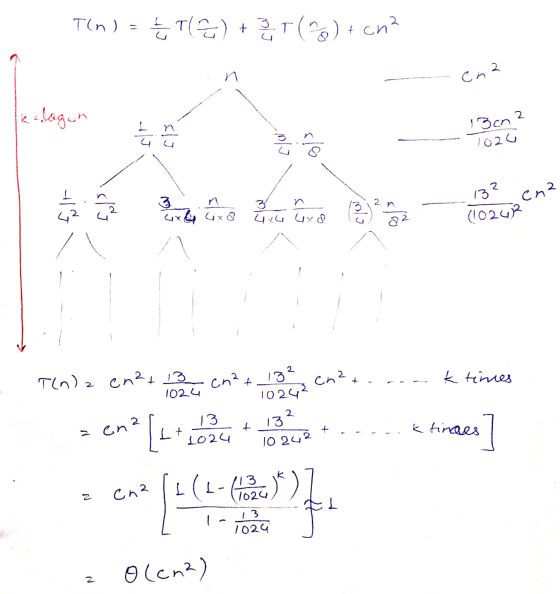
What is the time complexity of T(n) = cn^2 + T(n/4) + T(n/8) in θ ? What is the time complexity of T(n) = cn^2 + (1/4)T(n/4) + (3/4)T(n/8) in θ?
Homework Answers
If you're still having any doubt then please feel free to ask in the ccomment section.
Add Answer to:
What is the time complexity of T(n) = cn^2 + T(n/4) + T(n/8) in
θ ?...
FOR ALGORITHM A WORST CASE TIME COMPLEXITY IS DESCRIBED BY RECURRENCE FORMULA T(n)= n/ T (n...
 FOR ALGORITHM A WORST CASE TIME COMPLEXITY IS DESCRIBED BY RECURRENCE FORMULA T(n)= n/ T (n )thi T (c)=1 if c < 100 FOR ALGORITHM B WORST TIME COMPLEXITY IS DESCRIBED BY RECURRENCE FORMULA T(n) = 2T (2/2) + n/logn ; (c) = 1 fc 2100 WHICH ALGORITHM IS ASYMPTOTICALLY FASTER? WHY?
What is the worst-case asymptotic time complexity of the following divide-andconquer algorithm (give a Θ-bound). The...
What is the worst-case asymptotic time complexity of the following divide-andconquer algorithm (give a Θ-bound). The input is an array A of size n. You may assume that n is a power of 2. (NOTE: It doesn’t matter what the algorithm does, just analyze its complexity). Assume that the non-recursive function call, bar(A1,A2,A3,n) has cost 3n. Show your work! Next to each statement show its cost when the algorithm is executed on an imput of size n abd give the...
What is the worst-case asymptotic time complexity of the following divide-andconquer algorithm (give a Θ-bound). The...
What is the worst-case asymptotic time complexity of the following divide-andconquer algorithm (give a Θ-bound). The input is an array A of size n. You may assume that n is a power of 2. (NOTE: It doesn’t matter what the algorithm does, just analyze its complexity). Assume that the non-recursive function call, bar(A1,A2,A3,n) has cost 3n. Show your work! Next to each statement show its cost when the algorithm is executed on an imput of size n abd give the...
7. What is the worst-case running time complexity of an algorithm with the recurrence relation T(N)...
7. What is the worst-case running time complexity of an algorithm with the recurrence relation T(N) = 2T(N/4) + O(N2)? Hint: Use the Master Theorem.
What is the time complexity of the following code segment? for (int i = 0; i<n;...
 What is the time complexity of the following code segment? for (int i = 0; i<n; i--) if (a[i] != 0) sum = a[i]; What is the time complexity of the following code segment? for (int i = 0; i<10; i++) if (a[i] != 0) sum += a[i]; What is the time complexity of the following code segment? for (int i = 0; i<n/2; i++) if (a[i] != 0) sum += a[i]; What is the time complexity of the following...
Problem 5: Recurrence relations and detailed analysis of recursive algorithm efficiency g(n: non-negative integer)  
Problem 5: Recurrence relations and detailed analysis of recursive algorithm efficiency g(n: non-negative integer) 1. if n ≤ 1 then return n 2. else return (5 * g(n─1) ─ 6 * g(n─2)) MergeSort divides the array to be sorted into two equal halves, calls itself recursively on each half to sort that subarray, and then calls the Merge algorithm to merge the two sorted halves in linear time. This leads to its two recurrence relations T(n)=2T(n/2)+cn, n>1;...
Question 3: Given the following two code fragments [2 Marks] (i)Find T(n), the time complexity (as...
 Question 3: Given the following two
code fragments [2 Marks]
(i)Find T(n), the time complexity (as
operations count) in the worst case?
(ii)Express the growth rate of the
function in asymptotic notation in the closest bound possible.
(iii)Prove that T(n) is Big O (g(n)) by
the definition of Big O
(iv)Prove that T(n) is (g(n)) by using
limits
Question 3: Given the following two
code fragments [2 Marks]
(i)Find T(n), the time complexity (as
operations count) in the worst case?
(ii)Express the growth rate of the
function in asymptotic notation in the closest bound possible.
(iii)Prove that T(n) is Big O (g(n)) by
the definition of Big O
(iv)Prove that T(n) is (g(n)) by using
limits
Calculate the Big-O time complexity. Show work 4. 1^2 + 2^2 + 3^2 + · ·...
Calculate the Big-O time complexity. Show work 4. 1^2 + 2^2 + 3^2 + · · · + (n − 1)^2 + n^2 5. 12 log(n) + n/2 − 400 6. (n^4+2n^2+2n)/n)
discrete math (1) (15 pts) Time Complexity Analysis 1) (5 pts) What is the time complexity...
 discrete math
(1) (15 pts) Time Complexity Analysis 1) (5 pts) What is the time complexity of the following code segment? Explain your answer; otherwise, you can't get full mark from this question. for(int i=1; i<n; i*=2) { sum-0; sum++; Answer: 2) (5 pts) What is the time complexity of the following code segment? Explain your answer; otherwise, you can't get full mark from this question. for(int j=0; j<n; j++){ for (int k=0; k<n; k++) { for (int =0; i<n;...
discrete math
(1) (15 pts) Time Complexity Analysis 1) (5 pts) What is the time complexity of the following code segment? Explain your answer; otherwise, you can't get full mark from this question. for(int i=1; i<n; i*=2) { sum-0; sum++; Answer: 2) (5 pts) What is the time complexity of the following code segment? Explain your answer; otherwise, you can't get full mark from this question. for(int j=0; j<n; j++){ for (int k=0; k<n; k++) { for (int =0; i<n;...
which explanation matches the following runtime complexity? T(N)=k+T(N-1) a. Every time the function is called, k...
 which explanation matches the following runtime complexity? T(N)=k+T(N-1) a. Every time the function is called, k operations are done, and each of the 2 recursive calls reduces N by half. b. Every time the function is called, k operations are done, and the recursive call lowers N by 1. C. Every time the function is called, k operations are done, and each recursive call lowers N by one fourth. d. Every time the function is called, k operations are done,...
 FOR ALGORITHM A WORST CASE TIME COMPLEXITY IS DESCRIBED BY RECURRENCE FORMULA T(n)= n/ T (n )thi T (c)=1 if c < 100 FOR ALGORITHM B WORST TIME COMPLEXITY IS DESCRIBED BY RECURRENCE FORMULA T(n) = 2T (2/2) + n/logn ; (c) = 1 fc 2100 WHICH ALGORITHM IS ASYMPTOTICALLY FASTER? WHY?
 What is the time complexity of the following code segment? for (int i = 0; i<n; i--) if (a[i] != 0) sum = a[i]; What is the time complexity of the following code segment? for (int i = 0; i<10; i++) if (a[i] != 0) sum += a[i]; What is the time complexity of the following code segment? for (int i = 0; i<n/2; i++) if (a[i] != 0) sum += a[i]; What is the time complexity of the following...
 Question 3: Given the following two
code fragments [2 Marks]
(i)Find T(n), the time complexity (as
operations count) in the worst case?
(ii)Express the growth rate of the
function in asymptotic notation in the closest bound possible.
(iii)Prove that T(n) is Big O (g(n)) by
the definition of Big O
(iv)Prove that T(n) is (g(n)) by using
limits
Question 3: Given the following two
code fragments [2 Marks]
(i)Find T(n), the time complexity (as
operations count) in the worst case?
(ii)Express the growth rate of the
function in asymptotic notation in the closest bound possible.
(iii)Prove that T(n) is Big O (g(n)) by
the definition of Big O
(iv)Prove that T(n) is (g(n)) by using
limits
 discrete math
(1) (15 pts) Time Complexity Analysis 1) (5 pts) What is the time complexity of the following code segment? Explain your answer; otherwise, you can't get full mark from this question. for(int i=1; i<n; i*=2) { sum-0; sum++; Answer: 2) (5 pts) What is the time complexity of the following code segment? Explain your answer; otherwise, you can't get full mark from this question. for(int j=0; j<n; j++){ for (int k=0; k<n; k++) { for (int =0; i<n;...
discrete math
(1) (15 pts) Time Complexity Analysis 1) (5 pts) What is the time complexity of the following code segment? Explain your answer; otherwise, you can't get full mark from this question. for(int i=1; i<n; i*=2) { sum-0; sum++; Answer: 2) (5 pts) What is the time complexity of the following code segment? Explain your answer; otherwise, you can't get full mark from this question. for(int j=0; j<n; j++){ for (int k=0; k<n; k++) { for (int =0; i<n;...
 which explanation matches the following runtime complexity? T(N)=k+T(N-1) a. Every time the function is called, k operations are done, and each of the 2 recursive calls reduces N by half. b. Every time the function is called, k operations are done, and the recursive call lowers N by 1. C. Every time the function is called, k operations are done, and each recursive call lowers N by one fourth. d. Every time the function is called, k operations are done,...
Most questions answered within 3 hours.
-
Where is the error in this code sequence?
String s1 = "Hello";
String s2 = "ello";...
asked 11 months ago -
Financial data for Joel de Paris, Inc., for last year
follow:
Joel de Paris, Inc.
Balance...
asked 11 months ago -
Consider this reaction:
Al2(SO4)3 (aq)+ BaCl3
(aq) Al2Cl6 (aq)- +
3BaSO4(s) . What is the...
asked 11 months ago -
Suppose that Savneet is considering increasing her
recent random sample from 20 car rentals to 40...
asked 11 months ago -
Trucks arrive at an unloading terminal at an average rate of 120
per hour.
Trucks arrive...
asked 11 months ago -
Why are methanol and ethanol completely soluble in water while
octanol is not very little soluble....
asked 11 months ago -
A facilities manager at a university reads in a research report
that the mean amount of...
asked 11 months ago -
When the CuSO4 is rehydrated by adding water to the anhydrous
compound, is this an endothermic...
asked 11 months ago -
A ray of sunlight is passing from diamond into crown glass; the
angle of incidence is...
asked 11 months ago -
A block of mass 0.249 kg is placed on top of a light, vertical
spring of...
asked 11 months ago -
how do the kidneys compensate in the presences of acidosis
a) trigger hyperventilate
b) reserve acid...
asked 11 months ago -
Question 501 pts
The rental rate of capital to the firm increases. Which of the
following...
asked 11 months ago