
Homework Answers
![(10)9 Solubility equilibrium: Al (OH) Solubility product,K, [A][OHT 3x10-34 Al* (aq) + 3OH-(aa) ICE table AAi* (a) 30H(aq) (](http://img.homeworklib.com/questions/9efef800-38b5-11eb-884d-1ba0f635b901.png?x-oss-process=image/resize,w_560)
Add Answer to:
Find the equilibrium concentration of aluminum ions in pure water at 25 degree C caused by...
(15)10. Find the equilibrium pH value if pper ion (Cu2+) concentration in water is 10 mg/L....
 (15)10. Find the equilibrium pH value if pper ion (Cu2+) concentration in water is 10 mg/L. The copper ion is dissol ved from Cu(OH)2
1- Calculating [H+] for Pure Water: In a certain acidic solution at 25 ∘C, [H+] is...
1- Calculating [H+] for Pure Water: In a certain acidic solution at 25 ∘C, [H+] is 100 times greater than [OH −]. What is the value for [OH −] for the solution? In a certain acidic solution at 25 , [] is 100 times greater than [ ]. What is the value for [ ] for the solution? 1.0×10⁻⁸ M 1.0×10⁻⁷ M 1.0×10⁻⁶ M 1.0×10⁻² M 1.0×10⁻⁹ M 2. ± Acid-Base Relationships in Water: Water ionizes by the equation H2O(l)⇌H+(aq)+OH−(aq)The...
Calculate the solubility at 25 degree C of Co(OH)_2 in pure water and in a 0,0020...
 Calculate the solubility at 25 degree C of Co(OH)_2 in pure water and in a 0,0020 M CoCl_2 solution. K_sp is 5.92 times 10^-15. Round both of your answers to2 significant digits. Solubility in pure water: _______ Solubility in 0.00020 M CoCl_2 solution: ________
Calculate the following: a.) The molar concentration of calcium ions and carbonate ions in pure water....
Calculate the following: a.) The molar concentration of calcium ions and carbonate ions in pure water. b.) The molar solubility of calcium carbonate in pure water. c.) The mass, in mg, of calcium carbonate (MM = 100 g/mol) you would need to dissolve in 1 L of pure water to make a saturated solution.
Using the appropriate Ksp values, find the concentration of NO3− ions in the solution at equilibrium...
Using the appropriate Ksp values, find the concentration of NO3− ions in the solution at equilibrium after 650 mL of 0.45 M aqueous Cu(NO3)2 solution has been mixed with 350 mL of 0.40 M aqueous KOH solution. (Enter in M.) (Ksp for Cu(OH)2 is 2.6x10⁻¹⁹). Now find the concentration of OH− ions in this solution at equilibrium. (Enter in M.)
1. (15 pts) Use Ksp value (1E-32) and solubility reaction for aluminum hydroxide, AI(OH)3, found in...
 1. (15 pts) Use Ksp value (1E-32) and solubility reaction for aluminum hydroxide, AI(OH)3, found in Table 2.3 (p.62). pH is fixed at 6.0. What is the solubility of aluminum hydroxide? Report your result as the concentration of the aluminum metal cation in M units. Assume an infinite solid. Explain briefly how your result does or does not match the curves shown in the figure in class notes (see the graph for amorphous aluminum hydroxide solubility as a function of...
Calculate the equilibrium concentration of dissolved oxygen in 25°C water at sea level (p = 1.00...
 Calculate the equilibrium concentration of dissolved oxygen in 25°C water at sea level (p = 1.00 atm), and again at 4000 m elevation in 5°C water. [Use the exponential p vs. z equation provided in the lectures, not the empirical formula given in the textbook.] P(z)=P(O)exp(-z/H)
Using the appropriate Ksp values, find the concentration of NO3- ions in the solution at equilibrium...
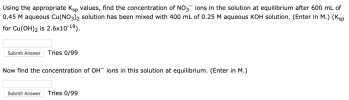 Using the appropriate Ksp values, find the concentration of NO3- ions in the solution at equilibrium after 600 mL of 0.45 M aqueous Cu(NO3)2 solution has been mixed with 400 mL of 0.25 M aqueous KOH solution. (Enter in M.) (Ksp for Cu(OH)2 is 2.6x10⁻¹⁹). Submit Answer Tries 0/99 Now find the concentration of OH ions in this solution at equilibrium. (Enter in M.) Submit Answer Tries 0/99
Calculate concentration of O_2 (in mg/L) in surface water in equilibrium with atmosphere (at 25 degree...
 Calculate concentration of O_2 (in mg/L) in surface water in equilibrium with atmosphere (at 25 degree C): K_O2 (25 degree C) = 1.28 times 10^-3 mol/L-atm 20.95% of O_2 in dry air P_H2O (25 degree C) = 0.0313 atm Knowing that O_2 solubility is 14.74 mg/L at 0 degree C and 7.03 mg/L at 35 degree C, estimate O_2 solubility at 50 degree C (in mg/L)
(6) Let's see how the spectator" ions present in solution affect the pH of a weak...
 (6) Let's see how the spectator" ions present in solution affect the pH of a weak acid (a) What is the pH of a 0.0200 M benzoic acid (Ka = 6.28 x 10) solution in water? (b) What is the % dissociation of the benzoic acid in pure water? Now we'll add some "spectator" ions to the solution. If the benzoic acid is dissolved in 0.10 M CaCl2 instead of pure water: (c) Calculate the ionic strength of the solution...
 (15)10. Find the equilibrium pH value if pper ion (Cu2+) concentration in water is 10 mg/L. The copper ion is dissol ved from Cu(OH)2
 Calculate the solubility at 25 degree C of Co(OH)_2 in pure water and in a 0,0020 M CoCl_2 solution. K_sp is 5.92 times 10^-15. Round both of your answers to2 significant digits. Solubility in pure water: _______ Solubility in 0.00020 M CoCl_2 solution: ________
 1. (15 pts) Use Ksp value (1E-32) and solubility reaction for aluminum hydroxide, AI(OH)3, found in Table 2.3 (p.62). pH is fixed at 6.0. What is the solubility of aluminum hydroxide? Report your result as the concentration of the aluminum metal cation in M units. Assume an infinite solid. Explain briefly how your result does or does not match the curves shown in the figure in class notes (see the graph for amorphous aluminum hydroxide solubility as a function of...
 Calculate the equilibrium concentration of dissolved oxygen in 25°C water at sea level (p = 1.00 atm), and again at 4000 m elevation in 5°C water. [Use the exponential p vs. z equation provided in the lectures, not the empirical formula given in the textbook.] P(z)=P(O)exp(-z/H)
 Using the appropriate Ksp values, find the concentration of NO3- ions in the solution at equilibrium after 600 mL of 0.45 M aqueous Cu(NO3)2 solution has been mixed with 400 mL of 0.25 M aqueous KOH solution. (Enter in M.) (Ksp for Cu(OH)2 is 2.6x10⁻¹⁹). Submit Answer Tries 0/99 Now find the concentration of OH ions in this solution at equilibrium. (Enter in M.) Submit Answer Tries 0/99
 Calculate concentration of O_2 (in mg/L) in surface water in equilibrium with atmosphere (at 25 degree C): K_O2 (25 degree C) = 1.28 times 10^-3 mol/L-atm 20.95% of O_2 in dry air P_H2O (25 degree C) = 0.0313 atm Knowing that O_2 solubility is 14.74 mg/L at 0 degree C and 7.03 mg/L at 35 degree C, estimate O_2 solubility at 50 degree C (in mg/L)
 (6) Let's see how the spectator" ions present in solution affect the pH of a weak acid (a) What is the pH of a 0.0200 M benzoic acid (Ka = 6.28 x 10) solution in water? (b) What is the % dissociation of the benzoic acid in pure water? Now we'll add some "spectator" ions to the solution. If the benzoic acid is dissolved in 0.10 M CaCl2 instead of pure water: (c) Calculate the ionic strength of the solution...
Most questions answered within 3 hours.
-
Where is the error in this code sequence?
String s1 = "Hello";
String s2 = "ello";...
asked 11 months ago -
Financial data for Joel de Paris, Inc., for last year
follow:
Joel de Paris, Inc.
Balance...
asked 11 months ago -
Consider this reaction:
Al2(SO4)3 (aq)+ BaCl3
(aq) Al2Cl6 (aq)- +
3BaSO4(s) . What is the...
asked 11 months ago -
Suppose that Savneet is considering increasing her
recent random sample from 20 car rentals to 40...
asked 11 months ago -
Trucks arrive at an unloading terminal at an average rate of 120
per hour.
Trucks arrive...
asked 11 months ago -
Why are methanol and ethanol completely soluble in water while
octanol is not very little soluble....
asked 11 months ago -
A facilities manager at a university reads in a research report
that the mean amount of...
asked 11 months ago -
When the CuSO4 is rehydrated by adding water to the anhydrous
compound, is this an endothermic...
asked 11 months ago -
A ray of sunlight is passing from diamond into crown glass; the
angle of incidence is...
asked 11 months ago -
A block of mass 0.249 kg is placed on top of a light, vertical
spring of...
asked 11 months ago -
how do the kidneys compensate in the presences of acidosis
a) trigger hyperventilate
b) reserve acid...
asked 11 months ago -
Question 501 pts
The rental rate of capital to the firm increases. Which of the
following...
asked 11 months ago