Calculate the standard change in Gibbs free energy of the following reactions at Standard Ambient Temperature and Pressure (SATP where T = 25°C and P = 1 atm) and label them as spontaneous or nonspontaneous.

Homework Answers

Add Answer to:
Calculate the standard change in Gibbs free energy of the
following reactions at Standard Ambient Temperature...
What is the standard Gibbs free energy for the transformation of diamond to graphite at 298 K? Cdiamond?Cgraphite Exp...
What is the standard Gibbs free energy for the transformation of diamond to graphite at 298 K? Cdiamond?Cgraphite Express your answer to three significant figures and include the appropriate units. Gibbs free energy is a measure of the spontaneity of a chemical reaction. It is the chemical potential for a reaction, which is minimized at equilibrium. It is defined as G=H?TS Elemental carbon usually exists in one of two forms: graphite or diamond. It is generally believed that diamonds last...
In Class Exercise - The Gibbs Free Energy Change, AG 1) Determining the Standard Gibbs Free...
 In Class Exercise - The Gibbs Free Energy Change, AG 1) Determining the Standard Gibbs Free Energy Change (AGⓇ) for a Chemical Reaction 2) Using AGº to Determine Spontaneity Name: Date: Lab section: Show your work when there are calculations, write units, and use correct significant figures. Consider the following reaction (balanced as written) and thermodynamic data from tables in your book: CO(NH2)2(aq) + H2O(l) → CO2(g) + 2NH3(g) Substance CO(NH2)2(aq) H2O(1) CO2(g) NH AH° (kJ/mol) -391.2 -285.9 -393.5 -46.19...
1. Determine the standard Gibb's free energy change for the conversion of diamond into graphite in...
 1. Determine the standard Gibb's free energy change for the
conversion of diamond into graphite in units of kJ/mol and is it
spontaneous, nonspontaneous, or neither.
Cdiamond (s) ?
Cgraphite (s)
f° for diamond =
2.9 kJ/mol
f° for graphite =
0.0 kJ/mol (Please be careful wtih sig figs.)
2. For the following reaction, = 68.1 kJ/mol:
2 C(s) + 2 H2(g) ?
C2H4(g)
Determine for the reaction in units of
kJ/mol at 1800. K, a partial pressure of C2H2
of...
1. Determine the standard Gibb's free energy change for the
conversion of diamond into graphite in units of kJ/mol and is it
spontaneous, nonspontaneous, or neither.
Cdiamond (s) ?
Cgraphite (s)
f° for diamond =
2.9 kJ/mol
f° for graphite =
0.0 kJ/mol (Please be careful wtih sig figs.)
2. For the following reaction, = 68.1 kJ/mol:
2 C(s) + 2 H2(g) ?
C2H4(g)
Determine for the reaction in units of
kJ/mol at 1800. K, a partial pressure of C2H2
of...
The standard Gibbs free energy for the transformation of diamond to graphite at 298 K is...
The standard Gibbs free energy for the transformation of diamond to graphite at 298 K is -2.9 kJ/mol. Why are diamonds not spontaneously transformed to graphite? C(diamond)→C(graphite) Δ?0=−2.9kJ/mol
Calculate the change in Gibbs free energy at standard conditions (TSS) and the equilibrium constant for...
Calculate the change in Gibbs free energy at standard conditions (TSS) and the equilibrium constant for each of the following reactions. (a) CH4(g) + H2O(g) equilibrium reaction arrow CO(g) + 3 H2(g); ?H° = +205.9 kJ, ?S° = +214.7 J/K ?G° 141.9 Correct: Your answer is correct. kJ K (b) CaCO3(s) equilibrium reaction arrow CaO(s) + CO2(g); ?H° = +179.2 kJ, ?S° = +160.2 J/K ?G° 131.5 Correct: Your answer is correct. kJ K
E) - 03. 9) Use the standard reaction enthalpies given below to determine AHºrxn for the following reaction: AHºrxn...
 E) - 03. 9) Use the standard reaction enthalpies given below to determine AHºrxn for the following reaction: AHºrxn = ? 4 S(s)+6 O2() → 4 SO3(e) Given: SO2(g) → S(s) + O2(e) 2 SO2(8)+O2(g) - 2 SO3(8) AHºrxn = 1296.8 kJ AHºrxn=-197.8 kJ D) -791.4 kJ E) 1583 kJ C) -1583 kJ A) -494.6 kJ B) -692.4 kJ
In Class Exercise - The Gibbs Free Energy Change, AG 1) Determining the Standard Gibbs Free...
 In Class Exercise - The Gibbs Free Energy Change, AG 1) Determining the Standard Gibbs Free Energy Change (AGⓇ) for a Chemical Reaction 2) Using AGº to Determine Spontaneity Name: Date: Lab section: Show your work when there are calculations, write units, and use correct significant figures. Consider the following reaction (balanced as written) and thermodynamic data from tables in your book: CO(NH2)2(aq) + H2O(1) ► CO2(g) + 2NH3(g) Substance CO(NH3)2(aq) H00 AH(kJ/mol) 1-391.2 -285.9 -3935 -46.19 S'J/mol K) 173.8...
Calculate the standard change in Gibbs free energy for the reaction at 25 °C. Standard Gibbs...
 Calculate the standard change in Gibbs free energy for the reaction at 25 °C. Standard Gibbs free energy of formation values can be found in this table. 3H2(g) + Fe,0,($) 2Fe(s) + 3 H,0 () AGran kJ/mol
Gibbs Free Energy Change Homework – Unanswered Use the data to determine the Gibbs Free Energy...
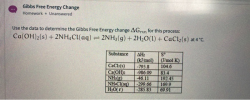 Gibbs Free Energy Change Homework – Unanswered Use the data to determine the Gibbs Free Energy change AGrxn for this process: Ca(OH)2(s) + 2NH4Cl(aq) = 2NH3(g) + 2H2O(1) + CaCl2(s) at 4°C. Substance CaCla(s) Ca(OH)2 NH3) NHCl(aq) HjO(0) ΔΗ: (kJ/mol -795.8 -986.09 -46.11 -299.66 -285.83 S (J/mol K) 104.6 83.4 192.45 169.9 69.91
What is the standard Gibbs free energy for the transformation of diamond to graphite at 298...
 What is the standard Gibbs free energy for the transformation of diamond to graphite at 298 K? Cdiamond+Cgraphite Express your answer to three significant figures and include the appropriate units. ► View Available Hint(s) kJ AGran = - 1.90 mol
 In Class Exercise - The Gibbs Free Energy Change, AG 1) Determining the Standard Gibbs Free Energy Change (AGⓇ) for a Chemical Reaction 2) Using AGº to Determine Spontaneity Name: Date: Lab section: Show your work when there are calculations, write units, and use correct significant figures. Consider the following reaction (balanced as written) and thermodynamic data from tables in your book: CO(NH2)2(aq) + H2O(l) → CO2(g) + 2NH3(g) Substance CO(NH2)2(aq) H2O(1) CO2(g) NH AH° (kJ/mol) -391.2 -285.9 -393.5 -46.19...
 1. Determine the standard Gibb's free energy change for the
conversion of diamond into graphite in units of kJ/mol and is it
spontaneous, nonspontaneous, or neither.
Cdiamond (s) ?
Cgraphite (s)
f° for diamond =
2.9 kJ/mol
f° for graphite =
0.0 kJ/mol (Please be careful wtih sig figs.)
2. For the following reaction, = 68.1 kJ/mol:
2 C(s) + 2 H2(g) ?
C2H4(g)
Determine for the reaction in units of
kJ/mol at 1800. K, a partial pressure of C2H2
of...
1. Determine the standard Gibb's free energy change for the
conversion of diamond into graphite in units of kJ/mol and is it
spontaneous, nonspontaneous, or neither.
Cdiamond (s) ?
Cgraphite (s)
f° for diamond =
2.9 kJ/mol
f° for graphite =
0.0 kJ/mol (Please be careful wtih sig figs.)
2. For the following reaction, = 68.1 kJ/mol:
2 C(s) + 2 H2(g) ?
C2H4(g)
Determine for the reaction in units of
kJ/mol at 1800. K, a partial pressure of C2H2
of...
 E) - 03. 9) Use the standard reaction enthalpies given below to determine AHºrxn for the following reaction: AHºrxn = ? 4 S(s)+6 O2() → 4 SO3(e) Given: SO2(g) → S(s) + O2(e) 2 SO2(8)+O2(g) - 2 SO3(8) AHºrxn = 1296.8 kJ AHºrxn=-197.8 kJ D) -791.4 kJ E) 1583 kJ C) -1583 kJ A) -494.6 kJ B) -692.4 kJ
 In Class Exercise - The Gibbs Free Energy Change, AG 1) Determining the Standard Gibbs Free Energy Change (AGⓇ) for a Chemical Reaction 2) Using AGº to Determine Spontaneity Name: Date: Lab section: Show your work when there are calculations, write units, and use correct significant figures. Consider the following reaction (balanced as written) and thermodynamic data from tables in your book: CO(NH2)2(aq) + H2O(1) ► CO2(g) + 2NH3(g) Substance CO(NH3)2(aq) H00 AH(kJ/mol) 1-391.2 -285.9 -3935 -46.19 S'J/mol K) 173.8...
 Calculate the standard change in Gibbs free energy for the reaction at 25 °C. Standard Gibbs free energy of formation values can be found in this table. 3H2(g) + Fe,0,($) 2Fe(s) + 3 H,0 () AGran kJ/mol
 Gibbs Free Energy Change Homework – Unanswered Use the data to determine the Gibbs Free Energy change AGrxn for this process: Ca(OH)2(s) + 2NH4Cl(aq) = 2NH3(g) + 2H2O(1) + CaCl2(s) at 4°C. Substance CaCla(s) Ca(OH)2 NH3) NHCl(aq) HjO(0) ΔΗ: (kJ/mol -795.8 -986.09 -46.11 -299.66 -285.83 S (J/mol K) 104.6 83.4 192.45 169.9 69.91
 What is the standard Gibbs free energy for the transformation of diamond to graphite at 298 K? Cdiamond+Cgraphite Express your answer to three significant figures and include the appropriate units. ► View Available Hint(s) kJ AGran = - 1.90 mol
Most questions answered within 3 hours.
-
Where is the error in this code sequence?
String s1 = "Hello";
String s2 = "ello";...
asked 10 months ago -
Financial data for Joel de Paris, Inc., for last year
follow:
Joel de Paris, Inc.
Balance...
asked 10 months ago -
Consider this reaction:
Al2(SO4)3 (aq)+ BaCl3
(aq) Al2Cl6 (aq)- +
3BaSO4(s) . What is the...
asked 10 months ago -
Suppose that Savneet is considering increasing her
recent random sample from 20 car rentals to 40...
asked 10 months ago -
Trucks arrive at an unloading terminal at an average rate of 120
per hour.
Trucks arrive...
asked 10 months ago -
Why are methanol and ethanol completely soluble in water while
octanol is not very little soluble....
asked 10 months ago -
A facilities manager at a university reads in a research report
that the mean amount of...
asked 10 months ago -
When the CuSO4 is rehydrated by adding water to the anhydrous
compound, is this an endothermic...
asked 10 months ago -
A ray of sunlight is passing from diamond into crown glass; the
angle of incidence is...
asked 10 months ago -
A block of mass 0.249 kg is placed on top of a light, vertical
spring of...
asked 10 months ago -
how do the kidneys compensate in the presences of acidosis
a) trigger hyperventilate
b) reserve acid...
asked 10 months ago -
Question 501 pts
The rental rate of capital to the firm increases. Which of the
following...
asked 10 months ago