
Homework Answers

Add Answer to:
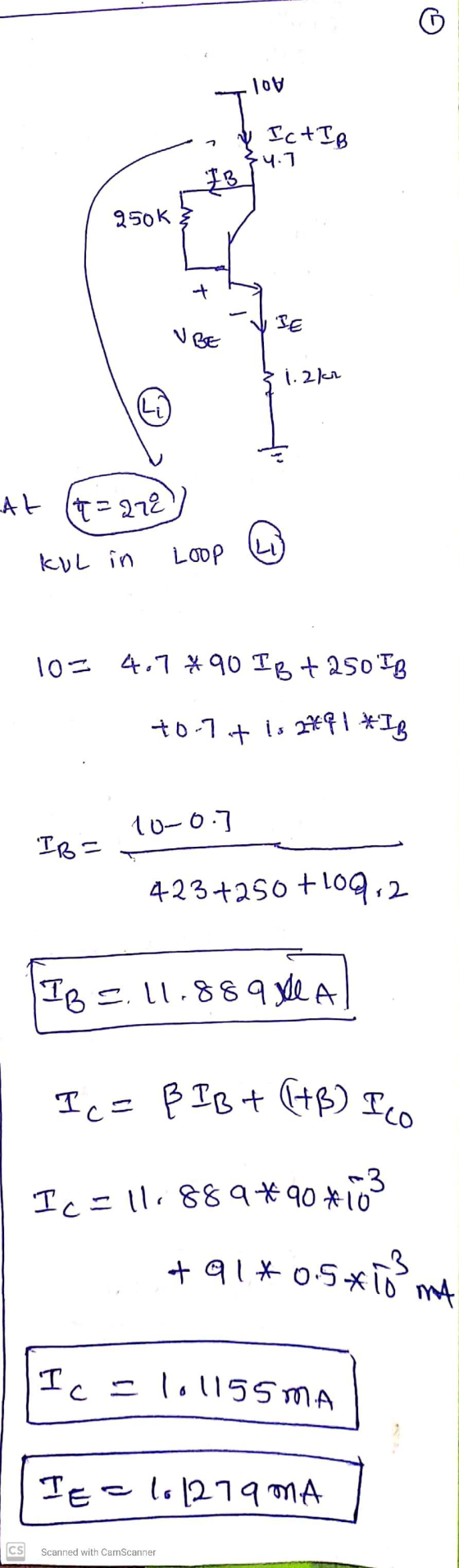
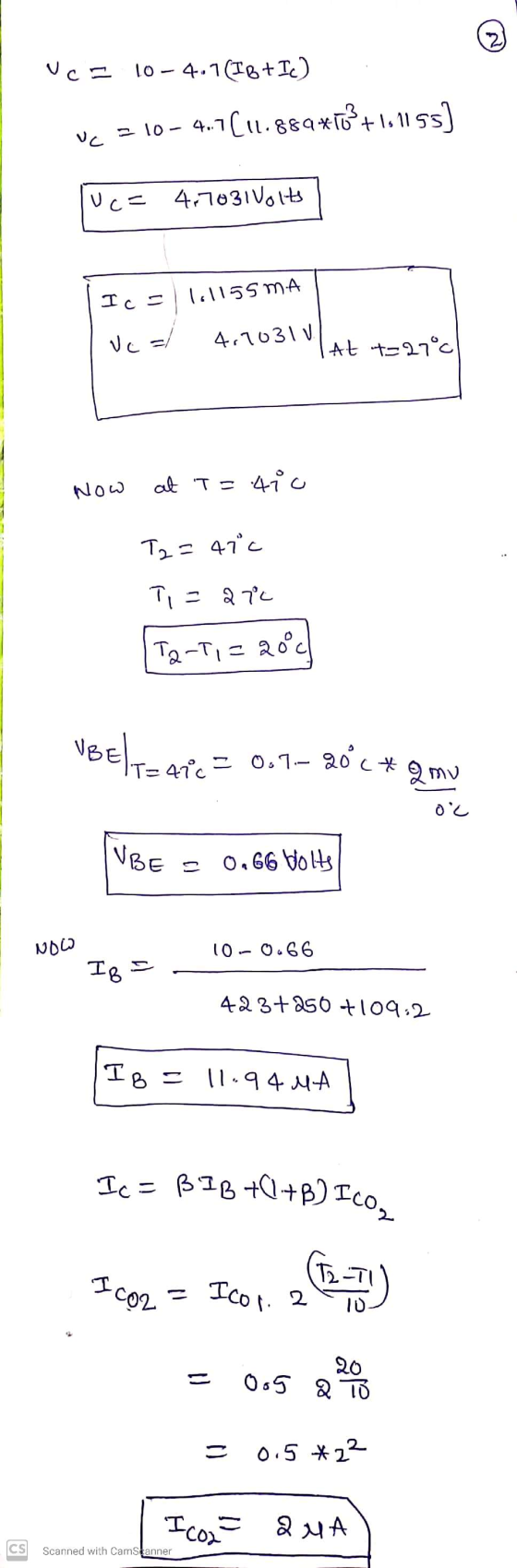
Find the variation of the collector current and the collector voltage VCat T = 47° C....
k) Biasing of a BJT transistor is the setting of the collector emitter voltage and the...
 k) Biasing of a BJT transistor is the setting of the collector emitter voltage and the collector current to the desired dc values. These voltages and currents determine the operating point (quiescent point, Q point). The three circuits given in Fig. 6.4 are designed to give the same operating point 12V 12V Rc Rc 12V R1 ?1 Rc R1 ?? Figure 6.4 a. Obtain the expression for VC in terms of the transistor parameters ?, VBE, Ico and the circuit...
8. Find a) base current is , b) collector current ic and c) voltage between collector...
 8. Find a) base current is , b) collector current ic and c) voltage between collector and emitter VCE Vcc=4.6V VCC RB=200k R WWW RRC=lk B=100 n-p-n BJT
QUESTION 3 In saturation, collector-emitter voltage is O a.5 V b.equal to collector-bias voltage O c....
 QUESTION 3 In saturation, collector-emitter voltage is O a.5 V b.equal to collector-bias voltage O c. minimum O d. maximum QUESTION 4 When operated in cutoff and saturation, the transistor acts like a a linear amplifier b. switch O c. variable capacitor Od variable resistor If a sinusoidal voltage is applied to the base of a biased on transistor and the resulting sinusoidal collector-to-emitter voltage is clipped near zero volts, the transistor is to Clipped ICO VE Clipped OVO a....
x=4 Question 3: The parameters of both bjt are as follows: base emitter turn on voltage...
 x=4
Question 3: The parameters of both bjt are as follows: base emitter turn on voltage is VBE,ON = 0.7 V, early voltage VA = 0, ac current gain B = 99. Small signal ac voltage source viis applied to the base of Q1 through a large capacitor. The resistors on the left branch are 63 X and 37xX2 (63 times X and 37 times X, note that these are not k2!!!). The remaining resistors are 4 k 2, 3...
x=4
Question 3: The parameters of both bjt are as follows: base emitter turn on voltage is VBE,ON = 0.7 V, early voltage VA = 0, ac current gain B = 99. Small signal ac voltage source viis applied to the base of Q1 through a large capacitor. The resistors on the left branch are 63 X and 37xX2 (63 times X and 37 times X, note that these are not k2!!!). The remaining resistors are 4 k 2, 3...
QUESTION 4 For the Circuit shown below. Find the Collector Current Vcc = 12 V Rp...
 QUESTION 4 For the Circuit shown below. Find the Collector Current Vcc = 12 V Rp = 500 ko Rc = 4 k22 + ß= ? VCE = 3 V VBE 2.25 A 2.25mA 3.0 A 3.0mA
(b) Based on Figure 4.1, evaluate Berdasarkan Rajah 4.1, nilaikan: (i) collector current at DC operating...
 (b) Based on Figure 4.1, evaluate Berdasarkan Rajah 4.1, nilaikan: (i) collector current at DC operating point (Q-point), Ico. arus pemungut di titik operasi AT (titik-O). Icl (2 Marks / Markah) (ii) collector to emitter voltage at DC operating point (Q-point), VceQ- voltan pemungut ke tapak di titik operasi AT (titik-O. Vcl 3 Marks/Markah) (iii) collector current at saturation, IcSAT) arus pemungut ketika tepu, Icsan (3 Marks / Markah) (iv) collector to emitter voltage at cutoff, VcE(cutofm voltan pemungut ke...
The source voltage V1 = 10 V dc . Find the diode current using the iterative...
 The source voltage V1 = 10 V dc . Find the diode current using
the iterative technique discussed in clas s. Assume the diode has V
D =0.7 V at I D =2 mA and V T =25 mV . Perform two iterations only.
Then calculate the percentage difference between the I D and V D of
it eration 2 and the same values from iteration 1 using iteration 1
values as the reference.
out R1 Vout 1K W1
The source voltage V1 = 10 V dc . Find the diode current using
the iterative technique discussed in clas s. Assume the diode has V
D =0.7 V at I D =2 mA and V T =25 mV . Perform two iterations only.
Then calculate the percentage difference between the I D and V D of
it eration 2 and the same values from iteration 1 using iteration 1
values as the reference.
out R1 Vout 1K W1
(60pts)For the differential amplifier below has the data: 1-1.2 (rnA), Vec-VEE-3 (V), VCM--8 (V),...
 (60pts)For the differential amplifier below has the data: 1-1.2 (rnA), Vec-VEE-3 (V), VCM--8 (V), Re-2 and β 100, assume that the BJT have vBE 0.7(V) at ic-1 (mA). Fine the voltage at emitters and at the outputs. If valo) 0.4 sin100nt (mv), vod(t)-? Vcc Rc Rc ici İC2 ei 02 İEI İE2
(60pts)For the differential amplifier below has the data: 1-1.2 (rnA), Vec-VEE-3 (V), VCM--8 (V), Re-2 and β 100, assume that the BJT have vBE 0.7(V) at ic-1 (mA)....
(60pts)For the differential amplifier below has the data: 1-1.2 (rnA), Vec-VEE-3 (V), VCM--8 (V), Re-2 and β 100, assume that the BJT have vBE 0.7(V) at ic-1 (mA). Fine the voltage at emitters and at the outputs. If valo) 0.4 sin100nt (mv), vod(t)-? Vcc Rc Rc ici İC2 ei 02 İEI İE2
(60pts)For the differential amplifier below has the data: 1-1.2 (rnA), Vec-VEE-3 (V), VCM--8 (V), Re-2 and β 100, assume that the BJT have vBE 0.7(V) at ic-1 (mA)....
10) Find the initial current and the initial voltage and the final current (i.e. at t...
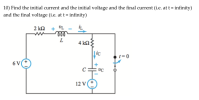 10) Find the initial current and the initial voltage and the final current (i.e. at t = infinity) and the final voltage (i.e. at t = infinity) 2 k2 + OL - iL 4k123 t=0 C DC 12 V
Problem 2. T Vcc=10v 4R3 Rc=5k12 Ko Yout C=0 Q(8=100, VBE=0.7, V=25mV, VA ) IRB IC=0...
 Problem 2. T Vcc=10v 4R3 Rc=5k12 Ko Yout C=0 Q(8=100, VBE=0.7, V=25mV, VA ) IRB IC=0 RB Fig. 3 In the common emitter amplifier shown in Fig. 3. a) Neglecting the base current (18 = 0), determine Rei and Rez to set Ice = 1 mA and the small-signal voltage gain |Apl= |Vout/Vin) = 20. [45 pt.) b) Base on the Ico given and ß = 100, choose Rp so that lg is 5% of IRB (15 pt.)
 k) Biasing of a BJT transistor is the setting of the collector emitter voltage and the collector current to the desired dc values. These voltages and currents determine the operating point (quiescent point, Q point). The three circuits given in Fig. 6.4 are designed to give the same operating point 12V 12V Rc Rc 12V R1 ?1 Rc R1 ?? Figure 6.4 a. Obtain the expression for VC in terms of the transistor parameters ?, VBE, Ico and the circuit...
 8. Find a) base current is , b) collector current ic and c) voltage between collector and emitter VCE Vcc=4.6V VCC RB=200k R WWW RRC=lk B=100 n-p-n BJT
 QUESTION 3 In saturation, collector-emitter voltage is O a.5 V b.equal to collector-bias voltage O c. minimum O d. maximum QUESTION 4 When operated in cutoff and saturation, the transistor acts like a a linear amplifier b. switch O c. variable capacitor Od variable resistor If a sinusoidal voltage is applied to the base of a biased on transistor and the resulting sinusoidal collector-to-emitter voltage is clipped near zero volts, the transistor is to Clipped ICO VE Clipped OVO a....
 x=4
Question 3: The parameters of both bjt are as follows: base emitter turn on voltage is VBE,ON = 0.7 V, early voltage VA = 0, ac current gain B = 99. Small signal ac voltage source viis applied to the base of Q1 through a large capacitor. The resistors on the left branch are 63 X and 37xX2 (63 times X and 37 times X, note that these are not k2!!!). The remaining resistors are 4 k 2, 3...
x=4
Question 3: The parameters of both bjt are as follows: base emitter turn on voltage is VBE,ON = 0.7 V, early voltage VA = 0, ac current gain B = 99. Small signal ac voltage source viis applied to the base of Q1 through a large capacitor. The resistors on the left branch are 63 X and 37xX2 (63 times X and 37 times X, note that these are not k2!!!). The remaining resistors are 4 k 2, 3...
 QUESTION 4 For the Circuit shown below. Find the Collector Current Vcc = 12 V Rp = 500 ko Rc = 4 k22 + ß= ? VCE = 3 V VBE 2.25 A 2.25mA 3.0 A 3.0mA
 (b) Based on Figure 4.1, evaluate Berdasarkan Rajah 4.1, nilaikan: (i) collector current at DC operating point (Q-point), Ico. arus pemungut di titik operasi AT (titik-O). Icl (2 Marks / Markah) (ii) collector to emitter voltage at DC operating point (Q-point), VceQ- voltan pemungut ke tapak di titik operasi AT (titik-O. Vcl 3 Marks/Markah) (iii) collector current at saturation, IcSAT) arus pemungut ketika tepu, Icsan (3 Marks / Markah) (iv) collector to emitter voltage at cutoff, VcE(cutofm voltan pemungut ke...
 The source voltage V1 = 10 V dc . Find the diode current using
the iterative technique discussed in clas s. Assume the diode has V
D =0.7 V at I D =2 mA and V T =25 mV . Perform two iterations only.
Then calculate the percentage difference between the I D and V D of
it eration 2 and the same values from iteration 1 using iteration 1
values as the reference.
out R1 Vout 1K W1
The source voltage V1 = 10 V dc . Find the diode current using
the iterative technique discussed in clas s. Assume the diode has V
D =0.7 V at I D =2 mA and V T =25 mV . Perform two iterations only.
Then calculate the percentage difference between the I D and V D of
it eration 2 and the same values from iteration 1 using iteration 1
values as the reference.
out R1 Vout 1K W1
 (60pts)For the differential amplifier below has the data: 1-1.2 (rnA), Vec-VEE-3 (V), VCM--8 (V), Re-2 and β 100, assume that the BJT have vBE 0.7(V) at ic-1 (mA). Fine the voltage at emitters and at the outputs. If valo) 0.4 sin100nt (mv), vod(t)-? Vcc Rc Rc ici İC2 ei 02 İEI İE2
(60pts)For the differential amplifier below has the data: 1-1.2 (rnA), Vec-VEE-3 (V), VCM--8 (V), Re-2 and β 100, assume that the BJT have vBE 0.7(V) at ic-1 (mA)....
(60pts)For the differential amplifier below has the data: 1-1.2 (rnA), Vec-VEE-3 (V), VCM--8 (V), Re-2 and β 100, assume that the BJT have vBE 0.7(V) at ic-1 (mA). Fine the voltage at emitters and at the outputs. If valo) 0.4 sin100nt (mv), vod(t)-? Vcc Rc Rc ici İC2 ei 02 İEI İE2
(60pts)For the differential amplifier below has the data: 1-1.2 (rnA), Vec-VEE-3 (V), VCM--8 (V), Re-2 and β 100, assume that the BJT have vBE 0.7(V) at ic-1 (mA)....
 10) Find the initial current and the initial voltage and the final current (i.e. at t = infinity) and the final voltage (i.e. at t = infinity) 2 k2 + OL - iL 4k123 t=0 C DC 12 V
 Problem 2. T Vcc=10v 4R3 Rc=5k12 Ko Yout C=0 Q(8=100, VBE=0.7, V=25mV, VA ) IRB IC=0 RB Fig. 3 In the common emitter amplifier shown in Fig. 3. a) Neglecting the base current (18 = 0), determine Rei and Rez to set Ice = 1 mA and the small-signal voltage gain |Apl= |Vout/Vin) = 20. [45 pt.) b) Base on the Ico given and ß = 100, choose Rp so that lg is 5% of IRB (15 pt.)
Most questions answered within 3 hours.
-
Where is the error in this code sequence?
String s1 = "Hello";
String s2 = "ello";...
asked 11 months ago -
Financial data for Joel de Paris, Inc., for last year
follow:
Joel de Paris, Inc.
Balance...
asked 11 months ago -
Consider this reaction:
Al2(SO4)3 (aq)+ BaCl3
(aq) Al2Cl6 (aq)- +
3BaSO4(s) . What is the...
asked 11 months ago -
Suppose that Savneet is considering increasing her
recent random sample from 20 car rentals to 40...
asked 11 months ago -
Trucks arrive at an unloading terminal at an average rate of 120
per hour.
Trucks arrive...
asked 11 months ago -
Why are methanol and ethanol completely soluble in water while
octanol is not very little soluble....
asked 11 months ago -
A facilities manager at a university reads in a research report
that the mean amount of...
asked 11 months ago -
When the CuSO4 is rehydrated by adding water to the anhydrous
compound, is this an endothermic...
asked 11 months ago -
A ray of sunlight is passing from diamond into crown glass; the
angle of incidence is...
asked 11 months ago -
A block of mass 0.249 kg is placed on top of a light, vertical
spring of...
asked 11 months ago -
how do the kidneys compensate in the presences of acidosis
a) trigger hyperventilate
b) reserve acid...
asked 11 months ago -
Question 501 pts
The rental rate of capital to the firm increases. Which of the
following...
asked 11 months ago