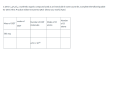
Complete the table: Compound Mass Moles Number of molecules CO2CO2 _____ 0.0193 _____ COCO _____ 0.0104...
Complete the table:
| Compound | Mass | Moles | Number of molecules |
| CO2CO2 | _____ | 0.0193 | _____ |
| COCO | _____ | 0.0104 | _____ |
| BrIBrI | 31.0 mgmg | _____ | _____ |
| CF2Cl2CF2Cl2 | 1.44 kgkg | _____ | _____ |
Homework Answers
1.
CO2CO2
we have moles for CO2CO2 = 0.0193
so we know
no of moles = mass of compound / molar mass of compound
0.0193 = mass / 88 (molar mass of CO2CO2 = 12+16+16+12+16+16 = 88 gm/mol)
mass = 1.6984 gm
we know 1 mole of any compound contain 6.02 x 10²³ molecules
we have mole = 0.0193
so no of moleculs = no of moles x 6.02 x 10²³
no of moleculs = 0.0193 x 6.02 x 1023 = 0.116 x 10²³
2.
COCO
we have moles for COCO= 0.0104
so we know
no of moles = mass of compound / molar mass of compound
0.0104 = mass / 56 (molar mass of COCO = 12+16+12+16= 56 gm/mol)
mass = 0.5824 gm
we know 1 mole of any compound contain 6.02 x 10²³ molecules
we have mole = 0.0104
so no of moleculs = no of moles x 6.02 x 10²³
no of moleculs = 0.0104 x 6.02 x 1023 = 0.062 x 10²³
3.
BrIBrI
we have mass of BrIBrI = 31 mg = 31 x 10-3 gm (1 mg = 10-3 g)
so we know
no of moles = mass of compound / molar mass of compound
no of moles = 31 x 10-3 / 414 (molar mass of BrIBrI = 80+ 127+80+127= 414 gm/mol)
no of moles = 0.074 x 10⁻³
we know 1 mole of any compound contain 6.02 x 10²³ molecules
we have mole =0.074 x 10⁻³
so no of moleculs = no of moles x 6.02 x 10²³
no of moleculs = 0.074 x 10-3x 6.02 x 1023 = 0.445 x 10²⁰
4.
CF2Cl2CF2Cl2
we have mass of CF2Cl2CF2Cl2 = 1.44 Kg = 1.44 x 10³ gm (1 Kg = 103 g)
so we know
no of moles = mass of compound / molar mass of compound
no of moles = 1.44 x 10³ / 242 (molar mass of CF2Cl2CF2Cl2 = 242 gm/mol)
no of moles = 5.95
we know 1 mole of any compound contain 6.02 x 10²³ molecules
we have mole =5.95
so no of moleculs = no of moles x 6.02 x 10²³
no of moleculs = 5.95x 6.02 x 1023 = 35.819 x 10²³
Add Answer to:
Complete the table:
Compound
Mass
Moles
Number of molecules
CO2CO2
_____
0.0193
_____
COCO
_____
0.0104...
Complete the table: Compound Mass Moles Number of molecules CO2 _____ 0.0162 _____ CO _____ 0.0189...
Complete the table: Compound Mass Moles Number of molecules CO2 _____ 0.0162 _____ CO _____ 0.0189 _____ BrI 31.4 mg _____ _____ CF2Cl2 1.48 kg _____ _____ Part A: Complete the second column of the table. Enter your answers numerically separated by a comma. Part B: Complete the third column of the table. Enter your answers numerically separated by a comma. Part C: Complete the fourth column of the table. Enter your answers numerically separated by commas.
Compound Mass Moles # of Molecules H2O 115kg ? ? N2O 5.59g ? ? SO2 ?...
Compound Mass Moles # of Molecules H2O 115kg ? ? N2O 5.59g ? ? SO2 ? 2.46 ? CH2Cl2 ? 0.0598 ? Complete the third column of the table. Enter your answers numerically separated by a comma. νH2O, νN2O = Complete the fourth column of the table. Enter your answers numerically separated by commas. NH2O, NN2O, NSO2, NCH2Cl2 =
Complete the following table. atoms in sample molecules in sample moles of sample mass of sample...
 Complete the following table. atoms in sample molecules in sample moles of sample mass of sample 404.70e25 X 403.19e22 400530 mol 4.14 g C6H6 402.60e24X 40 1.44e23 0.239 mol H2O 404.31 9 2.61 2.61 x 10²² molecules CO2 404.3 mol 4.0 191 g 7.28 40 7.29e23 1.21 mol HCI 4A44.1 444.08 4.08 x 1024 molecules H20 40 6.78 mol 40122 405.71e21 5.71 Check the number of significant figures. mol a0 .0095 0.304 g CH30H
1. Complete the table. Substance Mass Moles N0. of particle (atoms or molecules) Ar 5.0*10^-4 NO2...
1. Complete the table. Substance Mass Moles N0. of particle (atoms or molecules) Ar 5.0*10^-4 NO2 1.34*10^20 K 21.4 mg C8H18 2.50 kg 2.Complete The table Substance Mass Moles Number OF particles (atoms or molecules) C6H12O6 19.0 g Pb 8.24*10^21 CF4 24.5 kg C 0.0406 3. Amylose is a "polysaccharide" that plants use to store energy. It is made of repeating subunits of C6H10O5. a. A particular amylose molecule has 2113 of these subunits, what is its molecular formula? Express...
Complete the table below for calculating the molar mass of the compound phosphorus pentachloride. Molar mass...
 Complete the table below for calculating the molar mass of the compound phosphorus pentachloride. Molar mass of element Moles Mass in one mole of phosphorus pentachloride P D g /mol mol - g/mol mol Molar mass phosphorus pentachloride - g/mol
Complete the table below for calculating the molar mass of the compound sulfur trioxide. Molar mass...
 Complete the table below for calculating the molar mass of the compound sulfur trioxide. Molar mass of element M ass in one mole of sulfur trioxide g/mol * * Moles mol mol g/mol Molar mass sulfur trioxide = g/mol
1. DDT, C14H9C15, a synthetic organic compound used as an insecticide in some countries. Complete the...
 1. DDT, C14H9C15, a synthetic organic compound used as an insecticide in some countries. Complete the following table for DDT. (Hint: Practice midterm exam #2, Q#2) (Show your work) (4pts) moles of Mass of DDT Number of DDT molecules Moles of CI atoms Number of CI atoms DDT 500.mg 6.50 x 10²²
The number of moles of a substance can be converted into molecules by ______. a). multiplying...
The number of moles of a substance can be converted into molecules by ______. a). multiplying them with Avogadro's number b). dividing them with Avogadro's number c). multiplying them with molar mass d). dividing them with molar mass
A) Calculate the number of molecules of CH4 in 72 g CH4. B) The number of...
A) Calculate the number of molecules of CH4 in 72 g CH4. B) The number of grams in 3.33 mol of sodium carbonate is C) 3.44 g of Ca represents how many moles? D) 8.55 x 10⁻³ moles of an unknown compound has a mass of 0.376 g. The compound could be:
D. MORE PRACTICE... 1. Complete the table below. Massm m # moles Substance Mass (g) Molar...
 D. MORE PRACTICE... 1. Complete the table below. Massm m # moles Substance Mass (g) Molar mass (g/mol) of moles a. Aspirin tablet C.H.O.) 0.325 b. Wooden stick | (CHO) 14.482 c. Copper wire (Cu) Show work below. 1.809 2. A substance has a mass of 90.10 grams and contains 3.02 x 10 molecules. Which of the 3 substances in the chart above is it? Explain. 0 2 3 Fird noo or mores find mm mass per ind look at...
 Complete the following table. atoms in sample molecules in sample moles of sample mass of sample 404.70e25 X 403.19e22 400530 mol 4.14 g C6H6 402.60e24X 40 1.44e23 0.239 mol H2O 404.31 9 2.61 2.61 x 10²² molecules CO2 404.3 mol 4.0 191 g 7.28 40 7.29e23 1.21 mol HCI 4A44.1 444.08 4.08 x 1024 molecules H20 40 6.78 mol 40122 405.71e21 5.71 Check the number of significant figures. mol a0 .0095 0.304 g CH30H
 Complete the table below for calculating the molar mass of the compound phosphorus pentachloride. Molar mass of element Moles Mass in one mole of phosphorus pentachloride P D g /mol mol - g/mol mol Molar mass phosphorus pentachloride - g/mol
 Complete the table below for calculating the molar mass of the compound sulfur trioxide. Molar mass of element M ass in one mole of sulfur trioxide g/mol * * Moles mol mol g/mol Molar mass sulfur trioxide = g/mol
 1. DDT, C14H9C15, a synthetic organic compound used as an insecticide in some countries. Complete the following table for DDT. (Hint: Practice midterm exam #2, Q#2) (Show your work) (4pts) moles of Mass of DDT Number of DDT molecules Moles of CI atoms Number of CI atoms DDT 500.mg 6.50 x 10²²
 D. MORE PRACTICE... 1. Complete the table below. Massm m # moles Substance Mass (g) Molar mass (g/mol) of moles a. Aspirin tablet C.H.O.) 0.325 b. Wooden stick | (CHO) 14.482 c. Copper wire (Cu) Show work below. 1.809 2. A substance has a mass of 90.10 grams and contains 3.02 x 10 molecules. Which of the 3 substances in the chart above is it? Explain. 0 2 3 Fird noo or mores find mm mass per ind look at...
Most questions answered within 3 hours.
-
Where is the error in this code sequence?
String s1 = "Hello";
String s2 = "ello";...
asked 10 months ago -
Financial data for Joel de Paris, Inc., for last year
follow:
Joel de Paris, Inc.
Balance...
asked 10 months ago -
Consider this reaction:
Al2(SO4)3 (aq)+ BaCl3
(aq) Al2Cl6 (aq)- +
3BaSO4(s) . What is the...
asked 10 months ago -
Suppose that Savneet is considering increasing her
recent random sample from 20 car rentals to 40...
asked 10 months ago -
Trucks arrive at an unloading terminal at an average rate of 120
per hour.
Trucks arrive...
asked 10 months ago -
Why are methanol and ethanol completely soluble in water while
octanol is not very little soluble....
asked 10 months ago -
A facilities manager at a university reads in a research report
that the mean amount of...
asked 10 months ago -
When the CuSO4 is rehydrated by adding water to the anhydrous
compound, is this an endothermic...
asked 10 months ago -
A ray of sunlight is passing from diamond into crown glass; the
angle of incidence is...
asked 10 months ago -
A block of mass 0.249 kg is placed on top of a light, vertical
spring of...
asked 10 months ago -
how do the kidneys compensate in the presences of acidosis
a) trigger hyperventilate
b) reserve acid...
asked 10 months ago -
Question 501 pts
The rental rate of capital to the firm increases. Which of the
following...
asked 10 months ago