
Homework Answers
Add Answer to:
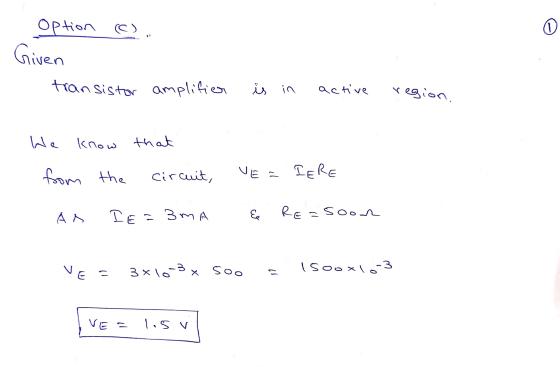
(2+5 pts) Consider the bias circuit below for a transistor amplifier designed for active region operation....
2) Consider the circuit below. Assume B=49 A/A, VBe=0.7V, VCEsat=0.2V. If the Collector current is Ic...
 2) Consider the circuit below. Assume B=49 A/A, VBe=0.7V, VCEsat=0.2V. If the Collector current is Ic = 9.8 mA, Find Vc, VE, VB and VBB; as well as the currents IE and IB. Hint: VBB>0. Verify your assumption. 15V V BB ic 3 Rc CS 30622 AVC RB 10k 2 B E → VE ięRE ES 33012
Consider the BJT common-emitter amplifier in Figure 1. Assume that the 2N3904G transistor has the following parameters: β-206, VBE-0.TV and the Early voltage VAT 1000V. vCC RB1a I multiple resistors...
 Consider the BJT common-emitter amplifier in Figure 1. Assume that the 2N3904G transistor has the following parameters: β-206, VBE-0.TV and the Early voltage VAT 1000V. vCC RB1a I multiple resistors RC want n Vload 22HF Rload 01 2N3904G V1 6302 4.7HF RE2CE 0.01Vpk 1kHz maliple esistons lue you available in the ki Figure 1 BJT CE amplifier 0.5 V and VC-3 V (a) Design the DC biasing circuit so that lc-2 mA, VCE = 2.5 V, VE
Consider the BJT...
Consider the BJT common-emitter amplifier in Figure 1. Assume that the 2N3904G transistor has the following parameters: β-206, VBE-0.TV and the Early voltage VAT 1000V. vCC RB1a I multiple resistors RC want n Vload 22HF Rload 01 2N3904G V1 6302 4.7HF RE2CE 0.01Vpk 1kHz maliple esistons lue you available in the ki Figure 1 BJT CE amplifier 0.5 V and VC-3 V (a) Design the DC biasing circuit so that lc-2 mA, VCE = 2.5 V, VE
Consider the BJT...
In the amplifier circuit in Figure 1 assume further that the transistor remains in the active region at all times. Express the amplitude of "vo" in terms of A and the circuit parameters. Plea...
 In the amplifier circuit in Figure 1 assume further that the
transistor remains in the active region at all times. Express the
amplitude of "vo" in terms of A and the circuit parameters. Please
express algebraically.
where Ve is a DC offset, and vb(t) is a time-varying purely AC signal. Suppose the amplitude of vb is A. Assume that the capacitor C is sufficiently large so that it can be considered to be short at the signal frequencies. . Rc,...
In the amplifier circuit in Figure 1 assume further that the
transistor remains in the active region at all times. Express the
amplitude of "vo" in terms of A and the circuit parameters. Please
express algebraically.
where Ve is a DC offset, and vb(t) is a time-varying purely AC signal. Suppose the amplitude of vb is A. Assume that the capacitor C is sufficiently large so that it can be considered to be short at the signal frequencies. . Rc,...
The 1 mA. V, ls -VE -15 15 V, in the following differential amplifier circuit, Vcc parameters are given as β, 100, VBE# 0.7 V, pr-25 mV, K.-100 V. transistor Rc-10 kΩ For: RE-150 Ω Rc Rc REE-200...
 The 1 mA. V, ls -VE -15 15 V, in the following differential amplifier circuit, Vcc parameters are given as β, 100, VBE# 0.7 V, pr-25 mV, K.-100 V. transistor Rc-10 kΩ For: RE-150 Ω Rc Rc REE-200 kΩ a) What is the input differential resistance, Rid b) What is the overall voltage gain vV? You c) What is input common mode resistance, d) What is the worst case common mode gain that appear across the two input terminals? (4...
The transistor in the circuit below has ?-100 and Vci(sat) OV. You may use the constant...
 The transistor in the circuit below has ?-100 and Vci(sat) OV. You may use the constant voltage model with VE 0.7V if the base emitter junction is forward biased. A variable DC source is attached to input VIN. Find the operating mode (cutoff, active, or saturation), the collector node voltage VC, and the collector current IC for each of the following cases: (a) VIN 0V (b) VIN = 1.2V (c) VIN 6.0v (d) VIN 12.0V 1 K IC VC 10K...
(20 pts) The BJT in the circuit below has the following specifications: • in active mode...
 (20 pts) The BJT in the circuit below has the following specifications: • in active mode ß = 50, VBE = 0.76 V, and • in saturation VCEsat = 0.2 V. Find VE, VB and Vc and determine the mode of operation (active, saturation, cut-off). Given values are: /= 1 mA, Rg=200 kN and Re =4 k12. I Vc RB VB. VEم RE
IX With reference to the transistor amplifier shown in Figure QB4 below d For the bipolar transistor circuit of Figure QB4 the following DC bias conditions were measured: VB made. 1.6 V and VBE =0.6...
 IX With reference to the transistor amplifier shown in Figure QB4 below d For the bipolar transistor circuit of Figure QB4 the following DC bias conditions were measured: VB made. 1.6 V and VBE =0.6 V. Detemine the value for RA, stating any assumptions e) Using these same conditions, calculate the current in Re and deduce the current in Rc, stating any assumptions made. Hence find the voltage across Rc and explain whether this voltage is suitable for this amplifier...
6.5 BI C2 Cl sig in 0 Design the bias circuit of the CE amplifier shown...
 6.5 BI C2 Cl sig in 0 Design the bias circuit of the CE amplifier shown to obtain IE= 0.5 mA and Vc= +6 V. Design for a dc voltage at the base of 5 V and a current through RB2 of 50 μΑ. Let Vcc-+15 V, β-100, and VBE 0.7 V. a) Specify the values of RBi, RB2, RE, and Rc b) Also give the values of the BJT small-signal parameters gm, rr , and ro at the bias...
draw a base biased circuit and refered to question 5 and complete table. please draw the fixed bias diagram circuit and follow throught step on the next question. Figure 1. Bipolar junction tran...
 draw a base biased circuit and refered to question 5 and
complete table.
please draw the fixed bias diagram circuit and follow throught step
on the next question.
Figure 1. Bipolar junction transistor under base bias/fixed bias 5. In the circuit drawn in Figure 1, label the components with the following values: Base voltage, Collector voltage10V Base resistance Collector resistance Base - emitter voltage 2.7 k2 0.7 V 160 6. Connect the circuit drawn in Figure 1 on the breadboard....
draw a base biased circuit and refered to question 5 and
complete table.
please draw the fixed bias diagram circuit and follow throught step
on the next question.
Figure 1. Bipolar junction transistor under base bias/fixed bias 5. In the circuit drawn in Figure 1, label the components with the following values: Base voltage, Collector voltage10V Base resistance Collector resistance Base - emitter voltage 2.7 k2 0.7 V 160 6. Connect the circuit drawn in Figure 1 on the breadboard....
4. Lab VIII: Experiment VII The Bipolar Junction Transistor (BJT) Characteristics The bipolar junction transistor (BJT)...
 4. Lab VIII: Experiment VII The Bipolar Junction Transistor (BJT) Characteristics The bipolar junction transistor (BJT) is a three-terminal solid state device widely used as an amplifier (or switching) device. It consists of two n-type materials sandwiched by p-type material (npn) or two p-type and n-type. The terminals (sections) are known as emitter E, base B and collector C. Two currents and two voltages uniquely describe the behavior of the device. The third current/voltage can be determined through KCL/KVL. See...
 2) Consider the circuit below. Assume B=49 A/A, VBe=0.7V, VCEsat=0.2V. If the Collector current is Ic = 9.8 mA, Find Vc, VE, VB and VBB; as well as the currents IE and IB. Hint: VBB>0. Verify your assumption. 15V V BB ic 3 Rc CS 30622 AVC RB 10k 2 B E → VE ięRE ES 33012
 Consider the BJT common-emitter amplifier in Figure 1. Assume that the 2N3904G transistor has the following parameters: β-206, VBE-0.TV and the Early voltage VAT 1000V. vCC RB1a I multiple resistors RC want n Vload 22HF Rload 01 2N3904G V1 6302 4.7HF RE2CE 0.01Vpk 1kHz maliple esistons lue you available in the ki Figure 1 BJT CE amplifier 0.5 V and VC-3 V (a) Design the DC biasing circuit so that lc-2 mA, VCE = 2.5 V, VE
Consider the BJT...
Consider the BJT common-emitter amplifier in Figure 1. Assume that the 2N3904G transistor has the following parameters: β-206, VBE-0.TV and the Early voltage VAT 1000V. vCC RB1a I multiple resistors RC want n Vload 22HF Rload 01 2N3904G V1 6302 4.7HF RE2CE 0.01Vpk 1kHz maliple esistons lue you available in the ki Figure 1 BJT CE amplifier 0.5 V and VC-3 V (a) Design the DC biasing circuit so that lc-2 mA, VCE = 2.5 V, VE
Consider the BJT...
 In the amplifier circuit in Figure 1 assume further that the
transistor remains in the active region at all times. Express the
amplitude of "vo" in terms of A and the circuit parameters. Please
express algebraically.
where Ve is a DC offset, and vb(t) is a time-varying purely AC signal. Suppose the amplitude of vb is A. Assume that the capacitor C is sufficiently large so that it can be considered to be short at the signal frequencies. . Rc,...
In the amplifier circuit in Figure 1 assume further that the
transistor remains in the active region at all times. Express the
amplitude of "vo" in terms of A and the circuit parameters. Please
express algebraically.
where Ve is a DC offset, and vb(t) is a time-varying purely AC signal. Suppose the amplitude of vb is A. Assume that the capacitor C is sufficiently large so that it can be considered to be short at the signal frequencies. . Rc,...
 The 1 mA. V, ls -VE -15 15 V, in the following differential amplifier circuit, Vcc parameters are given as β, 100, VBE# 0.7 V, pr-25 mV, K.-100 V. transistor Rc-10 kΩ For: RE-150 Ω Rc Rc REE-200 kΩ a) What is the input differential resistance, Rid b) What is the overall voltage gain vV? You c) What is input common mode resistance, d) What is the worst case common mode gain that appear across the two input terminals? (4...
 The transistor in the circuit below has ?-100 and Vci(sat) OV. You may use the constant voltage model with VE 0.7V if the base emitter junction is forward biased. A variable DC source is attached to input VIN. Find the operating mode (cutoff, active, or saturation), the collector node voltage VC, and the collector current IC for each of the following cases: (a) VIN 0V (b) VIN = 1.2V (c) VIN 6.0v (d) VIN 12.0V 1 K IC VC 10K...
 (20 pts) The BJT in the circuit below has the following specifications: • in active mode ß = 50, VBE = 0.76 V, and • in saturation VCEsat = 0.2 V. Find VE, VB and Vc and determine the mode of operation (active, saturation, cut-off). Given values are: /= 1 mA, Rg=200 kN and Re =4 k12. I Vc RB VB. VEم RE
 IX With reference to the transistor amplifier shown in Figure QB4 below d For the bipolar transistor circuit of Figure QB4 the following DC bias conditions were measured: VB made. 1.6 V and VBE =0.6 V. Detemine the value for RA, stating any assumptions e) Using these same conditions, calculate the current in Re and deduce the current in Rc, stating any assumptions made. Hence find the voltage across Rc and explain whether this voltage is suitable for this amplifier...
 6.5 BI C2 Cl sig in 0 Design the bias circuit of the CE amplifier shown to obtain IE= 0.5 mA and Vc= +6 V. Design for a dc voltage at the base of 5 V and a current through RB2 of 50 μΑ. Let Vcc-+15 V, β-100, and VBE 0.7 V. a) Specify the values of RBi, RB2, RE, and Rc b) Also give the values of the BJT small-signal parameters gm, rr , and ro at the bias...
 draw a base biased circuit and refered to question 5 and
complete table.
please draw the fixed bias diagram circuit and follow throught step
on the next question.
Figure 1. Bipolar junction transistor under base bias/fixed bias 5. In the circuit drawn in Figure 1, label the components with the following values: Base voltage, Collector voltage10V Base resistance Collector resistance Base - emitter voltage 2.7 k2 0.7 V 160 6. Connect the circuit drawn in Figure 1 on the breadboard....
draw a base biased circuit and refered to question 5 and
complete table.
please draw the fixed bias diagram circuit and follow throught step
on the next question.
Figure 1. Bipolar junction transistor under base bias/fixed bias 5. In the circuit drawn in Figure 1, label the components with the following values: Base voltage, Collector voltage10V Base resistance Collector resistance Base - emitter voltage 2.7 k2 0.7 V 160 6. Connect the circuit drawn in Figure 1 on the breadboard....
 4. Lab VIII: Experiment VII The Bipolar Junction Transistor (BJT) Characteristics The bipolar junction transistor (BJT) is a three-terminal solid state device widely used as an amplifier (or switching) device. It consists of two n-type materials sandwiched by p-type material (npn) or two p-type and n-type. The terminals (sections) are known as emitter E, base B and collector C. Two currents and two voltages uniquely describe the behavior of the device. The third current/voltage can be determined through KCL/KVL. See...
Most questions answered within 3 hours.
-
Where is the error in this code sequence?
String s1 = "Hello";
String s2 = "ello";...
asked 10 months ago -
Financial data for Joel de Paris, Inc., for last year
follow:
Joel de Paris, Inc.
Balance...
asked 10 months ago -
Consider this reaction:
Al2(SO4)3 (aq)+ BaCl3
(aq) Al2Cl6 (aq)- +
3BaSO4(s) . What is the...
asked 10 months ago -
Suppose that Savneet is considering increasing her
recent random sample from 20 car rentals to 40...
asked 10 months ago -
Trucks arrive at an unloading terminal at an average rate of 120
per hour.
Trucks arrive...
asked 10 months ago -
Why are methanol and ethanol completely soluble in water while
octanol is not very little soluble....
asked 10 months ago -
A facilities manager at a university reads in a research report
that the mean amount of...
asked 10 months ago -
When the CuSO4 is rehydrated by adding water to the anhydrous
compound, is this an endothermic...
asked 10 months ago -
A ray of sunlight is passing from diamond into crown glass; the
angle of incidence is...
asked 10 months ago -
A block of mass 0.249 kg is placed on top of a light, vertical
spring of...
asked 10 months ago -
how do the kidneys compensate in the presences of acidosis
a) trigger hyperventilate
b) reserve acid...
asked 10 months ago -
Question 501 pts
The rental rate of capital to the firm increases. Which of the
following...
asked 10 months ago