A speed of a rocket in space increases from 2*10^3m/s to 4*10^3m/s while its mass decrease...
Homework Answers

Add Answer to:
A speed of a rocket in space increases from 2*10^3m/s to
4*10^3m/s while its mass decrease...
A rocket that is in deep space and initially at rest relative to an inertial reference...
A rocket that is in deep space and initially at rest relative to an inertial reference frame has a mass of 2.80 105 kg, of which 1.92 105 kg is fuel. The rocket engine is then fired for 250 s while fuel is consumed at the rate of 480 kg/s. The speed of the exhaust product relative to the rocket is 3.21 km/s. (a) What is the rocket's thrust? N (b) What is the mass of the rocket after the...
10: A rocket accelerates upward by burning its onboard fuel, so its mass decreases with time....
 10: A rocket accelerates upward by burning its onboard fuel, so its mass decreases with time. Suppose the initial mass of the rocket at liftoff (including its fuel) is m, the fuel is consumed at rate r, and the exhaust gases are ejected with constant velocity ve (relative to the rocket). A model for the velocity of the rocket in meters per second after t seconds is given by the equation r(t)--gt-ve In (mmrt) where g is the acceleration due...
a rocket increases its speed from 30 km per second 280 km per second in 10...
a rocket increases its speed from 30 km per second 280 km per second in 10 seconds calculate the average acceleration of the rocket and the distance of Rocket move through
4: Suppose the mass of a rocket just as it runs out of fuel is 75550-kg,...
 4: Suppose the mass of a
rocket just as it runs out of fuel is 75550-kg, and its exhaust
speed is 2.7 × 10³ m/s.
Calculate
the maximum rate, in kilograms per second, at which the rocket can
expel gases, if its acceleration cannot exceed seven times that of
the gravitational acceleration on the surface of the Earth. Assume
the gravitational force on the rocket is negligible.
R =
|
We were unable to transcribe this imageWe were unable to...
4: Suppose the mass of a
rocket just as it runs out of fuel is 75550-kg, and its exhaust
speed is 2.7 × 10³ m/s.
Calculate
the maximum rate, in kilograms per second, at which the rocket can
expel gases, if its acceleration cannot exceed seven times that of
the gravitational acceleration on the surface of the Earth. Assume
the gravitational force on the rocket is negligible.
R =
|
We were unable to transcribe this imageWe were unable to...
A rocket, which is in deep space and initially at rest relative to an inertial reference...
A rocket, which is in deep space and initially at rest relative to an inertial reference frame, has a mass of 50.5 × 10⁵ kg, of which 9.42 × 10⁵ kg is fuel. The rocket engine is then fired for 200 s, during which fuel is consumed at the rate of 410 kg/s. The speed of the exhaust products relative to the rocket is 4.46 km/s. (a) What is the rocket's thrust? After the 200 s firing, what are (b)...
Constants Periodic Table A rocket of total mass 3230 kg is traveling in outer space with...
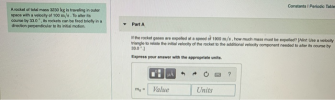 Constants Periodic Table A rocket of total mass 3230 kg is traveling in outer space with a velocity of 100 m/s. To alter its course by 33.0, its rockets can be fired briefly in a direction perpendicular to its initial motion Part A If the rocket gases are expelled at a speed of 1900 m/s, how much mass must be expelled? [Mint Uso a velocity triangle to relate the initial velocity of the rocket to the additional velocity component needed...
A rocket, which is in deep space and initially at rest relative to an inertial reference...
 A rocket, which is in deep space and initially at rest relative to an inertial reference frame, has a mass of 85.2 x 10⁵ kg, of which 18.3 x 10⁵ kg is fuel. The rocket engine is then fired for 170 s, during which fuel is consumed at the rate of 360 kg/s. The speed of the exhaust products relative to the rocket is 2.60 km/s. (a) What is the rocket's thrust? After the 170 s firing, what are (b)...
A rocket accelerates by burning its onboard fuel, so its mass decreases with time. Suppose the...
 A rocket accelerates by burning its onboard fuel, so its mass decreases with time. Suppose the initial mass of the rocket at liftoff (including its fuel) is m, the fuel is consumed at rate r, and the exhaust gases are ejected with constant velocity v_e (relative to the rocket). A model for the velocity of the rocket at time t is given by the equation v(t) = -gt - v_e ln m - rt/m where g is the acceleration due...
5. Rocket guidance A space probe with mass 5180 kg is traveling beyond Saturn with a...
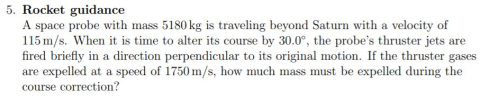 5. Rocket guidance A space probe with mass 5180 kg is traveling beyond Saturn with a velocity of 115 m/s. When it is time to alter its course by 30.0°, the probe's thruster jets are fired briefly in a direction perpendicular to its original motion. If the thruster gases are expelled at a speed of 1750 m/s, how much mass must be expelled during the course correction?
A rocket in deep space moving with velocity of 300 m/s has an initial mass of...
A rocket in deep space moving with velocity of 300 m/s has an initial mass of 5000 kg, of which 2000 kg are fuel. If it is ejecting gasses at a rate of 5 kg/s at a speed of 200 m/s relative to the rocket, then after 200 second of motion, its speed is
 10: A rocket accelerates upward by burning its onboard fuel, so its mass decreases with time. Suppose the initial mass of the rocket at liftoff (including its fuel) is m, the fuel is consumed at rate r, and the exhaust gases are ejected with constant velocity ve (relative to the rocket). A model for the velocity of the rocket in meters per second after t seconds is given by the equation r(t)--gt-ve In (mmrt) where g is the acceleration due...
 4: Suppose the mass of a
rocket just as it runs out of fuel is 75550-kg, and its exhaust
speed is 2.7 × 10³ m/s.
Calculate
the maximum rate, in kilograms per second, at which the rocket can
expel gases, if its acceleration cannot exceed seven times that of
the gravitational acceleration on the surface of the Earth. Assume
the gravitational force on the rocket is negligible.
R =
|
We were unable to transcribe this imageWe were unable to...
4: Suppose the mass of a
rocket just as it runs out of fuel is 75550-kg, and its exhaust
speed is 2.7 × 10³ m/s.
Calculate
the maximum rate, in kilograms per second, at which the rocket can
expel gases, if its acceleration cannot exceed seven times that of
the gravitational acceleration on the surface of the Earth. Assume
the gravitational force on the rocket is negligible.
R =
|
We were unable to transcribe this imageWe were unable to...
 Constants Periodic Table A rocket of total mass 3230 kg is traveling in outer space with a velocity of 100 m/s. To alter its course by 33.0, its rockets can be fired briefly in a direction perpendicular to its initial motion Part A If the rocket gases are expelled at a speed of 1900 m/s, how much mass must be expelled? [Mint Uso a velocity triangle to relate the initial velocity of the rocket to the additional velocity component needed...
 A rocket, which is in deep space and initially at rest relative to an inertial reference frame, has a mass of 85.2 x 10⁵ kg, of which 18.3 x 10⁵ kg is fuel. The rocket engine is then fired for 170 s, during which fuel is consumed at the rate of 360 kg/s. The speed of the exhaust products relative to the rocket is 2.60 km/s. (a) What is the rocket's thrust? After the 170 s firing, what are (b)...
 A rocket accelerates by burning its onboard fuel, so its mass decreases with time. Suppose the initial mass of the rocket at liftoff (including its fuel) is m, the fuel is consumed at rate r, and the exhaust gases are ejected with constant velocity v_e (relative to the rocket). A model for the velocity of the rocket at time t is given by the equation v(t) = -gt - v_e ln m - rt/m where g is the acceleration due...
 5. Rocket guidance A space probe with mass 5180 kg is traveling beyond Saturn with a velocity of 115 m/s. When it is time to alter its course by 30.0°, the probe's thruster jets are fired briefly in a direction perpendicular to its original motion. If the thruster gases are expelled at a speed of 1750 m/s, how much mass must be expelled during the course correction?
Most questions answered within 3 hours.
-
Where is the error in this code sequence?
String s1 = "Hello";
String s2 = "ello";...
asked 10 months ago -
Financial data for Joel de Paris, Inc., for last year
follow:
Joel de Paris, Inc.
Balance...
asked 10 months ago -
Consider this reaction:
Al2(SO4)3 (aq)+ BaCl3
(aq) Al2Cl6 (aq)- +
3BaSO4(s) . What is the...
asked 10 months ago -
Suppose that Savneet is considering increasing her
recent random sample from 20 car rentals to 40...
asked 10 months ago -
Trucks arrive at an unloading terminal at an average rate of 120
per hour.
Trucks arrive...
asked 10 months ago -
Why are methanol and ethanol completely soluble in water while
octanol is not very little soluble....
asked 10 months ago -
A facilities manager at a university reads in a research report
that the mean amount of...
asked 10 months ago -
When the CuSO4 is rehydrated by adding water to the anhydrous
compound, is this an endothermic...
asked 10 months ago -
A ray of sunlight is passing from diamond into crown glass; the
angle of incidence is...
asked 10 months ago -
A block of mass 0.249 kg is placed on top of a light, vertical
spring of...
asked 10 months ago -
how do the kidneys compensate in the presences of acidosis
a) trigger hyperventilate
b) reserve acid...
asked 10 months ago -
Question 501 pts
The rental rate of capital to the firm increases. Which of the
following...
asked 10 months ago