![8. 10 Points The figure on the right shows the path of an object. In the region AB and CD, the object moves along a straight line path. In the region BC and DA, the object moves along a partial circular path with radius of R-2.0m and R 3.0m as shown. During the entire time, the object moves with a constant speed of w6.0m/s. For the four point P, p Q, U and V as can be seen in the diagram, determine if the object has zsro or non-zero acceleration at that point. If the object has zero acceleration, explain briefly how you know! If the object has non-zero acceleration, acceleration is centripetal, tangential or both, and give the v bom magnitude and direction of the centripetal and/or tangential acceleration. 0 R1 state whether the and/or tangential Tangential acceleration Magnitude At Position [4 points) Draw the acceleration At Position e [2 points] acceleration Magnitude Magnitude Direction At Position U [4 points) Centripetal acceleration Magnitude Tangential accleration Direction Magnitude Direction At Position 2 points](http://img.homeworklib.com/questions/cd89a900-39b6-11eb-b405-c502d29cd360.png?x-oss-process=image/resize,w_560)
Homework Answers

Add Answer to:
8. 10 Points The figure on the right shows the path of an object. In the...
An object moves in a circular path with constant angular speed. Compare the direction of the...
An object moves in a circular path with constant angular speed. Compare the direction of the object's tangential velocity vector to its centripetal acceleration vector. A) Both vectors point in the same direction B) The vectors point in opposite directions C) The vectors are perpendicular D) Impossible. The acceleration is zero. Two objects with masses m1 and m2 are original a distance r apart. The magnitude of the gravitational force between them is F. if BOTH masses are doubled, and...
An object moves counter-clockwise along the circular path shown below. As it moves along the path...
 An object moves counter-clockwise along the circular path shown below. As it moves along the path its acceleration vector continuously points toward point S. The object speeds up at P, Q, and R. slows down at P, Q, and R. speeds up at P and slows down at R. slows down at P and speeds up at R. speeds up at Q. slows down at Q. No object can execute such a motion. An object moves counter-clockwise along the circular...
need help on numbers 4-6 1. Make a drawing of the path of an object in...
need help on numbers 4-6 1. Make a drawing of the path of an object in circular motion at constant speed. On that path, use a dot to represent the object’s position at time t 1 . Label this point as O, and draw a vector at O to represent the magnitude and direction of the object’s velocity at time t 1 . Draw another dot to represent the object’s position at a later time t 2 , shortly after...
please answer all A car is going with a constant tangential acceleration (i.e. increasing speed) in a circular path. As seen from above, the path is counter-clockwise. It crosses the point '...
 please answer all
A car is going with a constant tangential acceleration (i.e. increasing speed) in a circular path. As seen from above, the path is counter-clockwise. It crosses the point 'A' at time 0.00, at which point its speed is known. Find the direction of its centripetal acceleration at some time after it crosses the point A:Write your answer in degrees. Given: Speed when it crosses point 'A' - V-3.6 m/s, tangential acceleration a 3.6 m/s2, radius of path...
please answer all
A car is going with a constant tangential acceleration (i.e. increasing speed) in a circular path. As seen from above, the path is counter-clockwise. It crosses the point 'A' at time 0.00, at which point its speed is known. Find the direction of its centripetal acceleration at some time after it crosses the point A:Write your answer in degrees. Given: Speed when it crosses point 'A' - V-3.6 m/s, tangential acceleration a 3.6 m/s2, radius of path...
An object moves in a circular path at a constant speed. What is the relationship between the directions of the object's...
An object moves in a circular path at a constant speed. What is the relationship between the directions of the object's velocity and acceleration vectors? The velocity and acceleration vectors point in opposite directions. The velocity and acceleration vectors are perpendicular. The velocity vector points in a direction tangent to the circular path. The acceleration is zero. The velocity vector points toward the center of the circular path. The acceleration is zero. The velocity and acceleration vectors point in the...
The figure below shows an object initially at point A traveling in the +x-direction. It turns...
 The figure below shows an object initially
at point A traveling in the +x-direction. It turns in a circular
path at constant speed until it is traveling in the +y-direction at
point C. The quarter-circle arc from A to C is 201 m in length, and
the particle moves from A to C in 42.0 s. Point B on the path is
35.0° below the x-axis.
The figure below shows an object initially at point A traveling in the +x-direction....
The figure below shows an object initially
at point A traveling in the +x-direction. It turns in a circular
path at constant speed until it is traveling in the +y-direction at
point C. The quarter-circle arc from A to C is 201 m in length, and
the particle moves from A to C in 42.0 s. Point B on the path is
35.0° below the x-axis.
The figure below shows an object initially at point A traveling in the +x-direction....
A particle travels counterclockwise along a circular path of radius R with a linear velocity V....
 A particle travels counterclockwise along a circular path of radius R with a linear velocity V. Assume that V = constant-10m /s, R-10m, θ-450 For the specified coordinate O-xy system as shown in the figure below determine the velocity and acceleration components in the corresponding Cartesian, polar, and tangential and normal coordinate systems, respectively, at the position and also the magnitude and direction of the velocity and acceleration vectors You may summarize your results in the following table. Coordinate Components...
9. An object is set into motion on a circular path of radius R by giving...
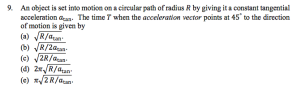 9. An object is set into motion on a circular path of radius R by giving it a constant tangential acceleration atan. The time T when the acceleration vector points at 45' to the direction of motion is given by (a) \R/atan atan- (c) v2R/atan (d) 2π R/atan. (c) π 2R/atan.
For this question, we are concerned with the movement of an object along a path in the plane. We are assuming that the plane is a coordinate plane and the object starts at the point. As the object mo...
 For this question, we are concerned with the movement of an object along a path in the plane. We are assuming that the plane is a coordinate plane and the object starts at the point. As the object moves along the path, each point on that path has two coordinates. The coordinates depend on the distance traveled along the path. Let us call this distance S, the length of the path from the origin to a point P on the...
c. It has tangential (linear) acceleration that points in the same direction as the velocity, and...
 c. It has tangential (linear) acceleration that points in the same direction as the velocity, and a decreasing centripetal acceleration d. It has tangential (linear) acceleration that point opposite the velosity, and a constant centripetal acceleration QUESTION 3 A 53.5 kg parachutist jumps from an airplane and falls to Earth with a drag force proportional to the square of the speed, R-CV. Take C -0.220 kg/m (with the parachute closed) and C - 22.0 kg/m (with the chute open). What...
 An object moves counter-clockwise along the circular path shown below. As it moves along the path its acceleration vector continuously points toward point S. The object speeds up at P, Q, and R. slows down at P, Q, and R. speeds up at P and slows down at R. slows down at P and speeds up at R. speeds up at Q. slows down at Q. No object can execute such a motion. An object moves counter-clockwise along the circular...
 please answer all
A car is going with a constant tangential acceleration (i.e. increasing speed) in a circular path. As seen from above, the path is counter-clockwise. It crosses the point 'A' at time 0.00, at which point its speed is known. Find the direction of its centripetal acceleration at some time after it crosses the point A:Write your answer in degrees. Given: Speed when it crosses point 'A' - V-3.6 m/s, tangential acceleration a 3.6 m/s2, radius of path...
please answer all
A car is going with a constant tangential acceleration (i.e. increasing speed) in a circular path. As seen from above, the path is counter-clockwise. It crosses the point 'A' at time 0.00, at which point its speed is known. Find the direction of its centripetal acceleration at some time after it crosses the point A:Write your answer in degrees. Given: Speed when it crosses point 'A' - V-3.6 m/s, tangential acceleration a 3.6 m/s2, radius of path...
 The figure below shows an object initially
at point A traveling in the +x-direction. It turns in a circular
path at constant speed until it is traveling in the +y-direction at
point C. The quarter-circle arc from A to C is 201 m in length, and
the particle moves from A to C in 42.0 s. Point B on the path is
35.0° below the x-axis.
The figure below shows an object initially at point A traveling in the +x-direction....
The figure below shows an object initially
at point A traveling in the +x-direction. It turns in a circular
path at constant speed until it is traveling in the +y-direction at
point C. The quarter-circle arc from A to C is 201 m in length, and
the particle moves from A to C in 42.0 s. Point B on the path is
35.0° below the x-axis.
The figure below shows an object initially at point A traveling in the +x-direction....
 A particle travels counterclockwise along a circular path of radius R with a linear velocity V. Assume that V = constant-10m /s, R-10m, θ-450 For the specified coordinate O-xy system as shown in the figure below determine the velocity and acceleration components in the corresponding Cartesian, polar, and tangential and normal coordinate systems, respectively, at the position and also the magnitude and direction of the velocity and acceleration vectors You may summarize your results in the following table. Coordinate Components...
 9. An object is set into motion on a circular path of radius R by giving it a constant tangential acceleration atan. The time T when the acceleration vector points at 45' to the direction of motion is given by (a) \R/atan atan- (c) v2R/atan (d) 2π R/atan. (c) π 2R/atan.
 For this question, we are concerned with the movement of an object along a path in the plane. We are assuming that the plane is a coordinate plane and the object starts at the point. As the object moves along the path, each point on that path has two coordinates. The coordinates depend on the distance traveled along the path. Let us call this distance S, the length of the path from the origin to a point P on the...
 c. It has tangential (linear) acceleration that points in the same direction as the velocity, and a decreasing centripetal acceleration d. It has tangential (linear) acceleration that point opposite the velosity, and a constant centripetal acceleration QUESTION 3 A 53.5 kg parachutist jumps from an airplane and falls to Earth with a drag force proportional to the square of the speed, R-CV. Take C -0.220 kg/m (with the parachute closed) and C - 22.0 kg/m (with the chute open). What...
Most questions answered within 3 hours.
-
Where is the error in this code sequence?
String s1 = "Hello";
String s2 = "ello";...
asked 10 months ago -
Financial data for Joel de Paris, Inc., for last year
follow:
Joel de Paris, Inc.
Balance...
asked 10 months ago -
Consider this reaction:
Al2(SO4)3 (aq)+ BaCl3
(aq) Al2Cl6 (aq)- +
3BaSO4(s) . What is the...
asked 10 months ago -
Suppose that Savneet is considering increasing her
recent random sample from 20 car rentals to 40...
asked 10 months ago -
Trucks arrive at an unloading terminal at an average rate of 120
per hour.
Trucks arrive...
asked 10 months ago -
Why are methanol and ethanol completely soluble in water while
octanol is not very little soluble....
asked 10 months ago -
A facilities manager at a university reads in a research report
that the mean amount of...
asked 10 months ago -
When the CuSO4 is rehydrated by adding water to the anhydrous
compound, is this an endothermic...
asked 10 months ago -
A ray of sunlight is passing from diamond into crown glass; the
angle of incidence is...
asked 10 months ago -
A block of mass 0.249 kg is placed on top of a light, vertical
spring of...
asked 10 months ago -
how do the kidneys compensate in the presences of acidosis
a) trigger hyperventilate
b) reserve acid...
asked 10 months ago -
Question 501 pts
The rental rate of capital to the firm increases. Which of the
following...
asked 10 months ago