
Homework Answers
Add Answer to:
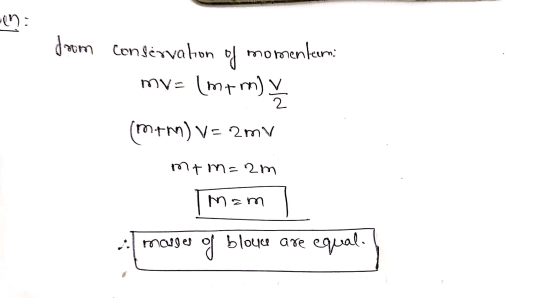
Before Collision M m After Collision V/2 M m A block having mass m slides on...
Block 1, of mass m1m1m_1 = 6.70 kgkg , moves along a frictionless air track with...
Block 1, of mass m1m1m_1 = 6.70 kgkg , moves along a frictionless air track with speed v1v1v_1 = 27.0 m/sm/s . It collides with block 2, of mass m2m2m_2 = 57.0 kgkg , which was initially at rest. The blocks stick together after the collision. (Figure 1) Figure 1 of 1The figure shows two states of a system of two blocks, labeled 1 and 2, of masses m 1 and m 2, respectively. Block 2 is to the right...
3. A block of mass 3m sits at rest on a horizontal, frictionless surface. Suddenly another...
 3. A block of mass 3m sits at rest on a horizontal, frictionless surface. Suddenly another block with mass m comes sliding in from the left with speed vo to the right. The blocks collide and stick together. Determine the speed of the blocks after the collision.
On a frictionless surface. a block of mass M moving at speed v collides elastically with...
 On a frictionless surface. a block of mass M moving at speed v collides elastically with another block of the same mass that is initially at rest. After the collision, the first block moves at an angle θ to its initial direction and has a speed U/2. The second block's speed after the collision is 3 4 (B) 2 2 U) (E) ut cose
Block 1, of mass m1 = 9.10 kg , moves along a frictionless air track with...
 Block 1, of mass m1 = 9.10 kg , moves along a frictionless air
track with speed v1 = 27.0 m/s . It collides with block 2, of mass
m2 = 13.0 kg , which was initially at rest. The blocks stick
together after the collision.
What is the change ΔK=Kfinal−Kinitial in the two-block system's
kinetic energy due to the collision?
Express your answer numerically in joules.
Before collision: m2 After collision:
Block 1, of mass m1 = 9.10 kg , moves along a frictionless air
track with speed v1 = 27.0 m/s . It collides with block 2, of mass
m2 = 13.0 kg , which was initially at rest. The blocks stick
together after the collision.
What is the change ΔK=Kfinal−Kinitial in the two-block system's
kinetic energy due to the collision?
Express your answer numerically in joules.
Before collision: m2 After collision:
A block of mass m1 = 1.10 kg moving at v1 = 1.20 m/s undergoes a...
A block of mass m1 = 1.10 kg moving at v1 = 1.20 m/s undergoes a completely inelastic collision with a stationary block of mass m2 = 0.900 kg . The blocks then move, stuck together, at speed v2. After a short time, the two-block system collides inelastically with a third block, of mass m3 = 2.40 kg , which is initially at rest. The three blocks then move, stuck together, with speed v3. Assume that the blocks slide without...
A block of mass m1 = 1.10 kg moving at v1 = 1.20 m/s undergoes a...
A block of mass m1 = 1.10 kg moving at v1 = 1.20 m/s undergoes a completely inelastic collision with a stationary block of mass m2 = 0.900 kg . The blocks then move, stuck together, at speed v2. After a short time, the two-block system collides inelastically with a third block, of mass m3 = 2.40 kg , which is initially at rest. The three blocks then move, stuck together, with speed v3. Assume that the blocks slide without...
3 Block Inelastic collision
 A block of massm1 = 1.30kg moving at v1 = 2.00m/s undergoes a completely inelastic collision with a stationary block of mass m2 = 0.100kg . The blocks then move, stuck together,at speed . After a short time, the two-block system collides inelastically with a third block, of mass m3 = 2.60kg , which is initially at rest. The three blocksthen move, stuck together, with speed v3 . Assume that the blocks slide without friction.Find v1/v2, the ratio of the...
please answer with showing work Section 2: Calculation Questions (8 pts. each part) 1. A block...
 please answer with showing work
Section 2: Calculation Questions (8 pts. each part) 1. A block with mass of m, = 5 kg is sliding across a frictionless table when it strikes a second mass with me = 3 kg, that is initially at rest. After the collision, the two masses stick and move off together with a speed of v= 1.5 m/s. The two masses then slide off the table and fall together 2 meters to the ground. a)...
please answer with showing work
Section 2: Calculation Questions (8 pts. each part) 1. A block with mass of m, = 5 kg is sliding across a frictionless table when it strikes a second mass with me = 3 kg, that is initially at rest. After the collision, the two masses stick and move off together with a speed of v= 1.5 m/s. The two masses then slide off the table and fall together 2 meters to the ground. a)...
1. A block of mass m = 0.23 kg slides with initial velocityv0 = 1.4...
 1. A block of mass m = 0.23 kg slides with initial velocity
v0 = 1.4 m/s along a frictionless surface (as in the
figure). The block next slides through a region of length d = 0.25
m with kinetic friction. After passing through the friction region,
the block slides up a curved ramp until momentarily coming to rest
at a height h above the level surface. If the kinetic friction
coefficient μ k = 0.204, what height h does...
1. A block of mass m = 0.23 kg slides with initial velocity
v0 = 1.4 m/s along a frictionless surface (as in the
figure). The block next slides through a region of length d = 0.25
m with kinetic friction. After passing through the friction region,
the block slides up a curved ramp until momentarily coming to rest
at a height h above the level surface. If the kinetic friction
coefficient μ k = 0.204, what height h does...
Block A of mass 2.00 kg and block B of mass 3.00 kg slide on a...
Block A of mass 2.00 kg and block B of mass 3.00 kg slide on a frictionless surface toward one another and collide. Before the collision, block A moves east with a speed of 3.00 m/s, block B moves south with a speed of 1.50 m/s. After the collision, block A moves 12 degrees west of south with a speed of 0.500 m/s. The two blocks do NOT stick together after the collision. (a) What is the magnitude and direction...
 3. A block of mass 3m sits at rest on a horizontal, frictionless surface. Suddenly another block with mass m comes sliding in from the left with speed vo to the right. The blocks collide and stick together. Determine the speed of the blocks after the collision.
 On a frictionless surface. a block of mass M moving at speed v collides elastically with another block of the same mass that is initially at rest. After the collision, the first block moves at an angle θ to its initial direction and has a speed U/2. The second block's speed after the collision is 3 4 (B) 2 2 U) (E) ut cose
 Block 1, of mass m1 = 9.10 kg , moves along a frictionless air
track with speed v1 = 27.0 m/s . It collides with block 2, of mass
m2 = 13.0 kg , which was initially at rest. The blocks stick
together after the collision.
What is the change ΔK=Kfinal−Kinitial in the two-block system's
kinetic energy due to the collision?
Express your answer numerically in joules.
Before collision: m2 After collision:
Block 1, of mass m1 = 9.10 kg , moves along a frictionless air
track with speed v1 = 27.0 m/s . It collides with block 2, of mass
m2 = 13.0 kg , which was initially at rest. The blocks stick
together after the collision.
What is the change ΔK=Kfinal−Kinitial in the two-block system's
kinetic energy due to the collision?
Express your answer numerically in joules.
Before collision: m2 After collision:
 please answer with showing work
Section 2: Calculation Questions (8 pts. each part) 1. A block with mass of m, = 5 kg is sliding across a frictionless table when it strikes a second mass with me = 3 kg, that is initially at rest. After the collision, the two masses stick and move off together with a speed of v= 1.5 m/s. The two masses then slide off the table and fall together 2 meters to the ground. a)...
please answer with showing work
Section 2: Calculation Questions (8 pts. each part) 1. A block with mass of m, = 5 kg is sliding across a frictionless table when it strikes a second mass with me = 3 kg, that is initially at rest. After the collision, the two masses stick and move off together with a speed of v= 1.5 m/s. The two masses then slide off the table and fall together 2 meters to the ground. a)...
 1. A block of mass m = 0.23 kg slides with initial velocity
v0 = 1.4 m/s along a frictionless surface (as in the
figure). The block next slides through a region of length d = 0.25
m with kinetic friction. After passing through the friction region,
the block slides up a curved ramp until momentarily coming to rest
at a height h above the level surface. If the kinetic friction
coefficient μ k = 0.204, what height h does...
1. A block of mass m = 0.23 kg slides with initial velocity
v0 = 1.4 m/s along a frictionless surface (as in the
figure). The block next slides through a region of length d = 0.25
m with kinetic friction. After passing through the friction region,
the block slides up a curved ramp until momentarily coming to rest
at a height h above the level surface. If the kinetic friction
coefficient μ k = 0.204, what height h does...
Most questions answered within 3 hours.
-
Where is the error in this code sequence?
String s1 = "Hello";
String s2 = "ello";...
asked 10 months ago -
Financial data for Joel de Paris, Inc., for last year
follow:
Joel de Paris, Inc.
Balance...
asked 10 months ago -
Consider this reaction:
Al2(SO4)3 (aq)+ BaCl3
(aq) Al2Cl6 (aq)- +
3BaSO4(s) . What is the...
asked 10 months ago -
Suppose that Savneet is considering increasing her
recent random sample from 20 car rentals to 40...
asked 10 months ago -
Trucks arrive at an unloading terminal at an average rate of 120
per hour.
Trucks arrive...
asked 10 months ago -
Why are methanol and ethanol completely soluble in water while
octanol is not very little soluble....
asked 10 months ago -
A facilities manager at a university reads in a research report
that the mean amount of...
asked 10 months ago -
When the CuSO4 is rehydrated by adding water to the anhydrous
compound, is this an endothermic...
asked 10 months ago -
A ray of sunlight is passing from diamond into crown glass; the
angle of incidence is...
asked 10 months ago -
A block of mass 0.249 kg is placed on top of a light, vertical
spring of...
asked 10 months ago -
how do the kidneys compensate in the presences of acidosis
a) trigger hyperventilate
b) reserve acid...
asked 10 months ago -
Question 501 pts
The rental rate of capital to the firm increases. Which of the
following...
asked 10 months ago