 fluids qusion
Homework Answers
Add Answer to:
fluids qusion
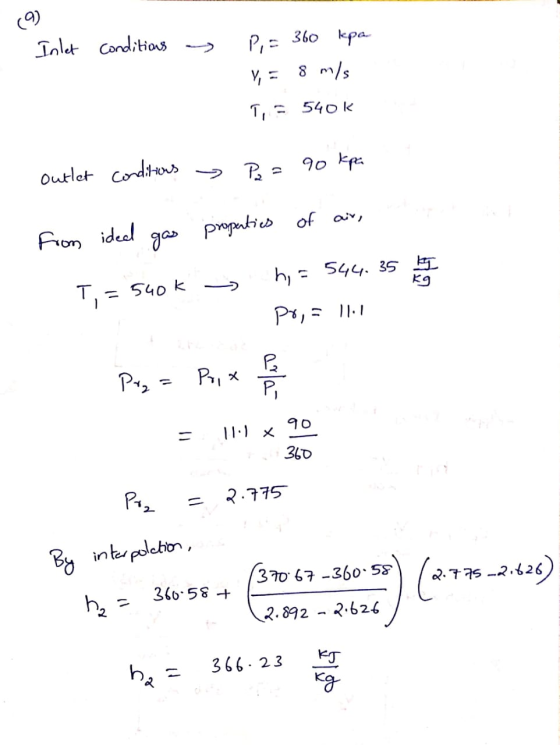
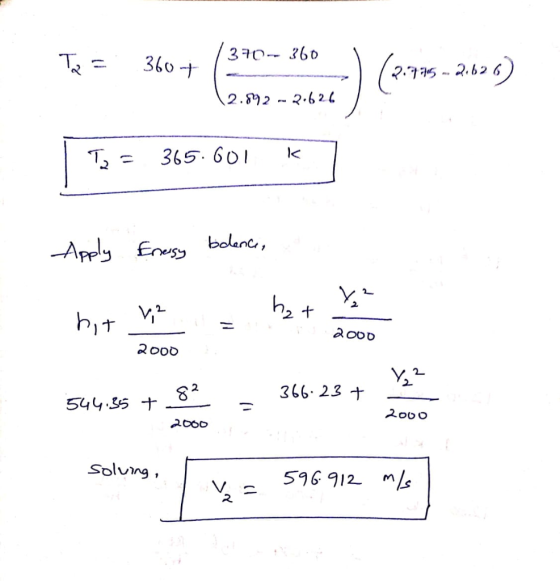
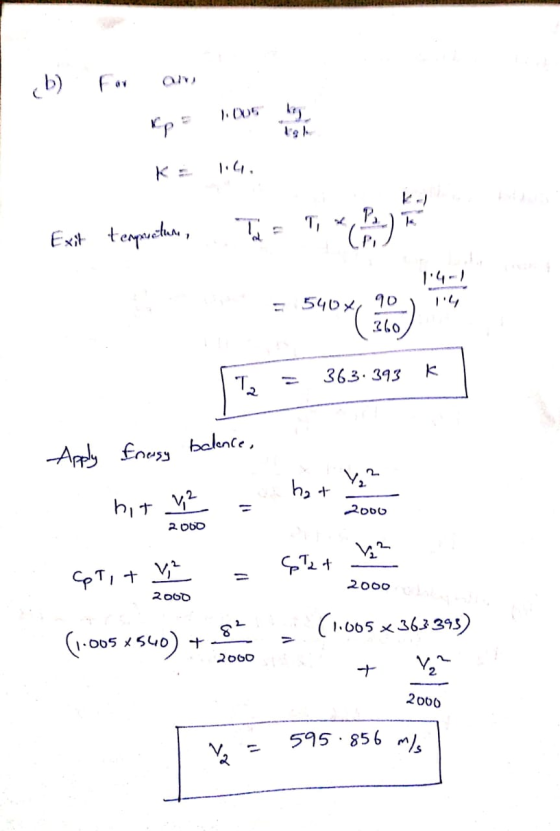
3) Air enters an isentropic nozzle at 360 kPa, 8 m/sec and 540 K....
Air enters an adiabatic nozzle at 500 kPa and a temperature of 200 °C with a...
Air enters an adiabatic nozzle at 500 kPa and a temperature of 200 °C with a velocity of 100 m/s. It exits the nozzle at a pressure of 100 kPa. Assuming that the expansion through the nozzle occurs reversibly, determine (a) the exit temperature and (b) the exit velocity of the air. The specific heats of air can be assumed to be constant with Cv = 0.742 kJ/kg oC and Cp = 1.029 kJ/kg oC.
Argon enters an insulated nozzle at 280 kPa, 1300 K, 10 m/s and exits at 645...
Argon enters an insulated nozzle at 280 kPa, 1300 K, 10 m/s and exits at 645 m/s. Assume argon is an ideal gas and has a constant specific heat. Determine a) The exit temperature of the argon under the actual process (K). b) The ideal exit temperature of the argon (K) under the isentropic process if the isentropic efficiency of the nozzle is 90 percent. c) The exit pressure of the argon (kPa). d) The amount of specific entropy generation...
Air flows through a converging-diverging nozzle/diffuser. Assuming isentropic flow, air as an ideal gas, and constant...
 Air flows through a converging-diverging nozzle/diffuser. Assuming isentropic flow, air as an ideal gas, and constant specific heats determine the state at several locations in the system. Note: The specific heat ratio and gas constant for air are given as k=1.4 and R=0.287 kJ/kg-K respectively. --Given Values-- Inlet Temperature: T1 (K) = 360 Inlet pressure: P1 (kPa) = 583 Inlet Velocity: V1 (m/s) = 105 Area at inlet (cm^2) = 8.2 Mach number at the exit = 1.86 a) Determine...
Air flows through a converging-diverging nozzle/diffuser. Assuming isentropic flow, air as an ideal gas, and constant...
Air flows through a converging-diverging nozzle/diffuser. Assuming isentropic flow, air as an ideal gas, and constant specific heats determine the state at several locations in the system. Solve using equations rather than with the tables. Note: The specific heat ratio and gas constant for air are given as k=1.4 and R=0.287 kJ/kg-K respectively. --Given Values-- Inlet Temperature: T1 (K) = 321 Inlet pressure: P1 (kPa) = 588 Inlet Velocity: V1 (m/s) = 97 Area at nozzle inlet: A1 (cm^2) =...
Air flows through a converging-diverging nozzle/diffuser. Assuming isentropic flow, air as an ideal gas, and constant...
 Air flows through a converging-diverging nozzle/diffuser. Assuming isentropic flow, air as an ideal gas, and constant specific heats determine the state at several locations in the system. Solve using equations rather than with the tables. Note: The specific heat ratio and gas constant for air are given as k=1.4 and R-0287 kJ/kg-K respectively --Given Values-- Inlet Temperature: TI (K) 349 Inlet pressure: Pl (kPa) 460 Inlet Velocity: V1 (m/s) 73 Area at nozzle inlet: Al (cmA2) 8.19 Throat area: A...
Q.4 Air at 26 kPa,230 K, and 220 m/s enters a turbojet engine in flight as...
 Q.4 Air at 26 kPa,230 K, and 220 m/s enters a turbojet engine in flight as shown below. The mass flow rate of air is 25 kg/s, the compression pressure ratio is 11, inlet temperature to the turbine is 1400 K, and air exits the nozzle at 26 kPa. The diffuser and nozzle processes are isentropic, but the compressor and turbine have isentropic efficiencies of 85 and 90 percent, respectively and there is no pressure drop for flow through the...
Air flows through a converging-diverging nozzle/diffuser. Assuming isentropic flow, air as an ideal gas, and constant...
 Air flows through a converging-diverging nozzle/diffuser. Assuming isentropic flow, air as an ideal gas, and constant specific heats determine the state at several locations in the system. Solve using equations rather than with the tables. Note: The specific heat ratio and gas constant for air are given as k=1.4 and R=0.287 kJ/kg-K respectively. --Given Values-- Inlet Temperature: T1 (K) 370 Inlet pressure: P1 (kPa) = 576 Inlet Velocity: V1 (m/s) - 106 Area at nozzle inlet: A1 (cm^2) = 8.32...
Air enters a nozzle in a jet engine at a pressure of 500 kPa, temperature of...
Air enters a nozzle in a jet engine at a pressure of 500 kPa, temperature of 650K, and velocity of 75 m/s. The air exits the nozzle at a pressure of 100 kPa, and the isentropic nozzle efficiency is 82%. a). Determine the velocity of the air at the nozzle exit. b). Determine the rate of entropy generation in the nozzle per kg of air flowing in kW/kgK
Air flows through a converging-diverging nozzle/diffuser. Assuming isentropic flow, air as an ideal gas, and constant...
 Air flows through a converging-diverging nozzle/diffuser. Assuming isentropic flow, air as an ideal gas, and constant specific heats determine the state at several locations in the system Note: The specific heat ratio and gas constant for air are given as k=1.4 and R=0.287 kJ/kg-K respectively. --Given Values-- Inlet Temperature: T1 (K)= 366 Inlet pressure: P1 (kPa) = 496 Inlet Velocity: V1 (m/s) = 99 Area at inlet (cm^2) = 8.7 Mach number at the exit = 1.7 a) Determine the...
Air flows through a converging-diverging nozzle/diffuser. Assuming isentropic flow, air as an ideal gas, and constant...
 Air flows through a converging-diverging nozzle/diffuser. Assuming isentropic flow, air as an ideal gas, and constant specific heats determine the state at several locations in the system. Solve using equations rather than with the tables. Note: The specific heat ratio and gas constant for air are given as k=1.4 and R=0.287 kJ/kg-K respectively. --Given Values-- Inlet Temperature: T1 (K) = 348 Inlet pressure: P1 (kPa) = 544 Inlet Velocity: V1 (m/s) = 122 Area at nozzle inlet: A1 (cm^2) =...
 Air flows through a converging-diverging nozzle/diffuser. Assuming isentropic flow, air as an ideal gas, and constant specific heats determine the state at several locations in the system. Note: The specific heat ratio and gas constant for air are given as k=1.4 and R=0.287 kJ/kg-K respectively. --Given Values-- Inlet Temperature: T1 (K) = 360 Inlet pressure: P1 (kPa) = 583 Inlet Velocity: V1 (m/s) = 105 Area at inlet (cm^2) = 8.2 Mach number at the exit = 1.86 a) Determine...
 Air flows through a converging-diverging nozzle/diffuser. Assuming isentropic flow, air as an ideal gas, and constant specific heats determine the state at several locations in the system. Solve using equations rather than with the tables. Note: The specific heat ratio and gas constant for air are given as k=1.4 and R-0287 kJ/kg-K respectively --Given Values-- Inlet Temperature: TI (K) 349 Inlet pressure: Pl (kPa) 460 Inlet Velocity: V1 (m/s) 73 Area at nozzle inlet: Al (cmA2) 8.19 Throat area: A...
 Q.4 Air at 26 kPa,230 K, and 220 m/s enters a turbojet engine in flight as shown below. The mass flow rate of air is 25 kg/s, the compression pressure ratio is 11, inlet temperature to the turbine is 1400 K, and air exits the nozzle at 26 kPa. The diffuser and nozzle processes are isentropic, but the compressor and turbine have isentropic efficiencies of 85 and 90 percent, respectively and there is no pressure drop for flow through the...
 Air flows through a converging-diverging nozzle/diffuser. Assuming isentropic flow, air as an ideal gas, and constant specific heats determine the state at several locations in the system. Solve using equations rather than with the tables. Note: The specific heat ratio and gas constant for air are given as k=1.4 and R=0.287 kJ/kg-K respectively. --Given Values-- Inlet Temperature: T1 (K) 370 Inlet pressure: P1 (kPa) = 576 Inlet Velocity: V1 (m/s) - 106 Area at nozzle inlet: A1 (cm^2) = 8.32...
 Air flows through a converging-diverging nozzle/diffuser. Assuming isentropic flow, air as an ideal gas, and constant specific heats determine the state at several locations in the system Note: The specific heat ratio and gas constant for air are given as k=1.4 and R=0.287 kJ/kg-K respectively. --Given Values-- Inlet Temperature: T1 (K)= 366 Inlet pressure: P1 (kPa) = 496 Inlet Velocity: V1 (m/s) = 99 Area at inlet (cm^2) = 8.7 Mach number at the exit = 1.7 a) Determine the...
 Air flows through a converging-diverging nozzle/diffuser. Assuming isentropic flow, air as an ideal gas, and constant specific heats determine the state at several locations in the system. Solve using equations rather than with the tables. Note: The specific heat ratio and gas constant for air are given as k=1.4 and R=0.287 kJ/kg-K respectively. --Given Values-- Inlet Temperature: T1 (K) = 348 Inlet pressure: P1 (kPa) = 544 Inlet Velocity: V1 (m/s) = 122 Area at nozzle inlet: A1 (cm^2) =...
Most questions answered within 3 hours.
-
Where is the error in this code sequence?
String s1 = "Hello";
String s2 = "ello";...
asked 11 months ago -
Financial data for Joel de Paris, Inc., for last year
follow:
Joel de Paris, Inc.
Balance...
asked 11 months ago -
Consider this reaction:
Al2(SO4)3 (aq)+ BaCl3
(aq) Al2Cl6 (aq)- +
3BaSO4(s) . What is the...
asked 11 months ago -
Suppose that Savneet is considering increasing her
recent random sample from 20 car rentals to 40...
asked 11 months ago -
Trucks arrive at an unloading terminal at an average rate of 120
per hour.
Trucks arrive...
asked 11 months ago -
Why are methanol and ethanol completely soluble in water while
octanol is not very little soluble....
asked 11 months ago -
A facilities manager at a university reads in a research report
that the mean amount of...
asked 11 months ago -
When the CuSO4 is rehydrated by adding water to the anhydrous
compound, is this an endothermic...
asked 11 months ago -
A ray of sunlight is passing from diamond into crown glass; the
angle of incidence is...
asked 11 months ago -
A block of mass 0.249 kg is placed on top of a light, vertical
spring of...
asked 11 months ago -
how do the kidneys compensate in the presences of acidosis
a) trigger hyperventilate
b) reserve acid...
asked 11 months ago -
Question 501 pts
The rental rate of capital to the firm increases. Which of the
following...
asked 11 months ago