
Homework Answers
Add Answer to:
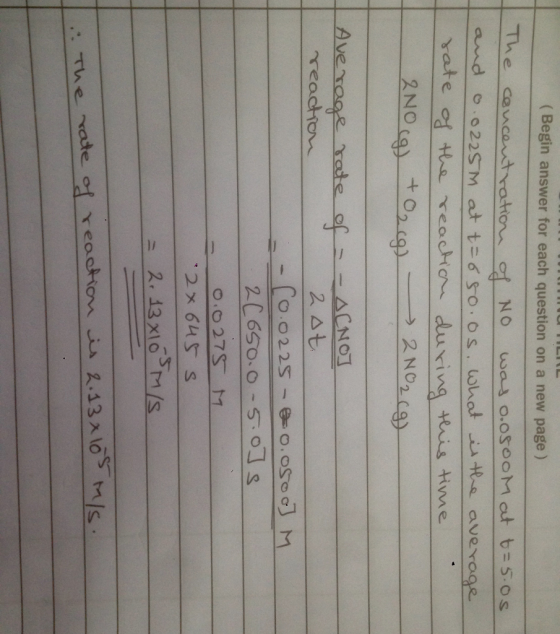
In a study to determine the rate of the following reaction: 2NO(g) + O_2(g) rightarrow 2NO_2(g)...
For the reaction: 2NO(g) + O_2(g) rightarrow 2NO_2(g) Determine the rate law: rate = k[NO]^m [O_2]^n...
 For the reaction: 2NO(g) + O_2(g) rightarrow 2NO_2(g) Determine the rate law: rate = k[NO]^m [O_2]^n Determine also the rate constant: k = (rate)/[NO]^m [O_2]^n
aruizgrahadosal.sisu.d v 3rd attempt d See Periodic Table See Hint In a study to determine the...
 aruizgrahadosal.sisu.d v 3rd attempt d See Periodic Table See Hint In a study to determine the rate of the following reaction: 2NO(g) +02 (8)2NO2(8) the concentration of NO was 0.0350 Mat t-5.0s and 0.0225 Mat t 650.0 s What is the average rate of the reaction during this time period? x 10 M/s 2.13 2nd attempt 1st attempt
Consider the equilibrium reaction: 2NO(g) + O_2(g) 2NO_2(g) Delta H = +114.6 kJ What will be...
 Consider the equilibrium reaction: 2NO(g) + O_2(g) 2NO_2(g) Delta H = +114.6 kJ What will be the change in the equilibrium concentration of NO_2 under each of the following conditions? Considering each change separately, state the effect (increase, I; decrease, D; or no change NC) specified). a) O_2 is added ___ b) energy is added___ c) NO is removed ___ d) a catalyst is added ___ e) it is placed in an ice bath ___ f) the volume is increased...
2N_2O_5(g) rightarrow 4NO_2(g) + O_2(g) The reaction of dinitrogen pentoxide decomposed into nitrogen dioxide and O_2...
 2N_2O_5(g) rightarrow 4NO_2(g) + O_2(g) The reaction of dinitrogen pentoxide decomposed into nitrogen dioxide and O_2 is first-order and has a rate constant of k = 9.55 times 10^-4 s^-1 under a particular set of conditions. What is the concentration of N_2O_5 in this system after 10.0 min if [N_2O_5]_0 = 0.807 M? Did you use the equation that relates initial reactant concentration, rate Number constant, time elapsed, and reaction concentration at time t for a first-order reaction? Did you...
Consider this initial-rate data at a certain temperature for the reaction described by 2NO_2 (g) +...
 Consider this initial-rate data at a certain temperature for the reaction described by 2NO_2 (g) + O_3 (g) rightarrow N_2 O_5 (g) + O_2 (g) Determine the value and units of the rate constant.
Consider the production of dinitrogen pentoxide (N_2O_5) by the reaction O_3(g) + 2NO_2(g) rightarrow N_2O_5(g) +...
 Consider the production of dinitrogen pentoxide (N_2O_5) by the reaction O_3(g) + 2NO_2(g) rightarrow N_2O_5(g) + O_2(g) The rate law is given by d[N_2O_5]/dt = k[O_3][NO_2] Which of the following expressions is equivalent to d[NO_2]/dt? k[O_3] [NO_2]^1/2 -2k [O_3][NO_2] K[O_3][NO_2] -(k/2) [O_3][NO_2]
The rate equation for the reaction 2NO(g) + Br_2(g) rightgarrow 2NOBr(g) was determined experimentally to be:...
 The rate equation for the reaction 2NO(g) + Br_2(g) rightgarrow 2NOBr(g) was determined experimentally to be: Rate = k[NO]^2 [Br_2] Five possible mechanisms have been proposed (i)-(v). Determine the rate equation for each mechanism below and then decide with reasons, (based on the information given) which mechanism is the most likely. (i) 2NO (g) + Br_2 (g) rightarrow 2NOBr (g) (ii)NO (g) + Br_2 rightwardsharpoonoverleftwardsharpoon NOBr_2 (g) NOBr_2 (g) + NO (g) rightarrow 2NOBr (g) (iii) Br_2 rightwardsharpoonoverleftwardsharpoon Br +...
The decomposition of nitrogen dioxide at a high temperature NO_2(g) rightarrow NO(g) + 1/2 O_2(g) is...
 The decomposition of nitrogen dioxide at a high temperature NO_2(g) rightarrow NO(g) + 1/2 O_2(g) is second-order in this reactant. The rate constant for this reaction is 3.40 L/mol min. Determine the time needed for the concentration of NO_2 to decrease from 2.00 mol/L to 1.50 mol/L.
Consider the reaction: FeO (s) + Fe (s) + O_2 (g) rightarrow Fe_2O_3 (s) Given the...
 Consider the reaction: FeO (s) + Fe (s) + O_2 (g) rightarrow Fe_2O_3 (s) Given the following table of thermodynamic data, Substance Delta H_f degree S degree FeO (S) -271.9 kJ/mol 60.75 J/mol - K Fe (s) 0 27.15 O_2 (g) 0 205.0 Fe_2O_3 (S) -822.16 89.96 determine the temperature (in degree C) above which the reaction is nonspontaneous.
Using the following reactions: N_2(g) + O_2(g) rightarrow 2 NO(g) Delta H = 181 kJ times...
 Using the following reactions: N_2(g) + O_2(g) rightarrow 2 NO(g) Delta H = 181 kJ times 2 NO(g) + O_2 rightarrow 2 NO_2(g) Delta H = -113 kJ times 2 N_2O(g) rightarrow 2 N_2(g) + O_2(g) Delta H = -163 kJ times Determine the enthalpy change for the reaction: N_2O(g) + NO_2(g) rightarrow 3 NO(g) Delta H =
 For the reaction: 2NO(g) + O_2(g) rightarrow 2NO_2(g) Determine the rate law: rate = k[NO]^m [O_2]^n Determine also the rate constant: k = (rate)/[NO]^m [O_2]^n
 aruizgrahadosal.sisu.d v 3rd attempt d See Periodic Table See Hint In a study to determine the rate of the following reaction: 2NO(g) +02 (8)2NO2(8) the concentration of NO was 0.0350 Mat t-5.0s and 0.0225 Mat t 650.0 s What is the average rate of the reaction during this time period? x 10 M/s 2.13 2nd attempt 1st attempt
 Consider the equilibrium reaction: 2NO(g) + O_2(g) 2NO_2(g) Delta H = +114.6 kJ What will be the change in the equilibrium concentration of NO_2 under each of the following conditions? Considering each change separately, state the effect (increase, I; decrease, D; or no change NC) specified). a) O_2 is added ___ b) energy is added___ c) NO is removed ___ d) a catalyst is added ___ e) it is placed in an ice bath ___ f) the volume is increased...
 2N_2O_5(g) rightarrow 4NO_2(g) + O_2(g) The reaction of dinitrogen pentoxide decomposed into nitrogen dioxide and O_2 is first-order and has a rate constant of k = 9.55 times 10^-4 s^-1 under a particular set of conditions. What is the concentration of N_2O_5 in this system after 10.0 min if [N_2O_5]_0 = 0.807 M? Did you use the equation that relates initial reactant concentration, rate Number constant, time elapsed, and reaction concentration at time t for a first-order reaction? Did you...
 Consider this initial-rate data at a certain temperature for the reaction described by 2NO_2 (g) + O_3 (g) rightarrow N_2 O_5 (g) + O_2 (g) Determine the value and units of the rate constant.
 Consider the production of dinitrogen pentoxide (N_2O_5) by the reaction O_3(g) + 2NO_2(g) rightarrow N_2O_5(g) + O_2(g) The rate law is given by d[N_2O_5]/dt = k[O_3][NO_2] Which of the following expressions is equivalent to d[NO_2]/dt? k[O_3] [NO_2]^1/2 -2k [O_3][NO_2] K[O_3][NO_2] -(k/2) [O_3][NO_2]
 The rate equation for the reaction 2NO(g) + Br_2(g) rightgarrow 2NOBr(g) was determined experimentally to be: Rate = k[NO]^2 [Br_2] Five possible mechanisms have been proposed (i)-(v). Determine the rate equation for each mechanism below and then decide with reasons, (based on the information given) which mechanism is the most likely. (i) 2NO (g) + Br_2 (g) rightarrow 2NOBr (g) (ii)NO (g) + Br_2 rightwardsharpoonoverleftwardsharpoon NOBr_2 (g) NOBr_2 (g) + NO (g) rightarrow 2NOBr (g) (iii) Br_2 rightwardsharpoonoverleftwardsharpoon Br +...
 The decomposition of nitrogen dioxide at a high temperature NO_2(g) rightarrow NO(g) + 1/2 O_2(g) is second-order in this reactant. The rate constant for this reaction is 3.40 L/mol min. Determine the time needed for the concentration of NO_2 to decrease from 2.00 mol/L to 1.50 mol/L.
 Consider the reaction: FeO (s) + Fe (s) + O_2 (g) rightarrow Fe_2O_3 (s) Given the following table of thermodynamic data, Substance Delta H_f degree S degree FeO (S) -271.9 kJ/mol 60.75 J/mol - K Fe (s) 0 27.15 O_2 (g) 0 205.0 Fe_2O_3 (S) -822.16 89.96 determine the temperature (in degree C) above which the reaction is nonspontaneous.
 Using the following reactions: N_2(g) + O_2(g) rightarrow 2 NO(g) Delta H = 181 kJ times 2 NO(g) + O_2 rightarrow 2 NO_2(g) Delta H = -113 kJ times 2 N_2O(g) rightarrow 2 N_2(g) + O_2(g) Delta H = -163 kJ times Determine the enthalpy change for the reaction: N_2O(g) + NO_2(g) rightarrow 3 NO(g) Delta H =
Most questions answered within 3 hours.
-
Where is the error in this code sequence?
String s1 = "Hello";
String s2 = "ello";...
asked 11 months ago -
Financial data for Joel de Paris, Inc., for last year
follow:
Joel de Paris, Inc.
Balance...
asked 11 months ago -
Consider this reaction:
Al2(SO4)3 (aq)+ BaCl3
(aq) Al2Cl6 (aq)- +
3BaSO4(s) . What is the...
asked 11 months ago -
Suppose that Savneet is considering increasing her
recent random sample from 20 car rentals to 40...
asked 11 months ago -
Trucks arrive at an unloading terminal at an average rate of 120
per hour.
Trucks arrive...
asked 11 months ago -
Why are methanol and ethanol completely soluble in water while
octanol is not very little soluble....
asked 11 months ago -
A facilities manager at a university reads in a research report
that the mean amount of...
asked 11 months ago -
When the CuSO4 is rehydrated by adding water to the anhydrous
compound, is this an endothermic...
asked 11 months ago -
A ray of sunlight is passing from diamond into crown glass; the
angle of incidence is...
asked 11 months ago -
A block of mass 0.249 kg is placed on top of a light, vertical
spring of...
asked 11 months ago -
how do the kidneys compensate in the presences of acidosis
a) trigger hyperventilate
b) reserve acid...
asked 11 months ago -
Question 501 pts
The rental rate of capital to the firm increases. Which of the
following...
asked 11 months ago