7. Show that the equation f(x) = x^3 + 3x^2 - 9x + 7 = 0...
7. Show that the equation f(x) = x^3 + 3x^2 - 9x + 7 = 0 has a
solution for some x is E(-6; -5).
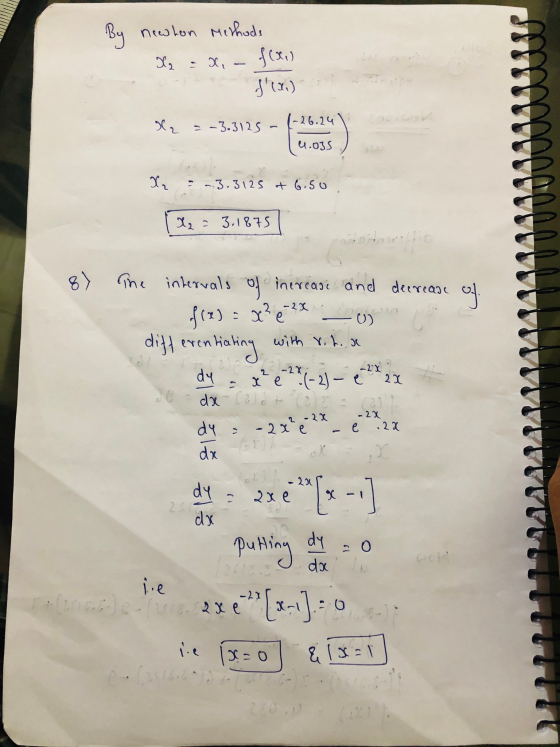
Apply Newton’s method with an initial guess x0 = -5 to find x2.
8. Find the intervals of increase and decrease of the function
x2e^-2x.
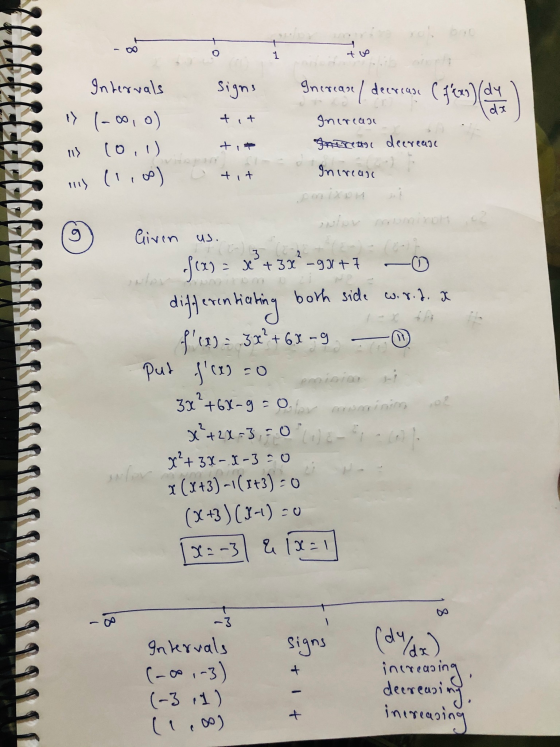
9. Sketch the graph of the curve y = x3 + 3x2 - 9x + 7. Be sure to
find the intervals of increase,
decrease and constant concavity and all local extremes and
inflection points and all intercepts.
If you don’t know the intercept(s) exactly, use Newton’s method to
get it accurarte to one
tenth.
Homework Answers


for the function f(x) = 3x-x^3, find: 1) Domain 2) Intercepts (if possible) 3) Intervals of...
for the function f(x) = 3x-x^3, find: 1) Domain 2) Intercepts (if possible) 3) Intervals of increasing/decreasing and Relative max/min 4) Intervals of concavity and point of inflection 5) End behavior 6) Any vertical and horizontal asymptote 7) Use all the above to make a detailed graph of the function on a grid please write everything clearly and i'l rate you depending on the work, thanks.
| Sketch the curve of the function f(x) = + unction f(x) = "* [r'(x) =...
 | Sketch the curve of the function f(x) = + unction f(x) = "* [r'(x) = 2*, S"(x) = 205*] Do this by determining the following information: domain, vertical asymptotes and limit - behavior, horizontal asymptotes, x \& y intercepts, symmetry, intervals of increase/decrease and maximum/minimum points, intervals of concavity and inflection points
please solve b and c 3. Use the following steps to sketch the graph of each...
 please solve b and c
3. Use the following steps to sketch the graph of each of the following functions. Step 1: Find the domain. Step 2: Find the y-intercept and all x-intercepts. Step 3: Decide if the function has any symmetry: odd, even, periodic. Step 4: Find any horizontal or vertical asymptotes. Justify using limits. Step 5: Find the critical numbers and determine intervals of increase/decrease. Step 6: Identify all local extrema. State as ordered pairs. Step 7: Determine...
please solve b and c
3. Use the following steps to sketch the graph of each of the following functions. Step 1: Find the domain. Step 2: Find the y-intercept and all x-intercepts. Step 3: Decide if the function has any symmetry: odd, even, periodic. Step 4: Find any horizontal or vertical asymptotes. Justify using limits. Step 5: Find the critical numbers and determine intervals of increase/decrease. Step 6: Identify all local extrema. State as ordered pairs. Step 7: Determine...
i need help with c, d, and e 3. Use the following steps to sketch the...
 i
need help with c, d, and e
3. Use the following steps to sketch the graph of each of the following functions. Step 1: Find the domain. Step 2: Find the y-intercept and all x-intercepts. Step 3: Decide if the function has any symmetry: odd, even, periodic. Step 4: Find any horizontal or vertical asymptotes. Justify using limits. Step 5: Find the critical numbers and determine intervals of increase/decrease. Step 6: Identify all local extrema. State as ordered pairs....
i
need help with c, d, and e
3. Use the following steps to sketch the graph of each of the following functions. Step 1: Find the domain. Step 2: Find the y-intercept and all x-intercepts. Step 3: Decide if the function has any symmetry: odd, even, periodic. Step 4: Find any horizontal or vertical asymptotes. Justify using limits. Step 5: Find the critical numbers and determine intervals of increase/decrease. Step 6: Identify all local extrema. State as ordered pairs....
3. Find the equation of the tangent line to the graph of f(x)-1+e 0 4 Graph the following functio...
 Could you label and explain how to get each term?
Thank you!
3. Find the equation of the tangent line to the graph of f(x)-1+e 0 4 Graph the following function, using information such as intervals of increase and decrease, relative extrema, intervals of upward and downward concavity, and inflection points: g(x) 3x4 +4.x Pro):-I -2 16 3 a7 al 16 min(-1,-1) y " 30+24K: 12x(3x+2) t ip. (oo) 2 3
3. Find the equation of the tangent line to...
Could you label and explain how to get each term?
Thank you!
3. Find the equation of the tangent line to the graph of f(x)-1+e 0 4 Graph the following function, using information such as intervals of increase and decrease, relative extrema, intervals of upward and downward concavity, and inflection points: g(x) 3x4 +4.x Pro):-I -2 16 3 a7 al 16 min(-1,-1) y " 30+24K: 12x(3x+2) t ip. (oo) 2 3
3. Find the equation of the tangent line to...
. Find the intervals on which f(x) = x^4 + 2x^3 − 36x^2 + 9x −...
. Find the intervals on which f(x) = x^4 + 2x^3 − 36x^2 + 9x − 47 is concave down and up, along with the x-coordinates of any inflection points. Justify all your work
For the function f(x) = -**-4x find the following, and use it to graph the function....
 For the function f(x) = -**-4x find the following, and use it to graph the function. Find: a) (2pts) Domain b)(2pts) Intercepts c)(2pts) Symmetry d) (2pts) Asymptotes e) 4pts) Intervals of Increase or decrease f) (2pts) Local maximum and local minimum values g)(4pts) Concavity and Points of inflection and h)(2pts) Sketch the curve
A Guide to Curve Sketching 1. Determine the domain of f. 2. Find the x- and...
 A Guide to Curve Sketching 1. Determine the domain of f. 2. Find the x- and y-intercepts off.* 3. Determine the behavior of f for large absolute values of x. 4. Find all horizontal and vertical asymptotes of the graph of f. 5. Determine the intervals where f is increasing and where f is decreasing, 6. Find the relative extrema of f. 7. Determine the concavity of the graph of f. 8. Find the inflection points of f. 9. Plot...
Consider the function: f(x) = ln(cos x) Do the following: • Find the domain of the...
 Consider the function: f(x) = ln(cos x) Do the following: • Find the domain of the function • Find all critical points • Find all extrema and classify each as a local maximum, local minimum, or a saddle • Find all intervals of increase and decrease • Find all intervals of concavity and find any inflection points • Sketch a graph of the function with the information you found above
for f(x) = * - 1. Find and label the following (if they exist) for f(x...
 for f(x) = * - 1. Find and label the following (if they exist) for f(x (a) Intervals of increase / decrease (b) the x-coordinates of all local maximums and local minimums (c) Intervals of concavity (d) the x-coordinates of all inflection points
 | Sketch the curve of the function f(x) = + unction f(x) = "* [r'(x) = 2*, S"(x) = 205*] Do this by determining the following information: domain, vertical asymptotes and limit - behavior, horizontal asymptotes, x \& y intercepts, symmetry, intervals of increase/decrease and maximum/minimum points, intervals of concavity and inflection points
 please solve b and c
3. Use the following steps to sketch the graph of each of the following functions. Step 1: Find the domain. Step 2: Find the y-intercept and all x-intercepts. Step 3: Decide if the function has any symmetry: odd, even, periodic. Step 4: Find any horizontal or vertical asymptotes. Justify using limits. Step 5: Find the critical numbers and determine intervals of increase/decrease. Step 6: Identify all local extrema. State as ordered pairs. Step 7: Determine...
please solve b and c
3. Use the following steps to sketch the graph of each of the following functions. Step 1: Find the domain. Step 2: Find the y-intercept and all x-intercepts. Step 3: Decide if the function has any symmetry: odd, even, periodic. Step 4: Find any horizontal or vertical asymptotes. Justify using limits. Step 5: Find the critical numbers and determine intervals of increase/decrease. Step 6: Identify all local extrema. State as ordered pairs. Step 7: Determine...
 i
need help with c, d, and e
3. Use the following steps to sketch the graph of each of the following functions. Step 1: Find the domain. Step 2: Find the y-intercept and all x-intercepts. Step 3: Decide if the function has any symmetry: odd, even, periodic. Step 4: Find any horizontal or vertical asymptotes. Justify using limits. Step 5: Find the critical numbers and determine intervals of increase/decrease. Step 6: Identify all local extrema. State as ordered pairs....
i
need help with c, d, and e
3. Use the following steps to sketch the graph of each of the following functions. Step 1: Find the domain. Step 2: Find the y-intercept and all x-intercepts. Step 3: Decide if the function has any symmetry: odd, even, periodic. Step 4: Find any horizontal or vertical asymptotes. Justify using limits. Step 5: Find the critical numbers and determine intervals of increase/decrease. Step 6: Identify all local extrema. State as ordered pairs....
 Could you label and explain how to get each term?
Thank you!
3. Find the equation of the tangent line to the graph of f(x)-1+e 0 4 Graph the following function, using information such as intervals of increase and decrease, relative extrema, intervals of upward and downward concavity, and inflection points: g(x) 3x4 +4.x Pro):-I -2 16 3 a7 al 16 min(-1,-1) y " 30+24K: 12x(3x+2) t ip. (oo) 2 3
3. Find the equation of the tangent line to...
Could you label and explain how to get each term?
Thank you!
3. Find the equation of the tangent line to the graph of f(x)-1+e 0 4 Graph the following function, using information such as intervals of increase and decrease, relative extrema, intervals of upward and downward concavity, and inflection points: g(x) 3x4 +4.x Pro):-I -2 16 3 a7 al 16 min(-1,-1) y " 30+24K: 12x(3x+2) t ip. (oo) 2 3
3. Find the equation of the tangent line to...
 For the function f(x) = -**-4x find the following, and use it to graph the function. Find: a) (2pts) Domain b)(2pts) Intercepts c)(2pts) Symmetry d) (2pts) Asymptotes e) 4pts) Intervals of Increase or decrease f) (2pts) Local maximum and local minimum values g)(4pts) Concavity and Points of inflection and h)(2pts) Sketch the curve
 A Guide to Curve Sketching 1. Determine the domain of f. 2. Find the x- and y-intercepts off.* 3. Determine the behavior of f for large absolute values of x. 4. Find all horizontal and vertical asymptotes of the graph of f. 5. Determine the intervals where f is increasing and where f is decreasing, 6. Find the relative extrema of f. 7. Determine the concavity of the graph of f. 8. Find the inflection points of f. 9. Plot...
 Consider the function: f(x) = ln(cos x) Do the following: • Find the domain of the function • Find all critical points • Find all extrema and classify each as a local maximum, local minimum, or a saddle • Find all intervals of increase and decrease • Find all intervals of concavity and find any inflection points • Sketch a graph of the function with the information you found above
 for f(x) = * - 1. Find and label the following (if they exist) for f(x (a) Intervals of increase / decrease (b) the x-coordinates of all local maximums and local minimums (c) Intervals of concavity (d) the x-coordinates of all inflection points
Most questions answered within 3 hours.
-
Where is the error in this code sequence?
String s1 = "Hello";
String s2 = "ello";...
asked 11 months ago -
Financial data for Joel de Paris, Inc., for last year
follow:
Joel de Paris, Inc.
Balance...
asked 11 months ago -
Consider this reaction:
Al2(SO4)3 (aq)+ BaCl3
(aq) Al2Cl6 (aq)- +
3BaSO4(s) . What is the...
asked 11 months ago -
Suppose that Savneet is considering increasing her
recent random sample from 20 car rentals to 40...
asked 11 months ago -
Trucks arrive at an unloading terminal at an average rate of 120
per hour.
Trucks arrive...
asked 11 months ago -
Why are methanol and ethanol completely soluble in water while
octanol is not very little soluble....
asked 11 months ago -
A facilities manager at a university reads in a research report
that the mean amount of...
asked 11 months ago -
When the CuSO4 is rehydrated by adding water to the anhydrous
compound, is this an endothermic...
asked 11 months ago -
A ray of sunlight is passing from diamond into crown glass; the
angle of incidence is...
asked 11 months ago -
A block of mass 0.249 kg is placed on top of a light, vertical
spring of...
asked 11 months ago -
how do the kidneys compensate in the presences of acidosis
a) trigger hyperventilate
b) reserve acid...
asked 11 months ago -
Question 501 pts
The rental rate of capital to the firm increases. Which of the
following...
asked 11 months ago