For protection, the damping barrier is placed in front of the bridge column. If the relationship...
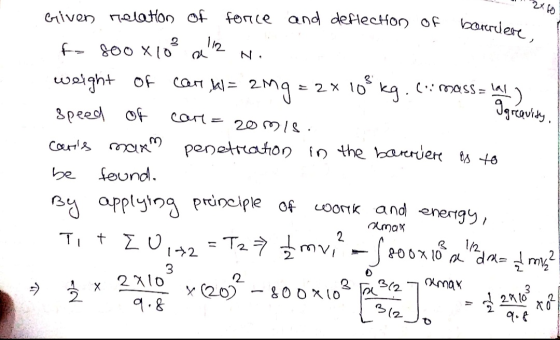
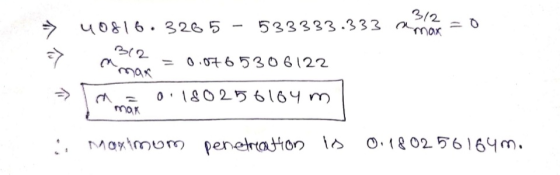
For protection, the damping barrier is placed in front of the bridge column. If the relationship between force and deflection of the barrier is
 .
Where x is given in m, determine the maximum penetration of the car
into the barrier. The car has a mass of 2 Mg and is moving at a
climbing speed of 20 m / s just before reaching the barrier.
.
Where x is given in m, determine the maximum penetration of the car
into the barrier. The car has a mass of 2 Mg and is moving at a
climbing speed of 20 m / s just before reaching the barrier.

Homework Answers
Add Answer to:
For protection, the damping barrier is placed in front of the
bridge column. If the relationship...
Q3] For protection, the barrel barrier is placed in front of the bridge pier. If the...
Q3] For protection, the barrel barrier is placed in front of the bridge pier. If the relation between the force and deflection of the barrier is F (90000x0.5) lb, %3D where is in x ft, determine the car's maximum penetration in the barrier. The car has a weight of 4000 lb and it is traveling with a speed of 75 ft/s just before it hits .the barrier
F(lb) For protection, the barrel barrier is placed in front of the bridge pier. If the...
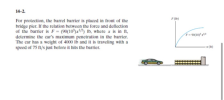 F(lb) For protection, the barrel barrier is placed in front of the bridge pier. If the relation between the force and deflection of the barrier is F = (90(10%)x12) lb, where x is in ft, determine the car's maximum penetration in the barrier. The car has a weight of 4000 lb and it is traveling with a speed of 75 ft/s just before it hits the barrier. F = 90(10)*x12 (R)
2. Calculate the speed of the car when it reaches the barrier but has not compressed...
 2. Calculate the speed of the car when it reaches the barrier
but has not compressed the barrier yet.
3. Determine the energy lost by friction.
4. Calculate the maximum compression of the spring barrier.
Explain your reasoning.
5. Assuming that the car bounces off the spring barrier with no
loss of energy, how far does the car slide on this road before
stopping?
6. Determine the maximum deceleration experienced by the
occupants and the corresponding maximum force exerting by...
2. Calculate the speed of the car when it reaches the barrier
but has not compressed the barrier yet.
3. Determine the energy lost by friction.
4. Calculate the maximum compression of the spring barrier.
Explain your reasoning.
5. Assuming that the car bounces off the spring barrier with no
loss of energy, how far does the car slide on this road before
stopping?
6. Determine the maximum deceleration experienced by the
occupants and the corresponding maximum force exerting by...
In a crash test, a car with a mass of 1500 kg is initially moving at...
In a crash test, a car with a mass of 1500 kg is initially moving at a speed of 18 m/s just before it collides with a barrier. The final speed of the car after the collision is zero. The original length of the car is 4.48 m, but after the collision, the smashed car is only 3.86 m long. Making the very rough approximation that the large force that the barrier exerts on the car is approximately constant during...
use Matlab Overview: The objective of a racetrack impact barrier is to slow a vehicle to...
 use Matlab
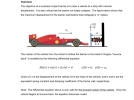
Overview: The objective of a racetrack impact barrier is to slow a vehicle to a stop with minimal deceleration. It is also critical that the barrier not totally collapse. The figure below shows that the maximum displacement of the barrier wall (before total collapse) is 'd' meters. Kb The motion of the vehicle from the instant it strikes the barrier to the instant it begins "bounce back" is modeled by the following differential equation: Mä(t) + bż(t) +...
use Matlab
Overview: The objective of a racetrack impact barrier is to slow a vehicle to a stop with minimal deceleration. It is also critical that the barrier not totally collapse. The figure below shows that the maximum displacement of the barrier wall (before total collapse) is 'd' meters. Kb The motion of the vehicle from the instant it strikes the barrier to the instant it begins "bounce back" is modeled by the following differential equation: Mä(t) + bż(t) +...
In a crash test, a car with a mass of 1600 kg is initially moving at...
 In a crash test, a car with a mass of 1600 kg is initially moving at a speed of 18 m/s just before it collides with a barrier. The final speed of the car after the collision is zero. The original length of the car is 3.80 m , but after the collision, the smashed car is only 3.23 m long Part 1: What is the average speed of the car during the period from first contact with the barrier...
Homework H.4.M Given: A cannonball P of mass m is fired toward a steel barrier on...
 Homework H.4.M Given: A cannonball P of mass m is fired toward a steel barrier on a stationary cart. At some time after rebounding from the barrier, the cannonball is observed to have a speed of up and is moving in the direction shown below in the figure. Let M be the combined mass of the cannon/cart. Assume that the cart is able to move without friction along the horizontal surface and ignore the influence of air resistance. Find: For...
* This is all the information given QUESTION 1 (iii,iv) PLEASE!!!: Examine the car performance when the angle of both the front and rear wings is set to θ = 10◦. In all the analysis that follows ign...
 * This is all the information given
QUESTION 1 (iii,iv) PLEASE!!!:
Examine the car performance when the angle of both the front and
rear wings is set to θ = 10◦. In all the analysis that follows
ignore frictional losses other than drag. Determine:
(iii) What is the maximum speed the vehicle can safely corner a
bend with R = 30 m (ans. 108Km/hr).
What is the power required at this speed? (ans. 27.8KW)
(iv) What is the maximum speed...
* This is all the information given
QUESTION 1 (iii,iv) PLEASE!!!:
Examine the car performance when the angle of both the front and
rear wings is set to θ = 10◦. In all the analysis that follows
ignore frictional losses other than drag. Determine:
(iii) What is the maximum speed the vehicle can safely corner a
bend with R = 30 m (ans. 108Km/hr).
What is the power required at this speed? (ans. 27.8KW)
(iv) What is the maximum speed...
Solve and plot with MATLAB . A safety bumper is placed at the end of a...
Solve and plot with MATLAB . A safety bumper is placed at the end of a racetrack to stop out-of-control cars. The bumper is designed such that the force that the bumper applies to the car is a function of the velocity v and the displacement x of the front edge of the bumper according to the equation: where K = 30 (s kg)/m5 is a constant. A car with a mass m of 1,500 kg hits the bumper at...
Block B of mass 10.0 kg is placed in contact with an unstretched spring on a...
 Block B of mass 10.0 kg is placed in contact with an unstretched spring on a horizontal, frictionless surface. The other end of the spring is attached to a fixed support. Block A with a mass of 4.00 kg is moving with a speed of 20.0 m/s when it collides with and sticks to B. (a) What is the speed of the combined blocks after the collision? The blocks compress the spring 2.60 m before coming to rest momentarily. (b)...
 F(lb) For protection, the barrel barrier is placed in front of the bridge pier. If the relation between the force and deflection of the barrier is F = (90(10%)x12) lb, where x is in ft, determine the car's maximum penetration in the barrier. The car has a weight of 4000 lb and it is traveling with a speed of 75 ft/s just before it hits the barrier. F = 90(10)*x12 (R)
 2. Calculate the speed of the car when it reaches the barrier
but has not compressed the barrier yet.
3. Determine the energy lost by friction.
4. Calculate the maximum compression of the spring barrier.
Explain your reasoning.
5. Assuming that the car bounces off the spring barrier with no
loss of energy, how far does the car slide on this road before
stopping?
6. Determine the maximum deceleration experienced by the
occupants and the corresponding maximum force exerting by...
2. Calculate the speed of the car when it reaches the barrier
but has not compressed the barrier yet.
3. Determine the energy lost by friction.
4. Calculate the maximum compression of the spring barrier.
Explain your reasoning.
5. Assuming that the car bounces off the spring barrier with no
loss of energy, how far does the car slide on this road before
stopping?
6. Determine the maximum deceleration experienced by the
occupants and the corresponding maximum force exerting by...
 use Matlab
Overview: The objective of a racetrack impact barrier is to slow a vehicle to a stop with minimal deceleration. It is also critical that the barrier not totally collapse. The figure below shows that the maximum displacement of the barrier wall (before total collapse) is 'd' meters. Kb The motion of the vehicle from the instant it strikes the barrier to the instant it begins "bounce back" is modeled by the following differential equation: Mä(t) + bż(t) +...
use Matlab
Overview: The objective of a racetrack impact barrier is to slow a vehicle to a stop with minimal deceleration. It is also critical that the barrier not totally collapse. The figure below shows that the maximum displacement of the barrier wall (before total collapse) is 'd' meters. Kb The motion of the vehicle from the instant it strikes the barrier to the instant it begins "bounce back" is modeled by the following differential equation: Mä(t) + bż(t) +...
 In a crash test, a car with a mass of 1600 kg is initially moving at a speed of 18 m/s just before it collides with a barrier. The final speed of the car after the collision is zero. The original length of the car is 3.80 m , but after the collision, the smashed car is only 3.23 m long Part 1: What is the average speed of the car during the period from first contact with the barrier...
 Homework H.4.M Given: A cannonball P of mass m is fired toward a steel barrier on a stationary cart. At some time after rebounding from the barrier, the cannonball is observed to have a speed of up and is moving in the direction shown below in the figure. Let M be the combined mass of the cannon/cart. Assume that the cart is able to move without friction along the horizontal surface and ignore the influence of air resistance. Find: For...
 * This is all the information given
QUESTION 1 (iii,iv) PLEASE!!!:
Examine the car performance when the angle of both the front and
rear wings is set to θ = 10◦. In all the analysis that follows
ignore frictional losses other than drag. Determine:
(iii) What is the maximum speed the vehicle can safely corner a
bend with R = 30 m (ans. 108Km/hr).
What is the power required at this speed? (ans. 27.8KW)
(iv) What is the maximum speed...
* This is all the information given
QUESTION 1 (iii,iv) PLEASE!!!:
Examine the car performance when the angle of both the front and
rear wings is set to θ = 10◦. In all the analysis that follows
ignore frictional losses other than drag. Determine:
(iii) What is the maximum speed the vehicle can safely corner a
bend with R = 30 m (ans. 108Km/hr).
What is the power required at this speed? (ans. 27.8KW)
(iv) What is the maximum speed...
 Block B of mass 10.0 kg is placed in contact with an unstretched spring on a horizontal, frictionless surface. The other end of the spring is attached to a fixed support. Block A with a mass of 4.00 kg is moving with a speed of 20.0 m/s when it collides with and sticks to B. (a) What is the speed of the combined blocks after the collision? The blocks compress the spring 2.60 m before coming to rest momentarily. (b)...
Most questions answered within 3 hours.
-
Where is the error in this code sequence?
String s1 = "Hello";
String s2 = "ello";...
asked 10 months ago -
Financial data for Joel de Paris, Inc., for last year
follow:
Joel de Paris, Inc.
Balance...
asked 10 months ago -
Consider this reaction:
Al2(SO4)3 (aq)+ BaCl3
(aq) Al2Cl6 (aq)- +
3BaSO4(s) . What is the...
asked 10 months ago -
Suppose that Savneet is considering increasing her
recent random sample from 20 car rentals to 40...
asked 10 months ago -
Trucks arrive at an unloading terminal at an average rate of 120
per hour.
Trucks arrive...
asked 10 months ago -
Why are methanol and ethanol completely soluble in water while
octanol is not very little soluble....
asked 10 months ago -
A facilities manager at a university reads in a research report
that the mean amount of...
asked 10 months ago -
When the CuSO4 is rehydrated by adding water to the anhydrous
compound, is this an endothermic...
asked 10 months ago -
A ray of sunlight is passing from diamond into crown glass; the
angle of incidence is...
asked 10 months ago -
A block of mass 0.249 kg is placed on top of a light, vertical
spring of...
asked 10 months ago -
how do the kidneys compensate in the presences of acidosis
a) trigger hyperventilate
b) reserve acid...
asked 10 months ago -
Question 501 pts
The rental rate of capital to the firm increases. Which of the
following...
asked 10 months ago