For the real or imaginary nucleus of 74X175, find (a) the net electrical charge of the...
For the real or imaginary nucleus of 74X175, find (a) the net electrical charge of the nucleus, (b) the number of neutrons, (c) the number of nucleons, (d) the approximate radius of the nucleus, and (e) the nuclear density.
Homework Answers


Add Answer to:
For the real or imaginary nucleus of 74X175, find (a) the net
electrical charge of the...
Assuming the nucleus of mass number A to be a spherical object with a sharp surface...
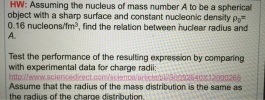 Assuming the nucleus of mass number A to be a spherical object with a sharp surface and constant nucleonic density rho_0= 0.16 nucleons/fm^3, find the relation between nuclear radius and A. Test the performance of the resulting expression by comparing with experimental data for charge radii: Assume that the radius of the mass distribution is the same as the radius of the charge distribution.
Activity 27-4. Nuclear fission (Accompanies Section 27-4] 1 A uranium nucleus (235U) absorbs a neutron. The...
 Activity 27-4. Nuclear fission (Accompanies Section 27-4] 1 A uranium nucleus (235U) absorbs a neutron. The result is a uranium nucleus (236U) in an excited state. 3 The excited uranium nucleus fissions into two smaller, more tightly bound nuclei... ...as well as a few neutrons. These can trigger the fission of other 235U nuclei. 3 neutrons Neutron + 2350 236U 134 Te 9976 Z = 0 protons Z = 92 protons N = 1 neutron N = 143 neutrons A=Z+N...
The illustration shows one possible way that a nucleus of uranium-235 (235U) can undergo neutron-induced fission....
 The illustration shows one
possible way that a nucleus of uranium-235 (235U) can undergo
neutron-induced fission. (a) Rank the following objects in order of
their binding energy per nucleon, from largest to smallest. If any
two objects have the same binding energy per nucleon, state this.
Explain how you made your ranking. (i) The uranium-235 (235U)
nucleus (ii) The tellurium-134 (134Te) nucleus (iii) The
zirconium-99 (99Zr) nucleus (iv) The three neutrons Activity 27-4
[continued]. (b) Using your results from part...
The illustration shows one
possible way that a nucleus of uranium-235 (235U) can undergo
neutron-induced fission. (a) Rank the following objects in order of
their binding energy per nucleon, from largest to smallest. If any
two objects have the same binding energy per nucleon, state this.
Explain how you made your ranking. (i) The uranium-235 (235U)
nucleus (ii) The tellurium-134 (134Te) nucleus (iii) The
zirconium-99 (99Zr) nucleus (iv) The three neutrons Activity 27-4
[continued]. (b) Using your results from part...
Find the electrical potential (in all space) produced by: d) A straight line with linear charge...
Find the electrical potential (in all space) produced by: d) A straight line with linear charge density. e) A volumetric density of charge, spherical and radius . f) A disk of radius that has a surface density of charge (on its axis). We were unable to transcribe this imageWe were unable to transcribe this image
The nucleus of an atom consists of protons and neutrons (no electrons). A nucleus of a...
 The nucleus of an atom consists of protons and neutrons (no electrons). A nucleus of a carbon-12 isotope contains six protons and six neutrons, while a nitrogen-14 nucleus comprises seven protons and seven neutrons. You perform a nuclear physics experiment in which you bombard nitrogen-14 nuclei with very high speed carbon-12 nuclei emerging from a particle accelerator. As a result of each such collision, the two nuclei disintegrate completely and a mix of different particles are emitted, including electrons, protons,...
A solid conducting sphere has a radius of 10.7 cm and a net electrical charge of...
 A solid conducting sphere has a radius of 10.7 cm and a net electrical charge of 4.06 nC. What is the magnitude of the electric field at a distance 18.6 cm from the sphere's center? Select one a. 10.5 N/C b. 1.9664 N/C c. 1050 N/C d. 196 N/G e. 3190 N/C 2. A hollow conducting sphere has an inner radius of 5.38 cm and an outer radius of 8.637 cm. The sphere has a net electric charge of -6.87...
Find the nuclear products after the imaginary nucleus undergoes three alpha decays, two beta plus decays, a beta minus...
 Find the nuclear products after the imaginary nucleus
undergoes three alpha decays, two beta plus decays, a beta minus
decay, and two gamma decays.
Find the nuclear products after the imaginary nucleus
undergoes three alpha decays, two beta plus decays, a beta minus
decay, and two gamma decays.
2 Consider a toy model of an atomic nucleus. In this picture, a proton is considered...
 2 Consider a toy model of an atomic nucleus. In this picture, a proton is considered to move through a uniform sphere of charge (p 1)e, where p is the number of protons in the nucleus and e is the charge on the proton. The radius of the nucleus is given by the formula In the above A is the atomic mass number (protons plus neutrons) and ro 1.3 × 10⁻¹⁵ m. For this model, find the force on a...
I can answer the multiple choice, I just need help with the fill ins. Question 1...
 I can answer the multiple choice, I just need help with the fill
ins.
Question 1 (1 Point) This assignment is set up for sequential assessment. Complete each question and submit the answer before moving on to the next question. Correct answers for each question will be made available once the maximum number of attempts have been made for each submission. Nuclear Physics - Nuclear Structure Nuclear Structure Z O Proton r=ro41/3 radius N Neutron A = Z+N A ro...
I can answer the multiple choice, I just need help with the fill
ins.
Question 1 (1 Point) This assignment is set up for sequential assessment. Complete each question and submit the answer before moving on to the next question. Correct answers for each question will be made available once the maximum number of attempts have been made for each submission. Nuclear Physics - Nuclear Structure Nuclear Structure Z O Proton r=ro41/3 radius N Neutron A = Z+N A ro...
I can answer the multiple choice, I just need help with the fill ins. Question 1...
 I can answer the multiple choice, I just need help with the fill
ins.
Question 1 (1 Point) This assignment is set up for sequential assessment. Complete each question and submit the answer before moving on to the next question. Correct answers for each question will be made available once the maximum number of attempts have been made for each submission. Nuclear Physics - Nuclear Structure Nuclear Structure Z O Proton r=ro41/3 radius N Neutron A = Z+N A ro...
I can answer the multiple choice, I just need help with the fill
ins.
Question 1 (1 Point) This assignment is set up for sequential assessment. Complete each question and submit the answer before moving on to the next question. Correct answers for each question will be made available once the maximum number of attempts have been made for each submission. Nuclear Physics - Nuclear Structure Nuclear Structure Z O Proton r=ro41/3 radius N Neutron A = Z+N A ro...
 Assuming the nucleus of mass number A to be a spherical object with a sharp surface and constant nucleonic density rho_0= 0.16 nucleons/fm^3, find the relation between nuclear radius and A. Test the performance of the resulting expression by comparing with experimental data for charge radii: Assume that the radius of the mass distribution is the same as the radius of the charge distribution.
 Activity 27-4. Nuclear fission (Accompanies Section 27-4] 1 A uranium nucleus (235U) absorbs a neutron. The result is a uranium nucleus (236U) in an excited state. 3 The excited uranium nucleus fissions into two smaller, more tightly bound nuclei... ...as well as a few neutrons. These can trigger the fission of other 235U nuclei. 3 neutrons Neutron + 2350 236U 134 Te 9976 Z = 0 protons Z = 92 protons N = 1 neutron N = 143 neutrons A=Z+N...
 The illustration shows one
possible way that a nucleus of uranium-235 (235U) can undergo
neutron-induced fission. (a) Rank the following objects in order of
their binding energy per nucleon, from largest to smallest. If any
two objects have the same binding energy per nucleon, state this.
Explain how you made your ranking. (i) The uranium-235 (235U)
nucleus (ii) The tellurium-134 (134Te) nucleus (iii) The
zirconium-99 (99Zr) nucleus (iv) The three neutrons Activity 27-4
[continued]. (b) Using your results from part...
The illustration shows one
possible way that a nucleus of uranium-235 (235U) can undergo
neutron-induced fission. (a) Rank the following objects in order of
their binding energy per nucleon, from largest to smallest. If any
two objects have the same binding energy per nucleon, state this.
Explain how you made your ranking. (i) The uranium-235 (235U)
nucleus (ii) The tellurium-134 (134Te) nucleus (iii) The
zirconium-99 (99Zr) nucleus (iv) The three neutrons Activity 27-4
[continued]. (b) Using your results from part...
 The nucleus of an atom consists of protons and neutrons (no electrons). A nucleus of a carbon-12 isotope contains six protons and six neutrons, while a nitrogen-14 nucleus comprises seven protons and seven neutrons. You perform a nuclear physics experiment in which you bombard nitrogen-14 nuclei with very high speed carbon-12 nuclei emerging from a particle accelerator. As a result of each such collision, the two nuclei disintegrate completely and a mix of different particles are emitted, including electrons, protons,...
 A solid conducting sphere has a radius of 10.7 cm and a net electrical charge of 4.06 nC. What is the magnitude of the electric field at a distance 18.6 cm from the sphere's center? Select one a. 10.5 N/C b. 1.9664 N/C c. 1050 N/C d. 196 N/G e. 3190 N/C 2. A hollow conducting sphere has an inner radius of 5.38 cm and an outer radius of 8.637 cm. The sphere has a net electric charge of -6.87...
 Find the nuclear products after the imaginary nucleus
undergoes three alpha decays, two beta plus decays, a beta minus
decay, and two gamma decays.
Find the nuclear products after the imaginary nucleus
undergoes three alpha decays, two beta plus decays, a beta minus
decay, and two gamma decays.
 2 Consider a toy model of an atomic nucleus. In this picture, a proton is considered to move through a uniform sphere of charge (p 1)e, where p is the number of protons in the nucleus and e is the charge on the proton. The radius of the nucleus is given by the formula In the above A is the atomic mass number (protons plus neutrons) and ro 1.3 × 10⁻¹⁵ m. For this model, find the force on a...
 I can answer the multiple choice, I just need help with the fill
ins.
Question 1 (1 Point) This assignment is set up for sequential assessment. Complete each question and submit the answer before moving on to the next question. Correct answers for each question will be made available once the maximum number of attempts have been made for each submission. Nuclear Physics - Nuclear Structure Nuclear Structure Z O Proton r=ro41/3 radius N Neutron A = Z+N A ro...
I can answer the multiple choice, I just need help with the fill
ins.
Question 1 (1 Point) This assignment is set up for sequential assessment. Complete each question and submit the answer before moving on to the next question. Correct answers for each question will be made available once the maximum number of attempts have been made for each submission. Nuclear Physics - Nuclear Structure Nuclear Structure Z O Proton r=ro41/3 radius N Neutron A = Z+N A ro...
 I can answer the multiple choice, I just need help with the fill
ins.
Question 1 (1 Point) This assignment is set up for sequential assessment. Complete each question and submit the answer before moving on to the next question. Correct answers for each question will be made available once the maximum number of attempts have been made for each submission. Nuclear Physics - Nuclear Structure Nuclear Structure Z O Proton r=ro41/3 radius N Neutron A = Z+N A ro...
I can answer the multiple choice, I just need help with the fill
ins.
Question 1 (1 Point) This assignment is set up for sequential assessment. Complete each question and submit the answer before moving on to the next question. Correct answers for each question will be made available once the maximum number of attempts have been made for each submission. Nuclear Physics - Nuclear Structure Nuclear Structure Z O Proton r=ro41/3 radius N Neutron A = Z+N A ro...
Most questions answered within 3 hours.
-
Where is the error in this code sequence?
String s1 = "Hello";
String s2 = "ello";...
asked 11 months ago -
Financial data for Joel de Paris, Inc., for last year
follow:
Joel de Paris, Inc.
Balance...
asked 11 months ago -
Consider this reaction:
Al2(SO4)3 (aq)+ BaCl3
(aq) Al2Cl6 (aq)- +
3BaSO4(s) . What is the...
asked 11 months ago -
Suppose that Savneet is considering increasing her
recent random sample from 20 car rentals to 40...
asked 11 months ago -
Trucks arrive at an unloading terminal at an average rate of 120
per hour.
Trucks arrive...
asked 11 months ago -
Why are methanol and ethanol completely soluble in water while
octanol is not very little soluble....
asked 11 months ago -
A facilities manager at a university reads in a research report
that the mean amount of...
asked 11 months ago -
When the CuSO4 is rehydrated by adding water to the anhydrous
compound, is this an endothermic...
asked 11 months ago -
A ray of sunlight is passing from diamond into crown glass; the
angle of incidence is...
asked 11 months ago -
A block of mass 0.249 kg is placed on top of a light, vertical
spring of...
asked 11 months ago -
how do the kidneys compensate in the presences of acidosis
a) trigger hyperventilate
b) reserve acid...
asked 11 months ago -
Question 501 pts
The rental rate of capital to the firm increases. Which of the
following...
asked 11 months ago