
Homework Answers
Add Answer to:
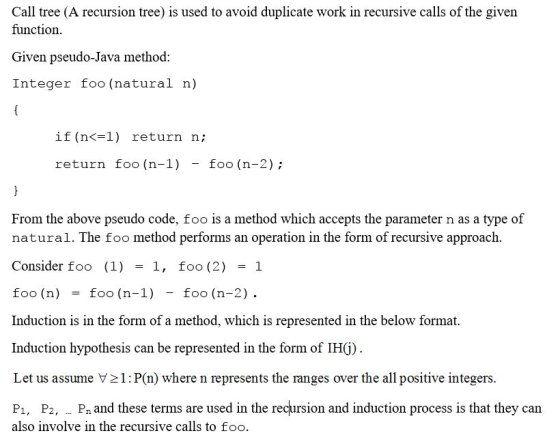
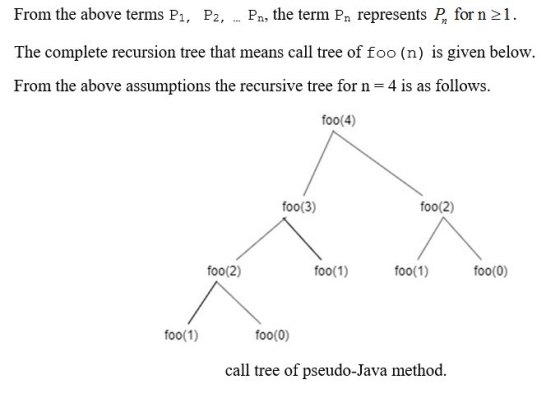
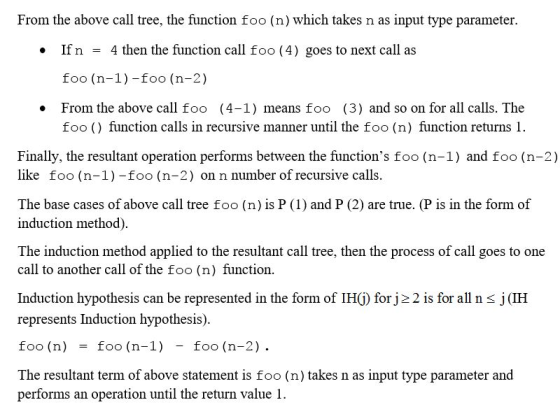
P9.3.1 Determine what the following pseudo-Java method outputs on input n. Prove your answer by induction...
1. Prove by induction that, for every natural number n, either 1 = n or 1<n....
 1. Prove by induction that, for every natural number n, either 1 = n or 1<n. 2. Prove the validity of the following form of the principle of mathematical in duction, resting your argument on the form enunciated in the text. Let B(n) denote a proposition associated with the integer n. Suppose B(n) is known (or can be shown) to be true when n = no, and suppose the truth of B(n + 1) can be deduced if the truth...
Prove using mathematical induction that for every positive integer n, = 1/i(i+1) = n/n+1. 2) Suppose...
 Prove using mathematical induction that for every positive integer n, = 1/i(i+1) = n/n+1. 2) Suppose r is a real number other than 1. Prove using mathematical induction that for every nonnegative integer n, = 1-r^n+1/1-r. 3) Prove using mathematical induction that for every nonnegative integer n, 1 + i+i! = (n+1)!. 4) Prove using mathematical induction that for every integer n>4, n!>2^n. 5) Prove using mathematical induction that for every positive integer n, 7 + 5 + 3 +.......
Please answer question 8 Given the following method, what is the result of a call to...
 Please answer question 8
Given the following method, what is the result of a call to System.out.println(foo(list)) if list contains { 1, 1, 2, 2 )? public Integer foo( IndexedunorderedList<Integer> list ) Integer bar = new Integer (0); 0; X < list.size(); x++) bar += list.get(x) * list.get (x); return bar; 30 is printed to the console 14 is printed to the console 10 is printed to the console Code throws an IndexOutOfBoundException QUESTION 8 What is the runtime of...
Please answer question 8
Given the following method, what is the result of a call to System.out.println(foo(list)) if list contains { 1, 1, 2, 2 )? public Integer foo( IndexedunorderedList<Integer> list ) Integer bar = new Integer (0); 0; X < list.size(); x++) bar += list.get(x) * list.get (x); return bar; 30 is printed to the console 14 is printed to the console 10 is printed to the console Code throws an IndexOutOfBoundException QUESTION 8 What is the runtime of...
2. Use Method of mathematical induction to prove identity : for all natural n > 2...
 2. Use Method of mathematical induction to prove identity : for all natural n > 2 1.1+(1.1)? + ... + (1.1)n-1 = - 11n-1 1.1 - (1.1)" - 0.1 inf of the set below
(a) Suppose you wish to use the Principle of Mathematical Induction to prove that n(n+1) 1+...
 (a) Suppose you wish to use the Principle of Mathematical Induction to prove that n(n+1) 1+ 2+ ... +n= - for any positive integer n. i) Write P(1). Write P(6. Write P(k) for any positive integer k. Write P(k+1) for any positive integer k. Use the Principle of Mathematical Induction to prove that P(n) is true for all positive integer n. (b) Suppose that function f is defined recursively by f(0) = 3 f(n+1)=2f (n)+3 Find f(1), f (2), f...
1. (Induction.) Consider the following program, called Ackbar(m,n). It takes in as input any two natural numbers m, n,...
 1. (Induction.) Consider the following program, called Ackbar(m,n). It takes in as input any two natural numbers m, n, and does the following: (i) If m-0, Ackbar(0, n) = n + 1. (ii) If n-0, Ackbar(rn,0) is equal to Ackbar(m-1, 1). iii) Otherwise, if n, m > 0, then Ackbar(m, n) can be found by calculating Ackbar(m - 1, Ackbar(m,n 1)) Here's a handful of calculations to illustrate this definition: Ackbar(1,0)-Ackbar(0,1) = 1 + 1-2 Ackbar (1, 1) Ackbar (0,...
Prove by Induction 24.) Prove that for all natural numbers n 2 5, (n+1)! 2n+3 b.)...
 Prove by Induction
24.) Prove that for all natural numbers n 2 5, (n+1)! 2n+3 b.) Prove that for all integers n (Hint: First prove the following lemma: If n E Z, n2 6 then then proceed with your proof.
Prove by Induction
24.) Prove that for all natural numbers n 2 5, (n+1)! 2n+3 b.) Prove that for all integers n (Hint: First prove the following lemma: If n E Z, n2 6 then then proceed with your proof.
by netBeans C++ java by netBeans C++ java by netBeans C++ java 1. Answer the following...
 by netBeans C++ java
by netBeans C++ java
1. Answer the following question a) (4 marks) Write a Java method, which takes an integer array and two integers x and y as input parameters. The method should exchange the value in position x with the value in the position y in the array. Example: If x = 1, y=2 Input Array Output Array b) (4 marks) Write the main method to do the following: 1. Define...
by netBeans C++ java
by netBeans C++ java
by netBeans C++ java
1. Answer the following question a) (4 marks) Write a Java method, which takes an integer array and two integers x and y as input parameters. The method should exchange the value in position x with the value in the position y in the array. Example: If x = 1, y=2 Input Array Output Array b) (4 marks) Write the main method to do the following: 1. Define...
Need help to answer this method in java Write a method int indexFirstOne(int[ ] input) The...
Need help to answer this method in java Write a method int indexFirstOne(int[ ] input) The input array is sorted, and every element is 0 or 1. Return the index of the first 1. If there are no 1s in the array, return -1. The worst-case runtime must be O(logn)where n is the number of elements (no credits for slower runtimes) Example: a = [0,0,1,1,1] return 2 a = [ 0,0,0,1] return 3 a = [0,0,0] return -1 int indexFirstOne...
Determine whether each of the following algorithms is fully correct, and prove that your answer is...
 Determine whether each of the following algorithms is fully
correct, and prove that your answer is correct.
Determine whether each of the following algorithms is fully correct, and prove that your answer is correct. 4 5 (a) [10 points) A(2) IN :TER,r> 1 1 r'= 2 p=0 3 while r'> 1 do p=p+1 r' = 2/2 6 return p OUT: p = log2 (b) [10 points) B(2) IN : r ER, 1 > 1 1 while r > 1 do...
Determine whether each of the following algorithms is fully
correct, and prove that your answer is correct.
Determine whether each of the following algorithms is fully correct, and prove that your answer is correct. 4 5 (a) [10 points) A(2) IN :TER,r> 1 1 r'= 2 p=0 3 while r'> 1 do p=p+1 r' = 2/2 6 return p OUT: p = log2 (b) [10 points) B(2) IN : r ER, 1 > 1 1 while r > 1 do...
 1. Prove by induction that, for every natural number n, either 1 = n or 1<n. 2. Prove the validity of the following form of the principle of mathematical in duction, resting your argument on the form enunciated in the text. Let B(n) denote a proposition associated with the integer n. Suppose B(n) is known (or can be shown) to be true when n = no, and suppose the truth of B(n + 1) can be deduced if the truth...
 Prove using mathematical induction that for every positive integer n, = 1/i(i+1) = n/n+1. 2) Suppose r is a real number other than 1. Prove using mathematical induction that for every nonnegative integer n, = 1-r^n+1/1-r. 3) Prove using mathematical induction that for every nonnegative integer n, 1 + i+i! = (n+1)!. 4) Prove using mathematical induction that for every integer n>4, n!>2^n. 5) Prove using mathematical induction that for every positive integer n, 7 + 5 + 3 +.......
 Please answer question 8
Given the following method, what is the result of a call to System.out.println(foo(list)) if list contains { 1, 1, 2, 2 )? public Integer foo( IndexedunorderedList<Integer> list ) Integer bar = new Integer (0); 0; X < list.size(); x++) bar += list.get(x) * list.get (x); return bar; 30 is printed to the console 14 is printed to the console 10 is printed to the console Code throws an IndexOutOfBoundException QUESTION 8 What is the runtime of...
Please answer question 8
Given the following method, what is the result of a call to System.out.println(foo(list)) if list contains { 1, 1, 2, 2 )? public Integer foo( IndexedunorderedList<Integer> list ) Integer bar = new Integer (0); 0; X < list.size(); x++) bar += list.get(x) * list.get (x); return bar; 30 is printed to the console 14 is printed to the console 10 is printed to the console Code throws an IndexOutOfBoundException QUESTION 8 What is the runtime of...
 2. Use Method of mathematical induction to prove identity : for all natural n > 2 1.1+(1.1)? + ... + (1.1)n-1 = - 11n-1 1.1 - (1.1)" - 0.1 inf of the set below
 (a) Suppose you wish to use the Principle of Mathematical Induction to prove that n(n+1) 1+ 2+ ... +n= - for any positive integer n. i) Write P(1). Write P(6. Write P(k) for any positive integer k. Write P(k+1) for any positive integer k. Use the Principle of Mathematical Induction to prove that P(n) is true for all positive integer n. (b) Suppose that function f is defined recursively by f(0) = 3 f(n+1)=2f (n)+3 Find f(1), f (2), f...
 1. (Induction.) Consider the following program, called Ackbar(m,n). It takes in as input any two natural numbers m, n, and does the following: (i) If m-0, Ackbar(0, n) = n + 1. (ii) If n-0, Ackbar(rn,0) is equal to Ackbar(m-1, 1). iii) Otherwise, if n, m > 0, then Ackbar(m, n) can be found by calculating Ackbar(m - 1, Ackbar(m,n 1)) Here's a handful of calculations to illustrate this definition: Ackbar(1,0)-Ackbar(0,1) = 1 + 1-2 Ackbar (1, 1) Ackbar (0,...
 Prove by Induction
24.) Prove that for all natural numbers n 2 5, (n+1)! 2n+3 b.) Prove that for all integers n (Hint: First prove the following lemma: If n E Z, n2 6 then then proceed with your proof.
Prove by Induction
24.) Prove that for all natural numbers n 2 5, (n+1)! 2n+3 b.) Prove that for all integers n (Hint: First prove the following lemma: If n E Z, n2 6 then then proceed with your proof.
 by netBeans C++ java
by netBeans C++ java
1. Answer the following question a) (4 marks) Write a Java method, which takes an integer array and two integers x and y as input parameters. The method should exchange the value in position x with the value in the position y in the array. Example: If x = 1, y=2 Input Array Output Array b) (4 marks) Write the main method to do the following: 1. Define...
by netBeans C++ java
by netBeans C++ java
by netBeans C++ java
1. Answer the following question a) (4 marks) Write a Java method, which takes an integer array and two integers x and y as input parameters. The method should exchange the value in position x with the value in the position y in the array. Example: If x = 1, y=2 Input Array Output Array b) (4 marks) Write the main method to do the following: 1. Define...
 Determine whether each of the following algorithms is fully
correct, and prove that your answer is correct.
Determine whether each of the following algorithms is fully correct, and prove that your answer is correct. 4 5 (a) [10 points) A(2) IN :TER,r> 1 1 r'= 2 p=0 3 while r'> 1 do p=p+1 r' = 2/2 6 return p OUT: p = log2 (b) [10 points) B(2) IN : r ER, 1 > 1 1 while r > 1 do...
Determine whether each of the following algorithms is fully
correct, and prove that your answer is correct.
Determine whether each of the following algorithms is fully correct, and prove that your answer is correct. 4 5 (a) [10 points) A(2) IN :TER,r> 1 1 r'= 2 p=0 3 while r'> 1 do p=p+1 r' = 2/2 6 return p OUT: p = log2 (b) [10 points) B(2) IN : r ER, 1 > 1 1 while r > 1 do...
Most questions answered within 3 hours.
-
Where is the error in this code sequence?
String s1 = "Hello";
String s2 = "ello";...
asked 10 months ago -
Financial data for Joel de Paris, Inc., for last year
follow:
Joel de Paris, Inc.
Balance...
asked 10 months ago -
Consider this reaction:
Al2(SO4)3 (aq)+ BaCl3
(aq) Al2Cl6 (aq)- +
3BaSO4(s) . What is the...
asked 10 months ago -
Suppose that Savneet is considering increasing her
recent random sample from 20 car rentals to 40...
asked 10 months ago -
Trucks arrive at an unloading terminal at an average rate of 120
per hour.
Trucks arrive...
asked 10 months ago -
Why are methanol and ethanol completely soluble in water while
octanol is not very little soluble....
asked 10 months ago -
A facilities manager at a university reads in a research report
that the mean amount of...
asked 10 months ago -
When the CuSO4 is rehydrated by adding water to the anhydrous
compound, is this an endothermic...
asked 10 months ago -
A ray of sunlight is passing from diamond into crown glass; the
angle of incidence is...
asked 10 months ago -
A block of mass 0.249 kg is placed on top of a light, vertical
spring of...
asked 10 months ago -
how do the kidneys compensate in the presences of acidosis
a) trigger hyperventilate
b) reserve acid...
asked 10 months ago -
Question 501 pts
The rental rate of capital to the firm increases. Which of the
following...
asked 10 months ago