
Homework Answers
Add Answer to:
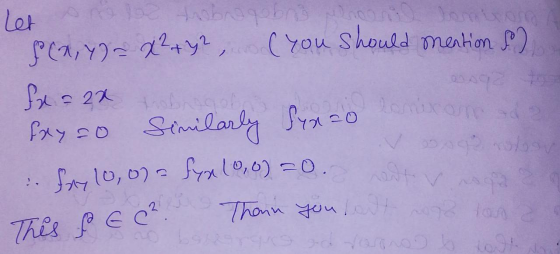
Q 3. (a)fxy(0,0) =? and fx(0,0) =? (b)fe C?? (Does the function have a continuous derivative?)
(8) 2 points Let f be a function defined and continuous, with continuous first partial derivative at the origin (0,...
 (8) 2 points Let f be a function defined and continuous, with continuous first partial derivative at the origin (0,0). A unit vector u for which D.f (0,0) is the maximum is: maximum a 1 (0,0)), A. /(0,0)x,0),y (0 af B. (0,0) 8x0,0),(0,0)), af 1 ((0,0),-y C. (0,0), /(0,0) D. None of the above.
(8) 2 points Let f be a function defined and continuous, with continuous first partial derivative at the origin (0,0). A unit vector u for which...
(8) 2 points Let f be a function defined and continuous, with continuous first partial derivative at the origin (0,0). A unit vector u for which D.f (0,0) is the maximum is: maximum a 1 (0,0)), A. /(0,0)x,0),y (0 af B. (0,0) 8x0,0),(0,0)), af 1 ((0,0),-y C. (0,0), /(0,0) D. None of the above.
(8) 2 points Let f be a function defined and continuous, with continuous first partial derivative at the origin (0,0). A unit vector u for which...
E2 3 does not have a complex antiderivative on CV 3. (a) The continuous function f(z) = 0 (b) The...
 e2 3 does not have a complex antiderivative on CV 3. (a) The continuous function f(z) = 0 (b) The continuous function g(z) does not have a complex antiderivative on C 1 + 1리-
e2 3 does not have a complex antiderivative on CV 3. (a) The continuous function f(z) = 0 (b) The continuous function g(z) does not have a complex antiderivative on C 1 + 1리-
e2 3 does not have a complex antiderivative on CV 3. (a) The continuous function f(z) = 0 (b) The continuous function g(z) does not have a complex antiderivative on C 1 + 1리-
4. f(x,y) = 3x3 – 4xy2 – 2x + 4y2 + 3 a. fx b. fxy...
 4. f(x,y) = 3x3 – 4xy2 – 2x + 4y2 + 3 a. fx b. fxy c. fy d. fyx
Ince ft) dt, then Fx) = fx) over Find the derivative using the Fundamental Theorem of...
 Ince ft) dt, then Fx) = fx) over Find the derivative using the Fundamental Theorem of Calculus, part 1, which states that if (x) is continuous over an interval [a, b], and the function F(x) is defined by F(x) Tabl d dr dx
is: 6. (8 points) / is a function that is continuous on (-0,00). The first derivative...
 is: 6. (8 points) / is a function that is continuous on (-0,00). The first derivative of /"(x) = (3x - 1)x+3X5 - x) Use this information to answer the following questions about : a. On what intervals is increasing or decreasing? Internal in which fis increasing or -- 8x-1) (x+3)(5-x) > 0 x=112, -3, -5 b. At what values of x does f have any local maximum or minimum values? - V2 ; Location(s) of Minima: Location(s) of Maxima:...
(II) Multiple continuous random variables: 8.2 Let X and Y have joint density fXY(x,y) = cx^2y...
(II) Multiple continuous random variables: 8.2 Let X and Y have joint density fXY(x,y) = cx^2y for x and y in the triangle defined by 0 < x < 1, 0 < y < 1, 0 < x + y < 1 and fXY(x,y) = 0 elsewhere. a. What is c? b. What are the marginals fX(x) and fY(y)? c. What are E[X], E[Y], Var[X] and Var[Y]? d. What is E[XY]? Are X and Y independent?
Question 3: Let X be a continuous random variable with cumulative distribution function FX (x) =...
 Question 3: Let X be a continuous random variable with
cumulative distribution function FX (x) = P (X ≤ x). Let Y = FX
(x). Find the probability density function and the cumulative
distribution function of Y .
Question 3: Let X be a continuous random variable with cumulative distribution function FX(x) = P(X-x). Let Y = FX (x). Find the probability density function and the cumulative distribution function of Y
Question 3: Let X be a continuous random variable with
cumulative distribution function FX (x) = P (X ≤ x). Let Y = FX
(x). Find the probability density function and the cumulative
distribution function of Y .
Question 3: Let X be a continuous random variable with cumulative distribution function FX(x) = P(X-x). Let Y = FX (x). Find the probability density function and the cumulative distribution function of Y
Q.4 (22') Suppose the joint probability density function of X and Y is fx,y(x, y) =...
 Q.4 (22') Suppose the joint probability density function of X and Y is fx,y(x, y) = { „) - k(2 - x + y)x 0 sxs 1,0 sys1 o otherwise (a) (7”) Show that the value of constant k = 12 (b) (7') Find the marginal density function of X, i.e., fx(x). (c) (8') Find the conditional probability density of X given Y=y, i.e., fxy(xly). 11
the function of two real variables defined below: 1 –9x + 2y“ (x, y) + (0,0),...
 the function of two real variables defined below: 1 –9x + 2y“ (x, y) + (0,0), f(x, y) = { 6x + 3y 10 (x, y) = (0,0). Use the limit definition of partial derivatives to compute the following partial derivatives. Enter "DNE" if the derivative does not exist. fx(0,0) = DNE fy(0,0) = 0
5. (a) Suppose f is any function with continuous second-order partial derivatives such that f(0,0) =...
 5. (a) Suppose f is any function with continuous second-order partial derivatives such that f(0,0) = 0 and (0,0) is a critical point of f. Write an expression for the second-degree Taylor polynomial, Q, of f at (0,0).
 (8) 2 points Let f be a function defined and continuous, with continuous first partial derivative at the origin (0,0). A unit vector u for which D.f (0,0) is the maximum is: maximum a 1 (0,0)), A. /(0,0)x,0),y (0 af B. (0,0) 8x0,0),(0,0)), af 1 ((0,0),-y C. (0,0), /(0,0) D. None of the above.
(8) 2 points Let f be a function defined and continuous, with continuous first partial derivative at the origin (0,0). A unit vector u for which...
(8) 2 points Let f be a function defined and continuous, with continuous first partial derivative at the origin (0,0). A unit vector u for which D.f (0,0) is the maximum is: maximum a 1 (0,0)), A. /(0,0)x,0),y (0 af B. (0,0) 8x0,0),(0,0)), af 1 ((0,0),-y C. (0,0), /(0,0) D. None of the above.
(8) 2 points Let f be a function defined and continuous, with continuous first partial derivative at the origin (0,0). A unit vector u for which...
 e2 3 does not have a complex antiderivative on CV 3. (a) The continuous function f(z) = 0 (b) The continuous function g(z) does not have a complex antiderivative on C 1 + 1리-
e2 3 does not have a complex antiderivative on CV 3. (a) The continuous function f(z) = 0 (b) The continuous function g(z) does not have a complex antiderivative on C 1 + 1리-
e2 3 does not have a complex antiderivative on CV 3. (a) The continuous function f(z) = 0 (b) The continuous function g(z) does not have a complex antiderivative on C 1 + 1리-
 4. f(x,y) = 3x3 – 4xy2 – 2x + 4y2 + 3 a. fx b. fxy c. fy d. fyx
 Ince ft) dt, then Fx) = fx) over Find the derivative using the Fundamental Theorem of Calculus, part 1, which states that if (x) is continuous over an interval [a, b], and the function F(x) is defined by F(x) Tabl d dr dx
 is: 6. (8 points) / is a function that is continuous on (-0,00). The first derivative of /"(x) = (3x - 1)x+3X5 - x) Use this information to answer the following questions about : a. On what intervals is increasing or decreasing? Internal in which fis increasing or -- 8x-1) (x+3)(5-x) > 0 x=112, -3, -5 b. At what values of x does f have any local maximum or minimum values? - V2 ; Location(s) of Minima: Location(s) of Maxima:...
 Question 3: Let X be a continuous random variable with
cumulative distribution function FX (x) = P (X ≤ x). Let Y = FX
(x). Find the probability density function and the cumulative
distribution function of Y .
Question 3: Let X be a continuous random variable with cumulative distribution function FX(x) = P(X-x). Let Y = FX (x). Find the probability density function and the cumulative distribution function of Y
Question 3: Let X be a continuous random variable with
cumulative distribution function FX (x) = P (X ≤ x). Let Y = FX
(x). Find the probability density function and the cumulative
distribution function of Y .
Question 3: Let X be a continuous random variable with cumulative distribution function FX(x) = P(X-x). Let Y = FX (x). Find the probability density function and the cumulative distribution function of Y
 Q.4 (22') Suppose the joint probability density function of X and Y is fx,y(x, y) = { „) - k(2 - x + y)x 0 sxs 1,0 sys1 o otherwise (a) (7”) Show that the value of constant k = 12 (b) (7') Find the marginal density function of X, i.e., fx(x). (c) (8') Find the conditional probability density of X given Y=y, i.e., fxy(xly). 11
 the function of two real variables defined below: 1 –9x + 2y“ (x, y) + (0,0), f(x, y) = { 6x + 3y 10 (x, y) = (0,0). Use the limit definition of partial derivatives to compute the following partial derivatives. Enter "DNE" if the derivative does not exist. fx(0,0) = DNE fy(0,0) = 0
 5. (a) Suppose f is any function with continuous second-order partial derivatives such that f(0,0) = 0 and (0,0) is a critical point of f. Write an expression for the second-degree Taylor polynomial, Q, of f at (0,0).
Most questions answered within 3 hours.
-
Where is the error in this code sequence?
String s1 = "Hello";
String s2 = "ello";...
asked 10 months ago -
Financial data for Joel de Paris, Inc., for last year
follow:
Joel de Paris, Inc.
Balance...
asked 10 months ago -
Consider this reaction:
Al2(SO4)3 (aq)+ BaCl3
(aq) Al2Cl6 (aq)- +
3BaSO4(s) . What is the...
asked 10 months ago -
Suppose that Savneet is considering increasing her
recent random sample from 20 car rentals to 40...
asked 10 months ago -
Trucks arrive at an unloading terminal at an average rate of 120
per hour.
Trucks arrive...
asked 10 months ago -
Why are methanol and ethanol completely soluble in water while
octanol is not very little soluble....
asked 10 months ago -
A facilities manager at a university reads in a research report
that the mean amount of...
asked 10 months ago -
When the CuSO4 is rehydrated by adding water to the anhydrous
compound, is this an endothermic...
asked 10 months ago -
A ray of sunlight is passing from diamond into crown glass; the
angle of incidence is...
asked 10 months ago -
A block of mass 0.249 kg is placed on top of a light, vertical
spring of...
asked 10 months ago -
how do the kidneys compensate in the presences of acidosis
a) trigger hyperventilate
b) reserve acid...
asked 10 months ago -
Question 501 pts
The rental rate of capital to the firm increases. Which of the
following...
asked 10 months ago