
Homework Answers
Add Answer to:
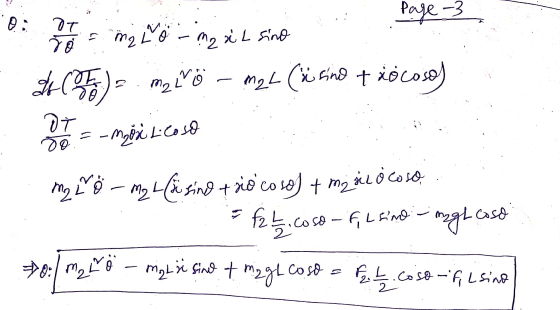
Problem # 2 (50pts) m2 Find the equations of motion to describe the system below. The...
3(a). Find the equations of motion for the system shown below. The system is two degree...
 3(a). Find the equations of motion for the system shown below. The system is two degree of freedom system with degrees of freedom X, and X2. Please find two equations of motion for this dynamical system by both Newtons method and Euler Lagrange. The point with which the spring is attached with the wall has zero displacement indeed) x X2 m2 ki kr Frictionless surfaces on which masses are resting Springs can be assumed to be massless Formulas: Formula to...
3. (15 points) Find the equations of motion for mi and m2 as shown in Figure 1.jo) is the input force of the system and xi is the output function of the system. Assume gravity is not a factor. of...
 3. (15 points) Find the equations of motion for mi and m2 as shown in Figure 1.jo) is the input force of the system and xi is the output function of the system. Assume gravity is not a factor. of the system, find the transfer f (t) C3 m2 mi Figure 1
3. (15 points) Find the equations of motion for mi and m2 as shown in Figure 1.jo) is the input force of the system and xi is the...
3. (15 points) Find the equations of motion for mi and m2 as shown in Figure 1.jo) is the input force of the system and xi is the output function of the system. Assume gravity is not a factor. of the system, find the transfer f (t) C3 m2 mi Figure 1
3. (15 points) Find the equations of motion for mi and m2 as shown in Figure 1.jo) is the input force of the system and xi is the...
Determine equations of motion for the system using the generalized coordinates theta1, theta2 as shown. Each...
 Determine equations of motion for the system using the
generalized coordinates theta1, theta2 as shown. Each bar has a
mass of m. A horizontal force F is applied to the end of the 2 bar
system.
5) Determine the equations of motion for the system using the generalized coordinates ???2 as shown. Each bar has a mass of m. A horizontal force Fis applied to the end of the 2 bar system. o,
Determine equations of motion for the system using the
generalized coordinates theta1, theta2 as shown. Each bar has a
mass of m. A horizontal force F is applied to the end of the 2 bar
system.
5) Determine the equations of motion for the system using the generalized coordinates ???2 as shown. Each bar has a mass of m. A horizontal force Fis applied to the end of the 2 bar system. o,
x2(t) m2 2 Two masses, m1 and m2, are connected with a spring, k. A force,...
 x2(t) m2 2 Two masses, m1 and m2, are connected with a spring, k. A force, f (t), is applied on the first mass. Both masses experience viscous damping, c1 and c2, through the surface that they sit on. The equations of motion that describe the system dynamics are m2 (t)--CzX2 (t)-k(X2(t)-x,(t)) The initial conditions are: x1(0) - a x(0)b (0) = c Assuming zero initial conditions, rearrange the two equations of motion to find the response for X1(s) and...
1 Q2. Figure 2 shows a system in which mass m is connected with a cylinder of mass m2 and moment of inertia Jo through...
 1 Q2. Figure 2 shows a system in which mass m is connected with a cylinder of mass m2 and moment of inertia Jo through a horizontal spring k. The cylinder is m1 rolling on the rough surface without slipping. (1) Find its total kinetic energy, total potential energy TN and Lagrangian, Figure 2 (2) Derive the equations of motion using Lagrangian equation method, and (3) Calculate its natural frequencies
1 Q2. Figure 2 shows a system in which mass...
1 Q2. Figure 2 shows a system in which mass m is connected with a cylinder of mass m2 and moment of inertia Jo through a horizontal spring k. The cylinder is m1 rolling on the rough surface without slipping. (1) Find its total kinetic energy, total potential energy TN and Lagrangian, Figure 2 (2) Derive the equations of motion using Lagrangian equation method, and (3) Calculate its natural frequencies
1 Q2. Figure 2 shows a system in which mass...
2. For the following 3-DOF spring-mass system: (a) Derive the equations of motion. (b) Assuming ki-k2-k3-k...
 2. For the following 3-DOF spring-mass system: (a) Derive the equations of motion. (b) Assuming ki-k2-k3-k and mi-m2-m3-m, determine the natural frequencies and mode shapes. rt
Problem 2: Consider two blocks of masses mi and m2 connected by a massless cable. The...
 Problem 2: Consider two blocks of masses mi and m2 connected by a massless cable. The coefficient of kinetic friction between the mass m2 and the inclined surface is ud. The coordinates x and y measure the displacements of the two blocks such that x=y=0 when the system is at rest. Find a single differential equation of motion for the system in coordinate y. Ideal Pulley m2 d
3. A frictionless and massless pulley with radius Ri and string of li is suspended as...
 3. A frictionless and massless pulley with radius Ri and string of li is suspended as shown in Fig. 1. One end connects with a mass mi and the other with another frictionless pulley of mass m with radius R2 and string /2, joining two masses ms and ms at the two ends. (a) Find the equations of holonomic constraints. (b) Find the equations of motion for masses mi, m2, m3, and m4. (c) Find the solutions for the undetermined...
4. Consider two asteroids with masses mi and m2 located in outer space far away from any external forces. m2 is initially stationary but mi travels horizontally to the right towards m2 with an initia...
 4. Consider two asteroids with masses mi and m2 located in outer space far away from any external forces. m2 is initially stationary but mi travels horizontally to the right towards m2 with an initial speed vo. Let's assume that after the collision the asteroids only move horizontally (in other words we'll assume this problem is purely 1-dimensional) a) Suppose the asteroids stick together after colliding. Find an expression for the final velocity of the asteroids and show that the...
3. Consider the spring - mass system shown below, consisting of two masses mi and m2 sus- pended ...
 3. Consider the spring - mass system shown below, consisting of two masses mi and m2 sus- pended from springs with spring constants ki and k2, respectively. Assume that there is no damping in the system. a) Show that the displacements ai and r2 of the masses from their respective equilibrium positions satisfy the differential equations b) Use the above result to show that the spring-mass system satisfies the following fourth order differential equation and c) Find the general solution...
 3(a). Find the equations of motion for the system shown below. The system is two degree of freedom system with degrees of freedom X, and X2. Please find two equations of motion for this dynamical system by both Newtons method and Euler Lagrange. The point with which the spring is attached with the wall has zero displacement indeed) x X2 m2 ki kr Frictionless surfaces on which masses are resting Springs can be assumed to be massless Formulas: Formula to...
 3. (15 points) Find the equations of motion for mi and m2 as shown in Figure 1.jo) is the input force of the system and xi is the output function of the system. Assume gravity is not a factor. of the system, find the transfer f (t) C3 m2 mi Figure 1
3. (15 points) Find the equations of motion for mi and m2 as shown in Figure 1.jo) is the input force of the system and xi is the...
3. (15 points) Find the equations of motion for mi and m2 as shown in Figure 1.jo) is the input force of the system and xi is the output function of the system. Assume gravity is not a factor. of the system, find the transfer f (t) C3 m2 mi Figure 1
3. (15 points) Find the equations of motion for mi and m2 as shown in Figure 1.jo) is the input force of the system and xi is the...
 Determine equations of motion for the system using the
generalized coordinates theta1, theta2 as shown. Each bar has a
mass of m. A horizontal force F is applied to the end of the 2 bar
system.
5) Determine the equations of motion for the system using the generalized coordinates ???2 as shown. Each bar has a mass of m. A horizontal force Fis applied to the end of the 2 bar system. o,
Determine equations of motion for the system using the
generalized coordinates theta1, theta2 as shown. Each bar has a
mass of m. A horizontal force F is applied to the end of the 2 bar
system.
5) Determine the equations of motion for the system using the generalized coordinates ???2 as shown. Each bar has a mass of m. A horizontal force Fis applied to the end of the 2 bar system. o,
 x2(t) m2 2 Two masses, m1 and m2, are connected with a spring, k. A force, f (t), is applied on the first mass. Both masses experience viscous damping, c1 and c2, through the surface that they sit on. The equations of motion that describe the system dynamics are m2 (t)--CzX2 (t)-k(X2(t)-x,(t)) The initial conditions are: x1(0) - a x(0)b (0) = c Assuming zero initial conditions, rearrange the two equations of motion to find the response for X1(s) and...
 1 Q2. Figure 2 shows a system in which mass m is connected with a cylinder of mass m2 and moment of inertia Jo through a horizontal spring k. The cylinder is m1 rolling on the rough surface without slipping. (1) Find its total kinetic energy, total potential energy TN and Lagrangian, Figure 2 (2) Derive the equations of motion using Lagrangian equation method, and (3) Calculate its natural frequencies
1 Q2. Figure 2 shows a system in which mass...
1 Q2. Figure 2 shows a system in which mass m is connected with a cylinder of mass m2 and moment of inertia Jo through a horizontal spring k. The cylinder is m1 rolling on the rough surface without slipping. (1) Find its total kinetic energy, total potential energy TN and Lagrangian, Figure 2 (2) Derive the equations of motion using Lagrangian equation method, and (3) Calculate its natural frequencies
1 Q2. Figure 2 shows a system in which mass...
 2. For the following 3-DOF spring-mass system: (a) Derive the equations of motion. (b) Assuming ki-k2-k3-k and mi-m2-m3-m, determine the natural frequencies and mode shapes. rt
 Problem 2: Consider two blocks of masses mi and m2 connected by a massless cable. The coefficient of kinetic friction between the mass m2 and the inclined surface is ud. The coordinates x and y measure the displacements of the two blocks such that x=y=0 when the system is at rest. Find a single differential equation of motion for the system in coordinate y. Ideal Pulley m2 d
 3. A frictionless and massless pulley with radius Ri and string of li is suspended as shown in Fig. 1. One end connects with a mass mi and the other with another frictionless pulley of mass m with radius R2 and string /2, joining two masses ms and ms at the two ends. (a) Find the equations of holonomic constraints. (b) Find the equations of motion for masses mi, m2, m3, and m4. (c) Find the solutions for the undetermined...
 4. Consider two asteroids with masses mi and m2 located in outer space far away from any external forces. m2 is initially stationary but mi travels horizontally to the right towards m2 with an initial speed vo. Let's assume that after the collision the asteroids only move horizontally (in other words we'll assume this problem is purely 1-dimensional) a) Suppose the asteroids stick together after colliding. Find an expression for the final velocity of the asteroids and show that the...
 3. Consider the spring - mass system shown below, consisting of two masses mi and m2 sus- pended from springs with spring constants ki and k2, respectively. Assume that there is no damping in the system. a) Show that the displacements ai and r2 of the masses from their respective equilibrium positions satisfy the differential equations b) Use the above result to show that the spring-mass system satisfies the following fourth order differential equation and c) Find the general solution...
Most questions answered within 3 hours.
-
Where is the error in this code sequence?
String s1 = "Hello";
String s2 = "ello";...
asked 10 months ago -
Financial data for Joel de Paris, Inc., for last year
follow:
Joel de Paris, Inc.
Balance...
asked 10 months ago -
Consider this reaction:
Al2(SO4)3 (aq)+ BaCl3
(aq) Al2Cl6 (aq)- +
3BaSO4(s) . What is the...
asked 10 months ago -
Suppose that Savneet is considering increasing her
recent random sample from 20 car rentals to 40...
asked 10 months ago -
Trucks arrive at an unloading terminal at an average rate of 120
per hour.
Trucks arrive...
asked 10 months ago -
Why are methanol and ethanol completely soluble in water while
octanol is not very little soluble....
asked 10 months ago -
A facilities manager at a university reads in a research report
that the mean amount of...
asked 10 months ago -
When the CuSO4 is rehydrated by adding water to the anhydrous
compound, is this an endothermic...
asked 10 months ago -
A ray of sunlight is passing from diamond into crown glass; the
angle of incidence is...
asked 10 months ago -
A block of mass 0.249 kg is placed on top of a light, vertical
spring of...
asked 10 months ago -
how do the kidneys compensate in the presences of acidosis
a) trigger hyperventilate
b) reserve acid...
asked 10 months ago -
Question 501 pts
The rental rate of capital to the firm increases. Which of the
following...
asked 10 months ago