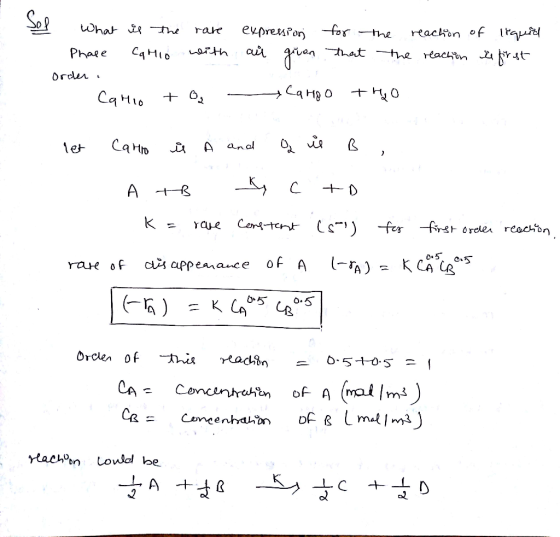
What is the rate expression for the reaction of liquid phase C9H10 with air given that...
Homework Answers
Add Answer to:
What is the rate expression for the reaction of liquid phase
C9H10 with air given that...
5. The gas "A" is absorbed into a completely stationary liquid phase where the reaction A...
 5. The gas "A" is absorbed into a completely stationary liquid phase where the reaction A → B occurs, characterized by the first order rate constant, k1. Let the gas-liquid interface correspond to z = 0, where the solubility of A is known. The liquid extends in the positive z-direction. The rate of reaction is much greater than the rate of diffusion, thus it can be assumed that CA O as z becomes large. Assume one dimensional diffusion. AB a....
Integrated Rate Laws 1. The rate law expression for the reaction of sucrose in water C12H22O11 ...
Integrated Rate Laws 1. The rate law expression for the reaction of sucrose in water C12H22O11 + H2O ---> 2 C6H12O6 Is rate = k[C12H22O11]. a. What is the order with respect to each reactant? b. What is the overall order of the reaction? c. After 2.57 hours, 6.00g/L of C12H22O11 has decreased to 5.40g/L. Express these concentrations in units of M. d. What is the value and units for k given the information in part c? e. Knowing the...
Question 2. (20 marks) The following liquid-phase consecutive reaction is taking place in a constant volume...
 Question 2. (20 marks) The following liquid-phase consecutive reaction is taking place in a constant volume batch reactor A_ky »B_k >C Derive expressions for the concentrations of A, B and C as functions of time given that the first reaction is first order and the second reaction is zeroth order.
An aqueous phase reversible reaction ? ⇌ ? + ? is carried out in a batch...
An aqueous phase reversible reaction ? ⇌ ? + ? is carried out in a batch reactor. The forward reaction is first order wrt A and the backward reaction is first order wrt each component. Initial concentration of A is 1 mol/litre and no R and S are present initially. Derive an expression for ?? ⁄??. What is the maximum allowable conversion in the reactor? If this reaction happens in gas phase (constant pressure), derive an expression for ?? ⁄??....
R1 - LIQUID PHASE CHEMICAL REACTOR The elementary liquid phase reaction given below is carried out...
 R1 - LIQUID PHASE CHEMICAL REACTOR The elementary liquid phase reaction given below is carried out in a CSTR by isothermal operation. k > NaOAC + EtOH k = 3.59 L/mol.min NaOH + EtOAC (A) (B) (C) (D) The volume of the CSTR is 2 L and the flowrates of the feeds in the individual streams are 50 ml/min for both reactants. The concentrations of NaOH and EtoAc are 0.05 mol/L and 0.1 mol/L, respectively. [6] a) Calculate the conversion...
Given the initial rate data for the reaction A+BC, determine the rate expression for the reaction....
 Given the initial rate data for the reaction A+BC, determine the rate expression for the reaction. [A], M [B].M Initial rate, M/S 0.10 0.20 5.00 10.20 0.20 10.0 0.10 0.15 2.81 O rate=250[A][B] rate - 5.0[A][B] rate=250[A)? rate - 50.0[A] rate= 1250[A][B] The first-order reaction A --> B+C has a half-life of 3.00 minutes. The rate equation for this reaction is rate = 1.50 min-1[A] rate = 1.05 min [A] O rate = 4.34 min [A] rate = 0.405 min...
One means of producing liquid oxygen from atmospheric air is to take advantage of the phase equil...
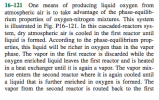 One means of producing liquid oxygen from atmospheric air is to
take advantage of the phase equilibrium properties of
oxygen-nitrogen mixtures. This system is illustrated in Fig.
P16–121. In this cascaded-reactors system, dry atmospheric air is
cooled in the first reactor until liquid is formed. According to
the phase-equilibrium properties, this liquid will be richer in
oxygen than in the vapor phase. The vapor in the first reactor is
discarded while the oxygen enriched liquid leaves the first reactor
and...
One means of producing liquid oxygen from atmospheric air is to
take advantage of the phase equilibrium properties of
oxygen-nitrogen mixtures. This system is illustrated in Fig.
P16–121. In this cascaded-reactors system, dry atmospheric air is
cooled in the first reactor until liquid is formed. According to
the phase-equilibrium properties, this liquid will be richer in
oxygen than in the vapor phase. The vapor in the first reactor is
discarded while the oxygen enriched liquid leaves the first reactor
and...
1. Consider the following irreversible, zero-order, liquid-phase reaction: A ➝ B. The reaction is strongly exothermic,...
1. Consider the following irreversible, zero-order, liquid-phase reaction: A ➝ B. The reaction is strongly exothermic, or ∆???? ? ≪ 0. For a given conversion XA, would an adiabatic CSTR and an adiabatic PFR require the same volume? If not, which reactor requires less volume? Justify your answer physically.
You are given the rate equation −rA" = -kA" CA for the liquid-phase reaction A--->B. Inlet...
You are given the rate equation −rA" = -kA" CA for the liquid-phase reaction A--->B. Inlet flow rates are 100 mol/s of pure A, which has a density of 1000 kg/m3 and a molar mass 1000 g/mol. The rate constant is 1x10⁻⁶m/s. You are told the reactor has a catalyst of surface area Sg of 5 m2/g, and the catalyst density in the reactor is 25 kg/m3. a. To achieve 50% conversion in an isothermal steady-state CSTR, what is the volume required?...
The rate of a certain reaction is given by the following rate law: rate = k...
The rate of a certain reaction is given by the following rate law: rate = k [NO]2[O2] Use this information to answer the questions below 1. What is the reaction order in NO? ________ 2. What is the reaction order in O2? __________ 3. What is overall reaction rate? __________- 4. At a certain concentration of NO and O2, the initial rate of reaction is 9.0 x 10⁵M / s. What would the initial rate of the reaction be if...
 5. The gas "A" is absorbed into a completely stationary liquid phase where the reaction A → B occurs, characterized by the first order rate constant, k1. Let the gas-liquid interface correspond to z = 0, where the solubility of A is known. The liquid extends in the positive z-direction. The rate of reaction is much greater than the rate of diffusion, thus it can be assumed that CA O as z becomes large. Assume one dimensional diffusion. AB a....
 Question 2. (20 marks) The following liquid-phase consecutive reaction is taking place in a constant volume batch reactor A_ky »B_k >C Derive expressions for the concentrations of A, B and C as functions of time given that the first reaction is first order and the second reaction is zeroth order.
 R1 - LIQUID PHASE CHEMICAL REACTOR The elementary liquid phase reaction given below is carried out in a CSTR by isothermal operation. k > NaOAC + EtOH k = 3.59 L/mol.min NaOH + EtOAC (A) (B) (C) (D) The volume of the CSTR is 2 L and the flowrates of the feeds in the individual streams are 50 ml/min for both reactants. The concentrations of NaOH and EtoAc are 0.05 mol/L and 0.1 mol/L, respectively. [6] a) Calculate the conversion...
 Given the initial rate data for the reaction A+BC, determine the rate expression for the reaction. [A], M [B].M Initial rate, M/S 0.10 0.20 5.00 10.20 0.20 10.0 0.10 0.15 2.81 O rate=250[A][B] rate - 5.0[A][B] rate=250[A)? rate - 50.0[A] rate= 1250[A][B] The first-order reaction A --> B+C has a half-life of 3.00 minutes. The rate equation for this reaction is rate = 1.50 min-1[A] rate = 1.05 min [A] O rate = 4.34 min [A] rate = 0.405 min...
 One means of producing liquid oxygen from atmospheric air is to
take advantage of the phase equilibrium properties of
oxygen-nitrogen mixtures. This system is illustrated in Fig.
P16–121. In this cascaded-reactors system, dry atmospheric air is
cooled in the first reactor until liquid is formed. According to
the phase-equilibrium properties, this liquid will be richer in
oxygen than in the vapor phase. The vapor in the first reactor is
discarded while the oxygen enriched liquid leaves the first reactor
and...
One means of producing liquid oxygen from atmospheric air is to
take advantage of the phase equilibrium properties of
oxygen-nitrogen mixtures. This system is illustrated in Fig.
P16–121. In this cascaded-reactors system, dry atmospheric air is
cooled in the first reactor until liquid is formed. According to
the phase-equilibrium properties, this liquid will be richer in
oxygen than in the vapor phase. The vapor in the first reactor is
discarded while the oxygen enriched liquid leaves the first reactor
and...
Most questions answered within 3 hours.
-
Where is the error in this code sequence?
String s1 = "Hello";
String s2 = "ello";...
asked 10 months ago -
Financial data for Joel de Paris, Inc., for last year
follow:
Joel de Paris, Inc.
Balance...
asked 10 months ago -
Consider this reaction:
Al2(SO4)3 (aq)+ BaCl3
(aq) Al2Cl6 (aq)- +
3BaSO4(s) . What is the...
asked 10 months ago -
Suppose that Savneet is considering increasing her
recent random sample from 20 car rentals to 40...
asked 10 months ago -
Trucks arrive at an unloading terminal at an average rate of 120
per hour.
Trucks arrive...
asked 10 months ago -
Why are methanol and ethanol completely soluble in water while
octanol is not very little soluble....
asked 10 months ago -
A facilities manager at a university reads in a research report
that the mean amount of...
asked 10 months ago -
When the CuSO4 is rehydrated by adding water to the anhydrous
compound, is this an endothermic...
asked 10 months ago -
A ray of sunlight is passing from diamond into crown glass; the
angle of incidence is...
asked 10 months ago -
A block of mass 0.249 kg is placed on top of a light, vertical
spring of...
asked 10 months ago -
how do the kidneys compensate in the presences of acidosis
a) trigger hyperventilate
b) reserve acid...
asked 10 months ago -
Question 501 pts
The rental rate of capital to the firm increases. Which of the
following...
asked 10 months ago