
Homework Answers
Add Answer to:
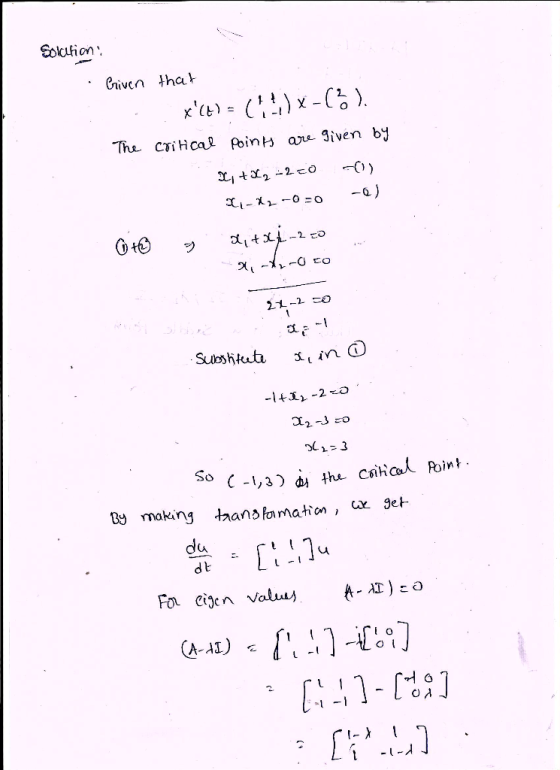
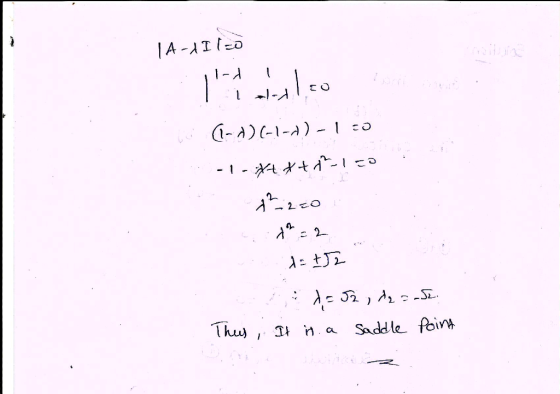
5. Consider the nonhomogeneous system X'(t) ( X cal point Xo and then classify its type...
Consider the following nonhomogeneous system for 2-dimensional vector X(t), t 2 0. 0 x(0)1 2 -1 where A- 5 -2 (a) Use t...
 Consider the following nonhomogeneous system for 2-dimensional vector X(t), t 2 0. 0 x(0)1 2 -1 where A- 5 -2 (a) Use the Laplace transform to compute eAt. (b) Using eAt of (a), find the solution of the above nonhomogeneous system
Consider the following nonhomogeneous system for 2-dimensional vector X(t), t 2 0. 0 x(0)1 2 -1 where A- 5 -2 (a) Use the Laplace transform to compute eAt. (b) Using eAt of (a), find the solution of the above...
Consider the following nonhomogeneous system for 2-dimensional vector X(t), t 2 0. 0 x(0)1 2 -1 where A- 5 -2 (a) Use the Laplace transform to compute eAt. (b) Using eAt of (a), find the solution of the above nonhomogeneous system
Consider the following nonhomogeneous system for 2-dimensional vector X(t), t 2 0. 0 x(0)1 2 -1 where A- 5 -2 (a) Use the Laplace transform to compute eAt. (b) Using eAt of (a), find the solution of the above...
Consider the system of differential equations Classify the critical point (0,0) as to type and d...
Consider the system of differential equations Classify the critical point (0,0) as to type and determine whether it is stable, asymptotically stable, or unstable draw several (at least eight) trajectories in the xy-plane. 5 0 -5 5 0 -5
(1 point) Solve the nonhomogeneous heat problem u, = Uxx + 5 sin(5x), 0<x<1, u(0,t) =...
 (1 point) Solve the nonhomogeneous heat problem u, = Uxx + 5 sin(5x), 0<x<1, u(0,t) = 0, u1,t) = 0 u(x,0) = 4 sin(4x) u(x, t) = Steady State Solution lim 700 u(x, t) =
7. Find and classify the type and stability of the critical point for each system below...
 7. Find and classify the type and stability of the critical point for each system below x' =-2x1-3x2 + 8 xz'= 3x1 + 2x2-8 Where α is a real number.
Problem 1. Consider the nonhomogeneous heat equation for u(x,t) subject to the nonhomogeneous boundary conditions and the initial condition e solution u(z, t) by completing each of the following...
 Problem 1. Consider the nonhomogeneous heat equation for u(x,t) subject to the nonhomogeneous boundary conditions and the initial condition e solution u(z, t) by completing each of the following steps Find the equilibrium temperature distribution ue(a) (b) Denote v(, t)t) -)Derive the IBVP for the function vz,t). (c) Find v(x, t) (d) Find u(x,t)
Problem 1. Consider the nonhomogeneous heat equation for u(x,t) subject to the nonhomogeneous boundary conditions and the initial condition e solution u(z, t) by completing each...
Problem 1. Consider the nonhomogeneous heat equation for u(x,t) subject to the nonhomogeneous boundary conditions and the initial condition e solution u(z, t) by completing each of the following steps Find the equilibrium temperature distribution ue(a) (b) Denote v(, t)t) -)Derive the IBVP for the function vz,t). (c) Find v(x, t) (d) Find u(x,t)
Problem 1. Consider the nonhomogeneous heat equation for u(x,t) subject to the nonhomogeneous boundary conditions and the initial condition e solution u(z, t) by completing each...
Problem 1. Consider the nonhomogeneous heat equation for u(,) subject to the nonhomogeneous boundary conditions 14(0,t) 1, u(r,t)-0,t> and the initial condition the solution u(x, t) by complet...
 Problem 1. Consider the nonhomogeneous heat equation for u(,) subject to the nonhomogeneous boundary conditions 14(0,t) 1, u(r,t)-0,t> and the initial condition the solution u(x, t) by completing each of the following steps (a) Find the equilibrium temperature distribution u ( (b) Denote v, t)t) - u(). Derive the IBVP for the function vz,t). (c) Find v(x, t) (d) Find u(x, t)
Problem 1. Consider the nonhomogeneous heat equation for u(,) subject to the nonhomogeneous boundary conditions 14(0,t) 1, u(r,t)-0,t>...
Problem 1. Consider the nonhomogeneous heat equation for u(,) subject to the nonhomogeneous boundary conditions 14(0,t) 1, u(r,t)-0,t> and the initial condition the solution u(x, t) by completing each of the following steps (a) Find the equilibrium temperature distribution u ( (b) Denote v, t)t) - u(). Derive the IBVP for the function vz,t). (c) Find v(x, t) (d) Find u(x, t)
Problem 1. Consider the nonhomogeneous heat equation for u(,) subject to the nonhomogeneous boundary conditions 14(0,t) 1, u(r,t)-0,t>...
Consider an autonomous system , = (1 + c)x + cy where c is a real constant. (a) Calculate the trace T and the determina...
 Consider an autonomous system , = (1 + c)x + cy where c is a real constant. (a) Calculate the trace T and the determinant of the coefficient matrix c+1 c (b) For each following cases of c, classify the stability (stable or unstable) and the type (center, node, saddle, or spiral) of the critical point (0,0). Note that if a critical point is a center, it is stablhe. (4) c=흘 (2) c=-2 (1) c=-1 (3) c=-8
Consider an autonomous...
Consider an autonomous system , = (1 + c)x + cy where c is a real constant. (a) Calculate the trace T and the determinant of the coefficient matrix c+1 c (b) For each following cases of c, classify the stability (stable or unstable) and the type (center, node, saddle, or spiral) of the critical point (0,0). Note that if a critical point is a center, it is stablhe. (4) c=흘 (2) c=-2 (1) c=-1 (3) c=-8
Consider an autonomous...
(1 point) Solve the nonhomogeneous heat problem Ut = uzz + sin(4x), 0 < x <...
 (1 point) Solve the nonhomogeneous heat problem Ut = uzz + sin(4x), 0 < x < , u(0,t) = 0, u(1,t) = 0 u(x,0) = 5 sin(3x) u(x, t) = Steady State Solution lim700 u(x, t) =
Problem 1. Consider the nonhomogeneous heat equation for u,t) ut = uzz + sin(2x), 0<x<π, t>0 subject to the nonhomogeneous boundary conditions u(0, t) t > 0 u(n, t) = 0, 1, - and the...
 Problem 1. Consider the nonhomogeneous heat equation for u,t) ut = uzz + sin(2x), 0<x<π, t>0 subject to the nonhomogeneous boundary conditions u(0, t) t > 0 u(n, t) = 0, 1, - and the initial condition Lee) Find the solution u(z, t) by completing each of the following steps: (a) Find the equilibrium temperature distribution ue(x). (b) Denote v(x, t) u(a, t) - e(). Derive the IBVP for the function v(x,t). (c) Find v(x, t) (d) Find u(, t)...
Consider the 2-dimensional system of linear equations -2 X' = 2 Note that the coefficient matrix...
 Consider the 2-dimensional system of linear equations -2 X' = 2 Note that the coefficient matrix for this system contains a parameter a. (a) Determine the eigenvalues of the system in terms of a (b) The qualitative behavior of the solutions depends value ao where the qualitative behavior changes. Classify the equilibrium point of the system (by type and stability) when a < ao, when a = a), and when a > ao. on the value of a. Determine a...
 Consider the following nonhomogeneous system for 2-dimensional vector X(t), t 2 0. 0 x(0)1 2 -1 where A- 5 -2 (a) Use the Laplace transform to compute eAt. (b) Using eAt of (a), find the solution of the above nonhomogeneous system
Consider the following nonhomogeneous system for 2-dimensional vector X(t), t 2 0. 0 x(0)1 2 -1 where A- 5 -2 (a) Use the Laplace transform to compute eAt. (b) Using eAt of (a), find the solution of the above...
Consider the following nonhomogeneous system for 2-dimensional vector X(t), t 2 0. 0 x(0)1 2 -1 where A- 5 -2 (a) Use the Laplace transform to compute eAt. (b) Using eAt of (a), find the solution of the above nonhomogeneous system
Consider the following nonhomogeneous system for 2-dimensional vector X(t), t 2 0. 0 x(0)1 2 -1 where A- 5 -2 (a) Use the Laplace transform to compute eAt. (b) Using eAt of (a), find the solution of the above...
 (1 point) Solve the nonhomogeneous heat problem u, = Uxx + 5 sin(5x), 0<x<1, u(0,t) = 0, u1,t) = 0 u(x,0) = 4 sin(4x) u(x, t) = Steady State Solution lim 700 u(x, t) =
 7. Find and classify the type and stability of the critical point for each system below x' =-2x1-3x2 + 8 xz'= 3x1 + 2x2-8 Where α is a real number.
 Problem 1. Consider the nonhomogeneous heat equation for u(x,t) subject to the nonhomogeneous boundary conditions and the initial condition e solution u(z, t) by completing each of the following steps Find the equilibrium temperature distribution ue(a) (b) Denote v(, t)t) -)Derive the IBVP for the function vz,t). (c) Find v(x, t) (d) Find u(x,t)
Problem 1. Consider the nonhomogeneous heat equation for u(x,t) subject to the nonhomogeneous boundary conditions and the initial condition e solution u(z, t) by completing each...
Problem 1. Consider the nonhomogeneous heat equation for u(x,t) subject to the nonhomogeneous boundary conditions and the initial condition e solution u(z, t) by completing each of the following steps Find the equilibrium temperature distribution ue(a) (b) Denote v(, t)t) -)Derive the IBVP for the function vz,t). (c) Find v(x, t) (d) Find u(x,t)
Problem 1. Consider the nonhomogeneous heat equation for u(x,t) subject to the nonhomogeneous boundary conditions and the initial condition e solution u(z, t) by completing each...
 Problem 1. Consider the nonhomogeneous heat equation for u(,) subject to the nonhomogeneous boundary conditions 14(0,t) 1, u(r,t)-0,t> and the initial condition the solution u(x, t) by completing each of the following steps (a) Find the equilibrium temperature distribution u ( (b) Denote v, t)t) - u(). Derive the IBVP for the function vz,t). (c) Find v(x, t) (d) Find u(x, t)
Problem 1. Consider the nonhomogeneous heat equation for u(,) subject to the nonhomogeneous boundary conditions 14(0,t) 1, u(r,t)-0,t>...
Problem 1. Consider the nonhomogeneous heat equation for u(,) subject to the nonhomogeneous boundary conditions 14(0,t) 1, u(r,t)-0,t> and the initial condition the solution u(x, t) by completing each of the following steps (a) Find the equilibrium temperature distribution u ( (b) Denote v, t)t) - u(). Derive the IBVP for the function vz,t). (c) Find v(x, t) (d) Find u(x, t)
Problem 1. Consider the nonhomogeneous heat equation for u(,) subject to the nonhomogeneous boundary conditions 14(0,t) 1, u(r,t)-0,t>...
 Consider an autonomous system , = (1 + c)x + cy where c is a real constant. (a) Calculate the trace T and the determinant of the coefficient matrix c+1 c (b) For each following cases of c, classify the stability (stable or unstable) and the type (center, node, saddle, or spiral) of the critical point (0,0). Note that if a critical point is a center, it is stablhe. (4) c=흘 (2) c=-2 (1) c=-1 (3) c=-8
Consider an autonomous...
Consider an autonomous system , = (1 + c)x + cy where c is a real constant. (a) Calculate the trace T and the determinant of the coefficient matrix c+1 c (b) For each following cases of c, classify the stability (stable or unstable) and the type (center, node, saddle, or spiral) of the critical point (0,0). Note that if a critical point is a center, it is stablhe. (4) c=흘 (2) c=-2 (1) c=-1 (3) c=-8
Consider an autonomous...
 (1 point) Solve the nonhomogeneous heat problem Ut = uzz + sin(4x), 0 < x < , u(0,t) = 0, u(1,t) = 0 u(x,0) = 5 sin(3x) u(x, t) = Steady State Solution lim700 u(x, t) =
 Problem 1. Consider the nonhomogeneous heat equation for u,t) ut = uzz + sin(2x), 0<x<π, t>0 subject to the nonhomogeneous boundary conditions u(0, t) t > 0 u(n, t) = 0, 1, - and the initial condition Lee) Find the solution u(z, t) by completing each of the following steps: (a) Find the equilibrium temperature distribution ue(x). (b) Denote v(x, t) u(a, t) - e(). Derive the IBVP for the function v(x,t). (c) Find v(x, t) (d) Find u(, t)...
 Consider the 2-dimensional system of linear equations -2 X' = 2 Note that the coefficient matrix for this system contains a parameter a. (a) Determine the eigenvalues of the system in terms of a (b) The qualitative behavior of the solutions depends value ao where the qualitative behavior changes. Classify the equilibrium point of the system (by type and stability) when a < ao, when a = a), and when a > ao. on the value of a. Determine a...
Most questions answered within 3 hours.
-
Where is the error in this code sequence?
String s1 = "Hello";
String s2 = "ello";...
asked 11 months ago -
Financial data for Joel de Paris, Inc., for last year
follow:
Joel de Paris, Inc.
Balance...
asked 11 months ago -
Consider this reaction:
Al2(SO4)3 (aq)+ BaCl3
(aq) Al2Cl6 (aq)- +
3BaSO4(s) . What is the...
asked 11 months ago -
Suppose that Savneet is considering increasing her
recent random sample from 20 car rentals to 40...
asked 11 months ago -
Trucks arrive at an unloading terminal at an average rate of 120
per hour.
Trucks arrive...
asked 11 months ago -
Why are methanol and ethanol completely soluble in water while
octanol is not very little soluble....
asked 11 months ago -
A facilities manager at a university reads in a research report
that the mean amount of...
asked 11 months ago -
When the CuSO4 is rehydrated by adding water to the anhydrous
compound, is this an endothermic...
asked 11 months ago -
A ray of sunlight is passing from diamond into crown glass; the
angle of incidence is...
asked 11 months ago -
A block of mass 0.249 kg is placed on top of a light, vertical
spring of...
asked 11 months ago -
how do the kidneys compensate in the presences of acidosis
a) trigger hyperventilate
b) reserve acid...
asked 11 months ago -
Question 501 pts
The rental rate of capital to the firm increases. Which of the
following...
asked 11 months ago