We’re going to titrate formic acid with the strong base, NaOH. There is initially 100. mL...
We’re going to titrate formic acid with the strong base, NaOH. There is initially 100. mL of 0.50 M formic acid and the concentration of NaOH is 1.0 M.
What is the initial pH of the formic acid solution?
2) What is the percent ionization under initial conditions?
3) After the addition of 10 mL of NaOH, what is the pH?
4) After the addition of 25 mL of NaOH, what is the pH? Think about where in the titration this brings you.
5) What volume of NaOH is required to reach the equivalence point?
6) What is the pH at the equivalence point?
7) What is the pOH at the equivalence point?
8) If, instead of NaOH being added, 0.05 moles of HCl is added by bubbling the gas through the solution. Assume that the volume has not changed. What is the percent dissociation of formic acid?
Could somone please help me and show your work please. Thank you so much
Homework Answers
You need to analize the reaction of formic acid at equilibrium:

An construct a ICE table:
 |
 |
 |
|
| Initial | 0.5 M | ||
| Change | -X | +X | +X |
| Equilibrium | 1-X | X | X |
Using the mass action equation:
![Ka=\frac{[For^-][H^+]}{[HFor]}](http://img.homeworklib.com/questions/826968c0-3c22-11eb-b025-d559621e2e80.png?x-oss-process=image/resize,w_560)
Ka for formic acid is 10-3.77
Using the concentrations at equilibrium :
 <----this
yields a second degree equation:
<----this
yields a second degree equation:

 <----
you can solve this using the quadratic formula:
<----
you can solve this using the quadratic formula:
 <----concentration
of H+
<----concentration
of H+
![[H^+]=0.0129M](http://img.homeworklib.com/questions/85e77520-3c22-11eb-984d-119ad26fa4f0.png?x-oss-process=image/resize,w_560)
![pH=-log[H^+]=-log(9.13\times10^{-3})=2.04](http://img.homeworklib.com/questions/86969b00-3c22-11eb-983a-85102f591743.png?x-oss-process=image/resize,w_560)
and also the concentration for formate is 9.13x10⁻³M
The percentage of dissociation is:
![100\times\frac{[For^-]}{[HFor]_o}\frac{formate\;at\;equilibrium}{initial\;concentration}](http://img.homeworklib.com/questions/88587af0-3c22-11eb-ac56-755e48e07ee1.png?x-oss-process=image/resize,w_560)

3)
After adding 10mL of NaOH:
You will be adding 0.01L*1mol/L=0.01mol of OH

Since initially you the acid is dissociated less than 2 % you can assume the whole initial concentration is HFor, thus the initial moles of HFor are:
0.100L*0.5mol/L=0.05mol HFor
after adding the OH the acid remaing is:

and the moles of base formed are:

Using the henderson hasselbach equation:

 <----this
is from the definition of pKa
<----this
is from the definition of pKa

4)
after addign 25mL of NaOH
at this point the moles of OH added are:
0.025*1M=0.025mol<-----this is half of the initilal moles of acid (0.5M*0.1L=0.05mol)
Hence you will have halaf the concentration of For- and half the concentration of HFor
at this point the pH is the pKa=3.77
you can prove it using the henderson hasselbach equation

5)
The volume required to reach the equilvalence point is:
Total moles of initial HFor=0.5*0.1=0.05mol
From the stoichiometry of the reaction above you need 0.05mol of NaOH to titrate the acid, thus:

6)
From the reaction
The equivalence point is where all the Hfor has been consumed and the pH is given by the base formed:
you need to analize the dissociation at equilibrium:

Using an ICE table:
|
 |
 |
 |
|
| Initial | 1 M | |||
| Change | -X | +X | +X | |
| Equilibrium | 1-X | X | X |
in this case you need to use the Kb:

and using the mass action equation:
![Kb=\frac{[HFor][OH^-]}{[For^-]}](http://img.homeworklib.com/questions/96813250-3c22-11eb-8913-078a7de7e7dc.png?x-oss-process=image/resize,w_560)
and the concentrations at equilibrium:
 ----->as
above you need to rearrange thi equation:
----->as
above you need to rearrange thi equation:


 <---
this is the concentration of OH:
<---
this is the concentration of OH:
![[OH^-]=5.43\times10^{-6}M](http://img.homeworklib.com/questions/990403a0-3c22-11eb-8fe3-779645da29a7.png?x-oss-process=image/resize,w_560)
![pOH=-log[OH^-]=-log(5.43\times10^{-6})=5.26](http://img.homeworklib.com/questions/9991c3d0-3c22-11eb-a7ec-e147e4c129ad.png?x-oss-process=image/resize,w_560)

7) pOH=5.26
8)
if you add 0.05mol of HCl, the concentration in the 100ml of H+ will be:
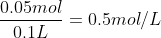
you can make another ICE table, but in this case the initial H concentration is 0.5
|
|
|
|
| Initial | 0.5 | 0.5 | |
| Change | -X | +X | +X |
| Equilibrium | 0.5-X | 0.5+X | X |
And the mass action equation with the concentrations at equilibrium:
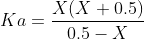


 <----ffrom
the ICE table this is the concentration of For-
<----ffrom
the ICE table this is the concentration of For-
![[H^+]=0.5+1.697\times10^{-4}\approx 0.5M](http://img.homeworklib.com/questions/9f2c1cd0-3c22-11eb-828a-4d5b1e0352e5.png?x-oss-process=image/resize,w_560)

The percentage of dissociation is:

Add Answer to:
We’re going to titrate formic acid with the strong base, NaOH.
There is initially 100. mL...
3. In the lab you are going to titrate a weak acid solution (25.00 mL of...
3. In the lab you are going to titrate a weak acid solution (25.00 mL of 0.100 M HCHO2, formic acid) with a strong base (0.100 M NaOH). Carry out the following calculations to determine the pH for four key points throughout the titration. Part a. Calculate the volume of 0.100 M NaOH required to reach the equivalence point for the titration. Ans. 25.00 mL Part b. Calculate the initial pH of 0.100 M HCHO2 (before adding any NaOH). Ans....
24A) 40mL of 0.2 M formic acid is titrated with a strong base (NaOH= 0.5 M). Determine the pH before any base has been...
 24A) 40mL of 0.2 M formic acid is titrated with a strong base
(NaOH= 0.5 M). Determine the pH before any base has been added.
Please show steps and please explain why the answer is what it
is.
24B) The 40mL 0.2 M formic acid is titrated with a 6.0mL of
strong base. Here NaOH can be treated as a conjugate base and
formic acid is the acid.
please show steps and explain!
Us (24-25, Acid/base, aqueous equilibrium) 24A) (4...
24A) 40mL of 0.2 M formic acid is titrated with a strong base
(NaOH= 0.5 M). Determine the pH before any base has been added.
Please show steps and please explain why the answer is what it
is.
24B) The 40mL 0.2 M formic acid is titrated with a 6.0mL of
strong base. Here NaOH can be treated as a conjugate base and
formic acid is the acid.
please show steps and explain!
Us (24-25, Acid/base, aqueous equilibrium) 24A) (4...
You titrate 50.0 mL of 0.400 M HClO4 (a strong acid) with 0.400 M NaOH. a....
You titrate 50.0 mL of 0.400 M HClO4 (a strong acid) with 0.400 M NaOH. a. Write the balanced equation. b. What is the pH at the beginning of the titration (0.0 mL of NaOH)? c. What is the pH after adding 30.0 mL of NaOH? d. At the equivalence point, is the pH greater than, less than, or equal to 7.00? Explain briefly.
Acid-Base Titration: A 0.15 M solution of NaOH is used to titrate 200.0 mL of 0.15...
Acid-Base Titration: A 0.15 M solution of NaOH is used to titrate 200.0 mL of 0.15 M HCN. What is the pH at the equivalence point? Ka = 4.9 x 10⁻¹⁰. Please include steps/work so I can see and understand how this problem is solved.
In a titration of 50.00 mL of .7497 M formic acid 071 M KOH was used...
In a titration of 50.00 mL of .7497 M formic acid 071 M KOH was used to reach equivalence. What is the equivalence volume? What is the initial pH of the formic acid? What is the pH of the solution after adding?
Determine the pH during the titration of 67.4 mL of 0.475 M formic acid (Ka =...
Determine the pH during the titration of 67.4 mL of 0.475 M formic acid (Ka = 1.8×10-4) by 0.475 M NaOH at the following points. (a) Before the addition of any NaOH (b) After the addition of 16.0 mL of NaOH (c) At the half-equivalence point (the titration midpoint) (d) At the equivalence point (e) After the addition of 101 mL of NaOH
If you titrate 25 mL of 0.15 M formic acid (HCOOH, Ka = 1.8x10⁻⁴) with 0.060...
If you titrate 25 mL of 0.15 M formic acid (HCOOH, Ka = 1.8x10⁻⁴) with 0.060 M NaOH, what would be the pH after addition of 15 mL of NaOH solution?
Acid-base titrations. You have 60.0 mL of a weak base (0.0305 M) and titrate it with...
Acid-base titrations. You have 60.0 mL of a weak base (0.0305 M) and titrate it with a strong acid (0.0500M). pKa of the weak conjugate acid is 4.36. a) What is the pH before the acid is added? b) What volume of the acid is needed at the equivalence point (in mL)? c) What is the pH at the equivalence point? d) What is the pH after 5.00 mL of the acid is added beyond the equivalence point?
A 0.10 M NaOH solution is used to titrate a 0.295 g sample of an unknown...
A 0.10 M NaOH solution is used to titrate a 0.295 g sample of an unknown acid that was dissolved in 40. mL of water at 25.0°C. The volume required to bring the solution to the equivalence point was 40. mL. (a) Calculate the molecular weight of the acid. (b) After 30. mL of the 0.10 M NaOH has been added during the titration, the pH of the solution was determined to be 5.37. Calculate the Ka of the unknown...
a) . Calculate the pH of a titration of 100 mL 1.5M HCOOH with 1.25M NaOH...
a) . Calculate the pH of a titration of 100 mL 1.5M HCOOH with 1.25M NaOH at equivalence. WHY is the pH what it is (if it’s 7, why is the solution neutral? If not 7, why?) b) . If it takes 50 mL of 2.5M NaOH to titrate 60 mL HF to equivalence, what is the concentration of the HF? c) What is true at the half-equivalence point of a titration of acid with base in terms of moles...
 24A) 40mL of 0.2 M formic acid is titrated with a strong base
(NaOH= 0.5 M). Determine the pH before any base has been added.
Please show steps and please explain why the answer is what it
is.
24B) The 40mL 0.2 M formic acid is titrated with a 6.0mL of
strong base. Here NaOH can be treated as a conjugate base and
formic acid is the acid.
please show steps and explain!
Us (24-25, Acid/base, aqueous equilibrium) 24A) (4...
24A) 40mL of 0.2 M formic acid is titrated with a strong base
(NaOH= 0.5 M). Determine the pH before any base has been added.
Please show steps and please explain why the answer is what it
is.
24B) The 40mL 0.2 M formic acid is titrated with a 6.0mL of
strong base. Here NaOH can be treated as a conjugate base and
formic acid is the acid.
please show steps and explain!
Us (24-25, Acid/base, aqueous equilibrium) 24A) (4...
Most questions answered within 3 hours.
-
Where is the error in this code sequence?
String s1 = "Hello";
String s2 = "ello";...
asked 10 months ago -
Financial data for Joel de Paris, Inc., for last year
follow:
Joel de Paris, Inc.
Balance...
asked 10 months ago -
Consider this reaction:
Al2(SO4)3 (aq)+ BaCl3
(aq) Al2Cl6 (aq)- +
3BaSO4(s) . What is the...
asked 10 months ago -
Suppose that Savneet is considering increasing her
recent random sample from 20 car rentals to 40...
asked 10 months ago -
Trucks arrive at an unloading terminal at an average rate of 120
per hour.
Trucks arrive...
asked 10 months ago -
Why are methanol and ethanol completely soluble in water while
octanol is not very little soluble....
asked 10 months ago -
A facilities manager at a university reads in a research report
that the mean amount of...
asked 10 months ago -
When the CuSO4 is rehydrated by adding water to the anhydrous
compound, is this an endothermic...
asked 10 months ago -
A ray of sunlight is passing from diamond into crown glass; the
angle of incidence is...
asked 10 months ago -
A block of mass 0.249 kg is placed on top of a light, vertical
spring of...
asked 10 months ago -
how do the kidneys compensate in the presences of acidosis
a) trigger hyperventilate
b) reserve acid...
asked 10 months ago -
Question 501 pts
The rental rate of capital to the firm increases. Which of the
following...
asked 10 months ago