
Homework Answers
Add Answer to:
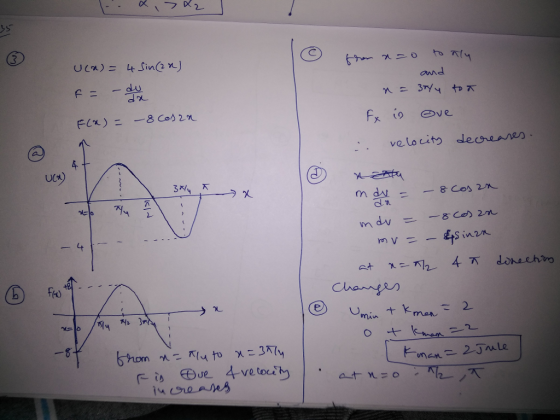
A particle moves and has a potential energy that can be described by the equation U(x)...
4. A particle of mass m 2 kg moves under the potential energy function U(x.y.z)- (kx...
 4. A particle of mass m 2 kg moves under the potential energy function U(x.y.z)- (kx + 2 k2y2 +3 k3z3) where k 1N. a. Suppose the particle has speed vo3 m/s when it passes through the origin. What will its speed be if and when it passes through the point (1,1.1)? b. Suppose the particle's speed vo at the origin is not known and that the point (1,1,1) is a turning point of the motion (a point where v0)....
The figure below shows a plot of potential energy U versus position x of a 1.04...
 The figure below shows a plot of potential energy U
versus position x of a 1.04 kg particle that can travel
only along an x axis. (Nonconservative forces are not
involved.) In the graphs, the potential energies are
U1 = 15 J, U2 = 30 J, and
U3 = 40 J.
The figure below shows a plot of potential energy U versus position x of a 1.04 kg particle that can travel only along an x axis. (Nonconservative forces are...
The figure below shows a plot of potential energy U
versus position x of a 1.04 kg particle that can travel
only along an x axis. (Nonconservative forces are not
involved.) In the graphs, the potential energies are
U1 = 15 J, U2 = 30 J, and
U3 = 40 J.
The figure below shows a plot of potential energy U versus position x of a 1.04 kg particle that can travel only along an x axis. (Nonconservative forces are...
A particle of mass m moves in one dimension. Its potential energy is given by U(x)...
 A particle of mass m moves in one dimension. Its potential energy is given by U(x) = -Voe-22/22 where U, and a are constants. (a) Draw an energy diagram showing the potential energy U(). Choose some value for the total mechanical energy E such that -U, < E < 0. Mark the kinetic energy, the potential energy and the total energy for the particle at some point of your choosing. (b) Find the force on the particle as a function...
A particle is introduced to a region with a potential described by U(x)--2x2 +x*+1 Joules. 3. a. ...
 A particle is introduced to a region with a potential described by U(x)--2x2 +x*+1 Joules. 3. a. (2 pts) In software, plot the potential U) Set your axis ranges: -2 SxS2 and 0s b. (5 pts) Find the equilibrium positions and determine whether they are stable or c. (8 pts) Describe the motion of the particle for total energy values E-О.0.05. 1.0, 2.0 unstable. Explain how you arrived at your answers. (all in Joules). What I am looking for here...
24&25 please The figure below shows the potential energy function U (r)for a particle moving along...
 24&25 please
The figure below shows the potential energy function U (r)for a particle moving along an axis labeled by the coordinate r. Values for energy and distance are in joules (j) millimeters (mm), respectively. The total energy of this particle is E = -4 J. Initially, the particle is at r = 1 mm and moving to the right (direction of increasing r) Which of the following statements best describes the subsequent motion of this particle? a. The particle...
24&25 please
The figure below shows the potential energy function U (r)for a particle moving along an axis labeled by the coordinate r. Values for energy and distance are in joules (j) millimeters (mm), respectively. The total energy of this particle is E = -4 J. Initially, the particle is at r = 1 mm and moving to the right (direction of increasing r) Which of the following statements best describes the subsequent motion of this particle? a. The particle...
The figure shows a plot of potential energy U versus position x of a 0.280 kg particle that can t...
 The figure shows a plot of potential energy U versus
position x of a 0.280 kg particle that can travel only
along an x axis under the influence of a conservative
force. The graph has these values: UA
= 9.00 J, UC = 20.0 J and
UD = 24.0 J. The particle is released
at the point where U forms a “potential hill” of “height”
UB = 12.0 J, with kinetic energy 5.00
J. What is the speed of the...
The figure shows a plot of potential energy U versus
position x of a 0.280 kg particle that can travel only
along an x axis under the influence of a conservative
force. The graph has these values: UA
= 9.00 J, UC = 20.0 J and
UD = 24.0 J. The particle is released
at the point where U forms a “potential hill” of “height”
UB = 12.0 J, with kinetic energy 5.00
J. What is the speed of the...
this is one question with many parts, thanks for the help! D. Imagine a negatively charged...
 this is one question with many parts, thanks for the
help!
D. Imagine a negatively charged particle (9--0.2 C) free to move back and forth along a straight line. There are other nearby charged particles that create electric potential and electric field at all points on the line. The system is made up of the negatively charged particle and the other particles that created the potential and field. As usual, we will assume an isolated system, so that this system's...
this is one question with many parts, thanks for the
help!
D. Imagine a negatively charged particle (9--0.2 C) free to move back and forth along a straight line. There are other nearby charged particles that create electric potential and electric field at all points on the line. The system is made up of the negatively charged particle and the other particles that created the potential and field. As usual, we will assume an isolated system, so that this system's...
A 1kg particle is in a region where the potential energy can be represented by the...
A 1kg particle is in a region where the potential energy can be represented by the function U(x) = x 2 − 5, where using x in meters will give you U in J. The particle is released from rest at x = 2.0m. (a)In which direction does it move? Why? (b)What is its velocity when it has moved 2m? (c)Where does the particle first come to rest after you release it? (d)Describe the long-term motion of the particle.
Question 2: A particle of mass m moves in a potential energy U(x) that is zero...
 Question 2: A particle of mass m moves in a potential energy U(x) that is zero forェ* 0 and is-oo at r-0. This is am attractive delta function, very odd. Do not worry about the physical meaning of the potential, just roll with it for now. The system is described by the wave function Afor <0 where a is a real, positive constant with dimensions of 1/Length, and A is the normalization constant, treat it as a unknown complex-number for...
A particle is moving to the right with initial kinetic energy To, subject to a force...
 A particle is moving to the right with initial kinetic energy To, subject to a force F(z)k function U(x) for this force ; (b) the kinetic energy and (c) the total energy of the particle as a function of its position; (d) find the turning points of the motion and the condition the total energy of the particle must satisfy if its motion is to exhibit turning points. (e) Sketch the potential, kinetic and total energy function (you can use...
 4. A particle of mass m 2 kg moves under the potential energy function U(x.y.z)- (kx + 2 k2y2 +3 k3z3) where k 1N. a. Suppose the particle has speed vo3 m/s when it passes through the origin. What will its speed be if and when it passes through the point (1,1.1)? b. Suppose the particle's speed vo at the origin is not known and that the point (1,1,1) is a turning point of the motion (a point where v0)....
 The figure below shows a plot of potential energy U
versus position x of a 1.04 kg particle that can travel
only along an x axis. (Nonconservative forces are not
involved.) In the graphs, the potential energies are
U1 = 15 J, U2 = 30 J, and
U3 = 40 J.
The figure below shows a plot of potential energy U versus position x of a 1.04 kg particle that can travel only along an x axis. (Nonconservative forces are...
The figure below shows a plot of potential energy U
versus position x of a 1.04 kg particle that can travel
only along an x axis. (Nonconservative forces are not
involved.) In the graphs, the potential energies are
U1 = 15 J, U2 = 30 J, and
U3 = 40 J.
The figure below shows a plot of potential energy U versus position x of a 1.04 kg particle that can travel only along an x axis. (Nonconservative forces are...
 A particle of mass m moves in one dimension. Its potential energy is given by U(x) = -Voe-22/22 where U, and a are constants. (a) Draw an energy diagram showing the potential energy U(). Choose some value for the total mechanical energy E such that -U, < E < 0. Mark the kinetic energy, the potential energy and the total energy for the particle at some point of your choosing. (b) Find the force on the particle as a function...
 A particle is introduced to a region with a potential described by U(x)--2x2 +x*+1 Joules. 3. a. (2 pts) In software, plot the potential U) Set your axis ranges: -2 SxS2 and 0s b. (5 pts) Find the equilibrium positions and determine whether they are stable or c. (8 pts) Describe the motion of the particle for total energy values E-О.0.05. 1.0, 2.0 unstable. Explain how you arrived at your answers. (all in Joules). What I am looking for here...
 24&25 please
The figure below shows the potential energy function U (r)for a particle moving along an axis labeled by the coordinate r. Values for energy and distance are in joules (j) millimeters (mm), respectively. The total energy of this particle is E = -4 J. Initially, the particle is at r = 1 mm and moving to the right (direction of increasing r) Which of the following statements best describes the subsequent motion of this particle? a. The particle...
24&25 please
The figure below shows the potential energy function U (r)for a particle moving along an axis labeled by the coordinate r. Values for energy and distance are in joules (j) millimeters (mm), respectively. The total energy of this particle is E = -4 J. Initially, the particle is at r = 1 mm and moving to the right (direction of increasing r) Which of the following statements best describes the subsequent motion of this particle? a. The particle...
 The figure shows a plot of potential energy U versus
position x of a 0.280 kg particle that can travel only
along an x axis under the influence of a conservative
force. The graph has these values: UA
= 9.00 J, UC = 20.0 J and
UD = 24.0 J. The particle is released
at the point where U forms a “potential hill” of “height”
UB = 12.0 J, with kinetic energy 5.00
J. What is the speed of the...
The figure shows a plot of potential energy U versus
position x of a 0.280 kg particle that can travel only
along an x axis under the influence of a conservative
force. The graph has these values: UA
= 9.00 J, UC = 20.0 J and
UD = 24.0 J. The particle is released
at the point where U forms a “potential hill” of “height”
UB = 12.0 J, with kinetic energy 5.00
J. What is the speed of the...
 this is one question with many parts, thanks for the
help!
D. Imagine a negatively charged particle (9--0.2 C) free to move back and forth along a straight line. There are other nearby charged particles that create electric potential and electric field at all points on the line. The system is made up of the negatively charged particle and the other particles that created the potential and field. As usual, we will assume an isolated system, so that this system's...
this is one question with many parts, thanks for the
help!
D. Imagine a negatively charged particle (9--0.2 C) free to move back and forth along a straight line. There are other nearby charged particles that create electric potential and electric field at all points on the line. The system is made up of the negatively charged particle and the other particles that created the potential and field. As usual, we will assume an isolated system, so that this system's...
 Question 2: A particle of mass m moves in a potential energy U(x) that is zero forェ* 0 and is-oo at r-0. This is am attractive delta function, very odd. Do not worry about the physical meaning of the potential, just roll with it for now. The system is described by the wave function Afor <0 where a is a real, positive constant with dimensions of 1/Length, and A is the normalization constant, treat it as a unknown complex-number for...
 A particle is moving to the right with initial kinetic energy To, subject to a force F(z)k function U(x) for this force ; (b) the kinetic energy and (c) the total energy of the particle as a function of its position; (d) find the turning points of the motion and the condition the total energy of the particle must satisfy if its motion is to exhibit turning points. (e) Sketch the potential, kinetic and total energy function (you can use...
Most questions answered within 3 hours.
-
Where is the error in this code sequence?
String s1 = "Hello";
String s2 = "ello";...
asked 11 months ago -
Financial data for Joel de Paris, Inc., for last year
follow:
Joel de Paris, Inc.
Balance...
asked 11 months ago -
Consider this reaction:
Al2(SO4)3 (aq)+ BaCl3
(aq) Al2Cl6 (aq)- +
3BaSO4(s) . What is the...
asked 11 months ago -
Suppose that Savneet is considering increasing her
recent random sample from 20 car rentals to 40...
asked 11 months ago -
Trucks arrive at an unloading terminal at an average rate of 120
per hour.
Trucks arrive...
asked 11 months ago -
Why are methanol and ethanol completely soluble in water while
octanol is not very little soluble....
asked 11 months ago -
A facilities manager at a university reads in a research report
that the mean amount of...
asked 11 months ago -
When the CuSO4 is rehydrated by adding water to the anhydrous
compound, is this an endothermic...
asked 11 months ago -
A ray of sunlight is passing from diamond into crown glass; the
angle of incidence is...
asked 11 months ago -
A block of mass 0.249 kg is placed on top of a light, vertical
spring of...
asked 11 months ago -
how do the kidneys compensate in the presences of acidosis
a) trigger hyperventilate
b) reserve acid...
asked 11 months ago -
Question 501 pts
The rental rate of capital to the firm increases. Which of the
following...
asked 11 months ago