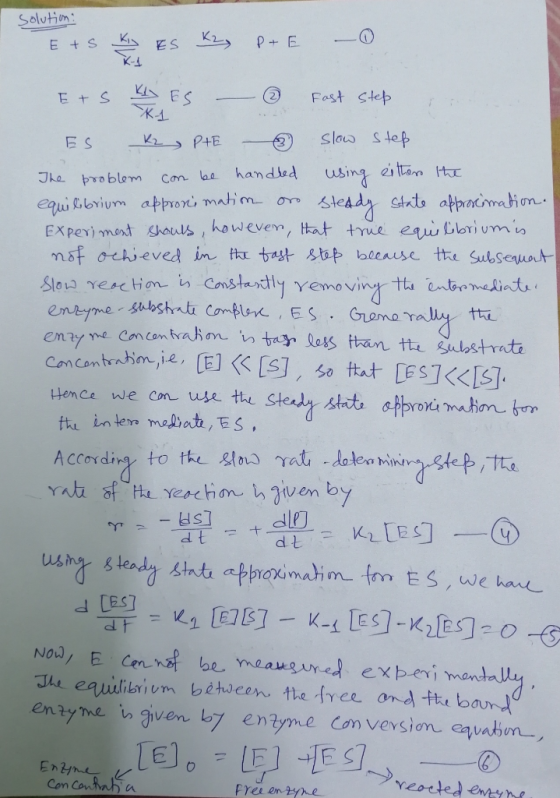
For substrate inhibition, one can write the following equations. Derive the Michaelis-Menten equation using the simplified...
For substrate inhibition, one can write the following equations. Derive the Michaelis-Menten equation using the simplified protocol described in the lab.
E + S ↔ ES-->E + P
ES + S-->ES2
Homework Answers

Add Answer to:
For substrate inhibition, one can write the following equations.
Derive the Michaelis-Menten equation using the simplified...
4. Basic concepts of Michaelis-Menten kinetics. The Michaelis-Menten equation is expression of the relationship between the...
 4. Basic concepts of Michaelis-Menten kinetics. The Michaelis-Menten equation is expression of the relationship between the initial velocity, Vo, of an enzymatic reaction and substrate concentration, [S]. There are three conditions that are useful for simplifying the Michaelis-Menten equation: [S] <<Km; [S] = Km; [S] >> Km. Match each condition with the statement(s) that describe it. TV, Vmox[S] Vo =Vmax m . V Vo - Vmax [S] Km +[S] V. (um/min) max [S] (mm) (a) Doubling [S] will almost double...
The kinetics of enzyme catalyzed reactions can be described the Michaelis-Menten equation and the Eadie-Hofstee equatio...
The kinetics of enzyme catalyzed reactions can be described the Michaelis-Menten equation and the Eadie-Hofstee equation as shown below: V0 = (-Km) V0 / [S] + Vmax a). Please derive the Eadie-Hofstee equation starting from the Michaelis-Menten equation. b). The Vmax and Km of the enzyme catalyzed reaction can be derived from a plot of V0 versus V0/[S]. Please draw one of these plots and explain how do you use it to derive Vmax and Km. c). Please draw a...
Substrate inhibition . ESE2 E- ES ES k6 E + P Home work - using this...
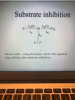 Substrate inhibition . ESE2 E- ES ES k6 E + P Home work - using this figure, derive the equation that will describe substrate inhibition.
The relation between Reaction Velocity and Substrate Concentration: Michaelis-Menten Equation a) At what substrate concentration would...
The relation between Reaction Velocity and Substrate Concentration: Michaelis-Menten Equation a) At what substrate concentration would an enzyme with a kcat of 30.0 s-1 and a Km of 0.0050 M operate at one-quarter of its maximum rate? b) Determine the fraction of Vmax that would be obtained at the following substrate concentrations: [S]=Km/2, [S]=2Km, [S]=10Km
Write the equations that describe the Michaelis-Menten and the Lineweaver-Burk double-reciprocal plots. Draw examples of each...
Write the equations that describe the Michaelis-Menten and the Lineweaver-Burk double-reciprocal plots. Draw examples of each plot, demonstrating how Km and Vmax can be determined. On the same graphs, draw another plot where the same enzyme-catalyzed reaction is subjected to inhibition by a competitive inhibitor.
Consider the following modification of the Michaelis Menten mechanism: E + S ES rightarrow E +...
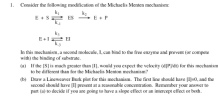 Consider the following modification of the Michaelis Menten mechanism: E + S ES rightarrow E + P E + I EI In this mechanism, a second molecule. I, can bind to the free enzyme and prevent (or compete with) the binding of substrate. If the [S] is much greater than [I], would you expect the velocity (d[P]/dt) for this mechanism to be different than for the Michaelis Menton mechanism? Draw- a Lineweaver Burk plot for this mechanism. The first line...
The Michaelis-Menten equation models the hyperbolic relationship between [S] and the initial reaction rate (V0) for...
 The Michaelis-Menten equation models the hyperbolic relationship
between [S] and the initial reaction rate (V0) for an enzyme
catalyzed, single substrate reaction: E S ES E P. The model can be
more readily understood when comparing three conditions: [S]Km.
Match each statement with the condition that it describes. Note:
\"Rate\" refers to initial velocity (V0) where steady state
conditions are assumed; [Etotal] refers to the total enzyme
concentration, and [Efree] refers to the concentration of free
enzyme.
categories: [S]<<Km, [S]=Km,...
The Michaelis-Menten equation models the hyperbolic relationship
between [S] and the initial reaction rate (V0) for an enzyme
catalyzed, single substrate reaction: E S ES E P. The model can be
more readily understood when comparing three conditions: [S]Km.
Match each statement with the condition that it describes. Note:
\"Rate\" refers to initial velocity (V0) where steady state
conditions are assumed; [Etotal] refers to the total enzyme
concentration, and [Efree] refers to the concentration of free
enzyme.
categories: [S]<<Km, [S]=Km,...
The Michaelis-Menten equation models the hyperbolic relationship between [S) and the initial reaction rate V, for a...
 The Michaelis-Menten equation models the hyperbolic relationship between [S) and the initial reaction rate V, for an enzyme-catalyzed, single-substrate reaction E+S ES E + P. The model can be more readily understood when comparing three conditions: [S] << Km, [S] = Km, and [S] >> K. Match each statement with the condition that it describes. Note that "rate" refers to initial velocity V where steady state conditions are assumed. (E l refers to the total enzyme concentration and [Erre refers...
The following is the process of deriving the Michaelis-Menten equation. What is a,b,c? [E] – [E]:-...
 The following is the process of deriving the Michaelis-Menten
equation. What is a,b,c?
[E] – [E]:- (ES) Now let (c), so that [s] =[s); With this assumption, and either of the previous two (E)=- [ES])[S] = Ky [ES] (Kx + [S])[ES] - [E] [S] E+S ES E + P Vi k[ES] Two alternative assumptions: (1) (a) k[E][S] = k., [ES] (2) (b) kj [E][S] = (k.1 + k) [ES] Under assumption (1), V. - K LEIS Under assumption (2), V....
The following is the process of deriving the Michaelis-Menten
equation. What is a,b,c?
[E] – [E]:- (ES) Now let (c), so that [s] =[s); With this assumption, and either of the previous two (E)=- [ES])[S] = Ky [ES] (Kx + [S])[ES] - [E] [S] E+S ES E + P Vi k[ES] Two alternative assumptions: (1) (a) k[E][S] = k., [ES] (2) (b) kj [E][S] = (k.1 + k) [ES] Under assumption (1), V. - K LEIS Under assumption (2), V....
1. Show, using the Michaelis-Menten equation, that when [S] >>> Km, vo = Vmax. Show, using...
1. Show, using the Michaelis-Menten equation, that when [S] >>> Km, vo = Vmax. Show, using the M-M equation that when [S] <<<Km, vo =[S][Et]kcat/Km. 2. What is Vmax? Provide both a mathematical and written description of Vmax? How can Vmax be experimentally altered? How can we use Vmax to determine the turnover number (kcat) of an enzyme-catalyzed reaction? What is the major challenge of determining Vmax from an Michaelis-Menten plot?
 4. Basic concepts of Michaelis-Menten kinetics. The Michaelis-Menten equation is expression of the relationship between the initial velocity, Vo, of an enzymatic reaction and substrate concentration, [S]. There are three conditions that are useful for simplifying the Michaelis-Menten equation: [S] <<Km; [S] = Km; [S] >> Km. Match each condition with the statement(s) that describe it. TV, Vmox[S] Vo =Vmax m . V Vo - Vmax [S] Km +[S] V. (um/min) max [S] (mm) (a) Doubling [S] will almost double...
 Substrate inhibition . ESE2 E- ES ES k6 E + P Home work - using this figure, derive the equation that will describe substrate inhibition.
 Consider the following modification of the Michaelis Menten mechanism: E + S ES rightarrow E + P E + I EI In this mechanism, a second molecule. I, can bind to the free enzyme and prevent (or compete with) the binding of substrate. If the [S] is much greater than [I], would you expect the velocity (d[P]/dt) for this mechanism to be different than for the Michaelis Menton mechanism? Draw- a Lineweaver Burk plot for this mechanism. The first line...
 The Michaelis-Menten equation models the hyperbolic relationship
between [S] and the initial reaction rate (V0) for an enzyme
catalyzed, single substrate reaction: E S ES E P. The model can be
more readily understood when comparing three conditions: [S]Km.
Match each statement with the condition that it describes. Note:
\"Rate\" refers to initial velocity (V0) where steady state
conditions are assumed; [Etotal] refers to the total enzyme
concentration, and [Efree] refers to the concentration of free
enzyme.
categories: [S]<<Km, [S]=Km,...
The Michaelis-Menten equation models the hyperbolic relationship
between [S] and the initial reaction rate (V0) for an enzyme
catalyzed, single substrate reaction: E S ES E P. The model can be
more readily understood when comparing three conditions: [S]Km.
Match each statement with the condition that it describes. Note:
\"Rate\" refers to initial velocity (V0) where steady state
conditions are assumed; [Etotal] refers to the total enzyme
concentration, and [Efree] refers to the concentration of free
enzyme.
categories: [S]<<Km, [S]=Km,...
 The Michaelis-Menten equation models the hyperbolic relationship between [S) and the initial reaction rate V, for an enzyme-catalyzed, single-substrate reaction E+S ES E + P. The model can be more readily understood when comparing three conditions: [S] << Km, [S] = Km, and [S] >> K. Match each statement with the condition that it describes. Note that "rate" refers to initial velocity V where steady state conditions are assumed. (E l refers to the total enzyme concentration and [Erre refers...
 The following is the process of deriving the Michaelis-Menten
equation. What is a,b,c?
[E] – [E]:- (ES) Now let (c), so that [s] =[s); With this assumption, and either of the previous two (E)=- [ES])[S] = Ky [ES] (Kx + [S])[ES] - [E] [S] E+S ES E + P Vi k[ES] Two alternative assumptions: (1) (a) k[E][S] = k., [ES] (2) (b) kj [E][S] = (k.1 + k) [ES] Under assumption (1), V. - K LEIS Under assumption (2), V....
The following is the process of deriving the Michaelis-Menten
equation. What is a,b,c?
[E] – [E]:- (ES) Now let (c), so that [s] =[s); With this assumption, and either of the previous two (E)=- [ES])[S] = Ky [ES] (Kx + [S])[ES] - [E] [S] E+S ES E + P Vi k[ES] Two alternative assumptions: (1) (a) k[E][S] = k., [ES] (2) (b) kj [E][S] = (k.1 + k) [ES] Under assumption (1), V. - K LEIS Under assumption (2), V....
Most questions answered within 3 hours.
-
Where is the error in this code sequence?
String s1 = "Hello";
String s2 = "ello";...
asked 10 months ago -
Financial data for Joel de Paris, Inc., for last year
follow:
Joel de Paris, Inc.
Balance...
asked 10 months ago -
Consider this reaction:
Al2(SO4)3 (aq)+ BaCl3
(aq) Al2Cl6 (aq)- +
3BaSO4(s) . What is the...
asked 10 months ago -
Suppose that Savneet is considering increasing her
recent random sample from 20 car rentals to 40...
asked 10 months ago -
Trucks arrive at an unloading terminal at an average rate of 120
per hour.
Trucks arrive...
asked 10 months ago -
Why are methanol and ethanol completely soluble in water while
octanol is not very little soluble....
asked 10 months ago -
A facilities manager at a university reads in a research report
that the mean amount of...
asked 10 months ago -
When the CuSO4 is rehydrated by adding water to the anhydrous
compound, is this an endothermic...
asked 10 months ago -
A ray of sunlight is passing from diamond into crown glass; the
angle of incidence is...
asked 10 months ago -
A block of mass 0.249 kg is placed on top of a light, vertical
spring of...
asked 10 months ago -
how do the kidneys compensate in the presences of acidosis
a) trigger hyperventilate
b) reserve acid...
asked 10 months ago -
Question 501 pts
The rental rate of capital to the firm increases. Which of the
following...
asked 10 months ago