

Homework Answers
Add Answer to:
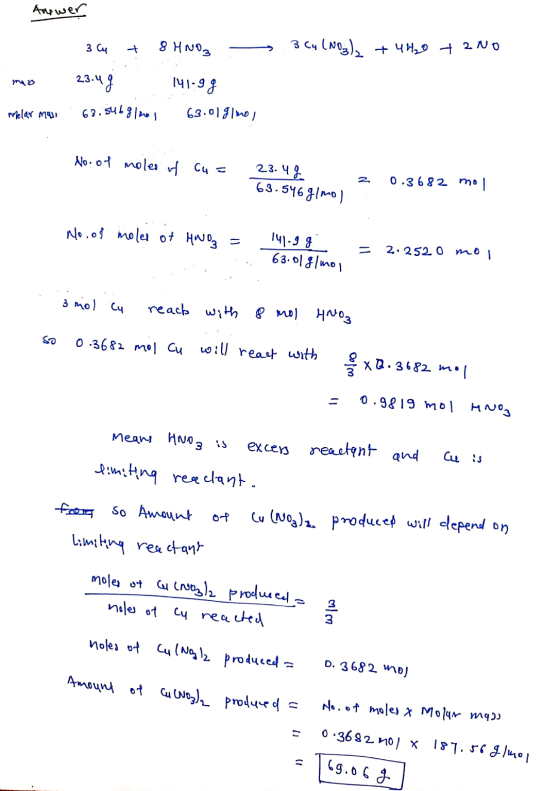
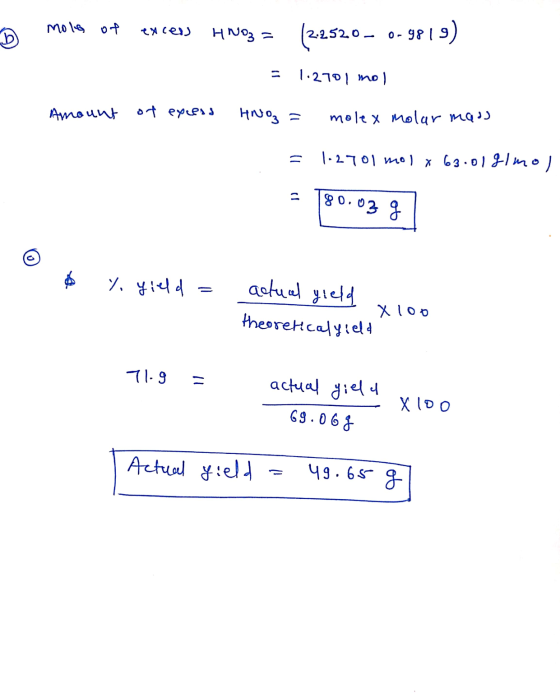
Question 3 In a laboratory experiment, 23.4 g of Cu were reacted with 141.9 g of...
1. When 15.4 g of aluminum (26.98 g/mol) reacts with 14.8 g of oxygen gas (32.00...
1. When 15.4 g of aluminum (26.98 g/mol) reacts with 14.8 g of oxygen gas (32.00 g/mol), what is the maximum mass (in grams) of aluminum oxide (101.96 g/mol) that can be produced? 4 Al(s) + 3 O2(g) → 2 Al2O3(s) 2. If 14.1 moles of Cu and 48.7 moles of HNO3 are allowed to react, how many moles of excess reactant will remain if the reaction goes to completion? Cu + 8 HNO3 → 3Cu(NO3)2 + 2NO + 4H2O...
Question 17 (4 points) ✓ Saved 50.0 g Cu are combined with 50.0 g of HNO3...
 Question 17 (4 points) ✓ Saved 50.0 g Cu are combined with 50.0 g of HNO3 according to the reaction: 3 Cu + 8 HNO3 +3 Cu(NO3)2 + 2 NO + 4H20. Which reagent is limiting (Blank #1) and how many grams of NO are produced (Blank #2)? Enter the number in the second blank with 3 significant figures and without units.
Name Extra Credit 1. Use the reaction equation below to answer a-f below. nomes mas su...
 Name Extra Credit 1. Use the reaction equation below to answer a-f below. nomes mas su Pezo, + AcO 2Fe + 3C02 MWilmassa. Balance the chemical reaction above. n=m:M b. If 3.00 moles of Iron(ul) oxide are used how many moles of CO were requirear 3 re,' M- 4790646 150.69 3 meie tronkio me 0.5 moles е со c. If 3.00 moles of Iron (1) oxide are used, how many moles of CO were required Question??? d. If 3.00 moles...
1.) An aqueous solution containing 5.66 g of lead(II) nitrate is added to an aqueous solution...
1.) An aqueous solution containing 5.66 g of lead(II) nitrate is added to an aqueous solution containing 6.30 g of potassium chloride. Enter the balanced chemical equation for this reaction. Be sure to include all physical states. balanced chemical equation What is the limiting reactant? The percent yield for the reaction is 79.2 % . How many grams of precipitate is recovered? precipitate recovered: How many grams of the excess reactant remain? excess reactant remaining: 2.) Chlorine gas can be...
The solid substance that is collected dried and weighed is Cu(s). 6) What is the mass...
 The solid substance that is collected dried and weighed is Cu(s). 6) What is the mass of Cu(s) collected? (Report in grams using all digits shown).(0.5 points) Cu 9 7) What is the theoretical yield of Cu(s)? (Report in grams using 4 significant figures) (2 points) 1.389 8) What is the percent yield of Cu(s)?(1.5 points) 9) What errors (list at least 2) could lead to less than 100% yield?(2 points) Think about the final weighing and transfer of product...
Question 10 Incorrect. The solubility of a gas in water is 0.010 g L1 at 25.0 °c with the partial...
 Question 10 Incorrect. The solubility of a gas in water is 0.010 g L1 at 25.0 °c with the partial pressure of the gas over the solution at 1.0 atm, predict the solubility of the gas at the same temperature but at quintuple the pressure 040 Use correct number of significant digits; the tolerance is +/-1 in the 2nd significant digit By accessing this Question Assistance, you will learn while you earn points based on the Point Potential Policy set...
What is the theoretical yield (in grams) of phosphorus pentachloride when 3.85 g of phosphorus reacts...
 What is the theoretical yield (in grams) of phosphorus
pentachloride when 3.85 g of phosphorus reacts with 25.8 g of
chlorine according to the following reaction:
P4 (s) + 10 Cl2 (g) → 4
PCl5 (l)
Use the correct number of significant figures, fill in the
number ONLY!
lan 4 15 What is the mass of excess reactant (in grams) that remains after the limiting reagent produces the maximum amount of phosphorus pentachloride possible upon the reaction of 4.69 g...
What is the theoretical yield (in grams) of phosphorus
pentachloride when 3.85 g of phosphorus reacts with 25.8 g of
chlorine according to the following reaction:
P4 (s) + 10 Cl2 (g) → 4
PCl5 (l)
Use the correct number of significant figures, fill in the
number ONLY!
lan 4 15 What is the mass of excess reactant (in grams) that remains after the limiting reagent produces the maximum amount of phosphorus pentachloride possible upon the reaction of 4.69 g...
Pre-Lab Assignment: 1. Describe the procedure for vacuum filtration. (3 pts) MUST SHOW ALL WORK TO...
 Pre-Lab Assignment: 1. Describe the procedure for vacuum filtration. (3 pts) MUST SHOW ALL WORK TO GET FULL CREDIT. USE SIGNIFICANT DIGITS. A student performed the following reaction using 2.50 mL of a 5.00 M aqueous solution of silver nitrate (AgNO3) and 1.80 mL of 3.00 M potassium chromate (K2CrO4) and obtained 1.567 g of silver chromate (Ag CrOs). Determine the limiting reactant. Calculate the theoretical yield and % yield of A&Cro. Use correct significant digits and show all work...
i need the answer for part 2 and 3! please PART II - Short answer questions...
 i need the answer for part 2 and 3! please
PART II - Short answer questions (50 points) Show all setup and work for all numerical "P and work for all numerical problems. Make sure that your final anwer has the correct sumber of significant figures. No acant figures. NO CREDIT for answers without CLEARLY shown setup and solution w many grams of 12 (253.8 g/mol) will be formed when 45.0 ml. of 0.350 M Cu(NO3)2 is reacted with excess...
i need the answer for part 2 and 3! please
PART II - Short answer questions (50 points) Show all setup and work for all numerical "P and work for all numerical problems. Make sure that your final anwer has the correct sumber of significant figures. No acant figures. NO CREDIT for answers without CLEARLY shown setup and solution w many grams of 12 (253.8 g/mol) will be formed when 45.0 ml. of 0.350 M Cu(NO3)2 is reacted with excess...
In this laboratory exploration various reactions of copper will illustrate these properties. First, begin with copper...
In this laboratory exploration various reactions of copper will illustrate these properties. First, begin with copper metal. When concentrated nitric acid is added, dramatic changes occur and the metal dissolves forming a brightly colored copper ion-containing solution. Cu(s) + 4HNO3(aq) à Cu(NO3)2(aq) + 2NO2(g) + 2H2O(l) _____________ equation Cu(s) + 4H+ + 4NO3-(aq) à Cu+2(aq) +2NO3-(aq)+ 2NO2(g) + 2H2O(l) _____________ equation Reaction type_______________ What advantage(s) is/are there to the second version of the reaction equation? However, if diluted...
 Question 17 (4 points) ✓ Saved 50.0 g Cu are combined with 50.0 g of HNO3 according to the reaction: 3 Cu + 8 HNO3 +3 Cu(NO3)2 + 2 NO + 4H20. Which reagent is limiting (Blank #1) and how many grams of NO are produced (Blank #2)? Enter the number in the second blank with 3 significant figures and without units.
 Name Extra Credit 1. Use the reaction equation below to answer a-f below. nomes mas su Pezo, + AcO 2Fe + 3C02 MWilmassa. Balance the chemical reaction above. n=m:M b. If 3.00 moles of Iron(ul) oxide are used how many moles of CO were requirear 3 re,' M- 4790646 150.69 3 meie tronkio me 0.5 moles е со c. If 3.00 moles of Iron (1) oxide are used, how many moles of CO were required Question??? d. If 3.00 moles...
 The solid substance that is collected dried and weighed is Cu(s). 6) What is the mass of Cu(s) collected? (Report in grams using all digits shown).(0.5 points) Cu 9 7) What is the theoretical yield of Cu(s)? (Report in grams using 4 significant figures) (2 points) 1.389 8) What is the percent yield of Cu(s)?(1.5 points) 9) What errors (list at least 2) could lead to less than 100% yield?(2 points) Think about the final weighing and transfer of product...
 Question 10 Incorrect. The solubility of a gas in water is 0.010 g L1 at 25.0 °c with the partial pressure of the gas over the solution at 1.0 atm, predict the solubility of the gas at the same temperature but at quintuple the pressure 040 Use correct number of significant digits; the tolerance is +/-1 in the 2nd significant digit By accessing this Question Assistance, you will learn while you earn points based on the Point Potential Policy set...
 What is the theoretical yield (in grams) of phosphorus
pentachloride when 3.85 g of phosphorus reacts with 25.8 g of
chlorine according to the following reaction:
P4 (s) + 10 Cl2 (g) → 4
PCl5 (l)
Use the correct number of significant figures, fill in the
number ONLY!
lan 4 15 What is the mass of excess reactant (in grams) that remains after the limiting reagent produces the maximum amount of phosphorus pentachloride possible upon the reaction of 4.69 g...
What is the theoretical yield (in grams) of phosphorus
pentachloride when 3.85 g of phosphorus reacts with 25.8 g of
chlorine according to the following reaction:
P4 (s) + 10 Cl2 (g) → 4
PCl5 (l)
Use the correct number of significant figures, fill in the
number ONLY!
lan 4 15 What is the mass of excess reactant (in grams) that remains after the limiting reagent produces the maximum amount of phosphorus pentachloride possible upon the reaction of 4.69 g...
 Pre-Lab Assignment: 1. Describe the procedure for vacuum filtration. (3 pts) MUST SHOW ALL WORK TO GET FULL CREDIT. USE SIGNIFICANT DIGITS. A student performed the following reaction using 2.50 mL of a 5.00 M aqueous solution of silver nitrate (AgNO3) and 1.80 mL of 3.00 M potassium chromate (K2CrO4) and obtained 1.567 g of silver chromate (Ag CrOs). Determine the limiting reactant. Calculate the theoretical yield and % yield of A&Cro. Use correct significant digits and show all work...
 i need the answer for part 2 and 3! please
PART II - Short answer questions (50 points) Show all setup and work for all numerical "P and work for all numerical problems. Make sure that your final anwer has the correct sumber of significant figures. No acant figures. NO CREDIT for answers without CLEARLY shown setup and solution w many grams of 12 (253.8 g/mol) will be formed when 45.0 ml. of 0.350 M Cu(NO3)2 is reacted with excess...
i need the answer for part 2 and 3! please
PART II - Short answer questions (50 points) Show all setup and work for all numerical "P and work for all numerical problems. Make sure that your final anwer has the correct sumber of significant figures. No acant figures. NO CREDIT for answers without CLEARLY shown setup and solution w many grams of 12 (253.8 g/mol) will be formed when 45.0 ml. of 0.350 M Cu(NO3)2 is reacted with excess...
Most questions answered within 3 hours.
-
Where is the error in this code sequence?
String s1 = "Hello";
String s2 = "ello";...
asked 10 months ago -
Financial data for Joel de Paris, Inc., for last year
follow:
Joel de Paris, Inc.
Balance...
asked 10 months ago -
Consider this reaction:
Al2(SO4)3 (aq)+ BaCl3
(aq) Al2Cl6 (aq)- +
3BaSO4(s) . What is the...
asked 10 months ago -
Suppose that Savneet is considering increasing her
recent random sample from 20 car rentals to 40...
asked 10 months ago -
Trucks arrive at an unloading terminal at an average rate of 120
per hour.
Trucks arrive...
asked 10 months ago -
Why are methanol and ethanol completely soluble in water while
octanol is not very little soluble....
asked 10 months ago -
A facilities manager at a university reads in a research report
that the mean amount of...
asked 10 months ago -
When the CuSO4 is rehydrated by adding water to the anhydrous
compound, is this an endothermic...
asked 10 months ago -
A ray of sunlight is passing from diamond into crown glass; the
angle of incidence is...
asked 10 months ago -
A block of mass 0.249 kg is placed on top of a light, vertical
spring of...
asked 10 months ago -
how do the kidneys compensate in the presences of acidosis
a) trigger hyperventilate
b) reserve acid...
asked 10 months ago -
Question 501 pts
The rental rate of capital to the firm increases. Which of the
following...
asked 10 months ago