
Homework Answers
Let us examine the equations of motion of a cylinder, of mass
and radius,
 rolling down a rough slope
there are three forces acting on the cylinder. Firstly, we have
the cylinder's weight,  which acts vertically downwards.
Secondly, we have the reaction,
which acts vertically downwards.
Secondly, we have the reaction,  of the slope, which acts normally
outwards from the surface of the slope. Finally, we have the
frictional force, which acts up the slope, parallel to its
surface.
of the slope, which acts normally
outwards from the surface of the slope. Finally, we have the
frictional force, which acts up the slope, parallel to its
surface.
Thus, applying the three forces, and, to the cylinder's center of
mass, and resolving in the direction normal to the surface of the
slope, we obtain
to the cylinder's center of
mass, and resolving in the direction normal to the surface of the
slope, we obtain
 |
Furthermore, Newton's second law applied to the motion of the center of mass parallel to the slope, yields
 |
where is the cylinder's translational
acceleration down the slope?
the cylinder's translational
acceleration down the slope?
examine the cylinder's rotational equation of motion. First, we
must evaluate the torques associated with the three forces acting
on the cylinder. Recall, that the torque associated with a given
force is the product of the magnitude of that force and the length
of the level arm--i.e., the perpendicular distance between
the line of action of the force and the axis of rotation. Now, by
definition, the weight of an extended object acts at its center of
mass. However, in this case, the axis of rotation passes through
the center of mass. Hence, the length of the lever arm associated
with the weight is zero. It follows that the
associated torque is also zero. It is clear, from Fig. 84, that the
line of action of the reaction force, passes through the center of mass
of the cylinder, which coincides with the axis of rotation. Thus,
the length of the lever arm associated with is zero, and so is the associated
torque. Finally, according to Fig. 84, the perpendicular distance
between the line of action of the friction force, and the axis of rotation is just
the radius of the cylinder, --so the associated torque
is. We conclude that the net torque
acting on the cylinder is simply
We conclude that the net torque
acting on the cylinder is simply
 |
It follows that the rotational equation of motion of the cylinder takes the form,
 |
where is its moment of inertia, and
is
its moment of inertia, and
is its rotational acceleration.
It follows from Eqs. (403) and (405) that
 |
 |
 |
|
 |
|
 |
Since the moment of inertia of the cylinder is actually
 , the above expressions simplify
to give
, the above expressions simplify
to give
 |
and
 |
Note that the acceleration of a uniform cylinder as it rolls down a slope, without slipping, is only two-thirds of the value obtainedwhen the cylinder slides down the same slope without friction. that, in the former case, the acceleration of the cylinder down the slope is retarded by friction. Note, however, that the frictional force merely acts to convert translational kinetic energy into rotational kinetic energy, and does not dissipate energy
Now, in order for the slope to exert the frictional force
specified in Eq. (410), without any slippage between the slope and
cylinder, this force must be less than the maximum allowable static
frictional force,  where
where  is the coefficient of static
friction. In other words, the condition for the cylinder to roll
down the slope without slipping is,
is the coefficient of static
friction. In other words, the condition for the cylinder to roll
down the slope without slipping is, or
or
 |
This condition is easily satisfied for gentle slopes, but may
well be violated for extremely steep slopes (depending on the size
of ). Of course, the above condition
is always violated for frictionless slopes, for which.
Suppose, finally, that we place two cylinders, side by side and
at rest, at the top of a frictional slope of inclination  . Let the two cylinders possess
the same mass, , and the same radius, . However, suppose that the first
cylinder is uniform, whereas the second is a hollow shell. Which
cylinder reaches the bottom of the slope first, assuming that they
are both released simultaneously, and both roll without slipping?
The acceleration of each cylinder down the slope is given by Eq.
(407). For the case of the solid cylinder, the moment of inertia is
, and so
. Let the two cylinders possess
the same mass, , and the same radius, . However, suppose that the first
cylinder is uniform, whereas the second is a hollow shell. Which
cylinder reaches the bottom of the slope first, assuming that they
are both released simultaneously, and both roll without slipping?
The acceleration of each cylinder down the slope is given by Eq.
(407). For the case of the solid cylinder, the moment of inertia is
, and so
 |
For the case of the hollow cylinder, the moment of inertia is
 (i.e., the same as that
of a ring with a similar mass, radius, and axis of rotation), and
so
(i.e., the same as that
of a ring with a similar mass, radius, and axis of rotation), and
so
 |
Add Answer to:
Problem 6: The angle θ is slowly increased from zero. Find the value of θ at...
Friction Situation 5 - The magnitude of the force shown in the figure is slowly increased...
 Friction
Situation 5 - The magnitude of the force shown in the figure is slowly increased from zero to P. The homogeneous box shown has a mass of 120 kg and the coefficient of static friction between the box feet and the floor is u. b 1.5 m, h 0.7 m. 14. If P 400 N and 0.3, find the maximum angle 0 (degrees) that will initiate slidin C. 45 D 48 AP-600 Nand'μ420.60 find the minimum angle θ (degrees)...
Friction
Situation 5 - The magnitude of the force shown in the figure is slowly increased from zero to P. The homogeneous box shown has a mass of 120 kg and the coefficient of static friction between the box feet and the floor is u. b 1.5 m, h 0.7 m. 14. If P 400 N and 0.3, find the maximum angle 0 (degrees) that will initiate slidin C. 45 D 48 AP-600 Nand'μ420.60 find the minimum angle θ (degrees)...
Find the value of the six trigonometric functions of θ
 Find the value of the six trigonometric functions of θ, where θ is the angle formed by the positive x-axis and the line segment from (0,0) to (-6, -1). Find the value of the six trigonometric functions of θ, where θ is the angle formed by the positive x-axis and the line segment from (0,0) to (-7,-4).
Please explain it. The angle θ is the angle of depression from E to T. This...
 Please explain it.
The angle θ is the angle of depression from E to T. This is the angle Al-Biruni measured as 0°34. (This is where you can see the picture is not to scale, as it would be a tiny angle.) The purpose of Al-Biruni's measurements was to find the radius and the circumference of the Earth Problem 1. Use the given information to: (a) Find the radius of the Earth in cubits. Round your final answer so that...
Please explain it.
The angle θ is the angle of depression from E to T. This is the angle Al-Biruni measured as 0°34. (This is where you can see the picture is not to scale, as it would be a tiny angle.) The purpose of Al-Biruni's measurements was to find the radius and the circumference of the Earth Problem 1. Use the given information to: (a) Find the radius of the Earth in cubits. Round your final answer so that...
Problem 7. (20 pts) A) Find all of the values of θ for which sin θ-1/4....
 Problem 7. (20 pts) A) Find all of the values of θ for which sin θ-1/4. B) Find all of the values of θ for which cos θ-1/4. C) Find all of the values of x for which sin(うー) = 1 /4 D) Find all of the values of z at which the function y -(l m) sinl 2m" -T/3 ) has the value y-^. 2π 2 7T
A box of mass m = 2.00 kg is positioned on a ramp at an angle...
A box of mass m = 2.00 kg is positioned on a ramp at an angle θ. The length of the ramp (minus the width of the base of the box) is d = 3.00 m. The surface of the ramp has a coefficient of static friction μs = 0.500 and a coefficient of kinetic friction μk = 0.350. The angle θ is slowly increased until the box starts to slide down the ramp. Calculate the angle θmax at which...
An adventurous archaeologist crosses between two rock cliffs by slowly going hand over hand along a...
An adventurous archaeologist crosses between two rock cliffs by slowly going hand over hand along a rope stretched between the cliffs. He stops to rest at the middle of the rope. (Figure 1) The rope will break if the tension in it exceeds 3.00×10⁴ N. Our hero’s mass is 70.0 kg. If the angle θ is 15.0 ∘, Part A find the tension in the rope. Part B What is the smallest value the angle θ can have if the...
An adventurous archaeologist crosses between two rock cliffs by slowly going hand over hand along a...
An adventurous archaeologist crosses between two rock cliffs by slowly going hand over hand along a rope stretched between the cliffs. He stops to rest at the middle of the rope (See the figure). The rope will break if the tension in it exceeds 2.50×10⁴ N . Our hero’s mass is 90.0 kg A.If the angle θ is 15.0 ∘, find the tension in the rope. Start with a free-body diagram of the archaeologist. B.What is the smallest value the...
An adventurous archaeologist crosses between two rock cliffs by slowly going hand over hand along a...
An adventurous archaeologist crosses between two rock cliffs by slowly going hand over hand along a rope stretched between the cliffs. He stops to rest at the middle of the rope (See the figure). The rope will break if the tension in it exceeds 3.50×10⁴ N . Our hero’s mass is 70.0 kg . A)If the angle θ is 12.0 ∘, find the tension in the rope. Start with a free-body diagram of the archaeologist. b)What is the smallest value...
If the angle θ=θ= 30 ∘∘ , determine the acceleration of the truck. The coefficient of...
 If the angle θ=θ= 30 ∘∘ , determine the acceleration of the
truck. The coefficient of kinetic friction between the pipe and the
ground is μk=0.20μk=0.20.
MasteringEngineering Masterir x + session.masteringengineering.com/myct/itemView?assignmentProblemlD=11226089 H MAE 242 Summer 2020 Hader 3 CME HW10 Problem 17.52 6 of 15 A Review The pipe has a mass of 870 kg and is being towed behind a truck (Figure 1) Part A If the angle A = 30°, determine the acceleration of the truck. The coefficient...
If the angle θ=θ= 30 ∘∘ , determine the acceleration of the
truck. The coefficient of kinetic friction between the pipe and the
ground is μk=0.20μk=0.20.
MasteringEngineering Masterir x + session.masteringengineering.com/myct/itemView?assignmentProblemlD=11226089 H MAE 242 Summer 2020 Hader 3 CME HW10 Problem 17.52 6 of 15 A Review The pipe has a mass of 870 kg and is being towed behind a truck (Figure 1) Part A If the angle A = 30°, determine the acceleration of the truck. The coefficient...
For fixed values of M (non-zero) and θ, is there a hanging mass value, m, that...
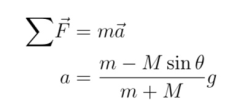 For fixed values of M (non-zero) and θ, is there a hanging mass
value, m, that would result in an acceleration equal to g? If so,
determine the value.
-This refers to a half atwood machine and the relating formula
is found below
F = mã m – M sin a= m +M 9
For fixed values of M (non-zero) and θ, is there a hanging mass
value, m, that would result in an acceleration equal to g? If so,
determine the value.
-This refers to a half atwood machine and the relating formula
is found below
F = mã m – M sin a= m +M 9
 Friction
Situation 5 - The magnitude of the force shown in the figure is slowly increased from zero to P. The homogeneous box shown has a mass of 120 kg and the coefficient of static friction between the box feet and the floor is u. b 1.5 m, h 0.7 m. 14. If P 400 N and 0.3, find the maximum angle 0 (degrees) that will initiate slidin C. 45 D 48 AP-600 Nand'μ420.60 find the minimum angle θ (degrees)...
Friction
Situation 5 - The magnitude of the force shown in the figure is slowly increased from zero to P. The homogeneous box shown has a mass of 120 kg and the coefficient of static friction between the box feet and the floor is u. b 1.5 m, h 0.7 m. 14. If P 400 N and 0.3, find the maximum angle 0 (degrees) that will initiate slidin C. 45 D 48 AP-600 Nand'μ420.60 find the minimum angle θ (degrees)...
 Please explain it.
The angle θ is the angle of depression from E to T. This is the angle Al-Biruni measured as 0°34. (This is where you can see the picture is not to scale, as it would be a tiny angle.) The purpose of Al-Biruni's measurements was to find the radius and the circumference of the Earth Problem 1. Use the given information to: (a) Find the radius of the Earth in cubits. Round your final answer so that...
Please explain it.
The angle θ is the angle of depression from E to T. This is the angle Al-Biruni measured as 0°34. (This is where you can see the picture is not to scale, as it would be a tiny angle.) The purpose of Al-Biruni's measurements was to find the radius and the circumference of the Earth Problem 1. Use the given information to: (a) Find the radius of the Earth in cubits. Round your final answer so that...
 Problem 7. (20 pts) A) Find all of the values of θ for which sin θ-1/4. B) Find all of the values of θ for which cos θ-1/4. C) Find all of the values of x for which sin(うー) = 1 /4 D) Find all of the values of z at which the function y -(l m) sinl 2m" -T/3 ) has the value y-^. 2π 2 7T
 If the angle θ=θ= 30 ∘∘ , determine the acceleration of the
truck. The coefficient of kinetic friction between the pipe and the
ground is μk=0.20μk=0.20.
MasteringEngineering Masterir x + session.masteringengineering.com/myct/itemView?assignmentProblemlD=11226089 H MAE 242 Summer 2020 Hader 3 CME HW10 Problem 17.52 6 of 15 A Review The pipe has a mass of 870 kg and is being towed behind a truck (Figure 1) Part A If the angle A = 30°, determine the acceleration of the truck. The coefficient...
If the angle θ=θ= 30 ∘∘ , determine the acceleration of the
truck. The coefficient of kinetic friction between the pipe and the
ground is μk=0.20μk=0.20.
MasteringEngineering Masterir x + session.masteringengineering.com/myct/itemView?assignmentProblemlD=11226089 H MAE 242 Summer 2020 Hader 3 CME HW10 Problem 17.52 6 of 15 A Review The pipe has a mass of 870 kg and is being towed behind a truck (Figure 1) Part A If the angle A = 30°, determine the acceleration of the truck. The coefficient...
 For fixed values of M (non-zero) and θ, is there a hanging mass
value, m, that would result in an acceleration equal to g? If so,
determine the value.
-This refers to a half atwood machine and the relating formula
is found below
F = mã m – M sin a= m +M 9
For fixed values of M (non-zero) and θ, is there a hanging mass
value, m, that would result in an acceleration equal to g? If so,
determine the value.
-This refers to a half atwood machine and the relating formula
is found below
F = mã m – M sin a= m +M 9
Most questions answered within 3 hours.
-
Where is the error in this code sequence?
String s1 = "Hello";
String s2 = "ello";...
asked 10 months ago -
Financial data for Joel de Paris, Inc., for last year
follow:
Joel de Paris, Inc.
Balance...
asked 10 months ago -
Consider this reaction:
Al2(SO4)3 (aq)+ BaCl3
(aq) Al2Cl6 (aq)- +
3BaSO4(s) . What is the...
asked 10 months ago -
Suppose that Savneet is considering increasing her
recent random sample from 20 car rentals to 40...
asked 10 months ago -
Trucks arrive at an unloading terminal at an average rate of 120
per hour.
Trucks arrive...
asked 10 months ago -
Why are methanol and ethanol completely soluble in water while
octanol is not very little soluble....
asked 10 months ago -
A facilities manager at a university reads in a research report
that the mean amount of...
asked 10 months ago -
When the CuSO4 is rehydrated by adding water to the anhydrous
compound, is this an endothermic...
asked 10 months ago -
A ray of sunlight is passing from diamond into crown glass; the
angle of incidence is...
asked 10 months ago -
A block of mass 0.249 kg is placed on top of a light, vertical
spring of...
asked 10 months ago -
how do the kidneys compensate in the presences of acidosis
a) trigger hyperventilate
b) reserve acid...
asked 10 months ago -
Question 501 pts
The rental rate of capital to the firm increases. Which of the
following...
asked 10 months ago