Homework Answers

3. Finding the following Derivatives. (1) f(x) = 3 +5 (2) f(x) = -4° -2x f(x)...
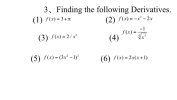 3. Finding the following Derivatives. (1) f(x) = 3 +5 (2) f(x) = -4° -2x f(x) = (3) f(x) = 27 x? (4) (5) f(x) = (3x2 - 1) (6) f(x) = 2x(x +1)
5. By using Fresnel method find f(x)where f(x) = 4 cos(2x) + 3 cos (2x + 2) + 2cos(2-2) 6 Coneide...
 5. By using Fresnel method find f(x)where f(x) = 4 cos(2x) + 3 cos (2x + 2) + 2cos(2-2) 6 Coneider 75 re crte choum in the iouro2 Thie crnte I
5. By using Fresnel method find f(x)where f(x) = 4 cos(2x) + 3 cos (2x + 2) + 2cos(2-2) 6 Coneider 75 re crte choum in the iouro2 Thie crnte I
5. By using Fresnel method find f(x)where f(x) = 4 cos(2x) + 3 cos (2x + 2) + 2cos(2-2) 6 Coneider 75 re crte choum in the iouro2 Thie crnte I
2x f(x) = ex+ f'(x) = (3x + 2) ex+3 B f'(x) = (x2 + 2x)...
 2x f(x) = ex+ f'(x) = (3x + 2) ex+3 B f'(x) = (x2 + 2x) e*+2x-1 С f'(x) = ex®+2x f'(x) = €3x+2
QUESTION 2 Given: f(x) = – 2x²+x-5 Find : f(-6)= Of(-6) = -83 f(-6) = 133...
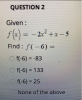 QUESTION 2 Given: f(x) = – 2x²+x-5 Find : f(-6)= Of(-6) = -83 f(-6) = 133 f(-6) = 25 None of the above
2. Find the derivative of f(x) = 5(723 – 2x + 1)-3. 3. Differentiate f(x) =...
 2. Find the derivative of f(x) = 5(723 – 2x + 1)-3. 3. Differentiate f(x) = (3.2 + 10 – sin x)". O e 99+ ASUS VivoBook
5) Given f(x) = a) (f•g)(2) g(x) = 2x - 4; find the following: c)(g°8X-2)
 5) Given f(x) = a) (f•g)(2) g(x) = 2x - 4; find the following: c)(g°8X-2)
2. For the function f(x)= (2x² – 3, x>2 19-2x, x<2 find the limits or explain...
 2. For the function f(x)= (2x² – 3, x>2 19-2x, x<2 find the limits or explain why they do not exist. (a) lim f(x) 1-2+ (b) lim f(x) (e) lim f(x) X2
part b 2. Let f(x) = x + 2x + x + 2x + 1 in...
 part b
2. Let f(x) = x + 2x + x + 2x + 1 in Zy[x]. (a) (12 points) Show that f(x) has no roots in Zs. (b) (8 points) If f(x) is not irreducible, what are the degrees of its irreducible factors? Explain. [Do not factor f (2)]
part b
2. Let f(x) = x + 2x + x + 2x + 1 in Zy[x]. (a) (12 points) Show that f(x) has no roots in Zs. (b) (8 points) If f(x) is not irreducible, what are the degrees of its irreducible factors? Explain. [Do not factor f (2)]
2. For f(x) = f(x) = $2x+5, Xs1 14 + 3x, x>1 a. Find f (1)...
 2. For f(x) = f(x) = $2x+5, Xs1 14 + 3x, x>1 a. Find f (1) b. Find lim f(x) X1 C. Is f(x) continuous? Why, or why not?
Use the rules to find the derivative f (x) = -3x e^x^5 + 2cos(2x^2 )
Use the rules to find the derivative f (x) = -3x e^x^5 + 2cos(2x^2 )
 3. Finding the following Derivatives. (1) f(x) = 3 +5 (2) f(x) = -4° -2x f(x) = (3) f(x) = 27 x? (4) (5) f(x) = (3x2 - 1) (6) f(x) = 2x(x +1)
 5. By using Fresnel method find f(x)where f(x) = 4 cos(2x) + 3 cos (2x + 2) + 2cos(2-2) 6 Coneider 75 re crte choum in the iouro2 Thie crnte I
5. By using Fresnel method find f(x)where f(x) = 4 cos(2x) + 3 cos (2x + 2) + 2cos(2-2) 6 Coneider 75 re crte choum in the iouro2 Thie crnte I
5. By using Fresnel method find f(x)where f(x) = 4 cos(2x) + 3 cos (2x + 2) + 2cos(2-2) 6 Coneider 75 re crte choum in the iouro2 Thie crnte I
 2x f(x) = ex+ f'(x) = (3x + 2) ex+3 B f'(x) = (x2 + 2x) e*+2x-1 С f'(x) = ex®+2x f'(x) = €3x+2
 QUESTION 2 Given: f(x) = – 2x²+x-5 Find : f(-6)= Of(-6) = -83 f(-6) = 133 f(-6) = 25 None of the above
 2. Find the derivative of f(x) = 5(723 – 2x + 1)-3. 3. Differentiate f(x) = (3.2 + 10 – sin x)". O e 99+ ASUS VivoBook
 5) Given f(x) = a) (f•g)(2) g(x) = 2x - 4; find the following: c)(g°8X-2)
 2. For the function f(x)= (2x² – 3, x>2 19-2x, x<2 find the limits or explain why they do not exist. (a) lim f(x) 1-2+ (b) lim f(x) (e) lim f(x) X2
 part b
2. Let f(x) = x + 2x + x + 2x + 1 in Zy[x]. (a) (12 points) Show that f(x) has no roots in Zs. (b) (8 points) If f(x) is not irreducible, what are the degrees of its irreducible factors? Explain. [Do not factor f (2)]
part b
2. Let f(x) = x + 2x + x + 2x + 1 in Zy[x]. (a) (12 points) Show that f(x) has no roots in Zs. (b) (8 points) If f(x) is not irreducible, what are the degrees of its irreducible factors? Explain. [Do not factor f (2)]
 2. For f(x) = f(x) = $2x+5, Xs1 14 + 3x, x>1 a. Find f (1) b. Find lim f(x) X1 C. Is f(x) continuous? Why, or why not?
Most questions answered within 3 hours.
-
Where is the error in this code sequence?
String s1 = "Hello";
String s2 = "ello";...
asked 11 months ago -
Financial data for Joel de Paris, Inc., for last year
follow:
Joel de Paris, Inc.
Balance...
asked 11 months ago -
Consider this reaction:
Al2(SO4)3 (aq)+ BaCl3
(aq) Al2Cl6 (aq)- +
3BaSO4(s) . What is the...
asked 11 months ago -
Suppose that Savneet is considering increasing her
recent random sample from 20 car rentals to 40...
asked 11 months ago -
Trucks arrive at an unloading terminal at an average rate of 120
per hour.
Trucks arrive...
asked 11 months ago -
Why are methanol and ethanol completely soluble in water while
octanol is not very little soluble....
asked 11 months ago -
A facilities manager at a university reads in a research report
that the mean amount of...
asked 11 months ago -
When the CuSO4 is rehydrated by adding water to the anhydrous
compound, is this an endothermic...
asked 11 months ago -
A ray of sunlight is passing from diamond into crown glass; the
angle of incidence is...
asked 11 months ago -
A block of mass 0.249 kg is placed on top of a light, vertical
spring of...
asked 11 months ago -
how do the kidneys compensate in the presences of acidosis
a) trigger hyperventilate
b) reserve acid...
asked 11 months ago -
Question 501 pts
The rental rate of capital to the firm increases. Which of the
following...
asked 11 months ago