How did they go from 1+(2/?(x+2)) to 2(4?(x+2))/(?(x+2)) ? in
the following step? 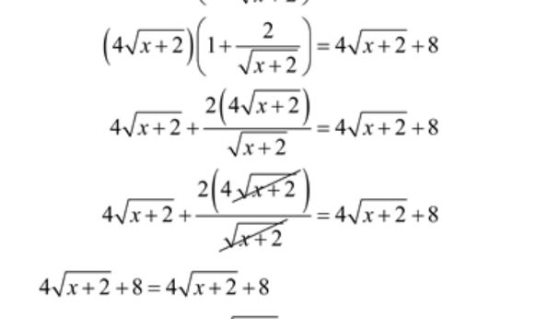
Thanks.
Homework Answers

Add Answer to:
How did they go from 1+(2/?(x+2)) to 2(4?(x+2))/(?(x+2)) ? in
the following step?
Thanks.
x+21 r+2...
how did they get this anser ? pls explain in simple terms step by step... thanks...
how did they get this anser ? pls explain in simple terms step by step... thanks 8.9x10^-8 = [x][x] / [0.200] 8.9x10^-8 = x^2 =1.3 x 10^-4=x
how did he go from step 1 to step 2 and 3 fesxCx- steps (x-2) -3) 12 l0 Step1 -fy X-3 X-2 X-1 2 x-15x +9 4 ) xCx- (x...
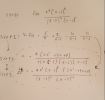 how did he go from step 1 to step 2 and 3
fesxCx- steps (x-2) -3) 12 l0 Step1 -fy X-3 X-2 X-1 2 x-15x +9 4 ) xCx- (x-L) x -3) 4 x (x-1 2x -15x+9) Step2 C tep 3 (x -2)x-3)'
fesxCx- steps (x-2) -3) 12 l0 Step1 -fy X-3 X-2 X-1 2 x-15x +9 4 ) xCx- (x-L) x -3) 4 x (x-1 2x -15x+9) Step2 C tep 3 (x -2)x-3)'
how did he go from step 1 to step 2 and 3
fesxCx- steps (x-2) -3) 12 l0 Step1 -fy X-3 X-2 X-1 2 x-15x +9 4 ) xCx- (x-L) x -3) 4 x (x-1 2x -15x+9) Step2 C tep 3 (x -2)x-3)'
fesxCx- steps (x-2) -3) 12 l0 Step1 -fy X-3 X-2 X-1 2 x-15x +9 4 ) xCx- (x-L) x -3) 4 x (x-1 2x -15x+9) Step2 C tep 3 (x -2)x-3)'
STATISTICAL MECHANICS. EXPLAIN HOW TO GO FROM STEP 4 TO STEP 5 AND THEN TO STEP...
 STATISTICAL MECHANICS. EXPLAIN HOW TO GO FROM STEP 4 TO
STEP 5 AND THEN TO STEP 6. DETAILS ARE REQUIRED. NOTE THAT THE
MICROSTATES ARE $\sigma$ : -1, 0, 1.
Thanks.
The energy of a system is:
We want to calculate:
So the following is done:
EXPLAIN HOW TO GO FROM STEP 4 TO STEP 5 AND THEN TO STEP
6. DETAILS ARE REQUIRED.
Ν Ν Ε(σ)Σσ+αΣσ i=1 i=1 σι Li=1 - αβ Σ Λ (σ1) σ1 exp β Ν...
STATISTICAL MECHANICS. EXPLAIN HOW TO GO FROM STEP 4 TO
STEP 5 AND THEN TO STEP 6. DETAILS ARE REQUIRED. NOTE THAT THE
MICROSTATES ARE $\sigma$ : -1, 0, 1.
Thanks.
The energy of a system is:
We want to calculate:
So the following is done:
EXPLAIN HOW TO GO FROM STEP 4 TO STEP 5 AND THEN TO STEP
6. DETAILS ARE REQUIRED.
Ν Ν Ε(σ)Σσ+αΣσ i=1 i=1 σι Li=1 - αβ Σ Λ (σ1) σ1 exp β Ν...
work step by step. Thanks الم 3. Let k : (0,1] x [0, 1] + R...
 work step by step. Thanks
الم 3. Let k : (0,1] x [0, 1] + R be a continuous function and let f be a Lebesgue integrable function on (0,1). (a) Show that for each y € (0,1), 2 + f(-x){}(2", y) is Lebesgue integrable on (0,1). (b) Define g : [0, 1] +R by 8(u) = Sam Slam)x(x, y)dır. 10,11 Prove that g is continuous at cach y € (0, 1].
work step by step. Thanks
الم 3. Let k : (0,1] x [0, 1] + R be a continuous function and let f be a Lebesgue integrable function on (0,1). (a) Show that for each y € (0,1), 2 + f(-x){}(2", y) is Lebesgue integrable on (0,1). (b) Define g : [0, 1] +R by 8(u) = Sam Slam)x(x, y)dır. 10,11 Prove that g is continuous at cach y € (0, 1].
4. The following algorithm step 1: 20 := r; j :=0 step 2: while x; #...
 4. The following algorithm step 1: 20 := r; j :=0 step 2: while x; # 0, do d; := remainder of integer divide x;/2 Xj+1 := quotient of integer divide x;/2 j:= + 1 end while can be used to convert a positive decimal integer x to its binary equivalent, x = (anan-1.0190)2. Implement the algorithm (write a computer program) and apply it to convert the following integers to their binary equivalents. (a) 56 (b) 1543 (The Matlab library...
Please Help. Where did I go wrong? Results for this submission Entered Answer Preview sqrt{{[4*sqrt{(x^2)+1}]/3)+75) 4.12...
 Please Help. Where did I go wrong?
Results for this submission Entered Answer Preview sqrt{{[4*sqrt{(x^2)+1}]/3)+75) 4.12 +1 +75 3 The answer above is NOT correct. (1 point) Solve the separable differential equation 4x – byvx2 +1 By/2 +1 = Subject to the initial condition: y(0) = 10. y= sqrt( (4* sqrt(x^2+1}}/3 + 75)
Please Help. Where did I go wrong?
Results for this submission Entered Answer Preview sqrt{{[4*sqrt{(x^2)+1}]/3)+75) 4.12 +1 +75 3 The answer above is NOT correct. (1 point) Solve the separable differential equation 4x – byvx2 +1 By/2 +1 = Subject to the initial condition: y(0) = 10. y= sqrt( (4* sqrt(x^2+1}}/3 + 75)
Step 2: x+2x+2 X+5x-1 (x+2)(x+2) (x+5)(x-1) x2+4 Step 3: Step 4: Part A: At which step...
 Step 2: x+2x+2 X+5x-1 (x+2)(x+2) (x+5)(x-1) x2+4 Step 3: Step 4: Part A: At which step did Nicolette make her first error? Part B: What was her first error? Part C: What is the correct product? Select one answer each for Part A, Part B, and Part C.
Please write legibly and write what you did in each step. Thanks 8. For the sequence {an) defined recursively by an 2-1 8. For the sequence {an) defined recursively by an 2-1
 Please write legibly and write what you did in each step.
Thanks
8. For the sequence {an) defined recursively by an 2-1
8. For the sequence {an) defined recursively by an 2-1
Please write legibly and write what you did in each step.
Thanks
8. For the sequence {an) defined recursively by an 2-1
8. For the sequence {an) defined recursively by an 2-1
Can someone help me with the circled ones. Don’t need to graph. Thanks! 2)hty-2) = (x-4)2...
 Can
someone help me with the circled ones. Don’t need to graph. Thanks!
2)hty-2) = (x-4)2 21)(x-8)2 45 3o,31 @).+3)2 ..하. _ 2) or -38 28. y=x2 + 4x + 1 ③)y = 3x2-24x + 50 mdde The focus and diręctrix of a parabola are given. Write an equation for each parabola. Then draw he graph. (3, 8), y = 4 15, 5), y =-3 33. (8, O), y 4 35. (6, 2), x-4 S)(3,-1), x =-2 , 39, (10,-3),...
Can
someone help me with the circled ones. Don’t need to graph. Thanks!
2)hty-2) = (x-4)2 21)(x-8)2 45 3o,31 @).+3)2 ..하. _ 2) or -38 28. y=x2 + 4x + 1 ③)y = 3x2-24x + 50 mdde The focus and diręctrix of a parabola are given. Write an equation for each parabola. Then draw he graph. (3, 8), y = 4 15, 5), y =-3 33. (8, O), y 4 35. (6, 2), x-4 S)(3,-1), x =-2 , 39, (10,-3),...
Need step by step solution each part thanks 8. All compositions are from right to left...
 Need step by step solution each part thanks
8. All compositions are from right to left (a) What is meant when a function f is said to be: surjective; injective; a bijection. When is a function invertible? [4 pt.] (b) Consider the function f : R ? R given by f(z) = (1-x)2 i. Write down the domain and range of f [1 pt.] ii. Show that the function is neither surjective nor injective. [2 pt.] iii. Now choose two...
Need step by step solution each part thanks
8. All compositions are from right to left (a) What is meant when a function f is said to be: surjective; injective; a bijection. When is a function invertible? [4 pt.] (b) Consider the function f : R ? R given by f(z) = (1-x)2 i. Write down the domain and range of f [1 pt.] ii. Show that the function is neither surjective nor injective. [2 pt.] iii. Now choose two...
 how did he go from step 1 to step 2 and 3
fesxCx- steps (x-2) -3) 12 l0 Step1 -fy X-3 X-2 X-1 2 x-15x +9 4 ) xCx- (x-L) x -3) 4 x (x-1 2x -15x+9) Step2 C tep 3 (x -2)x-3)'
fesxCx- steps (x-2) -3) 12 l0 Step1 -fy X-3 X-2 X-1 2 x-15x +9 4 ) xCx- (x-L) x -3) 4 x (x-1 2x -15x+9) Step2 C tep 3 (x -2)x-3)'
how did he go from step 1 to step 2 and 3
fesxCx- steps (x-2) -3) 12 l0 Step1 -fy X-3 X-2 X-1 2 x-15x +9 4 ) xCx- (x-L) x -3) 4 x (x-1 2x -15x+9) Step2 C tep 3 (x -2)x-3)'
fesxCx- steps (x-2) -3) 12 l0 Step1 -fy X-3 X-2 X-1 2 x-15x +9 4 ) xCx- (x-L) x -3) 4 x (x-1 2x -15x+9) Step2 C tep 3 (x -2)x-3)'
 STATISTICAL MECHANICS. EXPLAIN HOW TO GO FROM STEP 4 TO
STEP 5 AND THEN TO STEP 6. DETAILS ARE REQUIRED. NOTE THAT THE
MICROSTATES ARE $\sigma$ : -1, 0, 1.
Thanks.
The energy of a system is:
We want to calculate:
So the following is done:
EXPLAIN HOW TO GO FROM STEP 4 TO STEP 5 AND THEN TO STEP
6. DETAILS ARE REQUIRED.
Ν Ν Ε(σ)Σσ+αΣσ i=1 i=1 σι Li=1 - αβ Σ Λ (σ1) σ1 exp β Ν...
STATISTICAL MECHANICS. EXPLAIN HOW TO GO FROM STEP 4 TO
STEP 5 AND THEN TO STEP 6. DETAILS ARE REQUIRED. NOTE THAT THE
MICROSTATES ARE $\sigma$ : -1, 0, 1.
Thanks.
The energy of a system is:
We want to calculate:
So the following is done:
EXPLAIN HOW TO GO FROM STEP 4 TO STEP 5 AND THEN TO STEP
6. DETAILS ARE REQUIRED.
Ν Ν Ε(σ)Σσ+αΣσ i=1 i=1 σι Li=1 - αβ Σ Λ (σ1) σ1 exp β Ν...
 work step by step. Thanks
الم 3. Let k : (0,1] x [0, 1] + R be a continuous function and let f be a Lebesgue integrable function on (0,1). (a) Show that for each y € (0,1), 2 + f(-x){}(2", y) is Lebesgue integrable on (0,1). (b) Define g : [0, 1] +R by 8(u) = Sam Slam)x(x, y)dır. 10,11 Prove that g is continuous at cach y € (0, 1].
work step by step. Thanks
الم 3. Let k : (0,1] x [0, 1] + R be a continuous function and let f be a Lebesgue integrable function on (0,1). (a) Show that for each y € (0,1), 2 + f(-x){}(2", y) is Lebesgue integrable on (0,1). (b) Define g : [0, 1] +R by 8(u) = Sam Slam)x(x, y)dır. 10,11 Prove that g is continuous at cach y € (0, 1].
 4. The following algorithm step 1: 20 := r; j :=0 step 2: while x; # 0, do d; := remainder of integer divide x;/2 Xj+1 := quotient of integer divide x;/2 j:= + 1 end while can be used to convert a positive decimal integer x to its binary equivalent, x = (anan-1.0190)2. Implement the algorithm (write a computer program) and apply it to convert the following integers to their binary equivalents. (a) 56 (b) 1543 (The Matlab library...
 Please Help. Where did I go wrong?
Results for this submission Entered Answer Preview sqrt{{[4*sqrt{(x^2)+1}]/3)+75) 4.12 +1 +75 3 The answer above is NOT correct. (1 point) Solve the separable differential equation 4x – byvx2 +1 By/2 +1 = Subject to the initial condition: y(0) = 10. y= sqrt( (4* sqrt(x^2+1}}/3 + 75)
Please Help. Where did I go wrong?
Results for this submission Entered Answer Preview sqrt{{[4*sqrt{(x^2)+1}]/3)+75) 4.12 +1 +75 3 The answer above is NOT correct. (1 point) Solve the separable differential equation 4x – byvx2 +1 By/2 +1 = Subject to the initial condition: y(0) = 10. y= sqrt( (4* sqrt(x^2+1}}/3 + 75)
 Step 2: x+2x+2 X+5x-1 (x+2)(x+2) (x+5)(x-1) x2+4 Step 3: Step 4: Part A: At which step did Nicolette make her first error? Part B: What was her first error? Part C: What is the correct product? Select one answer each for Part A, Part B, and Part C.
 Please write legibly and write what you did in each step.
Thanks
8. For the sequence {an) defined recursively by an 2-1
8. For the sequence {an) defined recursively by an 2-1
Please write legibly and write what you did in each step.
Thanks
8. For the sequence {an) defined recursively by an 2-1
8. For the sequence {an) defined recursively by an 2-1
 Can
someone help me with the circled ones. Don’t need to graph. Thanks!
2)hty-2) = (x-4)2 21)(x-8)2 45 3o,31 @).+3)2 ..하. _ 2) or -38 28. y=x2 + 4x + 1 ③)y = 3x2-24x + 50 mdde The focus and diręctrix of a parabola are given. Write an equation for each parabola. Then draw he graph. (3, 8), y = 4 15, 5), y =-3 33. (8, O), y 4 35. (6, 2), x-4 S)(3,-1), x =-2 , 39, (10,-3),...
Can
someone help me with the circled ones. Don’t need to graph. Thanks!
2)hty-2) = (x-4)2 21)(x-8)2 45 3o,31 @).+3)2 ..하. _ 2) or -38 28. y=x2 + 4x + 1 ③)y = 3x2-24x + 50 mdde The focus and diręctrix of a parabola are given. Write an equation for each parabola. Then draw he graph. (3, 8), y = 4 15, 5), y =-3 33. (8, O), y 4 35. (6, 2), x-4 S)(3,-1), x =-2 , 39, (10,-3),...
 Need step by step solution each part thanks
8. All compositions are from right to left (a) What is meant when a function f is said to be: surjective; injective; a bijection. When is a function invertible? [4 pt.] (b) Consider the function f : R ? R given by f(z) = (1-x)2 i. Write down the domain and range of f [1 pt.] ii. Show that the function is neither surjective nor injective. [2 pt.] iii. Now choose two...
Need step by step solution each part thanks
8. All compositions are from right to left (a) What is meant when a function f is said to be: surjective; injective; a bijection. When is a function invertible? [4 pt.] (b) Consider the function f : R ? R given by f(z) = (1-x)2 i. Write down the domain and range of f [1 pt.] ii. Show that the function is neither surjective nor injective. [2 pt.] iii. Now choose two...
Most questions answered within 3 hours.
-
Where is the error in this code sequence?
String s1 = "Hello";
String s2 = "ello";...
asked 11 months ago -
Financial data for Joel de Paris, Inc., for last year
follow:
Joel de Paris, Inc.
Balance...
asked 11 months ago -
Consider this reaction:
Al2(SO4)3 (aq)+ BaCl3
(aq) Al2Cl6 (aq)- +
3BaSO4(s) . What is the...
asked 11 months ago -
Suppose that Savneet is considering increasing her
recent random sample from 20 car rentals to 40...
asked 11 months ago -
Trucks arrive at an unloading terminal at an average rate of 120
per hour.
Trucks arrive...
asked 11 months ago -
Why are methanol and ethanol completely soluble in water while
octanol is not very little soluble....
asked 11 months ago -
A facilities manager at a university reads in a research report
that the mean amount of...
asked 11 months ago -
When the CuSO4 is rehydrated by adding water to the anhydrous
compound, is this an endothermic...
asked 11 months ago -
A ray of sunlight is passing from diamond into crown glass; the
angle of incidence is...
asked 11 months ago -
A block of mass 0.249 kg is placed on top of a light, vertical
spring of...
asked 11 months ago -
how do the kidneys compensate in the presences of acidosis
a) trigger hyperventilate
b) reserve acid...
asked 11 months ago -
Question 501 pts
The rental rate of capital to the firm increases. Which of the
following...
asked 11 months ago