
Homework Answers
Add Answer to:
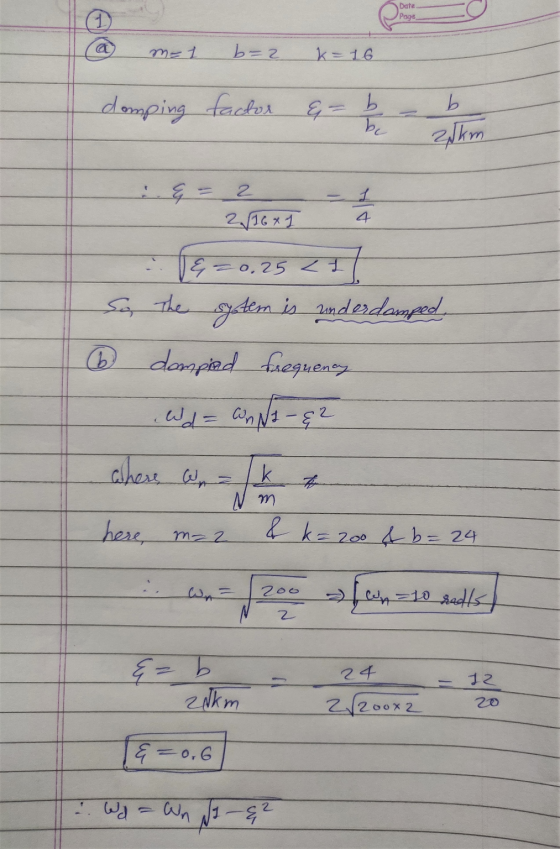
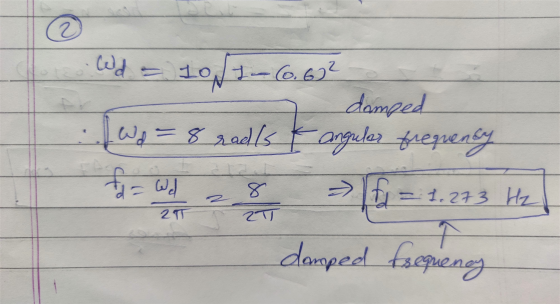
please answer both parts
Problem 3) (21 pt) Consider a system represented by the following second...
Problem 2: For the following general form of a second order measurement system (Eq. 1), classify...
 Problem 2: For the following general form of a second order measurement system (Eq. 1), classify the system as underdamped, critically damped or over damped for each of the sets of coefficients given in parts (a) - (d). Also determine the natural frequency (n), the damping ratio (0 and if possible, the ringing frequency (od). (b) k 25, c 44, m- 3 (c) k 125, c 235, m 1100 (d) k 18, c 24, m 8
Y(s) 4 3. Consider a second order system_ and undamped natural frequency. Is the system underdamped,...
 Y(s) 4 3. Consider a second order system_ and undamped natural frequency. Is the system underdamped, overdamped or critically damped? [5pts] What are the damping ratio U(s) s2+3s +4
Problem : Consider the systems A and B whose roots are shown below BI 1. Regarding stability, the systems are a) b) c) d) Both stable Both unstable A is unstable and B is stable A is stable and B is...
 Problem : Consider the systems A and B whose roots are shown below BI 1. Regarding stability, the systems are a) b) c) d) Both stable Both unstable A is unstable and B is stable A is stable and B is unstable 2. The responses of the systems to step input are characterized as follows: a) Both are underdamped b) Both are overdamped c) A is underdamped and B is overdamped d) A is overdamped and B is underdamped 3....
QUESTION 3 .1 List the two parameters of the second order system that helps to analyse...
 QUESTION 3 .1 List the two parameters of the second order system that helps to analyse the system perlormance 3.2 Parameters of a transfer function for a second order system are used to categorise the transfer function. Use the following transfer functions to categorise whether the system is underdamped, critically-damped or overdamped: a) G(s) 25/s+10st25 b) G(s) 36S-10s+36 c) G(s) 16/S+10s+16
1. The change of position of the center of mass of a rigid body in a mechanical system is being monitored. At time t 0, when the initial conditions of the system were x = 0.1 m and x -0m/s, a ste...
 1. The change of position of the center of mass of a rigid body in a mechanical system is being monitored. At time t 0, when the initial conditions of the system were x = 0.1 m and x -0m/s, a step input of size 10 N began to apply to the system. The response of the system was represented by this differential equation: 2r + 110x + 500 x = 10 a) Write the order of the system, its...
Problem 5. (20 pts) Let ER be a positive real number and consider the damped system...
 Problem 5. (20 pts) Let ER be a positive real number and consider the damped system modeled by the following second-order differential equation: y"(t) + yy' (t) + 25y(t) = 0, (a) Show that the long-term behaviour of all solutions is independent of y. (b) For which values of ye R+ does the above differential equation have oscillating solutions ? (i.e. solutions with infinitely many zeroes.) (c) Classify the above damped system into underdamped, critically damped and overdamped in terms...
Problem 5: Consider the circuit shown in the figure below in which the initial inductor current...
 Problem 5: Consider the circuit shown in the figure below in which the initial inductor current and capacitor voltage are both zero. (a) Write the differential equation for vc(t). (b) Find the particular solution. (c) Is this circuit overdamped, critically damped, or underdamped? 4 0 i(t) vc()
Consider a mass-spring-dashpot system in which the mass is m = 4 lb-sec^2/ft, the damping constant...
Consider a mass-spring-dashpot system in which the mass is m = 4 lb-sec^2/ft, the damping constant is c =24 lb-sec/ft, and the spring constant is k=52lb/ft. The motion is free damped motion and the mass is set in motion with initial position x0=5ft and the initial velocity v0= -7ft/sec. Find the position function x(t) and determine whether the motion is overdamped, critically damped, or underdamped.
Exercise 3 (15pts) A control system is given by the second order transfer function bellow: Natural frequency of oscillations Damped ratio Determine the range of values of K that render the system...
 Exercise 3 (15pts) A control system is given by the second order transfer function bellow: Natural frequency of oscillations Damped ratio Determine the range of values of K that render the system underdamped Pick one of those values of K (of your choice) and determine 1. 2. 3. 4. a. Percentage overshoot b. Settling time c. Peak time
Exercise 3 (15pts) A control system is given by the second order transfer function bellow: Natural frequency of oscillations Damped ratio Determine...
Exercise 3 (15pts) A control system is given by the second order transfer function bellow: Natural frequency of oscillations Damped ratio Determine the range of values of K that render the system underdamped Pick one of those values of K (of your choice) and determine 1. 2. 3. 4. a. Percentage overshoot b. Settling time c. Peak time
Exercise 3 (15pts) A control system is given by the second order transfer function bellow: Natural frequency of oscillations Damped ratio Determine...
5. A 2 kg mass is attached to a spring whose constant is 30 N/m, and the entire system is submerg...
 5. A 2 kg mass is attached to a spring whose constant is 30 N/m, and the entire system is submerged in a liquid that imparts a damping force equal to 12 times the instaataneous velocity (a) Write the second-order linear differential equation to umodel the motion (b) Convert the second-order linear differential equation from part (a) to a first-order linear system (c) Classify the critical (equilibrium) point (0.0) (d) Sketch the phase portrait (e) Indicate the initial condition x(0)-(...
 Problem 2: For the following general form of a second order measurement system (Eq. 1), classify the system as underdamped, critically damped or over damped for each of the sets of coefficients given in parts (a) - (d). Also determine the natural frequency (n), the damping ratio (0 and if possible, the ringing frequency (od). (b) k 25, c 44, m- 3 (c) k 125, c 235, m 1100 (d) k 18, c 24, m 8
 Y(s) 4 3. Consider a second order system_ and undamped natural frequency. Is the system underdamped, overdamped or critically damped? [5pts] What are the damping ratio U(s) s2+3s +4
 Problem : Consider the systems A and B whose roots are shown below BI 1. Regarding stability, the systems are a) b) c) d) Both stable Both unstable A is unstable and B is stable A is stable and B is unstable 2. The responses of the systems to step input are characterized as follows: a) Both are underdamped b) Both are overdamped c) A is underdamped and B is overdamped d) A is overdamped and B is underdamped 3....
 QUESTION 3 .1 List the two parameters of the second order system that helps to analyse the system perlormance 3.2 Parameters of a transfer function for a second order system are used to categorise the transfer function. Use the following transfer functions to categorise whether the system is underdamped, critically-damped or overdamped: a) G(s) 25/s+10st25 b) G(s) 36S-10s+36 c) G(s) 16/S+10s+16
 1. The change of position of the center of mass of a rigid body in a mechanical system is being monitored. At time t 0, when the initial conditions of the system were x = 0.1 m and x -0m/s, a step input of size 10 N began to apply to the system. The response of the system was represented by this differential equation: 2r + 110x + 500 x = 10 a) Write the order of the system, its...
 Problem 5. (20 pts) Let ER be a positive real number and consider the damped system modeled by the following second-order differential equation: y"(t) + yy' (t) + 25y(t) = 0, (a) Show that the long-term behaviour of all solutions is independent of y. (b) For which values of ye R+ does the above differential equation have oscillating solutions ? (i.e. solutions with infinitely many zeroes.) (c) Classify the above damped system into underdamped, critically damped and overdamped in terms...
 Problem 5: Consider the circuit shown in the figure below in which the initial inductor current and capacitor voltage are both zero. (a) Write the differential equation for vc(t). (b) Find the particular solution. (c) Is this circuit overdamped, critically damped, or underdamped? 4 0 i(t) vc()
 Exercise 3 (15pts) A control system is given by the second order transfer function bellow: Natural frequency of oscillations Damped ratio Determine the range of values of K that render the system underdamped Pick one of those values of K (of your choice) and determine 1. 2. 3. 4. a. Percentage overshoot b. Settling time c. Peak time
Exercise 3 (15pts) A control system is given by the second order transfer function bellow: Natural frequency of oscillations Damped ratio Determine...
Exercise 3 (15pts) A control system is given by the second order transfer function bellow: Natural frequency of oscillations Damped ratio Determine the range of values of K that render the system underdamped Pick one of those values of K (of your choice) and determine 1. 2. 3. 4. a. Percentage overshoot b. Settling time c. Peak time
Exercise 3 (15pts) A control system is given by the second order transfer function bellow: Natural frequency of oscillations Damped ratio Determine...
 5. A 2 kg mass is attached to a spring whose constant is 30 N/m, and the entire system is submerged in a liquid that imparts a damping force equal to 12 times the instaataneous velocity (a) Write the second-order linear differential equation to umodel the motion (b) Convert the second-order linear differential equation from part (a) to a first-order linear system (c) Classify the critical (equilibrium) point (0.0) (d) Sketch the phase portrait (e) Indicate the initial condition x(0)-(...
Most questions answered within 3 hours.
-
Where is the error in this code sequence?
String s1 = "Hello";
String s2 = "ello";...
asked 10 months ago -
Financial data for Joel de Paris, Inc., for last year
follow:
Joel de Paris, Inc.
Balance...
asked 10 months ago -
Consider this reaction:
Al2(SO4)3 (aq)+ BaCl3
(aq) Al2Cl6 (aq)- +
3BaSO4(s) . What is the...
asked 10 months ago -
Suppose that Savneet is considering increasing her
recent random sample from 20 car rentals to 40...
asked 10 months ago -
Trucks arrive at an unloading terminal at an average rate of 120
per hour.
Trucks arrive...
asked 10 months ago -
Why are methanol and ethanol completely soluble in water while
octanol is not very little soluble....
asked 10 months ago -
A facilities manager at a university reads in a research report
that the mean amount of...
asked 10 months ago -
When the CuSO4 is rehydrated by adding water to the anhydrous
compound, is this an endothermic...
asked 10 months ago -
A ray of sunlight is passing from diamond into crown glass; the
angle of incidence is...
asked 10 months ago -
A block of mass 0.249 kg is placed on top of a light, vertical
spring of...
asked 10 months ago -
how do the kidneys compensate in the presences of acidosis
a) trigger hyperventilate
b) reserve acid...
asked 10 months ago -
Question 501 pts
The rental rate of capital to the firm increases. Which of the
following...
asked 10 months ago