

Homework Answers

Add Answer to:
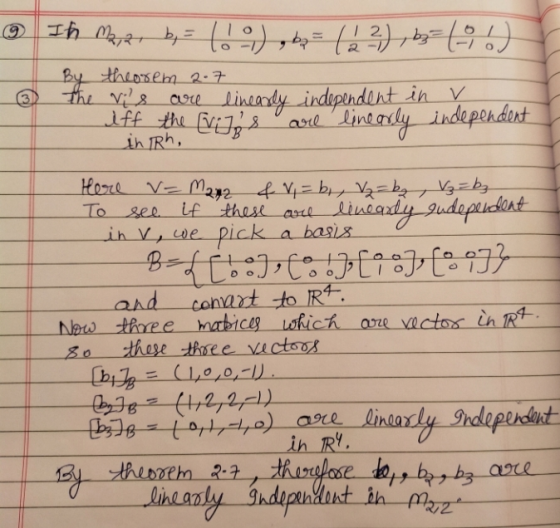
can anybody explain how to do #9 by using the theorem
2.7?
i know the vectors...
DETAILS LARLINALG8 4.R.084. ASK YOUR TEACHER Determine whether each statement is true or false. If a...
 DETAILS LARLINALG8 4.R.084. ASK YOUR TEACHER Determine whether each statement is true or false. If a statement is true, give a reason or cite an appropriate statement from the text. If a statement is false, provide an example that shows the statement is not true in all cases or cite an appropriate statement from the text. () The set w = {(0,x2,x): and X" are real numbers) is a subspace of R. False, this set is not closed under addition...
Question 6) (9 points) Prove each of the following statements. (a) Suppose that the vectors {v,...
 Question 6) (9 points) Prove each of the following statements. (a) Suppose that the vectors {v, w, u} are linearly independent vectors in some vector space V. Prove then that the vectors {v + w, w + u,v + u} are also linearly independent in V. (b) Suppose T is a linear transformation, T: P10(R) → M3(R) Prove that T cannot be 1-to-1 (c) Prove that in ANY inner product that if u and w are unit vectors (ie ||vl|...
1Hint: Use the theorem from class that any linearly independent list of vectors is contained in...
 1Hint: Use the theorem from class that any linearly independent
list of vectors is contained in a basis
2Hint: Remember that we prove the equality of sets X = Y by
showing X ⊂ Y and Y ⊂ X.
(2 points each for (a),(b),(d)) In this problem, we will prove the following di- mension formula. Theorem. If H and H' are subspaces of a finite-dimensional vector space V, then dim(H+H') = dim(H)+dim(H') - dim(H nH'). (a) Suppose {u1;...; up} is...
1Hint: Use the theorem from class that any linearly independent
list of vectors is contained in a basis
2Hint: Remember that we prove the equality of sets X = Y by
showing X ⊂ Y and Y ⊂ X.
(2 points each for (a),(b),(d)) In this problem, we will prove the following di- mension formula. Theorem. If H and H' are subspaces of a finite-dimensional vector space V, then dim(H+H') = dim(H)+dim(H') - dim(H nH'). (a) Suppose {u1;...; up} is...
Question 3 (10 marks) Suppose B-[bi, b2] and Cci, c2) are bases for a vector space V, even though we do not know the coordinates of all those vectors relative to the standard basis. However, we know...
 Question 3 (10 marks) Suppose B-[bi, b2] and Cci, c2) are bases for a vector space V, even though we do not know the coordinates of all those vectors relative to the standard basis. However, we know that bi--c1 +3c2 and b2-2c1 -4c2 (a) Show that if C is a basis, then B is also a basis (b) Find N, given that x-5but 3b2. (c) Find lyle given that y Зе-5c2.
Question 3 (10 marks) Suppose B-[bi, b2] and Cci,...
Question 3 (10 marks) Suppose B-[bi, b2] and Cci, c2) are bases for a vector space V, even though we do not know the coordinates of all those vectors relative to the standard basis. However, we know that bi--c1 +3c2 and b2-2c1 -4c2 (a) Show that if C is a basis, then B is also a basis (b) Find N, given that x-5but 3b2. (c) Find lyle given that y Зе-5c2.
Question 3 (10 marks) Suppose B-[bi, b2] and Cci,...
Lemma. If two vector spaces have the same dimension then they are isomorphic Proof. To show that ...
 Lemma. If two vector spaces have the same dimension then they are isomorphic Proof. To show that any two spaces of dimension n are isomorphic, we can simply show that any one is isomorphic to R. Then we will have shown that they are isomorphic to each other, by the transitivity of isomorphism (which was established in the first Theorem of this section) Theorem 1 Isomorphism is an equivalence relation among ctor spaces Let v be n--dimensional. Fix a basis...
Problem 1: Let W = {p(t) € Pz : p'le) = 0}. We know from Problem...
 Problem 1: Let W = {p(t) € Pz : p'le) = 0}. We know from Problem 1, Section 4.3 and Problem 1, Section 4.6 that W is a subspace of P3. Let T:W+Pbe given by T(p(t)) = p' (t). It is easy to check that T is a linear transformation. (a) Find a basis for and the dimension of Range T. (b) Find Ker T, a basis for Ker T and dim KerT. (c) Is T one-to-one? Explain. (d) Is...
Let p, (t) 6+t, P2(t) =t-3t, p3 (t) = 1 +t-2t. Complete parts (a) and (b) below. Use coordinate vectors to show that th...
 Let p, (t) 6+t, P2(t) =t-3t, p3 (t) = 1 +t-2t. Complete parts (a) and (b) below. Use coordinate vectors to show that these polynomials form a basis for P2. What are the coordinate vectors corresponding to p, p2, and pa? P- Place these coordinate vectors into the columns fa matrix A. What can be said about the matrix A? O A. The matrix A forms a basis for R3 by the Invertible Matrix Theorem because all square matrices are...
Problem 4. Let V be a vector space and let T : V → V and U : V → V be two linear transforinations...
 I need the answer to problem 6
Clear and step by step please
Problem 4. Let V be a vector space and let T : V → V and U : V → V be two linear transforinations 1. Show that. TU is also a linear transformation. 2. Show that aT is a linear transformation for any scalar a. 3. Suppose that T is invertible. Show that T-1 is also a linear transformation. Problem 5. Let T : R3 →...
I need the answer to problem 6
Clear and step by step please
Problem 4. Let V be a vector space and let T : V → V and U : V → V be two linear transforinations 1. Show that. TU is also a linear transformation. 2. Show that aT is a linear transformation for any scalar a. 3. Suppose that T is invertible. Show that T-1 is also a linear transformation. Problem 5. Let T : R3 →...
Problem 4. Let n E N. We consider the vector space R” (a) Prove that for...
 Problem 4. Let n E N. We consider the vector space R” (a) Prove that for all X, Y CR”, if X IY then Span(X) 1 Span(Y). (b) Let X and Y be linearly independent subsets of R”. Prove that if X IY, then X UY is linearly independent. (C) Prove that every maximally pairwise orthogonal set of vectors in R” has n + 1 elements. Definition: Let V be a vector space and let U and W be subspaces...
Problem 3. Let D be the vector space of all differentiable function R wth the usual pointwise add...
 Problem 3. Let D be the vector space of all differentiable function R wth the usual pointwise addition and scalar multiplication of functions. In other words, for f, g E D and λ E R the function R defined by: (f +Ag) ()-f(r) +Ag(x) Let R be four functions defined by: s(x)-: sin 11 c(r) : cosz, co(z)--cos(z + θ), and so(r) sin(z + θ), and Wspanls, c Which of the following statements are true: (a) For each fixed θ...
 DETAILS LARLINALG8 4.R.084. ASK YOUR TEACHER Determine whether each statement is true or false. If a statement is true, give a reason or cite an appropriate statement from the text. If a statement is false, provide an example that shows the statement is not true in all cases or cite an appropriate statement from the text. () The set w = {(0,x2,x): and X" are real numbers) is a subspace of R. False, this set is not closed under addition...
 Question 6) (9 points) Prove each of the following statements. (a) Suppose that the vectors {v, w, u} are linearly independent vectors in some vector space V. Prove then that the vectors {v + w, w + u,v + u} are also linearly independent in V. (b) Suppose T is a linear transformation, T: P10(R) → M3(R) Prove that T cannot be 1-to-1 (c) Prove that in ANY inner product that if u and w are unit vectors (ie ||vl|...
 1Hint: Use the theorem from class that any linearly independent
list of vectors is contained in a basis
2Hint: Remember that we prove the equality of sets X = Y by
showing X ⊂ Y and Y ⊂ X.
(2 points each for (a),(b),(d)) In this problem, we will prove the following di- mension formula. Theorem. If H and H' are subspaces of a finite-dimensional vector space V, then dim(H+H') = dim(H)+dim(H') - dim(H nH'). (a) Suppose {u1;...; up} is...
1Hint: Use the theorem from class that any linearly independent
list of vectors is contained in a basis
2Hint: Remember that we prove the equality of sets X = Y by
showing X ⊂ Y and Y ⊂ X.
(2 points each for (a),(b),(d)) In this problem, we will prove the following di- mension formula. Theorem. If H and H' are subspaces of a finite-dimensional vector space V, then dim(H+H') = dim(H)+dim(H') - dim(H nH'). (a) Suppose {u1;...; up} is...
 Question 3 (10 marks) Suppose B-[bi, b2] and Cci, c2) are bases for a vector space V, even though we do not know the coordinates of all those vectors relative to the standard basis. However, we know that bi--c1 +3c2 and b2-2c1 -4c2 (a) Show that if C is a basis, then B is also a basis (b) Find N, given that x-5but 3b2. (c) Find lyle given that y Зе-5c2.
Question 3 (10 marks) Suppose B-[bi, b2] and Cci,...
Question 3 (10 marks) Suppose B-[bi, b2] and Cci, c2) are bases for a vector space V, even though we do not know the coordinates of all those vectors relative to the standard basis. However, we know that bi--c1 +3c2 and b2-2c1 -4c2 (a) Show that if C is a basis, then B is also a basis (b) Find N, given that x-5but 3b2. (c) Find lyle given that y Зе-5c2.
Question 3 (10 marks) Suppose B-[bi, b2] and Cci,...
 Lemma. If two vector spaces have the same dimension then they are isomorphic Proof. To show that any two spaces of dimension n are isomorphic, we can simply show that any one is isomorphic to R. Then we will have shown that they are isomorphic to each other, by the transitivity of isomorphism (which was established in the first Theorem of this section) Theorem 1 Isomorphism is an equivalence relation among ctor spaces Let v be n--dimensional. Fix a basis...
 Problem 1: Let W = {p(t) € Pz : p'le) = 0}. We know from Problem 1, Section 4.3 and Problem 1, Section 4.6 that W is a subspace of P3. Let T:W+Pbe given by T(p(t)) = p' (t). It is easy to check that T is a linear transformation. (a) Find a basis for and the dimension of Range T. (b) Find Ker T, a basis for Ker T and dim KerT. (c) Is T one-to-one? Explain. (d) Is...
 Let p, (t) 6+t, P2(t) =t-3t, p3 (t) = 1 +t-2t. Complete parts (a) and (b) below. Use coordinate vectors to show that these polynomials form a basis for P2. What are the coordinate vectors corresponding to p, p2, and pa? P- Place these coordinate vectors into the columns fa matrix A. What can be said about the matrix A? O A. The matrix A forms a basis for R3 by the Invertible Matrix Theorem because all square matrices are...
 I need the answer to problem 6
Clear and step by step please
Problem 4. Let V be a vector space and let T : V → V and U : V → V be two linear transforinations 1. Show that. TU is also a linear transformation. 2. Show that aT is a linear transformation for any scalar a. 3. Suppose that T is invertible. Show that T-1 is also a linear transformation. Problem 5. Let T : R3 →...
I need the answer to problem 6
Clear and step by step please
Problem 4. Let V be a vector space and let T : V → V and U : V → V be two linear transforinations 1. Show that. TU is also a linear transformation. 2. Show that aT is a linear transformation for any scalar a. 3. Suppose that T is invertible. Show that T-1 is also a linear transformation. Problem 5. Let T : R3 →...
 Problem 4. Let n E N. We consider the vector space R” (a) Prove that for all X, Y CR”, if X IY then Span(X) 1 Span(Y). (b) Let X and Y be linearly independent subsets of R”. Prove that if X IY, then X UY is linearly independent. (C) Prove that every maximally pairwise orthogonal set of vectors in R” has n + 1 elements. Definition: Let V be a vector space and let U and W be subspaces...
 Problem 3. Let D be the vector space of all differentiable function R wth the usual pointwise addition and scalar multiplication of functions. In other words, for f, g E D and λ E R the function R defined by: (f +Ag) ()-f(r) +Ag(x) Let R be four functions defined by: s(x)-: sin 11 c(r) : cosz, co(z)--cos(z + θ), and so(r) sin(z + θ), and Wspanls, c Which of the following statements are true: (a) For each fixed θ...
Most questions answered within 3 hours.
-
Where is the error in this code sequence?
String s1 = "Hello";
String s2 = "ello";...
asked 11 months ago -
Financial data for Joel de Paris, Inc., for last year
follow:
Joel de Paris, Inc.
Balance...
asked 11 months ago -
Consider this reaction:
Al2(SO4)3 (aq)+ BaCl3
(aq) Al2Cl6 (aq)- +
3BaSO4(s) . What is the...
asked 11 months ago -
Suppose that Savneet is considering increasing her
recent random sample from 20 car rentals to 40...
asked 11 months ago -
Trucks arrive at an unloading terminal at an average rate of 120
per hour.
Trucks arrive...
asked 11 months ago -
Why are methanol and ethanol completely soluble in water while
octanol is not very little soluble....
asked 11 months ago -
A facilities manager at a university reads in a research report
that the mean amount of...
asked 11 months ago -
When the CuSO4 is rehydrated by adding water to the anhydrous
compound, is this an endothermic...
asked 11 months ago -
A ray of sunlight is passing from diamond into crown glass; the
angle of incidence is...
asked 11 months ago -
A block of mass 0.249 kg is placed on top of a light, vertical
spring of...
asked 11 months ago -
how do the kidneys compensate in the presences of acidosis
a) trigger hyperventilate
b) reserve acid...
asked 11 months ago -
Question 501 pts
The rental rate of capital to the firm increases. Which of the
following...
asked 11 months ago