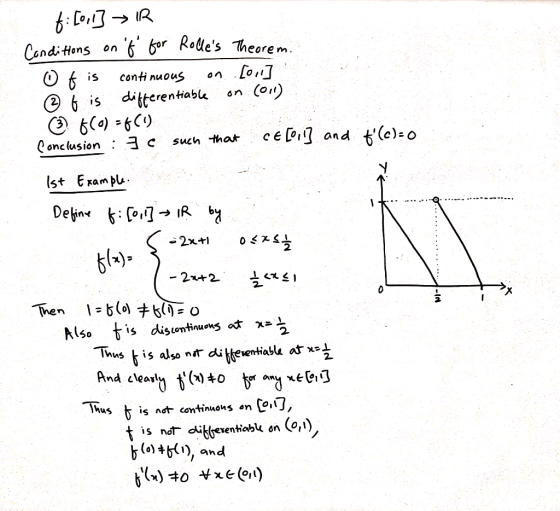
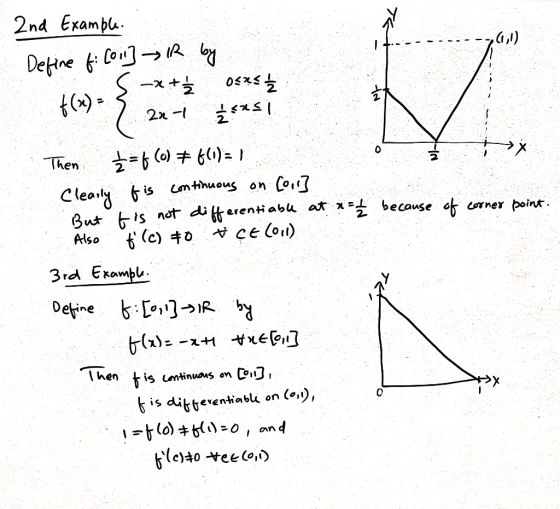
Give three examples for Rolle's Theorem: For the
first, define f : [0, 1]  R such that
condition 1 does not hold, condition 2 does hold, condition 3 does
hold, and f'(c)
R such that
condition 1 does not hold, condition 2 does hold, condition 3 does
hold, and f'(c) 0 for every c
 (0,1). For the second example, make sure only condition
2 does not hold and the conclusion do not hold. For the third
example, do the same with condition 3.
(0,1). For the second example, make sure only condition
2 does not hold and the conclusion do not hold. For the third
example, do the same with condition 3.
Homework Answers
Add Answer to:
Give three examples for Rolle's Theorem: For the
first, define f : [0, 1] R such that...
Real Analysis: Define f: [0,1] --> by f(x) = {0, x [0,1] ; 1, x [0,1]\...
 Real Analysis: Define f: [0,1] -->
by f(x) = {0, x
[0,1] ; 1, x
[0,1]\
}
(a) Identify U(f) = inf{U(f, P): P
(a,b)}
(b) Prove or disprove that f is Darboux Integrable.
Thanks in advance!
We were unable to transcribe this imageWe were unable to transcribe this imageWe were unable to transcribe this imageWe were unable to transcribe this imageWe were unable to transcribe this imageWe were unable to transcribe this imageWe were unable to transcribe this imageWe...
Real Analysis: Define f: [0,1] -->
by f(x) = {0, x
[0,1] ; 1, x
[0,1]\
}
(a) Identify U(f) = inf{U(f, P): P
(a,b)}
(b) Prove or disprove that f is Darboux Integrable.
Thanks in advance!
We were unable to transcribe this imageWe were unable to transcribe this imageWe were unable to transcribe this imageWe were unable to transcribe this imageWe were unable to transcribe this imageWe were unable to transcribe this imageWe were unable to transcribe this imageWe...
Verify that the function satisfies the three hypotheses of Rolle's Theorem on the given interval. Then...
 Verify that the function satisfies the three hypotheses of Rolle's Theorem on the given interval. Then find all numbers that satisfy the conclusion of Rolle's Theorem. f(x)=x-5x° +6x+2, (0.4) Select one: o 1.9 - 0 6.6 = 12 + c = 12 - 3 O C. None of the above 5. 3 S ſ d.. + 3 .C= 3 o e. c = 2 + -=2+2,03 o te=2-23
Give examples, if possible, of the following. i) A set with a supremum but no maximum....
 Give examples, if possible, of the following.
i) A set
with a supremum but no maximum.
ii) A decreasing sequence
so that
does not exist
iii) An increasing sequence
so that
does not exist.
We were unable to transcribe this image(an) n=1 We were unable to transcribe this imageWe were unable to transcribe this imageWe were unable to transcribe this image
Give examples, if possible, of the following.
i) A set
with a supremum but no maximum.
ii) A decreasing sequence
so that
does not exist
iii) An increasing sequence
so that
does not exist.
We were unable to transcribe this image(an) n=1 We were unable to transcribe this imageWe were unable to transcribe this imageWe were unable to transcribe this image
Let S ⊆ be the tetrahedron having vertices (0, 0, 0), (0, 1, 1), (1, 2,...
 Let S ⊆
be the tetrahedron having vertices (0, 0, 0), (0, 1, 1), (1, 2,
3), and (−1, 0, 1).
Let f :
→
be the function defined by f(x, y, x) = x − 2y + 3z.
Using the change of variables theorem,
rewrite
as an integral over a 3-rectangle, then use Fubini’s theorem to
evaluate the integral.
We were unable to transcribe this imageWe were unable to transcribe this imageWe were unable to transcribe this image}
Let S ⊆
be the tetrahedron having vertices (0, 0, 0), (0, 1, 1), (1, 2,
3), and (−1, 0, 1).
Let f :
→
be the function defined by f(x, y, x) = x − 2y + 3z.
Using the change of variables theorem,
rewrite
as an integral over a 3-rectangle, then use Fubini’s theorem to
evaluate the integral.
We were unable to transcribe this imageWe were unable to transcribe this imageWe were unable to transcribe this image}
2. The function (-3x if 0sx < 1 if x 1 -fO f(x) =f(x) 0 Is...
 2. The function (-3x if 0sx < 1 if x 1 -fO f(x) =f(x) 0 Is zero at x 0 and x = 1 and differentiable on (0,1), but its derivative on (0,1) is never zero. Does this example contradict Rolle's Theorem? Why or why not?
2. The function (-3x if 0sx
2. The function (-3x if 0sx < 1 if x 1 -fO f(x) =f(x) 0 Is zero at x 0 and x = 1 and differentiable on (0,1), but its derivative on (0,1) is never zero. Does this example contradict Rolle's Theorem? Why or why not?
2. The function (-3x if 0sx
This is the exact problem that was given to study for an upcoming exam, Give the...
 This is the exact problem that was given to study for an
upcoming exam,
Give the general form of the solution:
du/dt
= 3 (d2u/dr2 + 1/r du/dr +1/r2
d2u/d2)
inside the circle 0 r 3, - subject to the
periodicity conditions on
and initial condition u(r, , 0) = (r,)
We were unable to transcribe this imageWe were unable to transcribe this imageWe were unable to transcribe this imageWe were unable to transcribe this imageWe were unable to transcribe...
This is the exact problem that was given to study for an
upcoming exam,
Give the general form of the solution:
du/dt
= 3 (d2u/dr2 + 1/r du/dr +1/r2
d2u/d2)
inside the circle 0 r 3, - subject to the
periodicity conditions on
and initial condition u(r, , 0) = (r,)
We were unable to transcribe this imageWe were unable to transcribe this imageWe were unable to transcribe this imageWe were unable to transcribe this imageWe were unable to transcribe...
1-8 please 1. Find the value c that satisfies Rolle's Theorem for f(x) = cos x...
 1-8
please
1. Find the value c that satisfies Rolle's Theorem for f(x) = cos x on A / B./2 C. D. E. 0 F. None of the above 311/4 2. The function f is graphed below. Give the number of values that satisfy the mean value theorem on the interval (-6,6). A. 0 B. 1 C. 2 D. 3 E. 4 F. None of these Page 1 of 5 1. The graph off) is shown. Find the value(s) where)...
1-8
please
1. Find the value c that satisfies Rolle's Theorem for f(x) = cos x on A / B./2 C. D. E. 0 F. None of the above 311/4 2. The function f is graphed below. Give the number of values that satisfy the mean value theorem on the interval (-6,6). A. 0 B. 1 C. 2 D. 3 E. 4 F. None of these Page 1 of 5 1. The graph off) is shown. Find the value(s) where)...
Show that if is the cycle . Give examples. What does this say for 2-cycles? We...
 Show that if
is the cycle
. Give examples. What does this say for 2-cycles?
We were unable to transcribe this image(a, a, ..., and then 8-1 = (an, an-1, ..., 1)
Show that if
is the cycle
. Give examples. What does this say for 2-cycles?
We were unable to transcribe this image(a, a, ..., and then 8-1 = (an, an-1, ..., 1)
4. Suppose that X1, X2, . . . , Xn are i.i.d. random variables with density function f(x) = 0 <...
4. Suppose that X1, X2, . . . , Xn are i.i.d. random variables with density function f(x) = 0 < x < 1, > 0 a) Find a sufficient statistic for . Is the statistic minimal sufficient? b) Find the MLE for and verify that it is a function of the statistic in a) c) Find IX() and hence give the CRLB for an unbiased estimator of . pdf means probability distribution function We were unable to transcribe this...
Consider the IVP, 1. Apply the Fundamental Existence and Uniqueness Theorem to show that a solution...
Consider the IVP, 1. Apply the Fundamental Existence and Uniqueness Theorem to show that a solution exists. 2. Use the Runge-Kutta method with various step-sizes to estimate the maximum t-value, , for which the solution is defined on the interval . Include a few representative graphs with your submission, and the lists of points. 3. Find the exact solution to the IVP and solve for analytically. How close was your approximation from the previous question? 4. The Runge-Kutta method continues...
 Real Analysis: Define f: [0,1] -->
by f(x) = {0, x
[0,1] ; 1, x
[0,1]\
}
(a) Identify U(f) = inf{U(f, P): P
(a,b)}
(b) Prove or disprove that f is Darboux Integrable.
Thanks in advance!
We were unable to transcribe this imageWe were unable to transcribe this imageWe were unable to transcribe this imageWe were unable to transcribe this imageWe were unable to transcribe this imageWe were unable to transcribe this imageWe were unable to transcribe this imageWe...
Real Analysis: Define f: [0,1] -->
by f(x) = {0, x
[0,1] ; 1, x
[0,1]\
}
(a) Identify U(f) = inf{U(f, P): P
(a,b)}
(b) Prove or disprove that f is Darboux Integrable.
Thanks in advance!
We were unable to transcribe this imageWe were unable to transcribe this imageWe were unable to transcribe this imageWe were unable to transcribe this imageWe were unable to transcribe this imageWe were unable to transcribe this imageWe were unable to transcribe this imageWe...
 Verify that the function satisfies the three hypotheses of Rolle's Theorem on the given interval. Then find all numbers that satisfy the conclusion of Rolle's Theorem. f(x)=x-5x° +6x+2, (0.4) Select one: o 1.9 - 0 6.6 = 12 + c = 12 - 3 O C. None of the above 5. 3 S ſ d.. + 3 .C= 3 o e. c = 2 + -=2+2,03 o te=2-23
 Give examples, if possible, of the following.
i) A set
with a supremum but no maximum.
ii) A decreasing sequence
so that
does not exist
iii) An increasing sequence
so that
does not exist.
We were unable to transcribe this image(an) n=1 We were unable to transcribe this imageWe were unable to transcribe this imageWe were unable to transcribe this image
Give examples, if possible, of the following.
i) A set
with a supremum but no maximum.
ii) A decreasing sequence
so that
does not exist
iii) An increasing sequence
so that
does not exist.
We were unable to transcribe this image(an) n=1 We were unable to transcribe this imageWe were unable to transcribe this imageWe were unable to transcribe this image
 Let S ⊆
be the tetrahedron having vertices (0, 0, 0), (0, 1, 1), (1, 2,
3), and (−1, 0, 1).
Let f :
→
be the function defined by f(x, y, x) = x − 2y + 3z.
Using the change of variables theorem,
rewrite
as an integral over a 3-rectangle, then use Fubini’s theorem to
evaluate the integral.
We were unable to transcribe this imageWe were unable to transcribe this imageWe were unable to transcribe this image}
Let S ⊆
be the tetrahedron having vertices (0, 0, 0), (0, 1, 1), (1, 2,
3), and (−1, 0, 1).
Let f :
→
be the function defined by f(x, y, x) = x − 2y + 3z.
Using the change of variables theorem,
rewrite
as an integral over a 3-rectangle, then use Fubini’s theorem to
evaluate the integral.
We were unable to transcribe this imageWe were unable to transcribe this imageWe were unable to transcribe this image}
 2. The function (-3x if 0sx < 1 if x 1 -fO f(x) =f(x) 0 Is zero at x 0 and x = 1 and differentiable on (0,1), but its derivative on (0,1) is never zero. Does this example contradict Rolle's Theorem? Why or why not?
2. The function (-3x if 0sx
2. The function (-3x if 0sx < 1 if x 1 -fO f(x) =f(x) 0 Is zero at x 0 and x = 1 and differentiable on (0,1), but its derivative on (0,1) is never zero. Does this example contradict Rolle's Theorem? Why or why not?
2. The function (-3x if 0sx
 This is the exact problem that was given to study for an
upcoming exam,
Give the general form of the solution:
du/dt
= 3 (d2u/dr2 + 1/r du/dr +1/r2
d2u/d2)
inside the circle 0 r 3, - subject to the
periodicity conditions on
and initial condition u(r, , 0) = (r,)
We were unable to transcribe this imageWe were unable to transcribe this imageWe were unable to transcribe this imageWe were unable to transcribe this imageWe were unable to transcribe...
This is the exact problem that was given to study for an
upcoming exam,
Give the general form of the solution:
du/dt
= 3 (d2u/dr2 + 1/r du/dr +1/r2
d2u/d2)
inside the circle 0 r 3, - subject to the
periodicity conditions on
and initial condition u(r, , 0) = (r,)
We were unable to transcribe this imageWe were unable to transcribe this imageWe were unable to transcribe this imageWe were unable to transcribe this imageWe were unable to transcribe...
 1-8
please
1. Find the value c that satisfies Rolle's Theorem for f(x) = cos x on A / B./2 C. D. E. 0 F. None of the above 311/4 2. The function f is graphed below. Give the number of values that satisfy the mean value theorem on the interval (-6,6). A. 0 B. 1 C. 2 D. 3 E. 4 F. None of these Page 1 of 5 1. The graph off) is shown. Find the value(s) where)...
1-8
please
1. Find the value c that satisfies Rolle's Theorem for f(x) = cos x on A / B./2 C. D. E. 0 F. None of the above 311/4 2. The function f is graphed below. Give the number of values that satisfy the mean value theorem on the interval (-6,6). A. 0 B. 1 C. 2 D. 3 E. 4 F. None of these Page 1 of 5 1. The graph off) is shown. Find the value(s) where)...
 Show that if
is the cycle
. Give examples. What does this say for 2-cycles?
We were unable to transcribe this image(a, a, ..., and then 8-1 = (an, an-1, ..., 1)
Show that if
is the cycle
. Give examples. What does this say for 2-cycles?
We were unable to transcribe this image(a, a, ..., and then 8-1 = (an, an-1, ..., 1)
Most questions answered within 3 hours.
-
Where is the error in this code sequence?
String s1 = "Hello";
String s2 = "ello";...
asked 11 months ago -
Financial data for Joel de Paris, Inc., for last year
follow:
Joel de Paris, Inc.
Balance...
asked 11 months ago -
Consider this reaction:
Al2(SO4)3 (aq)+ BaCl3
(aq) Al2Cl6 (aq)- +
3BaSO4(s) . What is the...
asked 11 months ago -
Suppose that Savneet is considering increasing her
recent random sample from 20 car rentals to 40...
asked 11 months ago -
Trucks arrive at an unloading terminal at an average rate of 120
per hour.
Trucks arrive...
asked 11 months ago -
Why are methanol and ethanol completely soluble in water while
octanol is not very little soluble....
asked 11 months ago -
A facilities manager at a university reads in a research report
that the mean amount of...
asked 11 months ago -
When the CuSO4 is rehydrated by adding water to the anhydrous
compound, is this an endothermic...
asked 11 months ago -
A ray of sunlight is passing from diamond into crown glass; the
angle of incidence is...
asked 11 months ago -
A block of mass 0.249 kg is placed on top of a light, vertical
spring of...
asked 11 months ago -
how do the kidneys compensate in the presences of acidosis
a) trigger hyperventilate
b) reserve acid...
asked 11 months ago -
Question 501 pts
The rental rate of capital to the firm increases. Which of the
following...
asked 11 months ago