
Homework Answers
Any doubt then comment below..
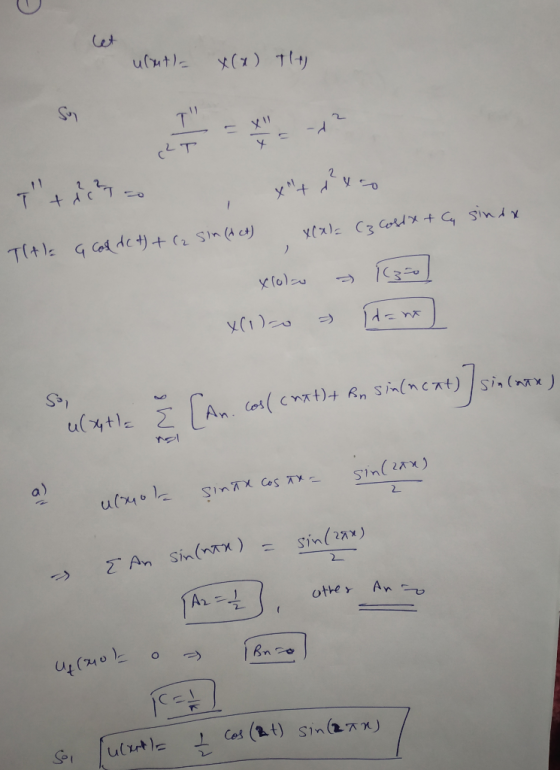
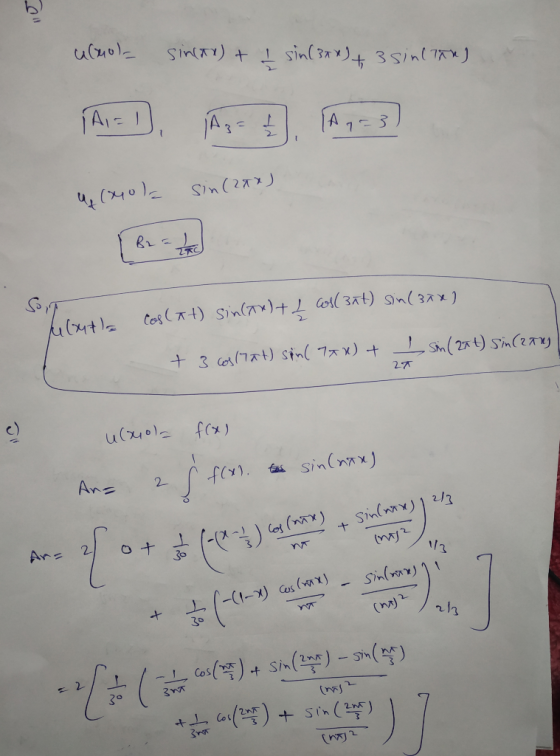
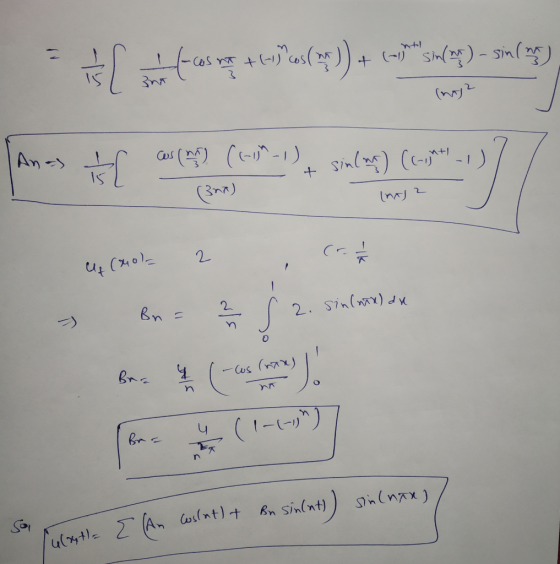
In last equation of last picture. , An and Bn are define above in last picture in closed bracket..
Add Answer to:
1. Solve the following IBVPs for a string of unit length, subject to the given conditions...
— дt ! [points=4] Q4. Solve the heat equation subject to the given conditions: д?u ди...
 — дt ! [points=4] Q4. Solve the heat equation subject to the given conditions: д?u ди 0<х «п, t> о дх2 ди ди - (0,t) = 0, - (п,t) = 0, t>0 дх дх и(x,0) = п - 3x
2. [-/3 Points] DETAILS ZILLENGMATH6 13.3.002. du at 0<x<L, t> 0 subject to the given conditions....
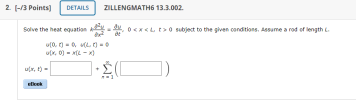 2. [-/3 Points] DETAILS ZILLENGMATH6 13.3.002. du at 0<x<L, t> 0 subject to the given conditions. Assume a rod of length L. Solve the heat equation Lazu axz u(0, 1) = 0, u(L, t) = 0 u(x,0) = x(L - x) u(x, t) = + n = 1 eBook
4. Consider the semi-infinite string problem given by Utt = cʻuza, 0<x< 0,> 0 u(x,0) =...
 4. Consider the semi-infinite string problem given by Utt = cʻuza, 0<x< 0,> 0 u(x,0) = f(x), 0<x< ~ ut(2,0) = g(2), 0 < x < 0 u(0,t) = 0, t> 0 Suppose that c=1, f(0) = (x - 1) - h(2 – 3) and g(C) = 0. (a) Write out the appropriate semi-infinite d'Alembert's solution for this problem and simplify. (b) Plot the solution surface and enough time snapshots to demostrate the dynam- ics of the solution.
Please answer question #1w and write legibly - it is circled in yellow 1. Evaluate the...
 Please answer question #1w and write legibly -
it is circled in yellow
1. Evaluate the following limits, where p, q > 0: X COS X - sinx (w) lim x+ 0 x2 sinx
Please answer question #1w and write legibly -
it is circled in yellow
1. Evaluate the following limits, where p, q > 0: X COS X - sinx (w) lim x+ 0 x2 sinx
+ – for n > 1, subject to Problem 5 (6 pts): Solve the recursive equation...
 + – for n > 1, subject to Problem 5 (6 pts): Solve the recursive equation T(n the initial condition T(1) = 0.
2. The beta function B(a, b) is given by B(a,b) = So va-1(1 – v)6–1dv; a...
 2. The beta function B(a, b) is given by B(a,b) = So va-1(1 – v)6–1dv; a > 0,6 > 0. The beta distribution has density f(x) = p139–(1 – x)6–1, for 0 < x < 1. If X has the beta distribution, show that E(X) = B(a+1,6)/B(a,b). What is Var(X)?
Please include step-by-step solution. D19. Solve t2x" +3tx -3 x-t', t>0.
 Please include step-by-step solution.
D19. Solve t2x" +3tx -3 x-t', t>0.
Please include step-by-step solution.
D19. Solve t2x" +3tx -3 x-t', t>0.
What is the solution of day 2 dy 1(1+1) dx² + xăx x² y = f(x...
 What is the solution of day 2 dy 1(1+1) dx² + xăx x² y = f(x = a) (a > 0). on the interval 0<x< 0, subject to the boundary conditions y(0) = y(0) = 0? / is a positive integer.
PDE Problem: homogenous diffusion equation with non-homogenous boundary conditions 27. Solve the nonhomogeneous initial boundary value...
 PDE Problem: homogenous diffusion equation with non-homogenous
boundary conditions
27. Solve the nonhomogeneous initial boundary value problem | Ut = kuzz, 0 < x < 1, t > 0, u(0, t) = T1, u(1,t) = T2, t> 0, | u(x,0) = 4(x), 0 < x < 1. for the following data: (c) T1 = 100, T2 = 50, 4(x) = 1 = , k = 1. 33x, 33(1 – 2), 0 < x <a/2, /2 < x < TT, [u(x,...
PDE Problem: homogenous diffusion equation with non-homogenous
boundary conditions
27. Solve the nonhomogeneous initial boundary value problem | Ut = kuzz, 0 < x < 1, t > 0, u(0, t) = T1, u(1,t) = T2, t> 0, | u(x,0) = 4(x), 0 < x < 1. for the following data: (c) T1 = 100, T2 = 50, 4(x) = 1 = , k = 1. 33x, 33(1 – 2), 0 < x <a/2, /2 < x < TT, [u(x,...
5. (20 pts). Solve the following initial-value problem: Ut + 2uuz - 0<x<, 0 <t<oo 0...
 5. (20 pts). Solve the following initial-value problem: Ut + 2uuz - 0<x<, 0 <t<oo 0 1 <1 > 1 u(t,0) = Then draw the solution for different values of time.
 — дt ! [points=4] Q4. Solve the heat equation subject to the given conditions: д?u ди 0<х «п, t> о дх2 ди ди - (0,t) = 0, - (п,t) = 0, t>0 дх дх и(x,0) = п - 3x
 2. [-/3 Points] DETAILS ZILLENGMATH6 13.3.002. du at 0<x<L, t> 0 subject to the given conditions. Assume a rod of length L. Solve the heat equation Lazu axz u(0, 1) = 0, u(L, t) = 0 u(x,0) = x(L - x) u(x, t) = + n = 1 eBook
 4. Consider the semi-infinite string problem given by Utt = cʻuza, 0<x< 0,> 0 u(x,0) = f(x), 0<x< ~ ut(2,0) = g(2), 0 < x < 0 u(0,t) = 0, t> 0 Suppose that c=1, f(0) = (x - 1) - h(2 – 3) and g(C) = 0. (a) Write out the appropriate semi-infinite d'Alembert's solution for this problem and simplify. (b) Plot the solution surface and enough time snapshots to demostrate the dynam- ics of the solution.
 Please answer question #1w and write legibly -
it is circled in yellow
1. Evaluate the following limits, where p, q > 0: X COS X - sinx (w) lim x+ 0 x2 sinx
Please answer question #1w and write legibly -
it is circled in yellow
1. Evaluate the following limits, where p, q > 0: X COS X - sinx (w) lim x+ 0 x2 sinx
 + – for n > 1, subject to Problem 5 (6 pts): Solve the recursive equation T(n the initial condition T(1) = 0.
 2. The beta function B(a, b) is given by B(a,b) = So va-1(1 – v)6–1dv; a > 0,6 > 0. The beta distribution has density f(x) = p139–(1 – x)6–1, for 0 < x < 1. If X has the beta distribution, show that E(X) = B(a+1,6)/B(a,b). What is Var(X)?
 Please include step-by-step solution.
D19. Solve t2x" +3tx -3 x-t', t>0.
Please include step-by-step solution.
D19. Solve t2x" +3tx -3 x-t', t>0.
 What is the solution of day 2 dy 1(1+1) dx² + xăx x² y = f(x = a) (a > 0). on the interval 0<x< 0, subject to the boundary conditions y(0) = y(0) = 0? / is a positive integer.
 PDE Problem: homogenous diffusion equation with non-homogenous
boundary conditions
27. Solve the nonhomogeneous initial boundary value problem | Ut = kuzz, 0 < x < 1, t > 0, u(0, t) = T1, u(1,t) = T2, t> 0, | u(x,0) = 4(x), 0 < x < 1. for the following data: (c) T1 = 100, T2 = 50, 4(x) = 1 = , k = 1. 33x, 33(1 – 2), 0 < x <a/2, /2 < x < TT, [u(x,...
PDE Problem: homogenous diffusion equation with non-homogenous
boundary conditions
27. Solve the nonhomogeneous initial boundary value problem | Ut = kuzz, 0 < x < 1, t > 0, u(0, t) = T1, u(1,t) = T2, t> 0, | u(x,0) = 4(x), 0 < x < 1. for the following data: (c) T1 = 100, T2 = 50, 4(x) = 1 = , k = 1. 33x, 33(1 – 2), 0 < x <a/2, /2 < x < TT, [u(x,...
 5. (20 pts). Solve the following initial-value problem: Ut + 2uuz - 0<x<, 0 <t<oo 0 1 <1 > 1 u(t,0) = Then draw the solution for different values of time.
Most questions answered within 3 hours.
-
Where is the error in this code sequence?
String s1 = "Hello";
String s2 = "ello";...
asked 10 months ago -
Financial data for Joel de Paris, Inc., for last year
follow:
Joel de Paris, Inc.
Balance...
asked 10 months ago -
Consider this reaction:
Al2(SO4)3 (aq)+ BaCl3
(aq) Al2Cl6 (aq)- +
3BaSO4(s) . What is the...
asked 10 months ago -
Suppose that Savneet is considering increasing her
recent random sample from 20 car rentals to 40...
asked 10 months ago -
Trucks arrive at an unloading terminal at an average rate of 120
per hour.
Trucks arrive...
asked 10 months ago -
Why are methanol and ethanol completely soluble in water while
octanol is not very little soluble....
asked 10 months ago -
A facilities manager at a university reads in a research report
that the mean amount of...
asked 10 months ago -
When the CuSO4 is rehydrated by adding water to the anhydrous
compound, is this an endothermic...
asked 10 months ago -
A ray of sunlight is passing from diamond into crown glass; the
angle of incidence is...
asked 10 months ago -
A block of mass 0.249 kg is placed on top of a light, vertical
spring of...
asked 10 months ago -
how do the kidneys compensate in the presences of acidosis
a) trigger hyperventilate
b) reserve acid...
asked 10 months ago -
Question 501 pts
The rental rate of capital to the firm increases. Which of the
following...
asked 10 months ago