A) Give a general expression for the work done by two forces acting on an object...
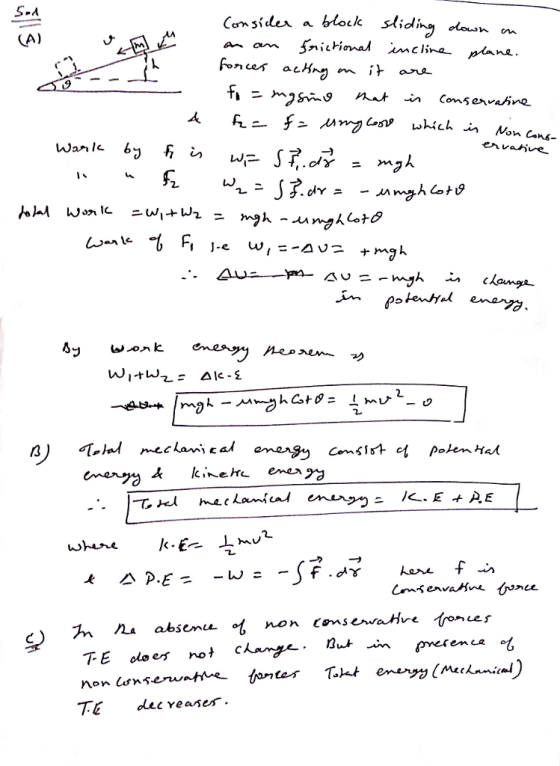
A) Give a general expression for the work done by two forces acting on an object (F1 and F2 vectors) as it moves along a trajectory. F1 is conservative, and F2 is dissipative. Your expression should include terms of kinetic and potential energies, if any, indexed during the forces. B) Define the Total Mechanical Energy C) How does it change?
Homework Answers
Add Answer to:
A) Give a general expression for the work done by two forces
acting on an object...
The mechanical energy of an object must change if: The object's kinetic energy is changing There...
The mechanical energy of an object must change if: The object's kinetic energy is changing There is a net non-conservative force acting on the object over some distance More than one non-conservative forces are acting on the object All forces acting on the object are conservative The kinetic and potential energies of the object are changing in opposite ways
Calculate the work WAB done by the electrostatic force on a particle of charge q as...
 Calculate the work WAB done by the electrostatic force on a
particle of charge q as it moves from A to B. Express your answer
in terms of some or all the variables E, q, L, and ?.
Constants Learning Goal: To review the concept of conservative forces and to understand that electrostatic forces are, in fact, conservative. Calculate the work WAB done by the electrostatic force on a particle of charge q as it moves from A to B....
Calculate the work WAB done by the electrostatic force on a
particle of charge q as it moves from A to B. Express your answer
in terms of some or all the variables E, q, L, and ?.
Constants Learning Goal: To review the concept of conservative forces and to understand that electrostatic forces are, in fact, conservative. Calculate the work WAB done by the electrostatic force on a particle of charge q as it moves from A to B....
Work Done by the Govtational Force bute the gravitational force G m./r into the integral equation...
 Work Done by the Govtational Force bute the gravitational force G m./r into the integral equation on the previous genith Y replacing and find the work done by this force df w is the work done by the gravitational for moves away from t he gravitational force positive, negative, or zero when an object in the Earth? When it moves toward the Earth? When it orbits the Earth in a circle? Part B: Conservative and Non-conservative Forces welop and understorence...
Give examples of : (a) two conservative forces, and (b) as many (but at least 3)...
Give examples of : (a) two conservative forces, and (b) as many (but at least 3) non-conservative forces as you can think of. For each example of the conservative force, give the expression for the potential energy associated with the conservative force. For each example of a non-conservative force, give a situation where non-conservative force changes the total mechanical energy of a system.
The object below, with mass M is pulled in the horizontal direction over a flat surface...
 The object below, with mass M is pulled in the horizontal
direction over a flat surface for a distance d, whose coefficient
of friction is uk.
2. The object below, with mass Mis pulled in the horizontal direction over a flat surface for a distance d, whose coefficient offriction is HK a. (5 points What is the total work done by friction? b. (5 points What is the change in thermal energy? 3. (5 points If both conservative forces and...
The object below, with mass M is pulled in the horizontal
direction over a flat surface for a distance d, whose coefficient
of friction is uk.
2. The object below, with mass Mis pulled in the horizontal direction over a flat surface for a distance d, whose coefficient offriction is HK a. (5 points What is the total work done by friction? b. (5 points What is the change in thermal energy? 3. (5 points If both conservative forces and...
Two forces are acting on an object F1: 13 N 57.5o F2: 23.5 N 12.3o Which...
Two forces are acting on an object F1: 13 N 57.5o F2: 23.5 N 12.3o Which of the following statements are true? Why? (select all that apply) A. The object could remain stationary B. The object could move with constant velocity C.The object would experience a net force D.The object would accelerate Suppose F1 in the problem above was rotated so that it pointed in exactly the opposite direction as F2. Assume F2 is unchanged in direction, and assume both...
An object, which is initially at rest on a frictionless horizontal surface, is acted upon by...
 An object, which is initially at rest on a frictionless horizontal surface, is acted upon by four constant forces F1 is 11.1 N acting due East, F2 is 28.6 N acting due North, F3 is 43.5 N acting due West, and F4 is 20.7 N acting due South. How much total work is done on the object in 3.33 seconds, if it has a mass of 18.0 kg? Number Units Which type of energy is changing for the object while...
An object, which is initially at rest on a frictionless horizontal surface, is acted upon by...
 An object, which is initially at rest on a frictionless horizontal surface, is acted upon by four constant forces F1 is 14.6 N acting due East, F2 is 28.6 N acting due North, F3 is 52.1 N acting due West, and F4 is 17.4 N acting due South. How much total work is done on the object in 2.22 seconds, if it has a mass of 14.0 kg? Number Units Which type of energy is changing for the object while...
Due Date: 11-21-19 Name: Jcninct pour Activity 7.3 Work Done by Common Forces, Conservative and Non-conservative...
 Due Date: 11-21-19 Name: Jcninct pour Activity 7.3 Work Done by Common Forces, Conservative and Non-conservative Forces, Potential and Internal Energy, and the Conservation of Energy 20 Points Text Reference: Ch.7.4-7.7.8.1-8.4.13.6 Part A: Work Done by Common Forces Discussion In this section, the goal is not to find numerical values for the work done by common forces, but to obtain simplified expressions for this work. Often, the magnitudes and directions or components of these common forces are known and unvarying...
Two forces act simultaneously on an object while it moves 2.82 m in a straight line...
Two forces act simultaneously on an object while it moves 2.82 m in a straight line on a horizontal surface. No other forces are acting. The forces are parallel to the surface and cause the kinetic energy of the object to change from 114 J to 222 J. If one of the forces is 155 N, what is the second force?
 Calculate the work WAB done by the electrostatic force on a
particle of charge q as it moves from A to B. Express your answer
in terms of some or all the variables E, q, L, and ?.
Constants Learning Goal: To review the concept of conservative forces and to understand that electrostatic forces are, in fact, conservative. Calculate the work WAB done by the electrostatic force on a particle of charge q as it moves from A to B....
Calculate the work WAB done by the electrostatic force on a
particle of charge q as it moves from A to B. Express your answer
in terms of some or all the variables E, q, L, and ?.
Constants Learning Goal: To review the concept of conservative forces and to understand that electrostatic forces are, in fact, conservative. Calculate the work WAB done by the electrostatic force on a particle of charge q as it moves from A to B....
 Work Done by the Govtational Force bute the gravitational force G m./r into the integral equation on the previous genith Y replacing and find the work done by this force df w is the work done by the gravitational for moves away from t he gravitational force positive, negative, or zero when an object in the Earth? When it moves toward the Earth? When it orbits the Earth in a circle? Part B: Conservative and Non-conservative Forces welop and understorence...
 The object below, with mass M is pulled in the horizontal
direction over a flat surface for a distance d, whose coefficient
of friction is uk.
2. The object below, with mass Mis pulled in the horizontal direction over a flat surface for a distance d, whose coefficient offriction is HK a. (5 points What is the total work done by friction? b. (5 points What is the change in thermal energy? 3. (5 points If both conservative forces and...
The object below, with mass M is pulled in the horizontal
direction over a flat surface for a distance d, whose coefficient
of friction is uk.
2. The object below, with mass Mis pulled in the horizontal direction over a flat surface for a distance d, whose coefficient offriction is HK a. (5 points What is the total work done by friction? b. (5 points What is the change in thermal energy? 3. (5 points If both conservative forces and...
 An object, which is initially at rest on a frictionless horizontal surface, is acted upon by four constant forces F1 is 11.1 N acting due East, F2 is 28.6 N acting due North, F3 is 43.5 N acting due West, and F4 is 20.7 N acting due South. How much total work is done on the object in 3.33 seconds, if it has a mass of 18.0 kg? Number Units Which type of energy is changing for the object while...
 An object, which is initially at rest on a frictionless horizontal surface, is acted upon by four constant forces F1 is 14.6 N acting due East, F2 is 28.6 N acting due North, F3 is 52.1 N acting due West, and F4 is 17.4 N acting due South. How much total work is done on the object in 2.22 seconds, if it has a mass of 14.0 kg? Number Units Which type of energy is changing for the object while...
 Due Date: 11-21-19 Name: Jcninct pour Activity 7.3 Work Done by Common Forces, Conservative and Non-conservative Forces, Potential and Internal Energy, and the Conservation of Energy 20 Points Text Reference: Ch.7.4-7.7.8.1-8.4.13.6 Part A: Work Done by Common Forces Discussion In this section, the goal is not to find numerical values for the work done by common forces, but to obtain simplified expressions for this work. Often, the magnitudes and directions or components of these common forces are known and unvarying...
Most questions answered within 3 hours.
-
Where is the error in this code sequence?
String s1 = "Hello";
String s2 = "ello";...
asked 10 months ago -
Financial data for Joel de Paris, Inc., for last year
follow:
Joel de Paris, Inc.
Balance...
asked 10 months ago -
Consider this reaction:
Al2(SO4)3 (aq)+ BaCl3
(aq) Al2Cl6 (aq)- +
3BaSO4(s) . What is the...
asked 10 months ago -
Suppose that Savneet is considering increasing her
recent random sample from 20 car rentals to 40...
asked 10 months ago -
Trucks arrive at an unloading terminal at an average rate of 120
per hour.
Trucks arrive...
asked 10 months ago -
Why are methanol and ethanol completely soluble in water while
octanol is not very little soluble....
asked 10 months ago -
A facilities manager at a university reads in a research report
that the mean amount of...
asked 10 months ago -
When the CuSO4 is rehydrated by adding water to the anhydrous
compound, is this an endothermic...
asked 10 months ago -
A ray of sunlight is passing from diamond into crown glass; the
angle of incidence is...
asked 10 months ago -
A block of mass 0.249 kg is placed on top of a light, vertical
spring of...
asked 10 months ago -
how do the kidneys compensate in the presences of acidosis
a) trigger hyperventilate
b) reserve acid...
asked 10 months ago -
Question 501 pts
The rental rate of capital to the firm increases. Which of the
following...
asked 10 months ago