
Homework Answers
![Given Shaw +6f → [ShF6] 2- complete cell Half cell reactins- [Snp6]?+e- →Sno tofaq E°N) = reaction shtetas tte. ~> Sn(s). EW](http://img.homeworklib.com/questions/d2db18a0-3fe7-11eb-a518-a7522710e6b8.png?x-oss-process=image/resize,w_560)
Add Answer to:
D Question 39 1 pts Given the information below, calculate the equilibrium constant of the reaction:...
show and explain work please 6. Calculate the equilibrium constant at 25°C for the following reaction:...
 show and explain work please
6. Calculate the equilibrium constant at 25°C for the following reaction: Cd(s) + Sn** (aq) → Cd²+ (aq) + Sn(s) K = 6.3 x 10⁸
show and explain work please
6. Calculate the equilibrium constant at 25°C for the following reaction: Cd(s) + Sn** (aq) → Cd²+ (aq) + Sn(s) K = 6.3 x 10⁸
Calculate the equilibrium constant for each of the reactions at 25∘C. Standard Electrode Potentials at 25...
Calculate the equilibrium constant for each of the reactions at 25∘C. Standard Electrode Potentials at 25 ∘C Reduction Half-Reaction E∘(V) Fe3+(aq)+3e− →Fe(s) -0.036 Sn2+(aq)+2e− →Sn(s) -0.14 Ni2+(aq)+2e− →Ni(s) -0.23 O2(g)+2H2O(l)+4e− →4OH−(aq) 0.40 Br2(l)+2e− →2Br− 1.09 I2(s)+2e− →2I− 0.54 A) 2Fe3+(aq)+3Sn(s)→2Fe(s)+3Sn2+(aq) (answers are not 4.1x10^5, 3.3x10^3, 2.7x10^10, or 2.6x10^10) B) O2(g)+2H2O(l)+2Ni(s)→4OH−(aq)+2Ni2+(aq) C) Br2(l)+2I−(aq)→2Br−(aq)+I2(s) (answer is not 1.7x10^18)
The equilibrium constant, K, for a redox reaction is related to the standard potential, Eº, by...
 The equilibrium constant, K, for a redox reaction is related to the standard potential, Eº, by the equation In K = nFE° RT where n is the number of moles of electrons transferred, F (the Faraday constant) is equal to 96,500 C/(mol e), R (the gas constant) is equal to 8.314 J/(mol · K), and T is the Kelvin temperature. Standard reduction potentials Reduction half-reaction E° (V) Ag+ (aq) + e +Ag(s) 0.80 Cu²+ (aq) + 2e + Cu(s) 0.34...
B3438 QUESTION 24 What is the equilibrium constant (K) at 350 K for the following reaction?...
 B3438 QUESTION 24 What is the equilibrium constant (K) at 350 K for the following reaction? (R= 8.314 J/K.mol, F = 96,500 C-moll) Sn2+ (aq) + Fe(s) Sn(s) + Fe2+(aq) E cell = 0.35 V O 7.1 x 10⁻¹¹ 1.2 x 10¹⁰ 1.2 x 10⁵ 8.6 x 10- 2.3 1023 QUESTION 30 A chemist adds substance A and B to a reaction flask and allows equilibrium to establish A+B=CKc= 1.5 x 10⁻²⁵ Which of the following describe the contents of...
Question 9 1 pts What is the reaction quotient (Q) for the equilibrium TISCN(s) Tit(aq) +...
 Question 9 1 pts What is the reaction quotient (Q) for the equilibrium TISCN(s) Tit(aq) + SCN*(aq) when 0.1837 L of 1.265 x 10⁻² M Tit is combined with 0.1335 L of 4.216 x 10⁻⁴ M SCN" in the presence of an excess of TISCN(s)? O 1.3 x 10⁻⁶ 5.333 x 10- 1.308 x 10⁻⁶ 4.123 x 10⁻⁶ 0 5.366 x 10⁻⁶
Question 10 1 pts For the reaction Cu2S(s) =2Cu* (aq) +52-(aq), the equilibrium concentrations are as...
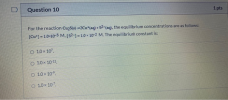 Question 10 1 pts For the reaction Cu2S(s) =2Cu* (aq) +52-(aq), the equilibrium concentrations are as follows: (Cut) = 1.0~10-5 M, [52-)- 10 x 10-2 M. The equilibrium constant is: 1.0 x 10⁷ 1.0 x 10⁻¹² O 1.0x 10 % 1.0 x 10⁷.
Question 8 1 pts Which equilibrium constant represents a reaction that favors the reactants to the...
 Question 8 1 pts Which equilibrium constant represents a reaction that favors the reactants to the greatest extent? O keq = 1.0 x 10⁻³ o Keq=100 O keq = 1.0 x 10⁻¹⁸ Keq = 1.0 x 10 Previous
Question 10 3.03 pts Use the standard reduction potenital to calculate equilibrium constants for the following...
 Question 10 3.03 pts Use the standard reduction potenital to calculate equilibrium constants for the following reaction at 298.15 K. AgCl(s) Ag+ (aq) +CH(aq) Ag+ (aq) +eAg(s) E° =0.7996 VAgCl(s) + e - Ag(s) + CH(aq) E° = 0.22233 V OK-5.2 x 10% spontaneous OK=3.8 x 10nonspontaneous N O K=1.7 x 10⁻¹⁰ nonspontaneous
19.03 pts Question 10 Use the standard reduction potenital to calculate equilibrium constants for the following...
 19.03 pts Question 10 Use the standard reduction potenital to calculate equilibrium constants for the following reaction at 298.15 K. AgCl (s) Ag+ (aq) +Cl- (aq) Ag+ (aq) +Ag(s) E° = 0.7996 V AgCl(s) + e - Ag(s) + CH- (aq) E° = 0.22233 V O K=5.2 x 10⁵ spontaneous O K = 3.8 x 10"nonspontaneous K - 1.7 x 10⁻¹⁰ nonspontaneous
D Question 4 1 pts The reaction shown is at equilibrium. If a student adds more...
 D Question 4 1 pts The reaction shown is at equilibrium. If a student adds more X to the system, what happens immediately (at that instant) to Q and K? X Y Z Both decrease Both increase O Qgets larger and gets smaller K gets larger and gets smaller Kremains constant and increases Kremains constant and a decreases 1 pts Question 5 You have a saturated solution of Ca(OH)2 in a flask, meaning there is some solid CaOH)2 sitting at...
 show and explain work please
6. Calculate the equilibrium constant at 25°C for the following reaction: Cd(s) + Sn** (aq) → Cd²+ (aq) + Sn(s) K = 6.3 x 10⁸
show and explain work please
6. Calculate the equilibrium constant at 25°C for the following reaction: Cd(s) + Sn** (aq) → Cd²+ (aq) + Sn(s) K = 6.3 x 10⁸
 The equilibrium constant, K, for a redox reaction is related to the standard potential, Eº, by the equation In K = nFE° RT where n is the number of moles of electrons transferred, F (the Faraday constant) is equal to 96,500 C/(mol e), R (the gas constant) is equal to 8.314 J/(mol · K), and T is the Kelvin temperature. Standard reduction potentials Reduction half-reaction E° (V) Ag+ (aq) + e +Ag(s) 0.80 Cu²+ (aq) + 2e + Cu(s) 0.34...
 B3438 QUESTION 24 What is the equilibrium constant (K) at 350 K for the following reaction? (R= 8.314 J/K.mol, F = 96,500 C-moll) Sn2+ (aq) + Fe(s) Sn(s) + Fe2+(aq) E cell = 0.35 V O 7.1 x 10⁻¹¹ 1.2 x 10¹⁰ 1.2 x 10⁵ 8.6 x 10- 2.3 1023 QUESTION 30 A chemist adds substance A and B to a reaction flask and allows equilibrium to establish A+B=CKc= 1.5 x 10⁻²⁵ Which of the following describe the contents of...
 Question 9 1 pts What is the reaction quotient (Q) for the equilibrium TISCN(s) Tit(aq) + SCN*(aq) when 0.1837 L of 1.265 x 10⁻² M Tit is combined with 0.1335 L of 4.216 x 10⁻⁴ M SCN" in the presence of an excess of TISCN(s)? O 1.3 x 10⁻⁶ 5.333 x 10- 1.308 x 10⁻⁶ 4.123 x 10⁻⁶ 0 5.366 x 10⁻⁶
 Question 10 1 pts For the reaction Cu2S(s) =2Cu* (aq) +52-(aq), the equilibrium concentrations are as follows: (Cut) = 1.0~10-5 M, [52-)- 10 x 10-2 M. The equilibrium constant is: 1.0 x 10⁷ 1.0 x 10⁻¹² O 1.0x 10 % 1.0 x 10⁷.
 Question 8 1 pts Which equilibrium constant represents a reaction that favors the reactants to the greatest extent? O keq = 1.0 x 10⁻³ o Keq=100 O keq = 1.0 x 10⁻¹⁸ Keq = 1.0 x 10 Previous
 Question 10 3.03 pts Use the standard reduction potenital to calculate equilibrium constants for the following reaction at 298.15 K. AgCl(s) Ag+ (aq) +CH(aq) Ag+ (aq) +eAg(s) E° =0.7996 VAgCl(s) + e - Ag(s) + CH(aq) E° = 0.22233 V OK-5.2 x 10% spontaneous OK=3.8 x 10nonspontaneous N O K=1.7 x 10⁻¹⁰ nonspontaneous
 19.03 pts Question 10 Use the standard reduction potenital to calculate equilibrium constants for the following reaction at 298.15 K. AgCl (s) Ag+ (aq) +Cl- (aq) Ag+ (aq) +Ag(s) E° = 0.7996 V AgCl(s) + e - Ag(s) + CH- (aq) E° = 0.22233 V O K=5.2 x 10⁵ spontaneous O K = 3.8 x 10"nonspontaneous K - 1.7 x 10⁻¹⁰ nonspontaneous
 D Question 4 1 pts The reaction shown is at equilibrium. If a student adds more X to the system, what happens immediately (at that instant) to Q and K? X Y Z Both decrease Both increase O Qgets larger and gets smaller K gets larger and gets smaller Kremains constant and increases Kremains constant and a decreases 1 pts Question 5 You have a saturated solution of Ca(OH)2 in a flask, meaning there is some solid CaOH)2 sitting at...
Most questions answered within 3 hours.
-
Where is the error in this code sequence?
String s1 = "Hello";
String s2 = "ello";...
asked 10 months ago -
Financial data for Joel de Paris, Inc., for last year
follow:
Joel de Paris, Inc.
Balance...
asked 10 months ago -
Consider this reaction:
Al2(SO4)3 (aq)+ BaCl3
(aq) Al2Cl6 (aq)- +
3BaSO4(s) . What is the...
asked 10 months ago -
Suppose that Savneet is considering increasing her
recent random sample from 20 car rentals to 40...
asked 10 months ago -
Trucks arrive at an unloading terminal at an average rate of 120
per hour.
Trucks arrive...
asked 10 months ago -
Why are methanol and ethanol completely soluble in water while
octanol is not very little soluble....
asked 10 months ago -
A facilities manager at a university reads in a research report
that the mean amount of...
asked 10 months ago -
When the CuSO4 is rehydrated by adding water to the anhydrous
compound, is this an endothermic...
asked 10 months ago -
A ray of sunlight is passing from diamond into crown glass; the
angle of incidence is...
asked 10 months ago -
A block of mass 0.249 kg is placed on top of a light, vertical
spring of...
asked 10 months ago -
how do the kidneys compensate in the presences of acidosis
a) trigger hyperventilate
b) reserve acid...
asked 10 months ago -
Question 501 pts
The rental rate of capital to the firm increases. Which of the
following...
asked 10 months ago