
Homework Answers

Add Answer to:
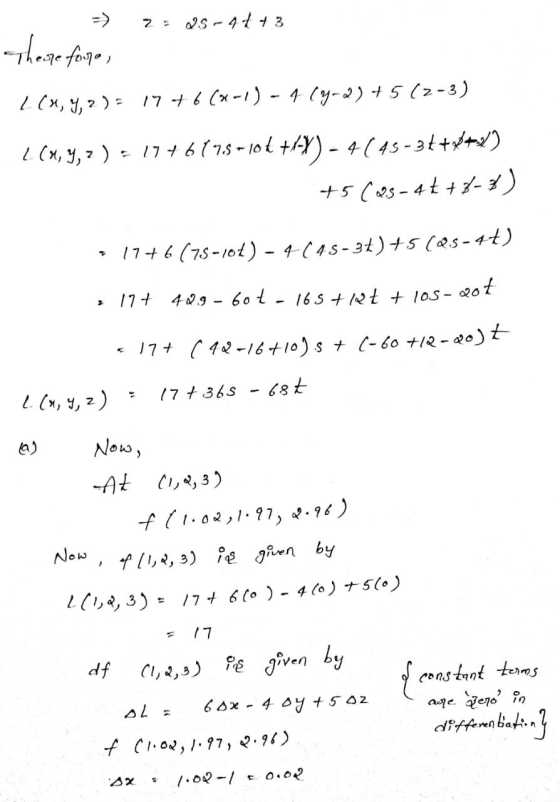
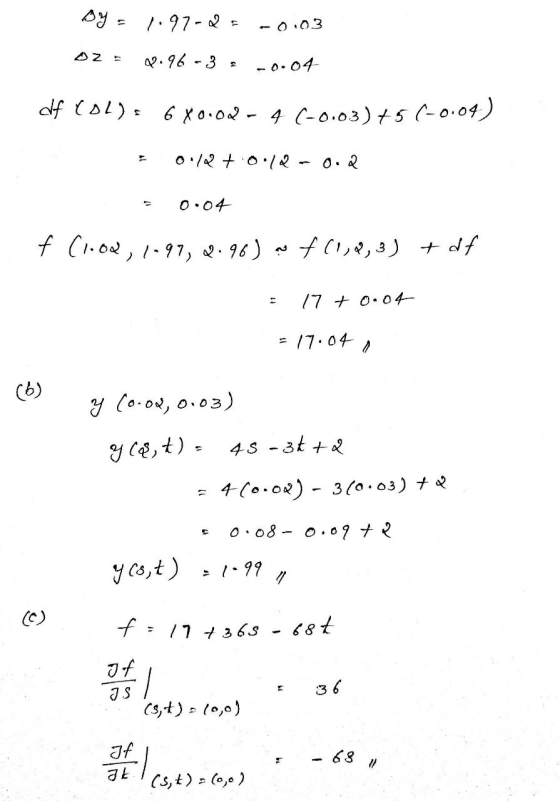
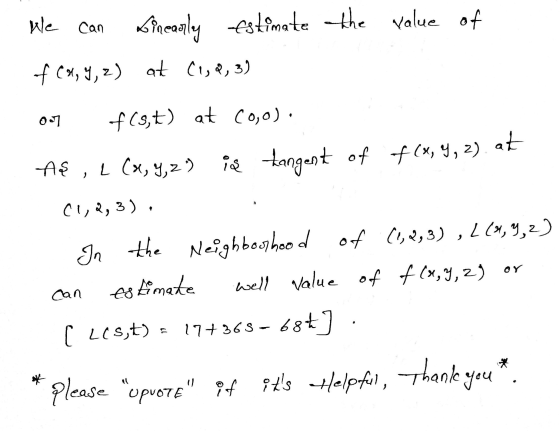
2. Suppose the linear approximation of a differentiable function f(x, y, z) at the point (1,2,3)...
(a) Suppose the equation defines a differentiable function y-f(z) (0) Find the derivatint ()-(e,l) (ii) Write the linear approximation for f(x) around a = e and use this to approx- dy Hence, e T,y 5...
 (a) Suppose the equation defines a differentiable function y-f(z) (0) Find the derivatint ()-(e,l) (ii) Write the linear approximation for f(x) around a = e and use this to approx- dy Hence, e T,y 5 marks imate f(3). markS (b) Evaluate the following limits. Simplify your results if possible. 5 marks 5 marks] lim cot 5x sin 6x cos 7a (i) (ii) limIn
(a) Suppose the equation defines a differentiable function y-f(z) (0) Find the derivatint ()-(e,l) (ii) Write the...
(a) Suppose the equation defines a differentiable function y-f(z) (0) Find the derivatint ()-(e,l) (ii) Write the linear approximation for f(x) around a = e and use this to approx- dy Hence, e T,y 5 marks imate f(3). markS (b) Evaluate the following limits. Simplify your results if possible. 5 marks 5 marks] lim cot 5x sin 6x cos 7a (i) (ii) limIn
(a) Suppose the equation defines a differentiable function y-f(z) (0) Find the derivatint ()-(e,l) (ii) Write the...
If z = f(x,y), where f is differentiable, and x = g(t) y = hết) g(3)...
 If z = f(x,y), where f is differentiable, and x = g(t) y = hết) g(3) = 2 h(3) = 7 g'(3) = 5 h'(3) = -4 fx(2,7) = 6 fy(2,7) = -8 Find dz/dt when t = 3.
Given f(x, y, z) = 4yz - x2, and that x, y, z are each differentiable...
 Given f(x, y, z) = 4yz - x2, and that x, y, z are each differentiable functions of u and v. Suppose (x, y, z) = (-1,0,1) at (u, v) = (1, 2), and that af 09 = 70. au |(1,2) = -50 and av (1,2) What is the value of x,(1, 2)? a) 230/3 b)-230/3 c) 40 d) 110 e) -120
6. (10 points) (a) (6 points) The gradient of the function o(x, y, z) at (1,2,3)...
 6. (10 points) (a) (6 points) The gradient of the function o(x, y, z) at (1,2,3) is the vector (2, 1, 1) and g(1,2,3) = 1 (1) (2 points) Find the equation of the tangent plane of the level surface g(r, y, z) = 1 at (1,2,3) (ii) (2 points) Find the maximum rate of change of g(x, y, z) at (1, 2, 3). hax. rarte ot change: 23 14 (iii) (2 points) Find the rate of change of g...
3. DO NOT USE CALCULATOR for this problem! Find the EXACT VALUES for all the parts. Given the function f(x,y) (a) Calculate the total differential of z at the point (x, y, z) (b) Use the total dif...
 3. DO NOT USE CALCULATOR for this problem! Find the EXACT VALUES for all the parts. Given the function f(x,y) (a) Calculate the total differential of z at the point (x, y, z) (b) Use the total differential to estimate the value of f(1+2(10200),-1 3(10-200). [ Hint : dz= 2(10-200) dy=_3(10-200)]. (c) Calculate the exact diffe ( f(1.-) I Note: total differentiala exact difference. ] rence of f(1+2(10-200)10 200))- (d) Find an equation for the plane s-L(x,y) tangent t(:-: f(z,y)...
true or false is zero. F 9. The plane tangent to the surface za the point (0,0, 3) is given by the equation 2x - 12y -z+3-0. 10. If f is a differentiable function and zf(x -y), then z +. T 11. If...
 true or false
is zero. F 9. The plane tangent to the surface za the point (0,0, 3) is given by the equation 2x - 12y -z+3-0. 10. If f is a differentiable function and zf(x -y), then z +. T 11. If a unit vector u makes the angle of π/4 with the gradient ▽f(P), the directional derivative Duf(P) is equal to |Vf(P)I/2. F 12. There is a point on the hyperboloid 2 -y is parallel to the plane...
true or false
is zero. F 9. The plane tangent to the surface za the point (0,0, 3) is given by the equation 2x - 12y -z+3-0. 10. If f is a differentiable function and zf(x -y), then z +. T 11. If a unit vector u makes the angle of π/4 with the gradient ▽f(P), the directional derivative Duf(P) is equal to |Vf(P)I/2. F 12. There is a point on the hyperboloid 2 -y is parallel to the plane...
Question 6 6 pts Suppose that f(x, y, z) is a scalar-valued function and F(x, y,...
 Question 6 6 pts Suppose that f(x, y, z) is a scalar-valued function and F(x, y, z) = (P(x, y, z), Q(2,y,z), R(x, y, z)) is a vector field. If P, Q, R, and f all have continuous partial derivatives, then which of the following equations is invalid? O curl (aF) N21 = a curl F for any positive integer Q. REC o div (fF) = fdiv F+FVF Odiv curl F = 0 O grad div f = div grad...
8 pts Question 3 Consider the function f(x,y, 2)(x 1)3(y2)3 ( 1)2(y2)2(z 3)2 (a) Compute the...
 8 pts Question 3 Consider the function f(x,y, 2)(x 1)3(y2)3 ( 1)2(y2)2(z 3)2 (a) Compute the increment Af if (r,y, z) changes from (1,2,3 (b) Compute the differential df for the corresponding change in position. What does (2,3,4) to this say about the point (1, 2,3)? ( 13y2)3 ( 1)2(y 2)2(z 3)2 with C (c) Consider the contour C = a constant. Use implicit differentiation to compute dz/Ox. Your answer should be a function of z. (d) Find the unit...
1. In the following function, evaluate the derivatives i-iii below: f(w,x,y,z)=3xy5 + w2z4/(16y) - xy3z/w2 ...
1. In the following function, evaluate the derivatives i-iii below: f(w,x,y,z)=3xy5 + w2z4/(16y) - xy3z/w2 i) (dF/dx)w,y,z ii) (dF/dy)w,x,z iii) [d/dz (dF/dx)w,y,z]w,x,y
4. Suppose you are given an equation of the form F(x, y,z) 0. Then we can say that each of the variables is defined implicitly as a function of the others. 2 a) If F and z(x, y) are both assumed to b...
 4. Suppose you are given an equation of the form F(x, y,z) 0. Then we can say that each of the variables is defined implicitly as a function of the others. 2 a) If F and z(x, y) are both assumed to be differentiable, fnd in terms of partial derivatives of F. b) Under similar assumptions on the other variables, find
4. Suppose you are given an equation of the form F(x, y,z) 0. Then we can say that each...
4. Suppose you are given an equation of the form F(x, y,z) 0. Then we can say that each of the variables is defined implicitly as a function of the others. 2 a) If F and z(x, y) are both assumed to be differentiable, fnd in terms of partial derivatives of F. b) Under similar assumptions on the other variables, find
4. Suppose you are given an equation of the form F(x, y,z) 0. Then we can say that each...
 (a) Suppose the equation defines a differentiable function y-f(z) (0) Find the derivatint ()-(e,l) (ii) Write the linear approximation for f(x) around a = e and use this to approx- dy Hence, e T,y 5 marks imate f(3). markS (b) Evaluate the following limits. Simplify your results if possible. 5 marks 5 marks] lim cot 5x sin 6x cos 7a (i) (ii) limIn
(a) Suppose the equation defines a differentiable function y-f(z) (0) Find the derivatint ()-(e,l) (ii) Write the...
(a) Suppose the equation defines a differentiable function y-f(z) (0) Find the derivatint ()-(e,l) (ii) Write the linear approximation for f(x) around a = e and use this to approx- dy Hence, e T,y 5 marks imate f(3). markS (b) Evaluate the following limits. Simplify your results if possible. 5 marks 5 marks] lim cot 5x sin 6x cos 7a (i) (ii) limIn
(a) Suppose the equation defines a differentiable function y-f(z) (0) Find the derivatint ()-(e,l) (ii) Write the...
 If z = f(x,y), where f is differentiable, and x = g(t) y = hết) g(3) = 2 h(3) = 7 g'(3) = 5 h'(3) = -4 fx(2,7) = 6 fy(2,7) = -8 Find dz/dt when t = 3.
 Given f(x, y, z) = 4yz - x2, and that x, y, z are each differentiable functions of u and v. Suppose (x, y, z) = (-1,0,1) at (u, v) = (1, 2), and that af 09 = 70. au |(1,2) = -50 and av (1,2) What is the value of x,(1, 2)? a) 230/3 b)-230/3 c) 40 d) 110 e) -120
 6. (10 points) (a) (6 points) The gradient of the function o(x, y, z) at (1,2,3) is the vector (2, 1, 1) and g(1,2,3) = 1 (1) (2 points) Find the equation of the tangent plane of the level surface g(r, y, z) = 1 at (1,2,3) (ii) (2 points) Find the maximum rate of change of g(x, y, z) at (1, 2, 3). hax. rarte ot change: 23 14 (iii) (2 points) Find the rate of change of g...
 3. DO NOT USE CALCULATOR for this problem! Find the EXACT VALUES for all the parts. Given the function f(x,y) (a) Calculate the total differential of z at the point (x, y, z) (b) Use the total differential to estimate the value of f(1+2(10200),-1 3(10-200). [ Hint : dz= 2(10-200) dy=_3(10-200)]. (c) Calculate the exact diffe ( f(1.-) I Note: total differentiala exact difference. ] rence of f(1+2(10-200)10 200))- (d) Find an equation for the plane s-L(x,y) tangent t(:-: f(z,y)...
 true or false
is zero. F 9. The plane tangent to the surface za the point (0,0, 3) is given by the equation 2x - 12y -z+3-0. 10. If f is a differentiable function and zf(x -y), then z +. T 11. If a unit vector u makes the angle of π/4 with the gradient ▽f(P), the directional derivative Duf(P) is equal to |Vf(P)I/2. F 12. There is a point on the hyperboloid 2 -y is parallel to the plane...
true or false
is zero. F 9. The plane tangent to the surface za the point (0,0, 3) is given by the equation 2x - 12y -z+3-0. 10. If f is a differentiable function and zf(x -y), then z +. T 11. If a unit vector u makes the angle of π/4 with the gradient ▽f(P), the directional derivative Duf(P) is equal to |Vf(P)I/2. F 12. There is a point on the hyperboloid 2 -y is parallel to the plane...
 Question 6 6 pts Suppose that f(x, y, z) is a scalar-valued function and F(x, y, z) = (P(x, y, z), Q(2,y,z), R(x, y, z)) is a vector field. If P, Q, R, and f all have continuous partial derivatives, then which of the following equations is invalid? O curl (aF) N21 = a curl F for any positive integer Q. REC o div (fF) = fdiv F+FVF Odiv curl F = 0 O grad div f = div grad...
 8 pts Question 3 Consider the function f(x,y, 2)(x 1)3(y2)3 ( 1)2(y2)2(z 3)2 (a) Compute the increment Af if (r,y, z) changes from (1,2,3 (b) Compute the differential df for the corresponding change in position. What does (2,3,4) to this say about the point (1, 2,3)? ( 13y2)3 ( 1)2(y 2)2(z 3)2 with C (c) Consider the contour C = a constant. Use implicit differentiation to compute dz/Ox. Your answer should be a function of z. (d) Find the unit...
 4. Suppose you are given an equation of the form F(x, y,z) 0. Then we can say that each of the variables is defined implicitly as a function of the others. 2 a) If F and z(x, y) are both assumed to be differentiable, fnd in terms of partial derivatives of F. b) Under similar assumptions on the other variables, find
4. Suppose you are given an equation of the form F(x, y,z) 0. Then we can say that each...
4. Suppose you are given an equation of the form F(x, y,z) 0. Then we can say that each of the variables is defined implicitly as a function of the others. 2 a) If F and z(x, y) are both assumed to be differentiable, fnd in terms of partial derivatives of F. b) Under similar assumptions on the other variables, find
4. Suppose you are given an equation of the form F(x, y,z) 0. Then we can say that each...
Most questions answered within 3 hours.
-
Where is the error in this code sequence?
String s1 = "Hello";
String s2 = "ello";...
asked 10 months ago -
Financial data for Joel de Paris, Inc., for last year
follow:
Joel de Paris, Inc.
Balance...
asked 10 months ago -
Consider this reaction:
Al2(SO4)3 (aq)+ BaCl3
(aq) Al2Cl6 (aq)- +
3BaSO4(s) . What is the...
asked 10 months ago -
Suppose that Savneet is considering increasing her
recent random sample from 20 car rentals to 40...
asked 10 months ago -
Trucks arrive at an unloading terminal at an average rate of 120
per hour.
Trucks arrive...
asked 10 months ago -
Why are methanol and ethanol completely soluble in water while
octanol is not very little soluble....
asked 10 months ago -
A facilities manager at a university reads in a research report
that the mean amount of...
asked 10 months ago -
When the CuSO4 is rehydrated by adding water to the anhydrous
compound, is this an endothermic...
asked 10 months ago -
A ray of sunlight is passing from diamond into crown glass; the
angle of incidence is...
asked 10 months ago -
A block of mass 0.249 kg is placed on top of a light, vertical
spring of...
asked 10 months ago -
how do the kidneys compensate in the presences of acidosis
a) trigger hyperventilate
b) reserve acid...
asked 10 months ago -
Question 501 pts
The rental rate of capital to the firm increases. Which of the
following...
asked 10 months ago