Chromel is an alloy composed of nickel, iron, and chromium. A 0.6445-g sample was dissolved and...
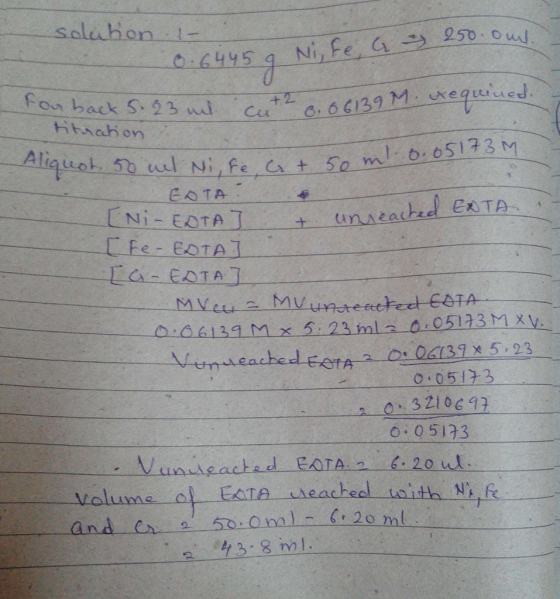
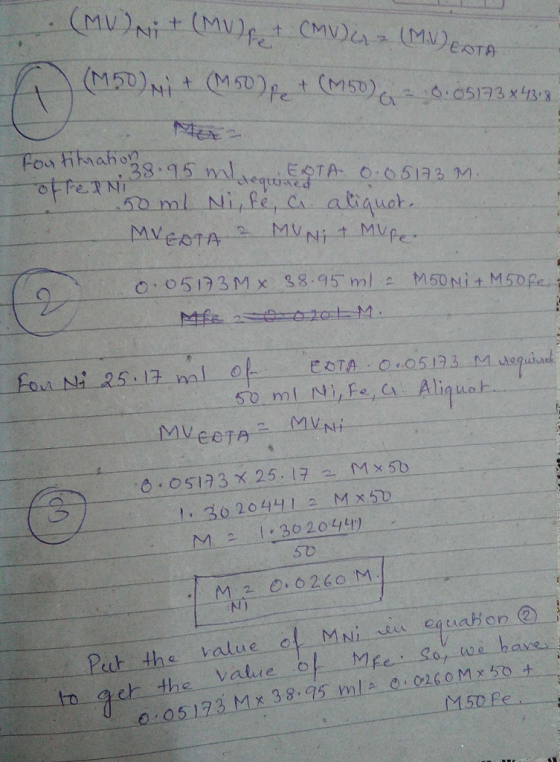
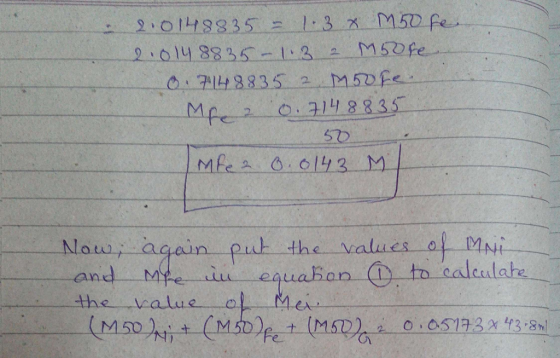
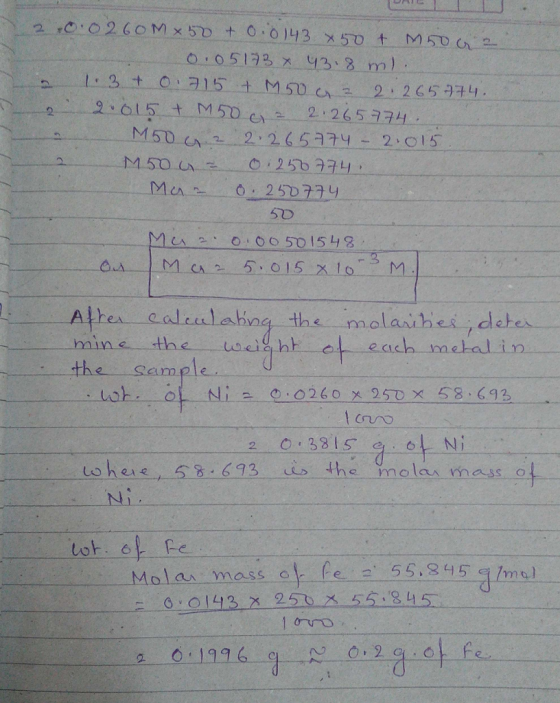
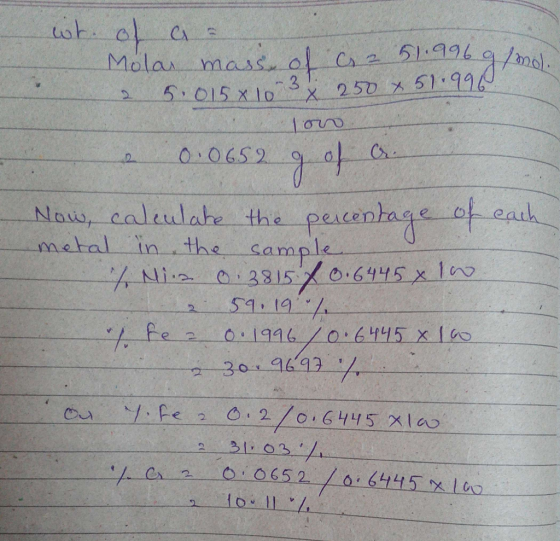
Chromel is an alloy composed of nickel, iron, and chromium. A 0.6445-g sample was dissolved and diluted to 250.0 mL. When a 50.00-mL aliquot of 0.05173 M EDTA was mixed with an equal volume of the diluted sample, all three ions were chelated, and a 5.23-mL back-titration with 0.06139 M copper(II) was required. The chromium in a second 50.0-mL aliquot was masked through the addition of hexamethylenetetramine; titration of the Fe and Ni required 38.95 mL of 0.05173 M EDTA. Iron and chromium were masked with pyrophosphate in a third 50.0-mL aliquot, and the nickel was titrated with 25.17 mL of the EDTA solution. Calculate the percentages of nickel, chromium, and iron in the alloy.
Homework Answers
Add Answer to:
Chromel is an alloy composed of nickel, iron, and chromium. A
0.6445-g sample was dissolved and...
A 0.3304-g sample of brass (containing lead, zinc, copper, and tin) was dissolved in nitric acid....
A 0.3304-g sample of brass (containing lead, zinc, copper, and tin) was dissolved in nitric acid. The sparingly soluble SnO2.4H2O was removed by filtration, and the combined filtrate and washings were then diluted to 500.0 mL. A 10.00-mL aliquot was suitably buffered; titration of the lead, zinc, and copper in this aliquot required 34.78 mL of 0.002700 M EDTA. The copper in a 25.00-mL aliquot was masked with thiosulfate; the lead and zinc were then titrated with 25.62 mL of...
A 0.6004 g sample of Ni/Cu condenser tubing was dissolved in acid and diluted to 100.0...
A 0.6004 g sample of Ni/Cu condenser tubing was dissolved in acid and diluted to 100.0 mL via a volumetric flask. Titration of both cations in a 25.00 mL aliquot of this solution required 45.81 mL of 0.05285 M EDTA. Mercaptoacetic acid and NH3 were then introduced; production of the Cu complex with the former resulted in the release of an equivalent amount of EDTA, which required a 22.85 mL titration with 0.07238 M Mg2+. Calculate the percentages of Cu...
EBTA TItration Q3. A 1. volumetric flask. A 50.00-ml aliquot of the diluted solution was brought...
 EBTA TItration Q3. A 1. volumetric flask. A 50.00-ml aliquot of the diluted solution was brought to a pH of 10.0 with a NH NH buffer; the subsequent titration involved both cations and required 28.89 ml of 0.06950 M EDTA. A secand 50.00-mL aliquot was brought to a pH of 10.0 with an HCN/NaCN buffer, which also served to mask the Cd? 11.56 mL of the EDTA solution were needed to titrate the Pb*, Calculate the percent Pb and Cd...
A 0.4505 g sample of pewter, containing tin, lead, copper, and zinc, was dissolved in acid....
A 0.4505 g sample of pewter, containing tin, lead, copper, and zinc, was dissolved in acid. Tin was precipitated as SnO2⋅4H2Oand removed by filtration. The resulting filtrate and washings were diluted to a total volume of 250.0 mL. A 15.00 mL aliquot of this solution was buffered, and titration of the lead, copper, and zinc in solution required 35.10 mL of 0.001497 M EDTA. Thiosulfate was used to mask the copper in a second 20.00 mL aliquot. Titration of the...
A 0.4504 g sample of pewter, containing tin, lead, copper, and zinc, was dissolved in acid....
A 0.4504 g sample of pewter, containing tin, lead, copper, and zinc, was dissolved in acid. Tin was precipitated as SnO2⋅4H2O and removed by filtration. The resulting filtrate and washings were diluted to a total volume of 250.0 mL. A 15.00 mL aliquot of this solution was buffered, and titration of the lead, copper, and zinc in solution required 35.78 mL of 0.001478 M EDTA. Thiosulfate was used to mask the copper in a second 20.00 mL aliquot. Titration of...
A 0.4598 g sample of pewter, containing tin, lead, copper, and zinc, was dissolved in acid....
A 0.4598 g sample of pewter, containing tin, lead, copper, and zinc, was dissolved in acid. Tin was precipitated as SnO2·4H2O and removed by filtration. The resulting filtrate and washings were diluted to a total volume of 250.0 mL. A 20.00 mL aliquot of this solution was buffered, and titration of the lead, copper, and zinc in solution required 34.81 mL of 0.001487 M EDTA. Thiosulfate was used to mask the copper in a second 25.00 mL aliquot. Titration of...
1.)A 1.998-g sample containing Cl' and CIO," was dissolved in sufficient water to give 250.0 mL...
 1.)A 1.998-g sample containing Cl' and CIO," was dissolved in sufficient water to give 250.0 mL of solution. A 50.00-ml aliquot required 13.97 mL of 0.08551 M AgNO3 to titrate the CI'. A second 50.00-ml aliquot was treated with V2(SO4)3 to reduce the CIOA to Cl": CIO:+4V2(SO)) + 4H20 C1 + 1250,2 +8VO2 + 8H Titration of the reduced sample required 40.12 mL of the AgNO, solution. Calculate the percentages of Cl' and CIO, in the sample.
A cream to treat skin problems contains a mixture of zinc and iron oxides. A portion...
A cream to treat skin problems contains a mixture of zinc and iron oxides. A portion of 1.022 g is dissolved in acid and the volume is made up to 250.0 mL. One 10.00-mL aliquot of the solution is treated with an excess of KF to mask Fe. Zn2+ is then titrated in an alkaline buffer by 38.78 mL of 0.0129 M EDTA. After, a second 50.00 mL aliquot of the initial solution is titrated by 2.40 mL of a...
1.)A 1.998-g sample containing Cl' and CIO," was dissolved in sufficient water to give 250.0 mL of solution. A 50.0...
 1.)A 1.998-g sample containing Cl' and CIO," was dissolved in sufficient water to give 250.0 mL of solution. A 50.00-ml aliquot required 13.97 mL of 0.08551 M AgNO3 to titrate the CI'. A second 50.00-ml aliquot was treated with V2(SO4)3 to reduce the CIOA to Cl": CIO:+4V2(SO)) + 4H20 C1 + 1250,2 +8VO2 + 8H Titration of the reduced sample required 40.12 mL of the AgNO, solution. Calculate the percentages of Cl' and CIO, in the sample.
Please help. I will rate! A 0.4721 g sample of pewter, containing tin, lead, copper, and...
 Please help. I will rate!
A 0.4721 g sample of pewter, containing tin, lead, copper, and zinc, was dissolved in acid. Tin was precipitated as SnO 4 H,O and removed by filtration. The resulting filtrate and washings were diluted to a total volume of 250.0 mL. A 15.00 mL aliquot of this solution was buffered, and titration of the lead, copper, and zinc in solution required 34.45 mL of 0.001518 M EDTA. Thiosulfate was used to mask the copper in...
Please help. I will rate!
A 0.4721 g sample of pewter, containing tin, lead, copper, and zinc, was dissolved in acid. Tin was precipitated as SnO 4 H,O and removed by filtration. The resulting filtrate and washings were diluted to a total volume of 250.0 mL. A 15.00 mL aliquot of this solution was buffered, and titration of the lead, copper, and zinc in solution required 34.45 mL of 0.001518 M EDTA. Thiosulfate was used to mask the copper in...
 EBTA TItration Q3. A 1. volumetric flask. A 50.00-ml aliquot of the diluted solution was brought to a pH of 10.0 with a NH NH buffer; the subsequent titration involved both cations and required 28.89 ml of 0.06950 M EDTA. A secand 50.00-mL aliquot was brought to a pH of 10.0 with an HCN/NaCN buffer, which also served to mask the Cd? 11.56 mL of the EDTA solution were needed to titrate the Pb*, Calculate the percent Pb and Cd...
 1.)A 1.998-g sample containing Cl' and CIO," was dissolved in sufficient water to give 250.0 mL of solution. A 50.00-ml aliquot required 13.97 mL of 0.08551 M AgNO3 to titrate the CI'. A second 50.00-ml aliquot was treated with V2(SO4)3 to reduce the CIOA to Cl": CIO:+4V2(SO)) + 4H20 C1 + 1250,2 +8VO2 + 8H Titration of the reduced sample required 40.12 mL of the AgNO, solution. Calculate the percentages of Cl' and CIO, in the sample.
 1.)A 1.998-g sample containing Cl' and CIO," was dissolved in sufficient water to give 250.0 mL of solution. A 50.00-ml aliquot required 13.97 mL of 0.08551 M AgNO3 to titrate the CI'. A second 50.00-ml aliquot was treated with V2(SO4)3 to reduce the CIOA to Cl": CIO:+4V2(SO)) + 4H20 C1 + 1250,2 +8VO2 + 8H Titration of the reduced sample required 40.12 mL of the AgNO, solution. Calculate the percentages of Cl' and CIO, in the sample.
 Please help. I will rate!
A 0.4721 g sample of pewter, containing tin, lead, copper, and zinc, was dissolved in acid. Tin was precipitated as SnO 4 H,O and removed by filtration. The resulting filtrate and washings were diluted to a total volume of 250.0 mL. A 15.00 mL aliquot of this solution was buffered, and titration of the lead, copper, and zinc in solution required 34.45 mL of 0.001518 M EDTA. Thiosulfate was used to mask the copper in...
Please help. I will rate!
A 0.4721 g sample of pewter, containing tin, lead, copper, and zinc, was dissolved in acid. Tin was precipitated as SnO 4 H,O and removed by filtration. The resulting filtrate and washings were diluted to a total volume of 250.0 mL. A 15.00 mL aliquot of this solution was buffered, and titration of the lead, copper, and zinc in solution required 34.45 mL of 0.001518 M EDTA. Thiosulfate was used to mask the copper in...
Most questions answered within 3 hours.
-
Where is the error in this code sequence?
String s1 = "Hello";
String s2 = "ello";...
asked 11 months ago -
Financial data for Joel de Paris, Inc., for last year
follow:
Joel de Paris, Inc.
Balance...
asked 11 months ago -
Consider this reaction:
Al2(SO4)3 (aq)+ BaCl3
(aq) Al2Cl6 (aq)- +
3BaSO4(s) . What is the...
asked 11 months ago -
Suppose that Savneet is considering increasing her
recent random sample from 20 car rentals to 40...
asked 11 months ago -
Trucks arrive at an unloading terminal at an average rate of 120
per hour.
Trucks arrive...
asked 11 months ago -
Why are methanol and ethanol completely soluble in water while
octanol is not very little soluble....
asked 11 months ago -
A facilities manager at a university reads in a research report
that the mean amount of...
asked 11 months ago -
When the CuSO4 is rehydrated by adding water to the anhydrous
compound, is this an endothermic...
asked 11 months ago -
A ray of sunlight is passing from diamond into crown glass; the
angle of incidence is...
asked 11 months ago -
A block of mass 0.249 kg is placed on top of a light, vertical
spring of...
asked 11 months ago -
how do the kidneys compensate in the presences of acidosis
a) trigger hyperventilate
b) reserve acid...
asked 11 months ago -
Question 501 pts
The rental rate of capital to the firm increases. Which of the
following...
asked 11 months ago