


Homework Answers
Add Answer to:
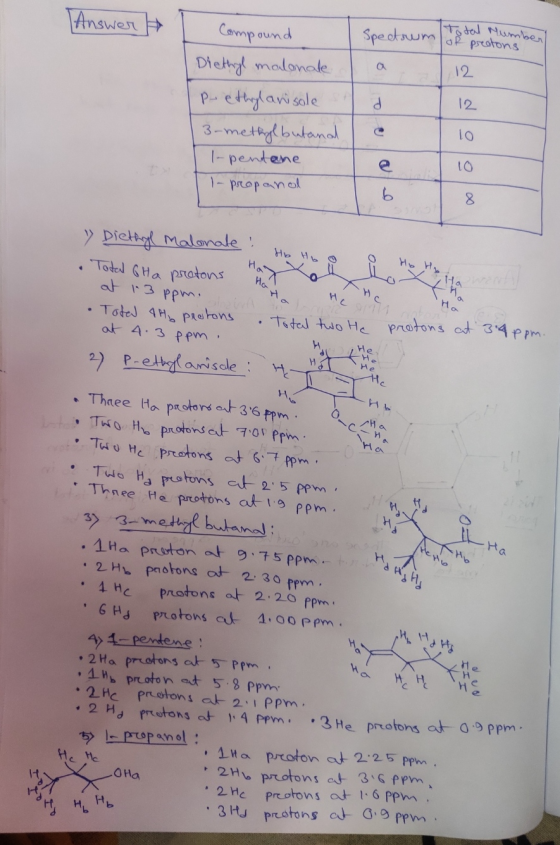
To give you more practice with analyzing NMR spectra, match each of the following 'H-NMR spectra...
Provide the justification for the structure of ethyl acutate. Name 9 H H нсь со ссн,...
 Provide the justification for the structure of ethyl
acutate.
Name 9 H H нсь со ссн, Figure 1. Structural representation of ethyl acetate Table 1. 'H and 13C NMR Data for ethyl acetate Proton peaks (ppm) Carbon peaks (ppm) Proton Justification: Carbon Justification: 1H NMR Data 5.6 5.4 5.2 5.0 4.8 4.6 4.4 4.2 4.0 3.8 3.6 3.4 3.2 3.0 2.8 2.6 2.4 1 (ppm) 2.2 2.0 1.8 1.6 1.4 1.2 1.0 0.8 0.6 0.4 0.2 0.0 -0.2 -0.4 13C...
Provide the justification for the structure of ethyl
acutate.
Name 9 H H нсь со ссн, Figure 1. Structural representation of ethyl acetate Table 1. 'H and 13C NMR Data for ethyl acetate Proton peaks (ppm) Carbon peaks (ppm) Proton Justification: Carbon Justification: 1H NMR Data 5.6 5.4 5.2 5.0 4.8 4.6 4.4 4.2 4.0 3.8 3.6 3.4 3.2 3.0 2.8 2.6 2.4 1 (ppm) 2.2 2.0 1.8 1.6 1.4 1.2 1.0 0.8 0.6 0.4 0.2 0.0 -0.2 -0.4 13C...
Proton NMR spectra help 3.4 P Problerna 82 8.18.0 79 7.8 7.7 7.6 7.5 74 73...
 Proton NMR spectra help
3.4 P Problerna 82 8.18.0 79 7.8 7.7 7.6 7.5 74 73 Pp Proposed Structure Q. Problem 3.4 Q 1 proton (x32) 12 11 Ppm 4.5 4.0 3.5 3.0 2.5 2.0 1.5 ppm Proposed Structure R. Problem 3.4 R 3.6 34 3.2 3.0 2.8 2.6 2.4 2.2 2.0 18 1.6 ppm Proposed Structure
Proton NMR spectra help
3.4 P Problerna 82 8.18.0 79 7.8 7.7 7.6 7.5 74 73 Pp Proposed Structure Q. Problem 3.4 Q 1 proton (x32) 12 11 Ppm 4.5 4.0 3.5 3.0 2.5 2.0 1.5 ppm Proposed Structure R. Problem 3.4 R 3.6 34 3.2 3.0 2.8 2.6 2.4 2.2 2.0 18 1.6 ppm Proposed Structure
Label NMR spectra. Label Functional groups: Esters- ethyl acetate # of unique H environment local chemical...
 Label NMR spectra.
Label
Functional groups: Esters- ethyl acetate
# of unique H environment
local chemical environment
# of H in each environment
# of neighboring protons
'H NMR Spectrum in CDCI; -2.289 L2.195 TTTTTTTTTTTTTTTTTTTTTTTTT 2.8 2.6 2.4 2.2 2.0 1.6 1.6 1.4 1.2 1.6 0.8 0.6 0.4 ppm 26.07 38.09 35.84 -0.806 -0.830 0.781 -.4 1.2 1.0 0.8 0.6 0.4 ppm 35.84 2.243 2.219 - -2.269 22.195 2.6 4 .4 2.2 2.0 1.8 1.6 26.07 1.4 38.09
Label NMR spectra.
Label
Functional groups: Esters- ethyl acetate
# of unique H environment
local chemical environment
# of H in each environment
# of neighboring protons
'H NMR Spectrum in CDCI; -2.289 L2.195 TTTTTTTTTTTTTTTTTTTTTTTTT 2.8 2.6 2.4 2.2 2.0 1.6 1.6 1.4 1.2 1.6 0.8 0.6 0.4 ppm 26.07 38.09 35.84 -0.806 -0.830 0.781 -.4 1.2 1.0 0.8 0.6 0.4 ppm 35.84 2.243 2.219 - -2.269 22.195 2.6 4 .4 2.2 2.0 1.8 1.6 26.07 1.4 38.09
Both the above is for one question. please answer the following according to the above. 1....
 Both the above is for one question. please answer the following
according to the above.
1. Assign signals of 13C and 1H spectra as well as find the
structural unit and functional group.
2. Give the structure
sample answer - as follows
1H NMR: p-substituted Ar at 7.27-7.97 ppm, benzylic CH3 group at
2.42 ppm, COOH proton at 12.9 ppm
13C NMR: carbonyl C at 167.8 ppm (ester or acid), benzylic CH3
at 21.40 ppm, 4 remaining signals are Ar...
Both the above is for one question. please answer the following
according to the above.
1. Assign signals of 13C and 1H spectra as well as find the
structural unit and functional group.
2. Give the structure
sample answer - as follows
1H NMR: p-substituted Ar at 7.27-7.97 ppm, benzylic CH3 group at
2.42 ppm, COOH proton at 12.9 ppm
13C NMR: carbonyl C at 167.8 ppm (ester or acid), benzylic CH3
at 21.40 ppm, 4 remaining signals are Ar...
The above is just one question. please answer the following according to the above. 1. Assign...
 The above is just one question. please answer the following
according to the above.
1. Assign signals of 13C and 1H spectra as well as find the
structural unit and functional group.
2. Give the structure
sample answer - as follows
1H NMR: p-substituted Ar at 7.27-7.97 ppm, benzylic CH3 group at
2.42 ppm, COOH proton at 12.9 ppm
13C NMR: carbonyl C at 167.8 ppm (ester or acid), benzylic CH3
at 21.40 ppm, 4 remaining signals are Ar carbons,...
The above is just one question. please answer the following
according to the above.
1. Assign signals of 13C and 1H spectra as well as find the
structural unit and functional group.
2. Give the structure
sample answer - as follows
1H NMR: p-substituted Ar at 7.27-7.97 ppm, benzylic CH3 group at
2.42 ppm, COOH proton at 12.9 ppm
13C NMR: carbonyl C at 167.8 ppm (ester or acid), benzylic CH3
at 21.40 ppm, 4 remaining signals are Ar carbons,...
Please answer the NMR tables for wintergreen and Pear, can you please make it as neat...
 Please answer the NMR tables for
wintergreen and Pear, can you please make it as neat as possible
thanks!
WINTERGREEN
Pear
The procedure below is written as if you were conducting this experiment in the lab. You will nee to read through it carefully to complete the lab report and answer the questions appropriately For NMR analyses, complete the spectral assignments as shown in the example below. Example of a 'H-NMR analysis table: HoHo Ha Iodomethane Há На Chemical Shift...
Please answer the NMR tables for
wintergreen and Pear, can you please make it as neat as possible
thanks!
WINTERGREEN
Pear
The procedure below is written as if you were conducting this experiment in the lab. You will nee to read through it carefully to complete the lab report and answer the questions appropriately For NMR analyses, complete the spectral assignments as shown in the example below. Example of a 'H-NMR analysis table: HoHo Ha Iodomethane Há На Chemical Shift...
Can you please show the structure of the ester and fill out an NMR analysis table...
 Can you please show the structure of the ester and fill out an
NMR analysis table for the synthesis of banana based on the NMR
below? Could you also briefly explain your choice?
2. Banana
Acid: Acetic acid
Alcohol: Isoamyl alcohol
Structure of the ester:
Example of a’H-NMR analysis table: Hb Ho Labeled structure: Ha Há Ha Chemical Shift (ppm) Integration Splitting (n+1 rule) Structural Assignment (label of the corresponding proton) 1.8 ppm 3 3 Н. 3.1 ppm 2 4...
Can you please show the structure of the ester and fill out an
NMR analysis table for the synthesis of banana based on the NMR
below? Could you also briefly explain your choice?
2. Banana
Acid: Acetic acid
Alcohol: Isoamyl alcohol
Structure of the ester:
Example of a’H-NMR analysis table: Hb Ho Labeled structure: Ha Há Ha Chemical Shift (ppm) Integration Splitting (n+1 rule) Structural Assignment (label of the corresponding proton) 1.8 ppm 3 3 Н. 3.1 ppm 2 4...
Write down problem number. Provide formula, HDI value, and a complete, chemically correct structure for each...
 Write down problem number.
Provide formula, HDI value, and a complete, chemically correct
structure for each problem.
Assign signals in the 1H and 13C spectra to specific atoms,
identify structural units and/or functional groups.
Example:
Problem # 3
Formula: C8H8O2
HDI: 5
1H NMR: p-substituted Ar at 7.27-7.97 ppm, benzylic CH3 group at
2.42 ppm, COOH proton at 12.9 ppm
13C NMR: carbonyl C at 167.8 ppm (ester or acid), benzylic CH3
at 21.40 ppm, 4 remaining signals are Ar...
Write down problem number.
Provide formula, HDI value, and a complete, chemically correct
structure for each problem.
Assign signals in the 1H and 13C spectra to specific atoms,
identify structural units and/or functional groups.
Example:
Problem # 3
Formula: C8H8O2
HDI: 5
1H NMR: p-substituted Ar at 7.27-7.97 ppm, benzylic CH3 group at
2.42 ppm, COOH proton at 12.9 ppm
13C NMR: carbonyl C at 167.8 ppm (ester or acid), benzylic CH3
at 21.40 ppm, 4 remaining signals are Ar...
A compound A, C7H12O3, contains two functional groups. One of the functional groups is a derivative...
 A compound A, C7H12O3, contains two functional groups. One of the functional groups is a derivative of carboxylic acid. The 1H NMR spectrum of the compound is given below. Deduce the structure of the compound A. Write your structure on the spectrum and using arrows assign all the peaks in the spectrum to various protons in the molecule. (5 Pts, NO PARTIAL CREDITS) 4.3 4.2 4.1 4.0 3.9 3.8 3.7 3.6 3.5 3.4 3.3 3.2 3.1 3.0 2.9 2.8 2.7...
(a) From the spectral data ( H, C NMR, IR, MS) you were given, identify the...
 (a) From the spectral data ( H, C NMR, IR, MS) you were given,
identify the structure of your product. Explain why you chose your
particular product based on the spectroscopic data.
(b) Fully assign the 1H NMR spectrum of your product (i.e.
determine which peaks in the 1H NMR correspond to which hydrogens
in the product). You will not receive full marks for determination
of the unknown unless you assign the 1H NMR spectrum
completely.
(c) Now work backwards...
(a) From the spectral data ( H, C NMR, IR, MS) you were given,
identify the structure of your product. Explain why you chose your
particular product based on the spectroscopic data.
(b) Fully assign the 1H NMR spectrum of your product (i.e.
determine which peaks in the 1H NMR correspond to which hydrogens
in the product). You will not receive full marks for determination
of the unknown unless you assign the 1H NMR spectrum
completely.
(c) Now work backwards...
 Provide the justification for the structure of ethyl
acutate.
Name 9 H H нсь со ссн, Figure 1. Structural representation of ethyl acetate Table 1. 'H and 13C NMR Data for ethyl acetate Proton peaks (ppm) Carbon peaks (ppm) Proton Justification: Carbon Justification: 1H NMR Data 5.6 5.4 5.2 5.0 4.8 4.6 4.4 4.2 4.0 3.8 3.6 3.4 3.2 3.0 2.8 2.6 2.4 1 (ppm) 2.2 2.0 1.8 1.6 1.4 1.2 1.0 0.8 0.6 0.4 0.2 0.0 -0.2 -0.4 13C...
Provide the justification for the structure of ethyl
acutate.
Name 9 H H нсь со ссн, Figure 1. Structural representation of ethyl acetate Table 1. 'H and 13C NMR Data for ethyl acetate Proton peaks (ppm) Carbon peaks (ppm) Proton Justification: Carbon Justification: 1H NMR Data 5.6 5.4 5.2 5.0 4.8 4.6 4.4 4.2 4.0 3.8 3.6 3.4 3.2 3.0 2.8 2.6 2.4 1 (ppm) 2.2 2.0 1.8 1.6 1.4 1.2 1.0 0.8 0.6 0.4 0.2 0.0 -0.2 -0.4 13C...
 Proton NMR spectra help
3.4 P Problerna 82 8.18.0 79 7.8 7.7 7.6 7.5 74 73 Pp Proposed Structure Q. Problem 3.4 Q 1 proton (x32) 12 11 Ppm 4.5 4.0 3.5 3.0 2.5 2.0 1.5 ppm Proposed Structure R. Problem 3.4 R 3.6 34 3.2 3.0 2.8 2.6 2.4 2.2 2.0 18 1.6 ppm Proposed Structure
Proton NMR spectra help
3.4 P Problerna 82 8.18.0 79 7.8 7.7 7.6 7.5 74 73 Pp Proposed Structure Q. Problem 3.4 Q 1 proton (x32) 12 11 Ppm 4.5 4.0 3.5 3.0 2.5 2.0 1.5 ppm Proposed Structure R. Problem 3.4 R 3.6 34 3.2 3.0 2.8 2.6 2.4 2.2 2.0 18 1.6 ppm Proposed Structure
 Label NMR spectra.
Label
Functional groups: Esters- ethyl acetate
# of unique H environment
local chemical environment
# of H in each environment
# of neighboring protons
'H NMR Spectrum in CDCI; -2.289 L2.195 TTTTTTTTTTTTTTTTTTTTTTTTT 2.8 2.6 2.4 2.2 2.0 1.6 1.6 1.4 1.2 1.6 0.8 0.6 0.4 ppm 26.07 38.09 35.84 -0.806 -0.830 0.781 -.4 1.2 1.0 0.8 0.6 0.4 ppm 35.84 2.243 2.219 - -2.269 22.195 2.6 4 .4 2.2 2.0 1.8 1.6 26.07 1.4 38.09
Label NMR spectra.
Label
Functional groups: Esters- ethyl acetate
# of unique H environment
local chemical environment
# of H in each environment
# of neighboring protons
'H NMR Spectrum in CDCI; -2.289 L2.195 TTTTTTTTTTTTTTTTTTTTTTTTT 2.8 2.6 2.4 2.2 2.0 1.6 1.6 1.4 1.2 1.6 0.8 0.6 0.4 ppm 26.07 38.09 35.84 -0.806 -0.830 0.781 -.4 1.2 1.0 0.8 0.6 0.4 ppm 35.84 2.243 2.219 - -2.269 22.195 2.6 4 .4 2.2 2.0 1.8 1.6 26.07 1.4 38.09
 Both the above is for one question. please answer the following
according to the above.
1. Assign signals of 13C and 1H spectra as well as find the
structural unit and functional group.
2. Give the structure
sample answer - as follows
1H NMR: p-substituted Ar at 7.27-7.97 ppm, benzylic CH3 group at
2.42 ppm, COOH proton at 12.9 ppm
13C NMR: carbonyl C at 167.8 ppm (ester or acid), benzylic CH3
at 21.40 ppm, 4 remaining signals are Ar...
Both the above is for one question. please answer the following
according to the above.
1. Assign signals of 13C and 1H spectra as well as find the
structural unit and functional group.
2. Give the structure
sample answer - as follows
1H NMR: p-substituted Ar at 7.27-7.97 ppm, benzylic CH3 group at
2.42 ppm, COOH proton at 12.9 ppm
13C NMR: carbonyl C at 167.8 ppm (ester or acid), benzylic CH3
at 21.40 ppm, 4 remaining signals are Ar...
 The above is just one question. please answer the following
according to the above.
1. Assign signals of 13C and 1H spectra as well as find the
structural unit and functional group.
2. Give the structure
sample answer - as follows
1H NMR: p-substituted Ar at 7.27-7.97 ppm, benzylic CH3 group at
2.42 ppm, COOH proton at 12.9 ppm
13C NMR: carbonyl C at 167.8 ppm (ester or acid), benzylic CH3
at 21.40 ppm, 4 remaining signals are Ar carbons,...
The above is just one question. please answer the following
according to the above.
1. Assign signals of 13C and 1H spectra as well as find the
structural unit and functional group.
2. Give the structure
sample answer - as follows
1H NMR: p-substituted Ar at 7.27-7.97 ppm, benzylic CH3 group at
2.42 ppm, COOH proton at 12.9 ppm
13C NMR: carbonyl C at 167.8 ppm (ester or acid), benzylic CH3
at 21.40 ppm, 4 remaining signals are Ar carbons,...
 Please answer the NMR tables for
wintergreen and Pear, can you please make it as neat as possible
thanks!
WINTERGREEN
Pear
The procedure below is written as if you were conducting this experiment in the lab. You will nee to read through it carefully to complete the lab report and answer the questions appropriately For NMR analyses, complete the spectral assignments as shown in the example below. Example of a 'H-NMR analysis table: HoHo Ha Iodomethane Há На Chemical Shift...
Please answer the NMR tables for
wintergreen and Pear, can you please make it as neat as possible
thanks!
WINTERGREEN
Pear
The procedure below is written as if you were conducting this experiment in the lab. You will nee to read through it carefully to complete the lab report and answer the questions appropriately For NMR analyses, complete the spectral assignments as shown in the example below. Example of a 'H-NMR analysis table: HoHo Ha Iodomethane Há На Chemical Shift...
 Can you please show the structure of the ester and fill out an
NMR analysis table for the synthesis of banana based on the NMR
below? Could you also briefly explain your choice?
2. Banana
Acid: Acetic acid
Alcohol: Isoamyl alcohol
Structure of the ester:
Example of a’H-NMR analysis table: Hb Ho Labeled structure: Ha Há Ha Chemical Shift (ppm) Integration Splitting (n+1 rule) Structural Assignment (label of the corresponding proton) 1.8 ppm 3 3 Н. 3.1 ppm 2 4...
Can you please show the structure of the ester and fill out an
NMR analysis table for the synthesis of banana based on the NMR
below? Could you also briefly explain your choice?
2. Banana
Acid: Acetic acid
Alcohol: Isoamyl alcohol
Structure of the ester:
Example of a’H-NMR analysis table: Hb Ho Labeled structure: Ha Há Ha Chemical Shift (ppm) Integration Splitting (n+1 rule) Structural Assignment (label of the corresponding proton) 1.8 ppm 3 3 Н. 3.1 ppm 2 4...
 Write down problem number.
Provide formula, HDI value, and a complete, chemically correct
structure for each problem.
Assign signals in the 1H and 13C spectra to specific atoms,
identify structural units and/or functional groups.
Example:
Problem # 3
Formula: C8H8O2
HDI: 5
1H NMR: p-substituted Ar at 7.27-7.97 ppm, benzylic CH3 group at
2.42 ppm, COOH proton at 12.9 ppm
13C NMR: carbonyl C at 167.8 ppm (ester or acid), benzylic CH3
at 21.40 ppm, 4 remaining signals are Ar...
Write down problem number.
Provide formula, HDI value, and a complete, chemically correct
structure for each problem.
Assign signals in the 1H and 13C spectra to specific atoms,
identify structural units and/or functional groups.
Example:
Problem # 3
Formula: C8H8O2
HDI: 5
1H NMR: p-substituted Ar at 7.27-7.97 ppm, benzylic CH3 group at
2.42 ppm, COOH proton at 12.9 ppm
13C NMR: carbonyl C at 167.8 ppm (ester or acid), benzylic CH3
at 21.40 ppm, 4 remaining signals are Ar...
 A compound A, C7H12O3, contains two functional groups. One of the functional groups is a derivative of carboxylic acid. The 1H NMR spectrum of the compound is given below. Deduce the structure of the compound A. Write your structure on the spectrum and using arrows assign all the peaks in the spectrum to various protons in the molecule. (5 Pts, NO PARTIAL CREDITS) 4.3 4.2 4.1 4.0 3.9 3.8 3.7 3.6 3.5 3.4 3.3 3.2 3.1 3.0 2.9 2.8 2.7...
 (a) From the spectral data ( H, C NMR, IR, MS) you were given,
identify the structure of your product. Explain why you chose your
particular product based on the spectroscopic data.
(b) Fully assign the 1H NMR spectrum of your product (i.e.
determine which peaks in the 1H NMR correspond to which hydrogens
in the product). You will not receive full marks for determination
of the unknown unless you assign the 1H NMR spectrum
completely.
(c) Now work backwards...
(a) From the spectral data ( H, C NMR, IR, MS) you were given,
identify the structure of your product. Explain why you chose your
particular product based on the spectroscopic data.
(b) Fully assign the 1H NMR spectrum of your product (i.e.
determine which peaks in the 1H NMR correspond to which hydrogens
in the product). You will not receive full marks for determination
of the unknown unless you assign the 1H NMR spectrum
completely.
(c) Now work backwards...
Most questions answered within 3 hours.
-
Where is the error in this code sequence?
String s1 = "Hello";
String s2 = "ello";...
asked 10 months ago -
Financial data for Joel de Paris, Inc., for last year
follow:
Joel de Paris, Inc.
Balance...
asked 10 months ago -
Consider this reaction:
Al2(SO4)3 (aq)+ BaCl3
(aq) Al2Cl6 (aq)- +
3BaSO4(s) . What is the...
asked 10 months ago -
Suppose that Savneet is considering increasing her
recent random sample from 20 car rentals to 40...
asked 10 months ago -
Trucks arrive at an unloading terminal at an average rate of 120
per hour.
Trucks arrive...
asked 10 months ago -
Why are methanol and ethanol completely soluble in water while
octanol is not very little soluble....
asked 10 months ago -
A facilities manager at a university reads in a research report
that the mean amount of...
asked 10 months ago -
When the CuSO4 is rehydrated by adding water to the anhydrous
compound, is this an endothermic...
asked 10 months ago -
A ray of sunlight is passing from diamond into crown glass; the
angle of incidence is...
asked 10 months ago -
A block of mass 0.249 kg is placed on top of a light, vertical
spring of...
asked 10 months ago -
how do the kidneys compensate in the presences of acidosis
a) trigger hyperventilate
b) reserve acid...
asked 10 months ago -
Question 501 pts
The rental rate of capital to the firm increases. Which of the
following...
asked 10 months ago