
Homework Answers
Add Answer to:
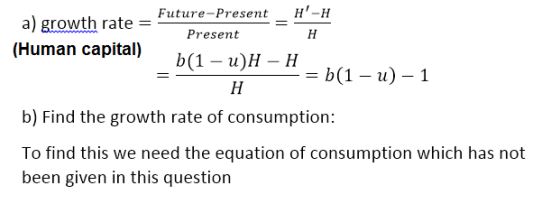
Consider the endogenous growth model, where the future period quantity of human capital is a function...
2 Endogenous Growth Theory (5 marks) In the AK model with production function Y = AK....
 2 Endogenous Growth Theory (5 marks) In the AK model with production function Y = AK. Assume g- is fixed. The saving rate is s and the depreciate rate of capital of. = 0 and p a. What is the growth rate of capital (K) and output (Y)? b. Under what conditions can the economy experience perpetual (positive) growth? c. What is the key factor that drives the perpetual growth? Explain the intuition. (hint: compare the AK model with the...
Consider the human capital growth model. Let us make the following changes. Depending on whether the...
Consider the human capital growth model. Let us make the following changes. Depending on whether the current calendar year is an odd or even number, the efficiency parameter of the human capital accumulation technology changes between 5.15 and 2.04. In particular, when the calendar year is an odd number (for example in years 1 and 3) the parameter b is 5.15 and z is 6. However, in even years (for example in years 2 and 4) the parameter is 2.04...
Consider the Solow growth model with the following production function where y is output. K is ca...
 A and B only
Consider the Solow growth model with the following production function where y is output. K is capital, s is the productivity and is labor. Assume that 0 < α < 1 Further, suppose that labor grows at a constant rate n. That is. 1 + n. Also, assume that capital depreciates at rate d and that gross investment in capital is fraction s of output. a Letting k-N, obtain the law of motion for capital accumulation...
A and B only
Consider the Solow growth model with the following production function where y is output. K is capital, s is the productivity and is labor. Assume that 0 < α < 1 Further, suppose that labor grows at a constant rate n. That is. 1 + n. Also, assume that capital depreciates at rate d and that gross investment in capital is fraction s of output. a Letting k-N, obtain the law of motion for capital accumulation...
Consider a version of the Solow model where the population growth rate is 0.05. There is...
Consider a version of the Solow model where the population growth rate is 0.05. There is no technological progress. Capital depreciates at rate ? each period and a fraction ? of income is invested in physical capital every period. Assume that the production function is given by: ?t = ?t1/2 ?t1/2 where ?t is output, ?t is capital and ?t is labour. a. Derive an expression for the accumulation of capital per worker in this economy, i.e. ∆?t+1 where ?t...
Consider the Solow growth model, with the production function given by where L = 1 in...
Consider the Solow growth model, with the production function given by where L = 1 in all cases (a) Using the data below, which country has the highest, and lowest, steady-state capital stock and output? Be sure to show your calculations here. (b) Given the predictions of the Solow growth model, what is likely driving your answer? (Consider the roles of A, alpha, s and d here!) Table 5.1 A s d α China 0.79 0.32 0.05 0.35 Hungary 0.95...
Suppose the production function is given by ? = ?^a?'^1-a, where Y is output; K is...
Suppose the production function is given by ? = ?^a?'^1-a, where Y is output; K is capital stock and N is Labor (look Appendix in Chapter 16). a. Is this production function characterized by constant return to scale? How? Show the work. b. Write this production function as a relationship between output per worker and capital per worker. c. If saving (S) equals investment (I), and S = sY, where s is saving rate, what is the corresponding investment per...
MALTHUS AND SOLOW GROWTH MODEL
Malthusian Model of Growth Notation: Yt Aggregate output; Nt Population size; L¯ Land (fixed); ct Per capita consumption Production: Aggregate production function is Yt = F(Nt , Lt) = zN2/3 t L 1/3 t Population Dynamics: Nt+1 = g(ct)Nt Population growth function: g(ct) = (3ct) 1/3 Parameter Values: Land: L¯ = 1000 for all t. Productivity parameter: z = 1 ...
Solow Growth Model D. Consider an economy with production characterized by function Y = AVKL, per...
 Solow Growth Model D. Consider an economy with production characterized by function Y = AVKL, per capita output y = AVkt with rate of depreciation of capital 8, investment it = sy. = sAvky, capital transition function kt+1 - k = SAVk - Okt, where s is savings ratio. 1. Putting per capita output (income) y on the y-axis and k on the x-axis, graph the curves for depre- ciation and investment. Label steady state capital k* and steady state...
8. Consider the following production function Y = AK0.3(NH)0.7 where Y is GDP, A is total...
 8. Consider the following production function Y = AK0.3(NH)0.7 where Y is GDP, A is total factor productivity, K is capital, N is employment and H is human capital. Denote by P the population of the country. Thus, Y/P is per-capita GDP and N/P is the fraction of the population employed. What is the contribution of the fraction of the population employed (N/P) to the growth rate of per-capita GDP (Y/P)? (a) Growth rate of N/P. (b) Growth rate of...
3. a) Consider the following model for the demand function: Where Q Quantity demanded P price e e...
 3. a) Consider the following model for the demand function: Where Q Quantity demanded P price e exponent, and U is the population error term i) Name at least one additional independent variable which may influence a. i) Linearize the above model by taking logs. b) Consider the following reciprocal regression model (sample): Y = b1 + b2(1/%) + ei 2 where bi and b2 are positive. i) What happens to Y as X increases? Show the relationship between Y...
 2 Endogenous Growth Theory (5 marks) In the AK model with production function Y = AK. Assume g- is fixed. The saving rate is s and the depreciate rate of capital of. = 0 and p a. What is the growth rate of capital (K) and output (Y)? b. Under what conditions can the economy experience perpetual (positive) growth? c. What is the key factor that drives the perpetual growth? Explain the intuition. (hint: compare the AK model with the...
 A and B only
Consider the Solow growth model with the following production function where y is output. K is capital, s is the productivity and is labor. Assume that 0 < α < 1 Further, suppose that labor grows at a constant rate n. That is. 1 + n. Also, assume that capital depreciates at rate d and that gross investment in capital is fraction s of output. a Letting k-N, obtain the law of motion for capital accumulation...
A and B only
Consider the Solow growth model with the following production function where y is output. K is capital, s is the productivity and is labor. Assume that 0 < α < 1 Further, suppose that labor grows at a constant rate n. That is. 1 + n. Also, assume that capital depreciates at rate d and that gross investment in capital is fraction s of output. a Letting k-N, obtain the law of motion for capital accumulation...
 Solow Growth Model D. Consider an economy with production characterized by function Y = AVKL, per capita output y = AVkt with rate of depreciation of capital 8, investment it = sy. = sAvky, capital transition function kt+1 - k = SAVk - Okt, where s is savings ratio. 1. Putting per capita output (income) y on the y-axis and k on the x-axis, graph the curves for depre- ciation and investment. Label steady state capital k* and steady state...
 8. Consider the following production function Y = AK0.3(NH)0.7 where Y is GDP, A is total factor productivity, K is capital, N is employment and H is human capital. Denote by P the population of the country. Thus, Y/P is per-capita GDP and N/P is the fraction of the population employed. What is the contribution of the fraction of the population employed (N/P) to the growth rate of per-capita GDP (Y/P)? (a) Growth rate of N/P. (b) Growth rate of...
 3. a) Consider the following model for the demand function: Where Q Quantity demanded P price e exponent, and U is the population error term i) Name at least one additional independent variable which may influence a. i) Linearize the above model by taking logs. b) Consider the following reciprocal regression model (sample): Y = b1 + b2(1/%) + ei 2 where bi and b2 are positive. i) What happens to Y as X increases? Show the relationship between Y...
Most questions answered within 3 hours.
-
Where is the error in this code sequence?
String s1 = "Hello";
String s2 = "ello";...
asked 10 months ago -
Financial data for Joel de Paris, Inc., for last year
follow:
Joel de Paris, Inc.
Balance...
asked 10 months ago -
Consider this reaction:
Al2(SO4)3 (aq)+ BaCl3
(aq) Al2Cl6 (aq)- +
3BaSO4(s) . What is the...
asked 10 months ago -
Suppose that Savneet is considering increasing her
recent random sample from 20 car rentals to 40...
asked 10 months ago -
Trucks arrive at an unloading terminal at an average rate of 120
per hour.
Trucks arrive...
asked 10 months ago -
Why are methanol and ethanol completely soluble in water while
octanol is not very little soluble....
asked 10 months ago -
A facilities manager at a university reads in a research report
that the mean amount of...
asked 10 months ago -
When the CuSO4 is rehydrated by adding water to the anhydrous
compound, is this an endothermic...
asked 10 months ago -
A ray of sunlight is passing from diamond into crown glass; the
angle of incidence is...
asked 10 months ago -
A block of mass 0.249 kg is placed on top of a light, vertical
spring of...
asked 10 months ago -
how do the kidneys compensate in the presences of acidosis
a) trigger hyperventilate
b) reserve acid...
asked 10 months ago -
Question 501 pts
The rental rate of capital to the firm increases. Which of the
following...
asked 10 months ago