What is the magnitude of the acceleration of an electron when in a electric field of...
What is the magnitude of the acceleration of an electron when in a electric field of 7.0 x 10^4 N/C?
Homework Answers
F = q*E
m*a = q*E
a = q*E/m
= 1.6*10^-19*7*10^4/9.1*10^-31
= 1.23*10^16 m/s^2
Force on electron = 7.0*10^4*1.69*10^-19 C = 1.183*10^-14 N
mass of electron = 9.1*10^-31 kg
So acc = 1.183*10^-14/9.1*10^-31 = 1.3*10^16 m=s2
E= 7 * 10^4 N/C
m= 9.109x10^-31 kg
q= 1.6x10^-19 C
a=?
F=ma
F=qE>>>>> 1.6e-19x 7 * 10^4= 11.2 * 10^-15
11.2e-15 is the F so you do this...
F=ma>>>> 11.2e-15=9.109e-31a..... solve for a.....
11.2e-15/9.109e-31= 1.23e16
1.23e16 m/s2 answers
mass of electron = 9.1 x10^-31 kg
charge of electron = 1.6 X 10^-19
accel= charge X field /mass
accel= 1.2307 X 10 ^ 16
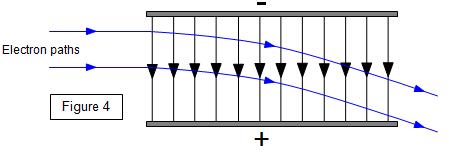
We will consider next the case of an electron entering a uniform
electroc field between two parallel plates (Figure 4). The
potential difference between the plates is V and the plates are
aligned along the x direction and the electron enters the field at
right angles to the field lines:
The force on the electron is given by the equation:
F = eE = eV/d = ma
There fore,
a=(e*E)/m
a = 1.2295*10-31 m/s
force= electric field*charge
F=e*E
F=1.6*10^-19*7*10^4
F=11.2*10^-15
now,
acceleration,a=F/m
a=(11.2*10^-15)/(9.1*10^-31)
a=1.23*10^16
Add Answer to:
What is the magnitude of the acceleration of an electron when in
a electric field of...
Part A Determine the magnitude of the acceleration experienced by an electron in an electric field...
 Part A Determine the magnitude of the acceleration experienced by an electron in an electric field of 540 N/C. 10 A¢ a= 9.49 • 10-49 OO? Submit Previous Answers Request Answer * Incorrect; Try Again Part B How does the direction of the acceleration depend on the direction of the field at that point?
A proton and an electron are moving due east in a constant electric field that also...
 A proton and an electron are moving due east in a constant electric field that also points due east. The electric field has a magnitude of 7.0 x 10⁴ N/C. Determine the magnitude of the acceleration of the proton and the electron. m/sn2 m/s 2 4
Problem 2 (a)What is the magnitude of an electron's acceleration in a uniform electric field of...
 Problem 2 (a)What is the magnitude of an electron's acceleration in a uniform electric field of magnitude 1.87 x 10⁶ N/C? (b)How long would the electron take, starting from rest, to attain 1/15-th the speed of light? (c)How far would it travel in that time?
Determine the magnitude of the acceleration experienced by an electron in an electric field of 802 N/C . How does the direction of the acceleration depend on the direction of the field at that point?
 A) Determine the magnitude of the acceleration experienced by an electron in an electric field of 802 N/C. B) How does the direction of the acceleration depend on the direction of the field at that point?
What is the magnitude of the acceleration of a proton in a uniform electric field of...
What is the magnitude of the acceleration of a proton in a uniform electric field of magnitude 7197 N/C? Give your answer in Standard SI units. Remember that when entering a number into the computer using scientific notation you must enter it using the "e" notation (for example 6.02 x 10²³ must be entered as 6.02e23.)
Determine the magnitude of the acceleration experienced by an electron in an electric field of 825N/C...
Determine the magnitude of the acceleration experienced by an electron in an electric field of 825N/C . Express your answer to three significant figures and include the appropriate units. How does the direction of the acceleration depend on the direction of the field at that point? along to the field perpendicular to the field opposite to the field
Part A: What is the acceleration of an electron that is placed in a uniform electric...
Part A: What is the acceleration of an electron that is placed in a uniform electric field of 7200 N/C pointing in the +y-direction? Find the magnitude of the acceleration. Express your answer to four significant figures and include the appropriate units. Part B: Find the direction of the acceleration. 1) pointing in the +y-direction 2) pointing in the −x-direction 3) pointing in the −y-direction 4) pointing in the +x-direction
11. What are the magnitude and direction of the acceleration of an electron at a point...
 11. What are the magnitude and direction of the acceleration of an electron at a point where the electric field has magnitude 6100 N/C and is directed due north? 12. Sketch the electric field lines in the plane of the page due to the charges shown in the diagram.
There is a uniform downward electric field below a thundercloud. The magnitude of this electric field...
There is a uniform downward electric field below a thundercloud. The magnitude of this electric field is E=28.3 kN/C. Useful constants: Mass of an electron: 9.11×10⁻³¹ kg Charge on an electron: -1.60×10⁻¹⁹ C What is the magnitude of the acceleration on an electron in this field?
An electron is released from rest in a uniform electric field of magnitude 2.16 x 10⁴...
 An electron is released from rest in a uniform electric field of magnitude 2.16 x 10⁴ N/C. Calculate the acceleration of the electron. (Ignore gravitation.) Number Units
 Part A Determine the magnitude of the acceleration experienced by an electron in an electric field of 540 N/C. 10 A¢ a= 9.49 • 10-49 OO? Submit Previous Answers Request Answer * Incorrect; Try Again Part B How does the direction of the acceleration depend on the direction of the field at that point?
 A proton and an electron are moving due east in a constant electric field that also points due east. The electric field has a magnitude of 7.0 x 10⁴ N/C. Determine the magnitude of the acceleration of the proton and the electron. m/sn2 m/s 2 4
 Problem 2 (a)What is the magnitude of an electron's acceleration in a uniform electric field of magnitude 1.87 x 10⁶ N/C? (b)How long would the electron take, starting from rest, to attain 1/15-th the speed of light? (c)How far would it travel in that time?
 11. What are the magnitude and direction of the acceleration of an electron at a point where the electric field has magnitude 6100 N/C and is directed due north? 12. Sketch the electric field lines in the plane of the page due to the charges shown in the diagram.
 An electron is released from rest in a uniform electric field of magnitude 2.16 x 10⁴ N/C. Calculate the acceleration of the electron. (Ignore gravitation.) Number Units
Most questions answered within 3 hours.
-
Where is the error in this code sequence?
String s1 = "Hello";
String s2 = "ello";...
asked 11 months ago -
Financial data for Joel de Paris, Inc., for last year
follow:
Joel de Paris, Inc.
Balance...
asked 11 months ago -
Consider this reaction:
Al2(SO4)3 (aq)+ BaCl3
(aq) Al2Cl6 (aq)- +
3BaSO4(s) . What is the...
asked 11 months ago -
Suppose that Savneet is considering increasing her
recent random sample from 20 car rentals to 40...
asked 11 months ago -
Trucks arrive at an unloading terminal at an average rate of 120
per hour.
Trucks arrive...
asked 11 months ago -
Why are methanol and ethanol completely soluble in water while
octanol is not very little soluble....
asked 11 months ago -
A facilities manager at a university reads in a research report
that the mean amount of...
asked 11 months ago -
When the CuSO4 is rehydrated by adding water to the anhydrous
compound, is this an endothermic...
asked 11 months ago -
A ray of sunlight is passing from diamond into crown glass; the
angle of incidence is...
asked 11 months ago -
A block of mass 0.249 kg is placed on top of a light, vertical
spring of...
asked 11 months ago -
how do the kidneys compensate in the presences of acidosis
a) trigger hyperventilate
b) reserve acid...
asked 11 months ago -
Question 501 pts
The rental rate of capital to the firm increases. Which of the
following...
asked 11 months ago