
Homework Answers
Ans a) Pressure head = P /  g
g
Velocity head = V2 /2g
Datum head = z
Since, all points are at equal elevation , datum head ,z = 0

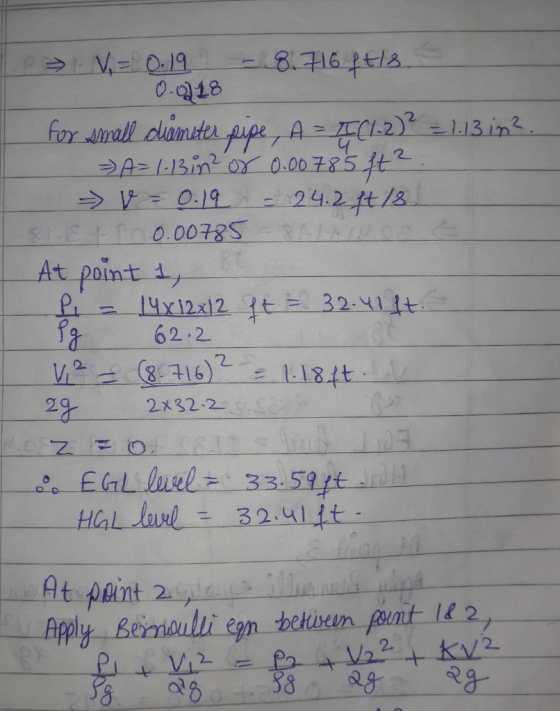
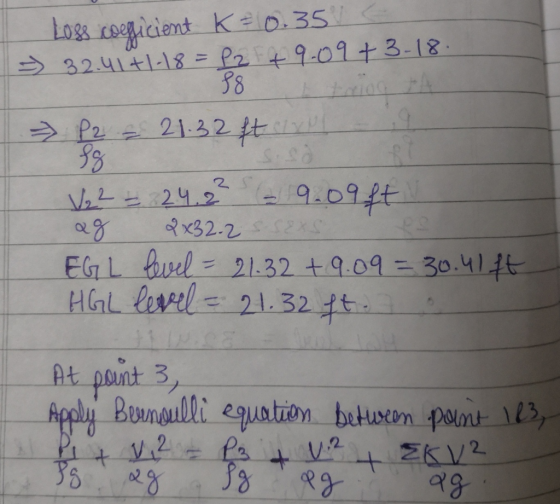

Ans (c) The EGL and HGL are curved due to sudden change in pressure and velocity head due to expansion and contraction of pipe in which fluid is flowing .
Add Answer to:
1. A constriction meter in a 2-inch diameter pipeline consists of a short section of 1.2-inch...
A reservoir A connected to B reservoir through a pipe that is 5 km long and 230 mm in diameter. The difference in water...
A reservoir A connected to B reservoir through a pipe that is 5 km long and 230 mm in diameter. The difference in water level of the two reservoirs is 70 m. At a distance of 2 km from the feeder reservoir, water is drawn at the rate of 40 litres/s . (a) Taking the friction factor as 0.008 and neglecting all other losses, determine the rate at which water enters the B reservoir. (b) Sketch the hydraulic grade line...
QA=2MGD, QE=1MGD, QF=0MGD, QG=2MGD, QPump=6MGD, Energy gradeline at node 1 (EGL1)=15. Diameter of the short pieces...
 QA=2MGD, QE=1MGD, QF=0MGD, QG=2MGD, QPump=6MGD, Energy
gradeline at node 1 (EGL1)=15. Diameter of the short pieces of pipe
upstream and downstream of the pump is 24 inches.
What is the hydraulic grade line at node 1 (HGL1)?
A water network is forned of five pipas, one treated water reservoir and one pump. The demands at junction nodes # 3, 4 and 5 are: d3 - 3 MGD, 1 MGD and ds - 2 MGD. The water surface elevation in the...
QA=2MGD, QE=1MGD, QF=0MGD, QG=2MGD, QPump=6MGD, Energy
gradeline at node 1 (EGL1)=15. Diameter of the short pieces of pipe
upstream and downstream of the pump is 24 inches.
What is the hydraulic grade line at node 1 (HGL1)?
A water network is forned of five pipas, one treated water reservoir and one pump. The demands at junction nodes # 3, 4 and 5 are: d3 - 3 MGD, 1 MGD and ds - 2 MGD. The water surface elevation in the...
(b) Water flows under gravity through a pipeline connecting two reservoirs as shown in Figure 2....
 (b) Water flows under gravity through a pipeline connecting two reservoirs as shown in Figure 2. The pipeline consists of 2 km of pipe diameter 400 mm and sand roughness equivalent 0.03 mm followed by an abrupt change to 3 km of 500 mm diameter pipe of sand roughness equivalent 0.08 mm. The pipe discharges as a free jet into a reservoir. The difference in elevation between the water surface of the upstream reservoir and the discharging jet is 21...
1. A pipeline with a pump from Tank A leads to a nozzle that discharges by...
 1. A pipeline with a pump from Tank A leads to a nozzle that discharges by cascade into Tank B. Tank 8 is located 10 ft above Tank A. What is the flow rate when the pump adds a head of 80 ft. Assume the head loss in the 6 ft suction pipe can be described by hy-5V-/2g, while the head loss in the 4 inch pipe can be described by 12V?/2g. Sketch the hydraulic grade line and the energy...
A flow rate meter is used to measure the flow rate of a water flow from...
 A flow rate meter is used to measure the flow rate of a water flow from left to right) in an inclined position. Due to spatial confinement, the two pressure taps-manometer tubes were inclined as well as shown. The meter is similar to a Venturi meter except at the small pipe the pressure tap is a stagnation pressure tap at 2. For the given geometries, calculate: 1) (4 pts)The velocity at the large pipe, in m/s 2) (3 pts)The velocity...
7. A 2 inch diameter hose shown in the figure below can withstand a maximum pressure...
 7. A 2 inch diameter hose shown in the figure below can withstand a maximum pressure of 200 psi gage before it ruptures. Determine the maximum length of the hose, I, if the friction factor is 0.022 and the flowrate is 0.020 ft'/s. Neglect only the minor losses. Nozzle tip diameter 0.30 in. 0.010 cfs D-0.50 in 10 ft s ft Pump
An orifice meter with a 2 inch diameter opening is used to measure the flow rate...
An orifice meter with a 2 inch diameter opening is used to measure the flow rate of water through a horizontal 3 inch diameter pipe. A mercury manometer is used to measure the pressure difference across the orifice. If the differential height of the manometer is 7 inches, determine the volumetric flowrate (gal/min) of water through the pipe. You may assume the discharge coefficient is 0.6.
Fluid Mechanics QUESTION 4 (a) What are the Energy Grade Line (EGL) and Hydraulic Grade Line (HGL) in a pipe system...
 Fluid Mechanics
QUESTION 4 (a) What are the Energy Grade Line (EGL) and Hydraulic Grade Line (HGL) in a pipe system? (1 mark) A factory draws its water supply from a mountain lake located 75 m above the factory (a) without pump. The factory is at present been supplied via 300 m of 20 cm diameter cast iron pipe. For control purposes, there are five gate valves and one globe valve in the line, as well as three standard 90...
Fluid Mechanics
QUESTION 4 (a) What are the Energy Grade Line (EGL) and Hydraulic Grade Line (HGL) in a pipe system? (1 mark) A factory draws its water supply from a mountain lake located 75 m above the factory (a) without pump. The factory is at present been supplied via 300 m of 20 cm diameter cast iron pipe. For control purposes, there are five gate valves and one globe valve in the line, as well as three standard 90...
make sure you show all work and its easy to read thank you 2. A 108-inch-diameter...
 make sure you show all work and its easy to read thank
you
2. A 108-inch-diameter commercial steel pipe is used to pump water through a 500-ft intertie pipeline at a flow rate of 234 cfs. What is the head loss based on the Hazen-Williams equation? Levee Field
make sure you show all work and its easy to read thank
you
2. A 108-inch-diameter commercial steel pipe is used to pump water through a 500-ft intertie pipeline at a flow rate of 234 cfs. What is the head loss based on the Hazen-Williams equation? Levee Field
Problem 1 (60 points; pipes in parallel & EGL/HGL) A large-size pipeline carrying a water flow...
 Problem 1 (60 points; pipes in parallel & EGL/HGL) A large-size pipeline carrying a water flow (Q) of 0.2 m/s branches into two relatively smaller pipelines (1 and 2). The two branches have the following characteristics: • Pipeline 1: length - 500 m; diameter -0.2 m; friction factor -0.01; two different bends. Pipeline 2: length - 800 m; diameter - 0.3 m; friction factor -0.02; two different bends. The plan view of these pipelines is shown in Figure 8.1. The...
 QA=2MGD, QE=1MGD, QF=0MGD, QG=2MGD, QPump=6MGD, Energy
gradeline at node 1 (EGL1)=15. Diameter of the short pieces of pipe
upstream and downstream of the pump is 24 inches.
What is the hydraulic grade line at node 1 (HGL1)?
A water network is forned of five pipas, one treated water reservoir and one pump. The demands at junction nodes # 3, 4 and 5 are: d3 - 3 MGD, 1 MGD and ds - 2 MGD. The water surface elevation in the...
QA=2MGD, QE=1MGD, QF=0MGD, QG=2MGD, QPump=6MGD, Energy
gradeline at node 1 (EGL1)=15. Diameter of the short pieces of pipe
upstream and downstream of the pump is 24 inches.
What is the hydraulic grade line at node 1 (HGL1)?
A water network is forned of five pipas, one treated water reservoir and one pump. The demands at junction nodes # 3, 4 and 5 are: d3 - 3 MGD, 1 MGD and ds - 2 MGD. The water surface elevation in the...
 (b) Water flows under gravity through a pipeline connecting two reservoirs as shown in Figure 2. The pipeline consists of 2 km of pipe diameter 400 mm and sand roughness equivalent 0.03 mm followed by an abrupt change to 3 km of 500 mm diameter pipe of sand roughness equivalent 0.08 mm. The pipe discharges as a free jet into a reservoir. The difference in elevation between the water surface of the upstream reservoir and the discharging jet is 21...
 1. A pipeline with a pump from Tank A leads to a nozzle that discharges by cascade into Tank B. Tank 8 is located 10 ft above Tank A. What is the flow rate when the pump adds a head of 80 ft. Assume the head loss in the 6 ft suction pipe can be described by hy-5V-/2g, while the head loss in the 4 inch pipe can be described by 12V?/2g. Sketch the hydraulic grade line and the energy...
 A flow rate meter is used to measure the flow rate of a water flow from left to right) in an inclined position. Due to spatial confinement, the two pressure taps-manometer tubes were inclined as well as shown. The meter is similar to a Venturi meter except at the small pipe the pressure tap is a stagnation pressure tap at 2. For the given geometries, calculate: 1) (4 pts)The velocity at the large pipe, in m/s 2) (3 pts)The velocity...
 7. A 2 inch diameter hose shown in the figure below can withstand a maximum pressure of 200 psi gage before it ruptures. Determine the maximum length of the hose, I, if the friction factor is 0.022 and the flowrate is 0.020 ft'/s. Neglect only the minor losses. Nozzle tip diameter 0.30 in. 0.010 cfs D-0.50 in 10 ft s ft Pump
 Fluid Mechanics
QUESTION 4 (a) What are the Energy Grade Line (EGL) and Hydraulic Grade Line (HGL) in a pipe system? (1 mark) A factory draws its water supply from a mountain lake located 75 m above the factory (a) without pump. The factory is at present been supplied via 300 m of 20 cm diameter cast iron pipe. For control purposes, there are five gate valves and one globe valve in the line, as well as three standard 90...
Fluid Mechanics
QUESTION 4 (a) What are the Energy Grade Line (EGL) and Hydraulic Grade Line (HGL) in a pipe system? (1 mark) A factory draws its water supply from a mountain lake located 75 m above the factory (a) without pump. The factory is at present been supplied via 300 m of 20 cm diameter cast iron pipe. For control purposes, there are five gate valves and one globe valve in the line, as well as three standard 90...
 make sure you show all work and its easy to read thank
you
2. A 108-inch-diameter commercial steel pipe is used to pump water through a 500-ft intertie pipeline at a flow rate of 234 cfs. What is the head loss based on the Hazen-Williams equation? Levee Field
make sure you show all work and its easy to read thank
you
2. A 108-inch-diameter commercial steel pipe is used to pump water through a 500-ft intertie pipeline at a flow rate of 234 cfs. What is the head loss based on the Hazen-Williams equation? Levee Field
 Problem 1 (60 points; pipes in parallel & EGL/HGL) A large-size pipeline carrying a water flow (Q) of 0.2 m/s branches into two relatively smaller pipelines (1 and 2). The two branches have the following characteristics: • Pipeline 1: length - 500 m; diameter -0.2 m; friction factor -0.01; two different bends. Pipeline 2: length - 800 m; diameter - 0.3 m; friction factor -0.02; two different bends. The plan view of these pipelines is shown in Figure 8.1. The...
Most questions answered within 3 hours.
-
Where is the error in this code sequence?
String s1 = "Hello";
String s2 = "ello";...
asked 10 months ago -
Financial data for Joel de Paris, Inc., for last year
follow:
Joel de Paris, Inc.
Balance...
asked 10 months ago -
Consider this reaction:
Al2(SO4)3 (aq)+ BaCl3
(aq) Al2Cl6 (aq)- +
3BaSO4(s) . What is the...
asked 10 months ago -
Suppose that Savneet is considering increasing her
recent random sample from 20 car rentals to 40...
asked 10 months ago -
Trucks arrive at an unloading terminal at an average rate of 120
per hour.
Trucks arrive...
asked 10 months ago -
Why are methanol and ethanol completely soluble in water while
octanol is not very little soluble....
asked 10 months ago -
A facilities manager at a university reads in a research report
that the mean amount of...
asked 10 months ago -
When the CuSO4 is rehydrated by adding water to the anhydrous
compound, is this an endothermic...
asked 10 months ago -
A ray of sunlight is passing from diamond into crown glass; the
angle of incidence is...
asked 10 months ago -
A block of mass 0.249 kg is placed on top of a light, vertical
spring of...
asked 10 months ago -
how do the kidneys compensate in the presences of acidosis
a) trigger hyperventilate
b) reserve acid...
asked 10 months ago -
Question 501 pts
The rental rate of capital to the firm increases. Which of the
following...
asked 10 months ago