
Homework Answers
 if a carbon atom has all 4 groups attached
to it different. Then this atom becomes Chiral and the molecule
with one chiral atom is also chital.
if a carbon atom has all 4 groups attached
to it different. Then this atom becomes Chiral and the molecule
with one chiral atom is also chital.
Add Answer to:
o. Which of the dikenes snown belowi would produce a chigviity upon markovnikov hydro halogenation?
Which is the regioselectivity of hydrohalogenation reaction and underlying reason of this regioselectivity. O Markovnikov addition:...
 Which is the regioselectivity of hydrohalogenation reaction and
underlying reason of this regioselectivity.
O Markovnikov addition: Alkene will accquire proton using the less substituted C so that it will produce more stable carbocation on the more substituted C. Markovnikov addition: Alkene will accquire proton using the more substituted C so that it will produce more stable carbocation on the more substituted C. anti-Markovnikov addition: Alkene will accquire a halide ion using the less substituted site to avoid larger steric hindrance...
Which is the regioselectivity of hydrohalogenation reaction and
underlying reason of this regioselectivity.
O Markovnikov addition: Alkene will accquire proton using the less substituted C so that it will produce more stable carbocation on the more substituted C. Markovnikov addition: Alkene will accquire proton using the more substituted C so that it will produce more stable carbocation on the more substituted C. anti-Markovnikov addition: Alkene will accquire a halide ion using the less substituted site to avoid larger steric hindrance...
Testbank, Question 119 or the alkenes shown, which would produce the product shown below, upon treatment...
 Testbank, Question 119 or the alkenes shown, which would produce the product shown below, upon treatment with ozone, followed by zinc metal and water? н ннн но неосно сон о нннн во о“ оо" - TIMPUNAN o o o o o
?? 16. Which of the following reagents would promote non-Markovnikov addition to an alkene? a. 1....
 ??
16. Which of the following reagents would promote non-Markovnikov addition to an alkene? a. 1. Hg(OAc)2, H20/THF, 2. NaBH4 b. KBr/KOH c. H30+ d. 1. BH3, THF 2. H202OH- 17. Halohydrin formation would be achieved by reacting an alkene with which of the following? a. b. c. d. Cl2 and water Water and methanol Os04 H2 and a catalyst 18. Reacting an alkene with 03 followed by Zn/H2O+ will create, a. Two carboxylic acids b. Two ketones c. One...
??
16. Which of the following reagents would promote non-Markovnikov addition to an alkene? a. 1. Hg(OAc)2, H20/THF, 2. NaBH4 b. KBr/KOH c. H30+ d. 1. BH3, THF 2. H202OH- 17. Halohydrin formation would be achieved by reacting an alkene with which of the following? a. b. c. d. Cl2 and water Water and methanol Os04 H2 and a catalyst 18. Reacting an alkene with 03 followed by Zn/H2O+ will create, a. Two carboxylic acids b. Two ketones c. One...
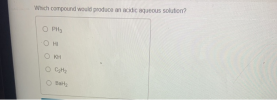
help Which compound would produce an acidic aqueous solution? O PH3 O HI Ο ΚΗ O...
 help
Which compound would produce an acidic aqueous solution? O PH3 O HI Ο ΚΗ O C₂H₂ O Bat2
help
Which compound would produce an acidic aqueous solution? O PH3 O HI Ο ΚΗ O C₂H₂ O Bat2
In which stage of free radical halogenation does the net number of radicals stay the same?...
 In which stage of free radical halogenation does the net number of radicals stay the same? Select one: O a. Termination O b. Alkylation c. Initiation O O d. Propagation
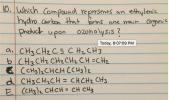
PLEASE EXPLAIN ALSO. Which compound represents an ethylenic hydro carbon that forms one main organic product...
 PLEASE EXPLAIN ALSO.
Which compound represents an ethylenic hydro carbon that forms one main organic product upon ozoholysis? CH_3CH_2C CH_2 CH_3 CH_3CH_2CH_2CH_2CH=CH_2 (CH_3)_2CHCH(CH_3)_2 CH_3CH_2CH=CHCH_2CH_3 (CH_3)_2CHCH=CHCH_3
PLEASE EXPLAIN ALSO.
Which compound represents an ethylenic hydro carbon that forms one main organic product upon ozoholysis? CH_3CH_2C CH_2 CH_3 CH_3CH_2CH_2CH_2CH=CH_2 (CH_3)_2CHCH(CH_3)_2 CH_3CH_2CH=CHCH_2CH_3 (CH_3)_2CHCH=CHCH_3
In the mechanism of the acid-catalyzed halogenation of ketones, which of the following is NOT true?...
 In the mechanism of the acid-catalyzed halogenation of ketones, which of the following is NOT true? Select one A. The rate-determining step is the attachment of a halogen atom to an enol intermediate. O B. The first step is attachment of Ht to the carbonyl oxygern. O C. The reaction rate is independent of the halogen (X2) concentration D. The rate-determining step is the loss of an H* from an alpha- carbon to form an enol intermediate
Which of the following combinations of reactants can provide a demonstrable example of anti-Markovnikov addition?
 35. Which of the following combinations of reactants can provide a demonstrable example of anti-Markovnikov addition? 36. In a competition reaction, equimolar amounts of five alkanes compete for a deficiency of chlorine at 300'c. The greatest amount of reaction would occur in the case of which of these alkanes? a. Ethane b. Propane c. Butane d. Isobutane e. Pentane
Which of the following would produce the most fluid lipid bilayer? O phospholipids with tails of...
 Which of the following would produce the most fluid lipid bilayer? O phospholipids with tails of 26 carbon atoms and two double bonds O phospholipids with fully saturated tails of 20 carbon atoms O large amounts of cholesterol O phospholipids with tails of 20 carbon atoms and two double bonds o phospholipids with fully saturated tails of 24 carbon atoms Which of the following can influence the rate at which a molecule will move across a lipid bilayer? (Check all...
4. Which of these compounds would produce the most gas product when reacting with NaHCO3? O...
 4. Which of these compounds would produce the most gas product when reacting with NaHCO3? O || { }-C C HO- HOA -CH2 12 H.co/ HCO ОН - OCH 3 B) D)
 Which is the regioselectivity of hydrohalogenation reaction and
underlying reason of this regioselectivity.
O Markovnikov addition: Alkene will accquire proton using the less substituted C so that it will produce more stable carbocation on the more substituted C. Markovnikov addition: Alkene will accquire proton using the more substituted C so that it will produce more stable carbocation on the more substituted C. anti-Markovnikov addition: Alkene will accquire a halide ion using the less substituted site to avoid larger steric hindrance...
Which is the regioselectivity of hydrohalogenation reaction and
underlying reason of this regioselectivity.
O Markovnikov addition: Alkene will accquire proton using the less substituted C so that it will produce more stable carbocation on the more substituted C. Markovnikov addition: Alkene will accquire proton using the more substituted C so that it will produce more stable carbocation on the more substituted C. anti-Markovnikov addition: Alkene will accquire a halide ion using the less substituted site to avoid larger steric hindrance...
 Testbank, Question 119 or the alkenes shown, which would produce the product shown below, upon treatment with ozone, followed by zinc metal and water? н ннн но неосно сон о нннн во о“ оо" - TIMPUNAN o o o o o
 ??
16. Which of the following reagents would promote non-Markovnikov addition to an alkene? a. 1. Hg(OAc)2, H20/THF, 2. NaBH4 b. KBr/KOH c. H30+ d. 1. BH3, THF 2. H202OH- 17. Halohydrin formation would be achieved by reacting an alkene with which of the following? a. b. c. d. Cl2 and water Water and methanol Os04 H2 and a catalyst 18. Reacting an alkene with 03 followed by Zn/H2O+ will create, a. Two carboxylic acids b. Two ketones c. One...
??
16. Which of the following reagents would promote non-Markovnikov addition to an alkene? a. 1. Hg(OAc)2, H20/THF, 2. NaBH4 b. KBr/KOH c. H30+ d. 1. BH3, THF 2. H202OH- 17. Halohydrin formation would be achieved by reacting an alkene with which of the following? a. b. c. d. Cl2 and water Water and methanol Os04 H2 and a catalyst 18. Reacting an alkene with 03 followed by Zn/H2O+ will create, a. Two carboxylic acids b. Two ketones c. One...
 help
Which compound would produce an acidic aqueous solution? O PH3 O HI Ο ΚΗ O C₂H₂ O Bat2
help
Which compound would produce an acidic aqueous solution? O PH3 O HI Ο ΚΗ O C₂H₂ O Bat2
 In which stage of free radical halogenation does the net number of radicals stay the same? Select one: O a. Termination O b. Alkylation c. Initiation O O d. Propagation
 PLEASE EXPLAIN ALSO.
Which compound represents an ethylenic hydro carbon that forms one main organic product upon ozoholysis? CH_3CH_2C CH_2 CH_3 CH_3CH_2CH_2CH_2CH=CH_2 (CH_3)_2CHCH(CH_3)_2 CH_3CH_2CH=CHCH_2CH_3 (CH_3)_2CHCH=CHCH_3
PLEASE EXPLAIN ALSO.
Which compound represents an ethylenic hydro carbon that forms one main organic product upon ozoholysis? CH_3CH_2C CH_2 CH_3 CH_3CH_2CH_2CH_2CH=CH_2 (CH_3)_2CHCH(CH_3)_2 CH_3CH_2CH=CHCH_2CH_3 (CH_3)_2CHCH=CHCH_3
 In the mechanism of the acid-catalyzed halogenation of ketones, which of the following is NOT true? Select one A. The rate-determining step is the attachment of a halogen atom to an enol intermediate. O B. The first step is attachment of Ht to the carbonyl oxygern. O C. The reaction rate is independent of the halogen (X2) concentration D. The rate-determining step is the loss of an H* from an alpha- carbon to form an enol intermediate
 Which of the following would produce the most fluid lipid bilayer? O phospholipids with tails of 26 carbon atoms and two double bonds O phospholipids with fully saturated tails of 20 carbon atoms O large amounts of cholesterol O phospholipids with tails of 20 carbon atoms and two double bonds o phospholipids with fully saturated tails of 24 carbon atoms Which of the following can influence the rate at which a molecule will move across a lipid bilayer? (Check all...
 4. Which of these compounds would produce the most gas product when reacting with NaHCO3? O || { }-C C HO- HOA -CH2 12 H.co/ HCO ОН - OCH 3 B) D)
Most questions answered within 3 hours.
-
Where is the error in this code sequence?
String s1 = "Hello";
String s2 = "ello";...
asked 11 months ago -
Financial data for Joel de Paris, Inc., for last year
follow:
Joel de Paris, Inc.
Balance...
asked 11 months ago -
Consider this reaction:
Al2(SO4)3 (aq)+ BaCl3
(aq) Al2Cl6 (aq)- +
3BaSO4(s) . What is the...
asked 11 months ago -
Suppose that Savneet is considering increasing her
recent random sample from 20 car rentals to 40...
asked 11 months ago -
Trucks arrive at an unloading terminal at an average rate of 120
per hour.
Trucks arrive...
asked 11 months ago -
Why are methanol and ethanol completely soluble in water while
octanol is not very little soluble....
asked 11 months ago -
A facilities manager at a university reads in a research report
that the mean amount of...
asked 11 months ago -
When the CuSO4 is rehydrated by adding water to the anhydrous
compound, is this an endothermic...
asked 11 months ago -
A ray of sunlight is passing from diamond into crown glass; the
angle of incidence is...
asked 11 months ago -
A block of mass 0.249 kg is placed on top of a light, vertical
spring of...
asked 11 months ago -
how do the kidneys compensate in the presences of acidosis
a) trigger hyperventilate
b) reserve acid...
asked 11 months ago -
Question 501 pts
The rental rate of capital to the firm increases. Which of the
following...
asked 11 months ago