In a certain town 60% of the households own mutual funds, 40% own individual stocks, and...
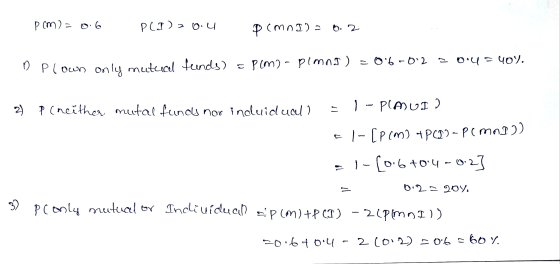
In a certain town 60% of the households own mutual funds, 40% own individual stocks, and 20% own both mutual funds and individual stocks.
1. The proportion of households that own mutual funds but not individual stocks is
a. 20%.
b. 30%.
c. 40%.
d. 50%.
2. The proportion of households that own neither mutual funds nor individual stocks is
a. 20%.
b. 30%.
c. 40%.
d. 50%.
3. The proportion of households that own mutual funds but not individual stocks or individual stocks but not mutual funds is
a. 40%.
b. 60%.
c. 80%.
d. 100%.
Homework Answers
Add Answer to:
In a certain town 60% of the households own mutual funds, 40%
own individual stocks, and...
18. In a certain town 60% of the households own mutual funds, 40 % own individual stocks, and 20% own both mutual f...
 18. In a certain town 60% of the households own mutual funds, 40 % own individual stocks, and 20% own both mutual funds and individual stocks. Reference: Ref 4-2 The proportion of households that own mutual funds but not individual stocks is: O50% O20%. 30%. 40%.
In a small town, 60% of the households own a Macintosh computer, 40% own a...
In a small town, 60% of the households own a Macintosh computer, 40% own a Windows computer, and 20% own both types of computers. The proportion of households that own a Macintosh but not a Windows computer is: a) 20%. b) 30%. c) 40%. d) 50%.
In a town, 30% of the households own a dog, 20% own a cat, and 60%...
In a town, 30% of the households own a dog, 20% own a cat, and 60% own neither a dog nor a cat. If we select a household at random, what is the chance that they own both a dog and a cat? please show all steps and also mention your reasoning in details.
please help with this question 2. A pension fund manager is considering three mutual funds. The...
 please help with this question
2. A pension fund manager is considering three mutual funds. The first is a stock fund, the second is a long-term government and corporate bond fund, and the third is a T-bill money market fund that yields a rate of 8%. The probability distribution of the risky funds is as follows: Fund Stock fund (S) Bond fund (B) Expected Return 20% 12% Standard Deviation 30% 15% The correlation between the fund returns is 0.10. a)...
please help with this question
2. A pension fund manager is considering three mutual funds. The first is a stock fund, the second is a long-term government and corporate bond fund, and the third is a T-bill money market fund that yields a rate of 8%. The probability distribution of the risky funds is as follows: Fund Stock fund (S) Bond fund (B) Expected Return 20% 12% Standard Deviation 30% 15% The correlation between the fund returns is 0.10. a)...
Format your numerical answers to 4 decimals. A survey of 200 college graduates who have been working for at least three...
Format your numerical answers to 4 decimals. A survey of 200 college graduates who have been working for at least three years found that 60 owned only mutual funds, 40 owned only stocks, 40 owned only bonds and 50 owned all three stocks, bonds and mutual funds. What is the probability that an individual owns a stock? What is the probability that an individual owns a bond? What is the probability that an individual owns a mutual fund? What is...
Format your numerical answers to 4 decimals. A survey of 200 college graduates who have been...
Format your numerical answers to 4 decimals. A survey of 200 college graduates who have been working for at least three years found that 60 owned only mutual funds, 40 owned only stocks, 40 owned only bonds and 50 owned all three stocks, bonds and mutual funds. What is the probability that an individual owns a stock? What is the probability that an individual owns a bond? What is the probability that an individual owns a mutual fund? What is...
A humane society claims that less than 60% of households in a certain country own a...
 A humane society claims that less than 60% of households in a certain country own a pet. In a random sample of 800 households in tha country, 464 say they own a pet. At α=005, is there enough evidence to support the society's claim? Complete parts (a) through (c) be (a) Identify the claim and state Ho and H3 ldentify the claim in this scenario. Select the correct choice below and fill in the answer box to complete your choice...
Households in China save 40 percent of their annual incomes each year, whereas U.S. households save...
 Households in China save 40 percent of their annual incomes each year, whereas U.S. households save less than 5 percent. At the same time, production possibilities are growing at roughly 9 percent per year in China but only about 3.5 percent in the United States. Use the graphical analysis of "present goods" versus "future goods" to explain the difference between China's growth rate and the U.S. growth rate. Production Possibilities (China) Production Possibilities (United States) 100 100 … 0ppc 80...
r 170 160+ 150 140+ 130 - 120 110 100+ 90 Supply 80- 70 60+ SO...
 r 170 160+ 150 140+ 130 - 120 110 100+ 90 Supply 80- 70 60+ SO 40- Demand 30 20- 10- 2 4 6 8 10 12 14 16 18 20 22 24 26 28 30 Quantity of Loanable Funds Suppose the market for loanable funds opened up to international borrowers and savers. Further suppose that the real interest rate worldwide is 120 basis points (100 basis points = 1%). Would the gains from trade end up with the households...
MyEPCC Course Content pter 1- Homework Help Save & ExitSubmit Households in China save 40 percent...
 MyEPCC Course Content pter 1- Homework Help Save & ExitSubmit Households in China save 40 percent of their annual incomes each year, whereas U.S. households save less than 5 same time, production possibilities are growing at roughly 9 percent per year in China but only about 3.5 percent in the United States. Use the graphical analysis of "present goods versus future goods" to explain the difference between China's growth rate and the U.S. growth rate. percent. At the Production Possibilities...
 18. In a certain town 60% of the households own mutual funds, 40 % own individual stocks, and 20% own both mutual funds and individual stocks. Reference: Ref 4-2 The proportion of households that own mutual funds but not individual stocks is: O50% O20%. 30%. 40%.
 please help with this question
2. A pension fund manager is considering three mutual funds. The first is a stock fund, the second is a long-term government and corporate bond fund, and the third is a T-bill money market fund that yields a rate of 8%. The probability distribution of the risky funds is as follows: Fund Stock fund (S) Bond fund (B) Expected Return 20% 12% Standard Deviation 30% 15% The correlation between the fund returns is 0.10. a)...
please help with this question
2. A pension fund manager is considering three mutual funds. The first is a stock fund, the second is a long-term government and corporate bond fund, and the third is a T-bill money market fund that yields a rate of 8%. The probability distribution of the risky funds is as follows: Fund Stock fund (S) Bond fund (B) Expected Return 20% 12% Standard Deviation 30% 15% The correlation between the fund returns is 0.10. a)...
 A humane society claims that less than 60% of households in a certain country own a pet. In a random sample of 800 households in tha country, 464 say they own a pet. At α=005, is there enough evidence to support the society's claim? Complete parts (a) through (c) be (a) Identify the claim and state Ho and H3 ldentify the claim in this scenario. Select the correct choice below and fill in the answer box to complete your choice...
 Households in China save 40 percent of their annual incomes each year, whereas U.S. households save less than 5 percent. At the same time, production possibilities are growing at roughly 9 percent per year in China but only about 3.5 percent in the United States. Use the graphical analysis of "present goods" versus "future goods" to explain the difference between China's growth rate and the U.S. growth rate. Production Possibilities (China) Production Possibilities (United States) 100 100 … 0ppc 80...
 r 170 160+ 150 140+ 130 - 120 110 100+ 90 Supply 80- 70 60+ SO 40- Demand 30 20- 10- 2 4 6 8 10 12 14 16 18 20 22 24 26 28 30 Quantity of Loanable Funds Suppose the market for loanable funds opened up to international borrowers and savers. Further suppose that the real interest rate worldwide is 120 basis points (100 basis points = 1%). Would the gains from trade end up with the households...
 MyEPCC Course Content pter 1- Homework Help Save & ExitSubmit Households in China save 40 percent of their annual incomes each year, whereas U.S. households save less than 5 same time, production possibilities are growing at roughly 9 percent per year in China but only about 3.5 percent in the United States. Use the graphical analysis of "present goods versus future goods" to explain the difference between China's growth rate and the U.S. growth rate. percent. At the Production Possibilities...
Most questions answered within 3 hours.
-
Where is the error in this code sequence?
String s1 = "Hello";
String s2 = "ello";...
asked 11 months ago -
Financial data for Joel de Paris, Inc., for last year
follow:
Joel de Paris, Inc.
Balance...
asked 11 months ago -
Consider this reaction:
Al2(SO4)3 (aq)+ BaCl3
(aq) Al2Cl6 (aq)- +
3BaSO4(s) . What is the...
asked 11 months ago -
Suppose that Savneet is considering increasing her
recent random sample from 20 car rentals to 40...
asked 11 months ago -
Trucks arrive at an unloading terminal at an average rate of 120
per hour.
Trucks arrive...
asked 11 months ago -
Why are methanol and ethanol completely soluble in water while
octanol is not very little soluble....
asked 11 months ago -
A facilities manager at a university reads in a research report
that the mean amount of...
asked 11 months ago -
When the CuSO4 is rehydrated by adding water to the anhydrous
compound, is this an endothermic...
asked 11 months ago -
A ray of sunlight is passing from diamond into crown glass; the
angle of incidence is...
asked 11 months ago -
A block of mass 0.249 kg is placed on top of a light, vertical
spring of...
asked 11 months ago -
how do the kidneys compensate in the presences of acidosis
a) trigger hyperventilate
b) reserve acid...
asked 11 months ago -
Question 501 pts
The rental rate of capital to the firm increases. Which of the
following...
asked 11 months ago