
Homework Answers
6. a)
The Carrier Sense Multiple Access with Collision Avoidance (CSMA/CA) algorithm was designed for the wireless network technology [802.11]. It senses the transmission channel before transmitting a frame and also tries to avoid collisions by carefully tuning the timers used by CSMA/CA devices.
CSMA/CA uses acknowledgements after a frame is received. Each frame contains a sequence number and a CRC (Cyclic Redundancy Check). The CRC is used to detect transmission errors while the sequence number is used to avoid frame duplication. When a device receives a correct frame, it returns a special acknowledgement frame to the sender. CSMA/CA introduces a small delay, named Short Inter Frame Spacing (SIFS), between the reception of a frame and the transmission of the acknowledgement frame. This delay corresponds to the time that is required to switch the device between the reception and transmission modes.
CSMA/CA defines more precisely when a device is allowed to send a frame. First, CSMA/CA defines two delays : DIFS (the Distributed Coordination Function Inter Frame Space) and EIFS (the Extended Inter Frame Space). To send a frame, a device must first wait until the channel has been idle for at least (DIFS) if the previous frame was received correctly. However, if the previously received frame was corrupted, this indicates that there are collisions and the device must sense the channel idle for at least (EIFS), with SIFS < DIFS < EIFS. The exact values for SIFS, DIFS and EIFS depend on the underlying physical layer.
The figure a. below shows the basic operation of CSMA/CA devices. Before transmitting, host A verifies that the channel is empty for a long enough period. Then, its sends its data frame. After checking the validity of the received frame, the recipient sends an acknowledgement frame after a short SIFS delay. Host C, which does not participate in the frame exchange, senses the channel to be busy at the beginning of the data frame. Host C can use this information to determine how long the channel will be busy for. Note that as SIFS < DIFS < EIFS, even a device that would start to sense the channel immediately after the last bit of the data frame could not decide to transmit its own frame during the transmission of the acknowledgement frame.
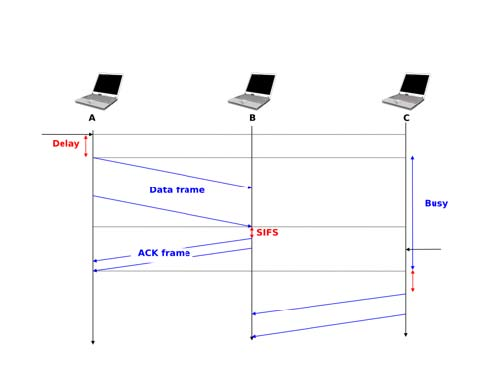
Figure a. Operation of a CSMA/CA device
The main difficulty with CSMA/CA is when two or more devices transmit at the same time and cause collisions. This is illustrated in the figure b. below, assuming a fixed timeout after the transmission of a data frame. With CSMA/CA, the timeout after the transmission of a data frame is very small, since it corresponds to the SIFS plus the time required to transmit the acknowledgement frame.
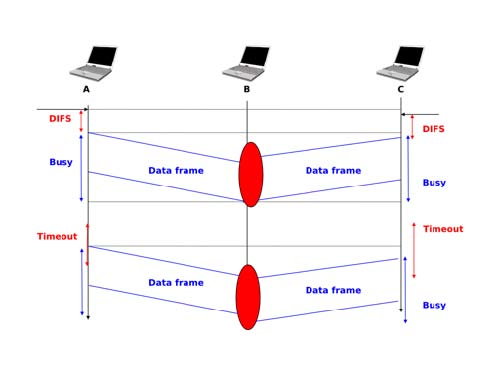
Figure b. Collisions with CSMA/CA
To deal with this problem, CSMA/CA relies on a backoff timer. This backoff timer is a random delay that is chosen by each device in a range that depends on the number of retransmissions for the current frame. The range grows exponentially with the retransmissions. The minimum range for the backoff timer is [0, 7 ∗ slot Time] where the slotTime is a parameter that depends on the underlying physical layer.
The two reasons why collisions cannot be eliminated in a network, whose nodes perform carrier sensing before transmitting a packet are:-
- The initial range for the backoff timer is seven times larger. This is because it is impossible in CSMA/CA to detect collisions as they happen. With CSMA/CA, a collision may affect the entire frame while with CSMA/CD it can only affect the beginning of the frame.
- A CSMA/CA device must regularly sense the transmission channel during its back off timer. If the channel becomes busy (i.e. because another device is transmitting), then the back off timer must be frozen until the channel becomes free again. Once the channel becomes free, the back off timer is restarted. This is in contrast with CSMA/CD where the back off is recomputed after each collision. This is illustrated in the figure c. below. Host A chooses a smaller backoff than host C. When C senses the channel to be busy, it freezes its backoff timer and only restarts it once the channel is free again.
![DIFS Backoff[0, 91 DIFS Backoff[0, 7] Dara frame Channel busy! 1 SIFS Busy Ack frame- Remaining Backoff Data frame](http://img.homeworklib.com/questions/59e9f960-4229-11eb-a8b2-f17fef682073.png?x-oss-process=image/resize,w_560)
Figure c. Detailed example with CSMA/CA
Add Answer to:
Problem 6 a) State two approaches of avoiding collision in a carrier sense multiple access with...
Most questions answered within 3 hours.
-
Where is the error in this code sequence?
String s1 = "Hello";
String s2 = "ello";...
asked 10 months ago -
Financial data for Joel de Paris, Inc., for last year
follow:
Joel de Paris, Inc.
Balance...
asked 10 months ago -
Consider this reaction:
Al2(SO4)3 (aq)+ BaCl3
(aq) Al2Cl6 (aq)- +
3BaSO4(s) . What is the...
asked 10 months ago -
Suppose that Savneet is considering increasing her
recent random sample from 20 car rentals to 40...
asked 10 months ago -
Trucks arrive at an unloading terminal at an average rate of 120
per hour.
Trucks arrive...
asked 10 months ago -
Why are methanol and ethanol completely soluble in water while
octanol is not very little soluble....
asked 10 months ago -
A facilities manager at a university reads in a research report
that the mean amount of...
asked 10 months ago -
When the CuSO4 is rehydrated by adding water to the anhydrous
compound, is this an endothermic...
asked 10 months ago -
A ray of sunlight is passing from diamond into crown glass; the
angle of incidence is...
asked 10 months ago -
A block of mass 0.249 kg is placed on top of a light, vertical
spring of...
asked 10 months ago -
how do the kidneys compensate in the presences of acidosis
a) trigger hyperventilate
b) reserve acid...
asked 10 months ago -
Question 501 pts
The rental rate of capital to the firm increases. Which of the
following...
asked 10 months ago