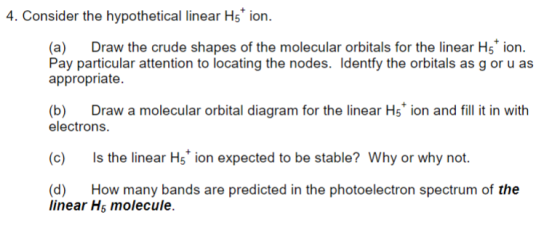
in fact there is no more information. this is how the question is
Homework Answers
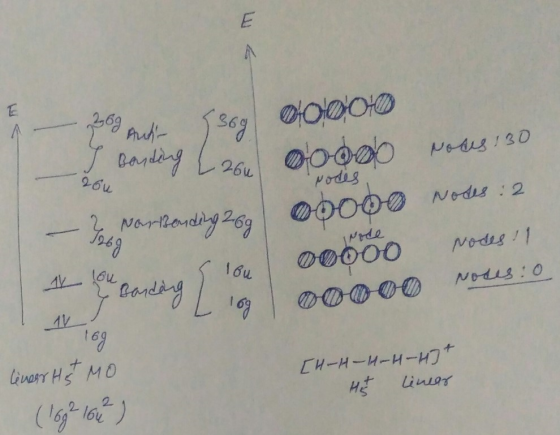
nth orbital will have n-1 nodes.
Thus orbitals : 1σg, 1σu, 2σg, 2σu, and 3σg will have : 0,1,2,3,4 nodes respectively.
Energy order : 1σg< 1σu (bonding MOs) <2σg (Nonbonding MOs) < 2σu < 3σg (Antibonding MOs)
Electrons shall be filled as hund's rule with increasing energy : 1σg21σu2
Thus both bonding orbitals are occupied , no electron in antibonding orbitals : thus it can be expected to be stable.
(d)
A photoelecton spectrum show the relative energies of occupied molecular orbitals by ionization. (i.e. ejection of an electron).
Linear H5 molecule :
Electrons shall be filled as hund's rule with increasing energy : 1σg21σu2 2σg1
Since three MO orbitals (different) energy are occupied , thus we can expect 3 bands in photoelectron spectroscopy.
Add Answer to:
in fact there is no more information. this is how the question
is
4. Consider the...
4. Consider the hypothetical linear Hg ion (a) Draw the crude shapes of the molecular orbitals...
 4. Consider the hypothetical linear Hg ion (a) Draw the crude shapes of the molecular orbitals for the linear H ion. Pay particular attention to locating the nodes. Identfy the orbitals as g or u as appropriate (b) Draw a molecular orbital diagram for the linear H ion and fill it in with electrons. Is the linear Ha ion expected to be stable? Why or why not How many bands are predicted in the photoelectron spectrum of linear He (c)...
(a) Draw a molecular orbital energy diagram for Cl2 and show which orbitals are occupied with electrons. (b) How many ba...
(a) Draw a molecular orbital energy diagram for Cl2 and show which orbitals are occupied with electrons. (b) How many bands are expected in the photoelectron spectrum of the valence electrons for Cl2? Why? (c) Draw the shape of the pi* orbital in Cl2. (d) What is the bond order for Cl2? (e) Is Cl2 diamagnetic or paramagnetic?
(a) Draw a molecular orbital energy diagram for Cl2 and show which orbitals are occupied with...
 (a) Draw a molecular orbital energy diagram for Cl2 and show which orbitals are occupied with electrons. (b) How many bands are expected in the photoelectron spectrum of the valence electrons for Cl2? Why? (c) Draw the shape of the r* orbital in Cl2. (d) What is the bond order for Cl2? (e) Is Cl2 diamagnetic or paramagnetic?
The H3+ ion is unstable under ambient terrestrial conditions, but because of the abundance of H...
The H3+ ion is unstable under ambient terrestrial conditions, but because of the abundance of H in the universe and the cold vacuous nature of space between celestial bodies, it is, in fact, quite abundant in the universe and important in the chemistry of outer space. Actual H3+ ions are cyclic, but we will consider instead the simpler possibility of a linear H3+ molecule. Draw a molecular orbital diagram for linear H3+. Include both the atomic orbitals that combine and...
Question 4 [31] For a diatomic molecule, the electronic wavefunction was descri bed by CA +...
 Question 4 [31] For a diatomic molecule, the electronic wavefunction was descri bed by CA + €pB R (a)Express energy expectation value as a function of c, Ca and integral constants [3] (b) Derive and explain their chemical implications of Coulombic integral (a), Resonance Integral (B), and Overlap Integral (s). [3] (c)What are the key Hückel's approximations for a homonuclear molecule? [4] Question 4 [31]; Contin ued Propene Cyclopropene Cyclopropenyl Cation Using the Hückel molecular orbital theory, wavefunction of electrons...
Consider the diatomic molecule NF. (a) Draw the shape of the 2 pz orbital on N....
 Consider the diatomic molecule NF. (a) Draw the shape of the 2 pz orbital on N. How many nodes does this orbital have? Show the nodes in your diagram. (b) Construct a molecular orbital energy diagram for NF. For this drawing consider both the s and p valence orbitals on each atom, but do not include orbital mixing. Show how the electrons are placed in the MO's. (c) How would orbital mixing alter the MO energy diagram you just constructed?...
b) Is CO paramagnetic or diamagnetic? What is the bond order of CO? c) Draw a Lewis structure...
Draw an energy-level diagram for the valence molecular orbitals of CO. Include the relevant atomic orbitals in your diagram. Clearly label each molecular orbital (e.gs2s, p2p, etc.) and fill in the appropriate number of electrons. Use the same energy order as the neutral O2 molecule.b) Is CO paramagnetic or diamagnetic? What is the bond order of CO? c) Draw a Lewis structure for CO. Does this match the predicted bond order? d) CO can react withOH– to form the formate...
4. On the basis of molecular orbitals and molecular orbital diagrams, predict which molecule in each...
 4. On the basis of molecular orbitals and molecular orbital diagrams, predict which molecule in each series will have the longest bond. Be sure to provide a brief explanation a. B2, B2 b. 02*, 0,- c. HHe", Hz 5. Consider the hydroxide ion, OH and do the following: a. Prepare a molecular orbital diagram and fill with electrons given the following atomic orbital potential energies: O(2s) = -32.3 eV, O(2p) = -15.8 eV, H(s) -13.6 eV. Be sure to label...
Question #4 & #5? 3) Using Early and Late Molecular Orbitals, draw the two M.O. diagrams...
 Question #4 & #5?
3) Using Early and Late Molecular Orbitals, draw the two M.O. diagrams for NO , determine which is most stable; calculate and state bond order of each, state diamagnetic or paramagnetioc d if paramagnetic and by how many electrons. an 4) If four hydrogens, each with its 1s orbital, and two carbons, each with its one 2s and three 2p orbitals, form a molecule, then how many molecular orbitals will there be? How many bonding orbitals,...
Question #4 & #5?
3) Using Early and Late Molecular Orbitals, draw the two M.O. diagrams for NO , determine which is most stable; calculate and state bond order of each, state diamagnetic or paramagnetioc d if paramagnetic and by how many electrons. an 4) If four hydrogens, each with its 1s orbital, and two carbons, each with its one 2s and three 2p orbitals, form a molecule, then how many molecular orbitals will there be? How many bonding orbitals,...
please answer following question. (d) Cah 2. The molecule NO2 is a reactive gas with a...
 please answer
following question.
(d) Cah 2. The molecule NO2 is a reactive gas with a bond angle of 134.3º. (a) Draw the most stable possible Lewis structure(s) of NO2. (b) Determine the correct point group for NO2 and determine the sand p orbital symmetry Mulliken symbols for the central nitrogen from the character table. Make sure your molecule is in the xz plane with the z-axis as the main rotation axis. (©) Find the reducible representations for SALCs formed...
please answer
following question.
(d) Cah 2. The molecule NO2 is a reactive gas with a bond angle of 134.3º. (a) Draw the most stable possible Lewis structure(s) of NO2. (b) Determine the correct point group for NO2 and determine the sand p orbital symmetry Mulliken symbols for the central nitrogen from the character table. Make sure your molecule is in the xz plane with the z-axis as the main rotation axis. (©) Find the reducible representations for SALCs formed...
 4. Consider the hypothetical linear Hg ion (a) Draw the crude shapes of the molecular orbitals for the linear H ion. Pay particular attention to locating the nodes. Identfy the orbitals as g or u as appropriate (b) Draw a molecular orbital diagram for the linear H ion and fill it in with electrons. Is the linear Ha ion expected to be stable? Why or why not How many bands are predicted in the photoelectron spectrum of linear He (c)...
 (a) Draw a molecular orbital energy diagram for Cl2 and show which orbitals are occupied with electrons. (b) How many bands are expected in the photoelectron spectrum of the valence electrons for Cl2? Why? (c) Draw the shape of the r* orbital in Cl2. (d) What is the bond order for Cl2? (e) Is Cl2 diamagnetic or paramagnetic?
 Question 4 [31] For a diatomic molecule, the electronic wavefunction was descri bed by CA + €pB R (a)Express energy expectation value as a function of c, Ca and integral constants [3] (b) Derive and explain their chemical implications of Coulombic integral (a), Resonance Integral (B), and Overlap Integral (s). [3] (c)What are the key Hückel's approximations for a homonuclear molecule? [4] Question 4 [31]; Contin ued Propene Cyclopropene Cyclopropenyl Cation Using the Hückel molecular orbital theory, wavefunction of electrons...
 Consider the diatomic molecule NF. (a) Draw the shape of the 2 pz orbital on N. How many nodes does this orbital have? Show the nodes in your diagram. (b) Construct a molecular orbital energy diagram for NF. For this drawing consider both the s and p valence orbitals on each atom, but do not include orbital mixing. Show how the electrons are placed in the MO's. (c) How would orbital mixing alter the MO energy diagram you just constructed?...
 4. On the basis of molecular orbitals and molecular orbital diagrams, predict which molecule in each series will have the longest bond. Be sure to provide a brief explanation a. B2, B2 b. 02*, 0,- c. HHe", Hz 5. Consider the hydroxide ion, OH and do the following: a. Prepare a molecular orbital diagram and fill with electrons given the following atomic orbital potential energies: O(2s) = -32.3 eV, O(2p) = -15.8 eV, H(s) -13.6 eV. Be sure to label...
 Question #4 & #5?
3) Using Early and Late Molecular Orbitals, draw the two M.O. diagrams for NO , determine which is most stable; calculate and state bond order of each, state diamagnetic or paramagnetioc d if paramagnetic and by how many electrons. an 4) If four hydrogens, each with its 1s orbital, and two carbons, each with its one 2s and three 2p orbitals, form a molecule, then how many molecular orbitals will there be? How many bonding orbitals,...
Question #4 & #5?
3) Using Early and Late Molecular Orbitals, draw the two M.O. diagrams for NO , determine which is most stable; calculate and state bond order of each, state diamagnetic or paramagnetioc d if paramagnetic and by how many electrons. an 4) If four hydrogens, each with its 1s orbital, and two carbons, each with its one 2s and three 2p orbitals, form a molecule, then how many molecular orbitals will there be? How many bonding orbitals,...
 please answer
following question.
(d) Cah 2. The molecule NO2 is a reactive gas with a bond angle of 134.3º. (a) Draw the most stable possible Lewis structure(s) of NO2. (b) Determine the correct point group for NO2 and determine the sand p orbital symmetry Mulliken symbols for the central nitrogen from the character table. Make sure your molecule is in the xz plane with the z-axis as the main rotation axis. (©) Find the reducible representations for SALCs formed...
please answer
following question.
(d) Cah 2. The molecule NO2 is a reactive gas with a bond angle of 134.3º. (a) Draw the most stable possible Lewis structure(s) of NO2. (b) Determine the correct point group for NO2 and determine the sand p orbital symmetry Mulliken symbols for the central nitrogen from the character table. Make sure your molecule is in the xz plane with the z-axis as the main rotation axis. (©) Find the reducible representations for SALCs formed...
Most questions answered within 3 hours.
-
Where is the error in this code sequence?
String s1 = "Hello";
String s2 = "ello";...
asked 10 months ago -
Financial data for Joel de Paris, Inc., for last year
follow:
Joel de Paris, Inc.
Balance...
asked 10 months ago -
Consider this reaction:
Al2(SO4)3 (aq)+ BaCl3
(aq) Al2Cl6 (aq)- +
3BaSO4(s) . What is the...
asked 10 months ago -
Suppose that Savneet is considering increasing her
recent random sample from 20 car rentals to 40...
asked 10 months ago -
Trucks arrive at an unloading terminal at an average rate of 120
per hour.
Trucks arrive...
asked 10 months ago -
Why are methanol and ethanol completely soluble in water while
octanol is not very little soluble....
asked 10 months ago -
A facilities manager at a university reads in a research report
that the mean amount of...
asked 10 months ago -
When the CuSO4 is rehydrated by adding water to the anhydrous
compound, is this an endothermic...
asked 10 months ago -
A ray of sunlight is passing from diamond into crown glass; the
angle of incidence is...
asked 10 months ago -
A block of mass 0.249 kg is placed on top of a light, vertical
spring of...
asked 10 months ago -
how do the kidneys compensate in the presences of acidosis
a) trigger hyperventilate
b) reserve acid...
asked 10 months ago -
Question 501 pts
The rental rate of capital to the firm increases. Which of the
following...
asked 10 months ago