
Homework Answers
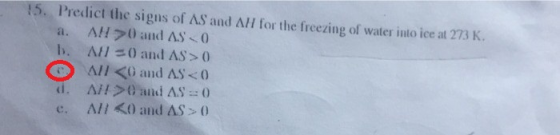
Explanation :
freeze the water to ice. the delta S is negative.
becuase in water the molecules move more randomly than in a solid. if randomness is more entropy is more.
in solids randomness of molecules is decreases. so entropy decreases.
so delta S is negative (delta S < 0)
and this process is exothermic. so delta H < 0
Add Answer to:
What is delta S?
Predict the signs of Delta S and Delta H for the freezing...
Predict the delta G and the product assuming presence of acid or base catalyst as needed....
 Predict the delta G and the product assuming presence of acid
or base catalyst as needed.
0: SOCI2 ? OH AG° <0 kJ/mol AG° 0 kJ/mol AG° >0 kJ/mol CH3NH2 - ? H H AG° <0 kJ/mol AG° 0 kJ/mol AG° >0 kJ/mol O: CH3OH ? HOOL CH3 AG° <0 kJ/mol AG° 0 kJ/mol AG° >0 kJ/mol CH3OH CF3 - ? AG° <0 kJ/mol AG° 0 kJ/mol AG° > kJ/mol
Predict the delta G and the product assuming presence of acid
or base catalyst as needed.
0: SOCI2 ? OH AG° <0 kJ/mol AG° 0 kJ/mol AG° >0 kJ/mol CH3NH2 - ? H H AG° <0 kJ/mol AG° 0 kJ/mol AG° >0 kJ/mol O: CH3OH ? HOOL CH3 AG° <0 kJ/mol AG° 0 kJ/mol AG° >0 kJ/mol CH3OH CF3 - ? AG° <0 kJ/mol AG° 0 kJ/mol AG° > kJ/mol
Predict the signs of delta H (Enthalpy) and delta S (Entropy) for the evaporation of water at 85 C
Predict the signs of delta H (Enthalpy) and delta S (Entropy) for the evaporation of water at 85 C.
Predict delta G and the product assuming presence of acid or base catalyst as needed. NH...
 Predict delta G and the product assuming presence of acid or
base catalyst as needed.
NH ? OCH3 AG° <0 kJ/mol AG° 20 kJ/mol AG° >0 kJ/mol O: ОН - ? Br AG° <0 kJ/mol AG° 0 kJ/mol AGº > kJ/mol H/Pt ? AG° <0 kJ/mol AG° 0 kJ/mol AGⓇ>0 kJ/mol NaOH CH3 ? (2 eq.) AG° <0 kJ/mol AG° 0 kJ/mol om AGº >0 kJ/mol
Predict delta G and the product assuming presence of acid or
base catalyst as needed.
NH ? OCH3 AG° <0 kJ/mol AG° 20 kJ/mol AG° >0 kJ/mol O: ОН - ? Br AG° <0 kJ/mol AG° 0 kJ/mol AGº > kJ/mol H/Pt ? AG° <0 kJ/mol AG° 0 kJ/mol AGⓇ>0 kJ/mol NaOH CH3 ? (2 eq.) AG° <0 kJ/mol AG° 0 kJ/mol om AGº >0 kJ/mol
Predict delta G and the product assuming presence of acid or base catalyst as needed. HOCH...
 Predict delta G and the product assuming presence of acid or
base catalyst as needed.
HOCH CH2OH CH3 * ? AG° <0 kJ/mol AGⓇ=0 kJ/mol AG° >0 kJ/mol CH3OH NH2 ? AG° <0 kJ/mol AG° 20 kJ/mol AG° >0 kJ/mol -ОН С. ОСН3 ДG° <0 kJ/mol AG° 0 kJ/mol ДG° >0 kJ/mol CH3NH2 ? ОН AG° <0 kJ/mol AG° 0 kJ/mol AGⓇ>0 kJ/mol
Predict delta G and the product assuming presence of acid or
base catalyst as needed.
HOCH CH2OH CH3 * ? AG° <0 kJ/mol AGⓇ=0 kJ/mol AG° >0 kJ/mol CH3OH NH2 ? AG° <0 kJ/mol AG° 20 kJ/mol AG° >0 kJ/mol -ОН С. ОСН3 ДG° <0 kJ/mol AG° 0 kJ/mol ДG° >0 kJ/mol CH3NH2 ? ОН AG° <0 kJ/mol AG° 0 kJ/mol AGⓇ>0 kJ/mol
What are the signs (+ or -) for delta H, delta S, and -T(delta S) which...
What are the signs (+ or -) for delta H, delta S, and -T(delta S) which are required to produce the following signs (+ or -) of delta G. Think about the equation delta G = delta H - T(delta S). 1. If delta G is negative 2. If delta G is either positive or negative (there are 2 solutions) 3. If delta G is negative
8. Part A. (9 pt) For the reaction below, predict the signs for delta H system,...
 8. Part A. (9 pt) For the reaction below, predict the
signs for delta H system, delta S system, and delta S surrounding,
AND explain your answer for each.
8. Part A. (9 pt) For the reaction below, predict the signs for AHºsys, ASºsys, and AS surr, and EXPLAIN your answers.
8. Part A. (9 pt) For the reaction below, predict the
signs for delta H system, delta S system, and delta S surrounding,
AND explain your answer for each.
8. Part A. (9 pt) For the reaction below, predict the signs for AHºsys, ASºsys, and AS surr, and EXPLAIN your answers.
In terms of the algebraic signs of delta H and delta S, under which of the...
In terms of the algebraic signs of delta H and delta S, under which of the following circumstances will a change be spontaneous? a) at all temperatures? b) at low temperatures but not high temperatures? c) at high temperatures but not at low temperatures?
Consider the following reaction at 298K. 2 Cr (a)+Co(s)2 Cr2 (a) Co* (aq) Which of the...
 Consider the following reaction at 298K. 2 Cr (a)+Co(s)2 Cr2 (a) Co* (aq) Which of the following statements are correct? Choose all that apply. E°cell0 O delta Go < 0 The reaction is product-favored On 4 mol electrons
< Question 20 of 20 > What is the heat of combustion of ethane, C, H,...
 < Question 20 of 20 > What is the heat of combustion of ethane, C, H, in kilojoules per mole of ethane? Enthalpy of formation values can be found in this list of thermodynamic properties. AH = kJ/mol ethane
4.25 In the circuit shown in Figure P4.25. let forooto for O t < 1 s...
 4.25 In the circuit shown in Figure P4.25. let forooto for O t < 1 s for 1 s ,<2s for 2 s stoo Find the energy stored in the inductor for all te 2 H Figure P4.25
 Predict the delta G and the product assuming presence of acid
or base catalyst as needed.
0: SOCI2 ? OH AG° <0 kJ/mol AG° 0 kJ/mol AG° >0 kJ/mol CH3NH2 - ? H H AG° <0 kJ/mol AG° 0 kJ/mol AG° >0 kJ/mol O: CH3OH ? HOOL CH3 AG° <0 kJ/mol AG° 0 kJ/mol AG° >0 kJ/mol CH3OH CF3 - ? AG° <0 kJ/mol AG° 0 kJ/mol AG° > kJ/mol
Predict the delta G and the product assuming presence of acid
or base catalyst as needed.
0: SOCI2 ? OH AG° <0 kJ/mol AG° 0 kJ/mol AG° >0 kJ/mol CH3NH2 - ? H H AG° <0 kJ/mol AG° 0 kJ/mol AG° >0 kJ/mol O: CH3OH ? HOOL CH3 AG° <0 kJ/mol AG° 0 kJ/mol AG° >0 kJ/mol CH3OH CF3 - ? AG° <0 kJ/mol AG° 0 kJ/mol AG° > kJ/mol
 Predict delta G and the product assuming presence of acid or
base catalyst as needed.
NH ? OCH3 AG° <0 kJ/mol AG° 20 kJ/mol AG° >0 kJ/mol O: ОН - ? Br AG° <0 kJ/mol AG° 0 kJ/mol AGº > kJ/mol H/Pt ? AG° <0 kJ/mol AG° 0 kJ/mol AGⓇ>0 kJ/mol NaOH CH3 ? (2 eq.) AG° <0 kJ/mol AG° 0 kJ/mol om AGº >0 kJ/mol
Predict delta G and the product assuming presence of acid or
base catalyst as needed.
NH ? OCH3 AG° <0 kJ/mol AG° 20 kJ/mol AG° >0 kJ/mol O: ОН - ? Br AG° <0 kJ/mol AG° 0 kJ/mol AGº > kJ/mol H/Pt ? AG° <0 kJ/mol AG° 0 kJ/mol AGⓇ>0 kJ/mol NaOH CH3 ? (2 eq.) AG° <0 kJ/mol AG° 0 kJ/mol om AGº >0 kJ/mol
 Predict delta G and the product assuming presence of acid or
base catalyst as needed.
HOCH CH2OH CH3 * ? AG° <0 kJ/mol AGⓇ=0 kJ/mol AG° >0 kJ/mol CH3OH NH2 ? AG° <0 kJ/mol AG° 20 kJ/mol AG° >0 kJ/mol -ОН С. ОСН3 ДG° <0 kJ/mol AG° 0 kJ/mol ДG° >0 kJ/mol CH3NH2 ? ОН AG° <0 kJ/mol AG° 0 kJ/mol AGⓇ>0 kJ/mol
Predict delta G and the product assuming presence of acid or
base catalyst as needed.
HOCH CH2OH CH3 * ? AG° <0 kJ/mol AGⓇ=0 kJ/mol AG° >0 kJ/mol CH3OH NH2 ? AG° <0 kJ/mol AG° 20 kJ/mol AG° >0 kJ/mol -ОН С. ОСН3 ДG° <0 kJ/mol AG° 0 kJ/mol ДG° >0 kJ/mol CH3NH2 ? ОН AG° <0 kJ/mol AG° 0 kJ/mol AGⓇ>0 kJ/mol
 8. Part A. (9 pt) For the reaction below, predict the
signs for delta H system, delta S system, and delta S surrounding,
AND explain your answer for each.
8. Part A. (9 pt) For the reaction below, predict the signs for AHºsys, ASºsys, and AS surr, and EXPLAIN your answers.
8. Part A. (9 pt) For the reaction below, predict the
signs for delta H system, delta S system, and delta S surrounding,
AND explain your answer for each.
8. Part A. (9 pt) For the reaction below, predict the signs for AHºsys, ASºsys, and AS surr, and EXPLAIN your answers.
 Consider the following reaction at 298K. 2 Cr (a)+Co(s)2 Cr2 (a) Co* (aq) Which of the following statements are correct? Choose all that apply. E°cell0 O delta Go < 0 The reaction is product-favored On 4 mol electrons
 < Question 20 of 20 > What is the heat of combustion of ethane, C, H, in kilojoules per mole of ethane? Enthalpy of formation values can be found in this list of thermodynamic properties. AH = kJ/mol ethane
 4.25 In the circuit shown in Figure P4.25. let forooto for O t < 1 s for 1 s ,<2s for 2 s stoo Find the energy stored in the inductor for all te 2 H Figure P4.25
Most questions answered within 3 hours.
-
Where is the error in this code sequence?
String s1 = "Hello";
String s2 = "ello";...
asked 11 months ago -
Financial data for Joel de Paris, Inc., for last year
follow:
Joel de Paris, Inc.
Balance...
asked 11 months ago -
Consider this reaction:
Al2(SO4)3 (aq)+ BaCl3
(aq) Al2Cl6 (aq)- +
3BaSO4(s) . What is the...
asked 11 months ago -
Suppose that Savneet is considering increasing her
recent random sample from 20 car rentals to 40...
asked 11 months ago -
Trucks arrive at an unloading terminal at an average rate of 120
per hour.
Trucks arrive...
asked 11 months ago -
Why are methanol and ethanol completely soluble in water while
octanol is not very little soluble....
asked 11 months ago -
A facilities manager at a university reads in a research report
that the mean amount of...
asked 11 months ago -
When the CuSO4 is rehydrated by adding water to the anhydrous
compound, is this an endothermic...
asked 11 months ago -
A ray of sunlight is passing from diamond into crown glass; the
angle of incidence is...
asked 11 months ago -
A block of mass 0.249 kg is placed on top of a light, vertical
spring of...
asked 11 months ago -
how do the kidneys compensate in the presences of acidosis
a) trigger hyperventilate
b) reserve acid...
asked 11 months ago -
Question 501 pts
The rental rate of capital to the firm increases. Which of the
following...
asked 11 months ago