Determine the cell notation for: 2Ag(s) + Hg2Cl2(s) -> 2AgCl(s) + 2Hg(l)
Determine the cell notation for:
2Ag(s) + Hg2Cl2(s) -> 2AgCl(s) + 2Hg(l)
Homework Answers
cell notation as follows
Ag(s) / Ag+(aq) // Hg+1(aq) / Hg(l)
// represents salt bridge
first part is oxidation half cell
second part is reduction half cell
Add Answer to:
Determine the cell notation for:
2Ag(s) + Hg2Cl2(s) -> 2AgCl(s) +
2Hg(l)
- Write the reactions below in cell notation. a. 2Ag+ + Pb(s) + 2Ag(s) + Pb2+(aq)...
 - Write the reactions below in cell notation. a. 2Ag+ + Pb(s) + 2Ag(s) + Pb2+(aq) b. 20102(g) + 21 (aq) → 2C102 (aq) + 12(s) C. O2(g) + 4H+(aq) + 2Zn(s) → 2H2O(l) + 2Zn2+(aq)
For the reactions below, calculate the cell potential then determine which will be a voltaic cell...
For the reactions below, calculate the cell potential then determine which will be a voltaic cell and which will be an electrolytic cell. Reaction 1: Zn(OH)2(aq)+ 2Hg(l)+2Cl-(aq)> Zn(s) + Hg2Cl2(s)+2 OH-(aq) Reaction 2: Zn(s) + Hg2Cl2)s) + 2 OH-(aq)> Zn(OH)2(aq)+ 2Hg(l) + 2Cl- (aq)
Question 26 The following reaction is spontaneous. 2Hg (1) + 2HCl (aq) → Hg2Cl2 (s) +...
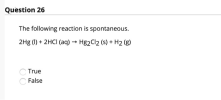 Question 26 The following reaction is spontaneous. 2Hg (1) + 2HCl (aq) → Hg2Cl2 (s) + H2 (g) True False
Question 4 (1 point) Write the cell diagram for the reaction 2AgCl(s) + H2(g) --> 2Ag(s)...
 Question 4 (1 point) Write the cell diagram for the reaction 2AgCl(s) + H2(g) --> 2Ag(s) + 2H+(aq) + 2C1-(aq) OPt(s) | H2(g)| H+(aq) || CI+(aq)| AgCl(s) | Ag(s) Pt(s) | H2(g)| H+(aq) || CI+(aq) | Ag(s) | Pt(s) O Ag(s) | AgCl(s) || H+(aq), Ci-(aq) | H2(g) | Pt(s) O Ag(s) | AgCl(s) | CI+(aq) || H+(aq)| H2(g) | Pt(s) Pt(s) Cl(aq), H(aq)| H2(g) || AgCl(s) Ag(s)
Consider the electrochemical cell: Pt(s)|Hg(l)| Hg2Cl2(s)|HCl(aq, 1.0M)|Hg(g,1 bar)|Pt(s) a.) write the overall balanced redox reaction. What...
Consider the electrochemical cell: Pt(s)|Hg(l)| Hg2Cl2(s)|HCl(aq, 1.0M)|Hg(g,1 bar)|Pt(s) a.) write the overall balanced redox reaction. What is the notation saying up above. Please explain very stuck. b.) dH* > 0 and dS*>0 for the reaction. Upon increasing the temperature, will the cell potential 1.) increase 2.) decrease 3.) stay the same 4.) There is insufficient information to say. Please explain b. I don't even understand the question!
A galvanic cell uses the reaction: 2Ag+(aq) + Ni(s) --> 2Ag(s) + N12+(aq) a) calculate the...
 A galvanic cell uses the reaction: 2Ag+(aq) + Ni(s) --> 2Ag(s) + N12+(aq) a) calculate the Standard Cell Potential (Ecell) of this galvanic cell and b) which metal is the cathode?
Which is the correct line notation for the galvanic cell you constructed using a Pb2+ solution,...
Which is the correct line notation for the galvanic cell you constructed using a Pb2+ solution, a Pb electrode and a Saturated Calomel Electrode (SCE) as reference? Hg Ι Hg2Cl2(s) Ι KCl(sat) ΙΙ Pb2+(aq) Ι Pb Pb2+(aq) Ι Pb ΙΙ KCl(sat) Ι Hg Ι Hg2Cl2(s) Pb Ι Pb2+(aq) ΙΙ KCl(sat) Ι Hg2Cl2(s) Ι Hg Hg Ι Pb2+(aq) ΙΙ KCl(sat) Ι Hg2Cl2(s) Ι Pb Which is the correct full oxidation/reduction equation for the copper/SCE galvanic cell that you investigated in Part C...
Question 4 A galvanic cell uses the reaction: 2Ag+(aq) + Ni(s) --> 2Ag(s) + Ni2+(aq) a)...
 Question 4 A galvanic cell uses the reaction: 2Ag+(aq) + Ni(s) --> 2Ag(s) + Ni2+(aq) a) calculate the Standard Cell Potential (Ecell) of this galvanic cell and b) which metal is the cathode? a) 1.03 V; b) nickel a) 1.03 V; b) silver oooo a) 0.57 V; b) nickel a) 0.57V; b) silver
4. Determine the standard cell potential for each of the electrochemical cells. 2Ag(s) + Pb2+(aa) 2"...
 4. Determine the standard cell potential for each of the electrochemical cells. 2Ag(s) + Pb2+(aa) 2" (ac) + 2(s) a. 2Ag1+(aa) + Pb(s) 2(g) (ac) 2+ (ag)
1.) Given the following notation for an electrochemical cell Pt(s) | H2(g) | H+(aq) || Ag+(aq)...
1.) Given the following notation for an electrochemical cell Pt(s) | H2(g) | H+(aq) || Ag+(aq) | Ag(s), what is the balanced overall (net) cell reaction? A. H2(g) + 2Ag(s) ® H+(aq) + 2Ag+(aq B. H2(g) + 2Ag+(aq) ® 2H+(aq) + 2Ag(s) C. H2(g) + Ag+(aq) ® H+(aq) + Ag(s D. 2H+(aq) + 2Ag(s) ® H2(g) + 2Ag+(aq) E. 2H+(aq) + 2Ag+(aq) ® H2(g) + 2Ag(s) 2.) Calculate E°cell for the following (nonspontaneous) reaction: Cd(s) + 2Fe3+(aq) ® 2Fe2+(aq) + Cd2+(aq) → A. -0.37...
 - Write the reactions below in cell notation. a. 2Ag+ + Pb(s) + 2Ag(s) + Pb2+(aq) b. 20102(g) + 21 (aq) → 2C102 (aq) + 12(s) C. O2(g) + 4H+(aq) + 2Zn(s) → 2H2O(l) + 2Zn2+(aq)
 Question 26 The following reaction is spontaneous. 2Hg (1) + 2HCl (aq) → Hg2Cl2 (s) + H2 (g) True False
 Question 4 (1 point) Write the cell diagram for the reaction 2AgCl(s) + H2(g) --> 2Ag(s) + 2H+(aq) + 2C1-(aq) OPt(s) | H2(g)| H+(aq) || CI+(aq)| AgCl(s) | Ag(s) Pt(s) | H2(g)| H+(aq) || CI+(aq) | Ag(s) | Pt(s) O Ag(s) | AgCl(s) || H+(aq), Ci-(aq) | H2(g) | Pt(s) O Ag(s) | AgCl(s) | CI+(aq) || H+(aq)| H2(g) | Pt(s) Pt(s) Cl(aq), H(aq)| H2(g) || AgCl(s) Ag(s)
 A galvanic cell uses the reaction: 2Ag+(aq) + Ni(s) --> 2Ag(s) + N12+(aq) a) calculate the Standard Cell Potential (Ecell) of this galvanic cell and b) which metal is the cathode?
 Question 4 A galvanic cell uses the reaction: 2Ag+(aq) + Ni(s) --> 2Ag(s) + Ni2+(aq) a) calculate the Standard Cell Potential (Ecell) of this galvanic cell and b) which metal is the cathode? a) 1.03 V; b) nickel a) 1.03 V; b) silver oooo a) 0.57 V; b) nickel a) 0.57V; b) silver
 4. Determine the standard cell potential for each of the electrochemical cells. 2Ag(s) + Pb2+(aa) 2" (ac) + 2(s) a. 2Ag1+(aa) + Pb(s) 2(g) (ac) 2+ (ag)
Most questions answered within 3 hours.
-
Where is the error in this code sequence?
String s1 = "Hello";
String s2 = "ello";...
asked 11 months ago -
Financial data for Joel de Paris, Inc., for last year
follow:
Joel de Paris, Inc.
Balance...
asked 11 months ago -
Consider this reaction:
Al2(SO4)3 (aq)+ BaCl3
(aq) Al2Cl6 (aq)- +
3BaSO4(s) . What is the...
asked 11 months ago -
Suppose that Savneet is considering increasing her
recent random sample from 20 car rentals to 40...
asked 11 months ago -
Trucks arrive at an unloading terminal at an average rate of 120
per hour.
Trucks arrive...
asked 11 months ago -
Why are methanol and ethanol completely soluble in water while
octanol is not very little soluble....
asked 11 months ago -
A facilities manager at a university reads in a research report
that the mean amount of...
asked 11 months ago -
When the CuSO4 is rehydrated by adding water to the anhydrous
compound, is this an endothermic...
asked 11 months ago -
A ray of sunlight is passing from diamond into crown glass; the
angle of incidence is...
asked 11 months ago -
A block of mass 0.249 kg is placed on top of a light, vertical
spring of...
asked 11 months ago -
how do the kidneys compensate in the presences of acidosis
a) trigger hyperventilate
b) reserve acid...
asked 11 months ago -
Question 501 pts
The rental rate of capital to the firm increases. Which of the
following...
asked 11 months ago