
Homework Answers
Add Answer to:
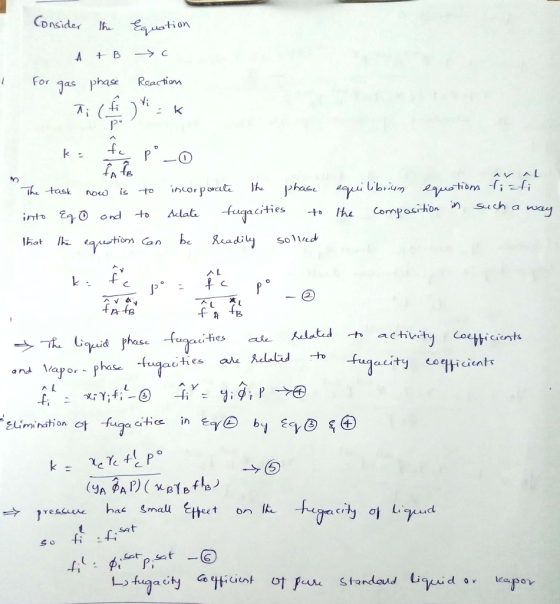
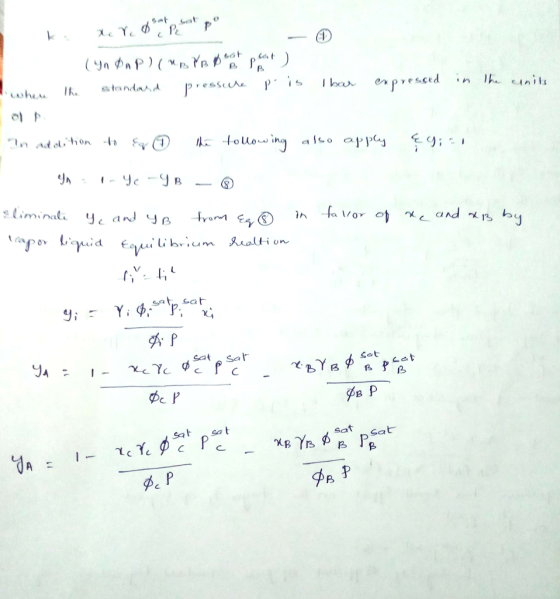
Show that the equilibrium equations for single phase reactions in gases and liquids are recovered when...
Learning Goal: To understand how to calculate the equilibrium constants for chemical equations that can be...
Learning Goal: To understand how to calculate the equilibrium constants for chemical equations that can be produced by the addition of other chemical equations with known equilibrium constants. For a chemical reaction equation with the general form aA+bB⇌cC+dD the equilibrium equation is given by K1=[C]c[D]d[A]a[B]b Thus, for a chemical reaction equation with the general form cC+dD⇌eE+fF the equilibrium equation is given by K2=[E]e[F]f[C]c[D]d If the first two equations are added together such that aA+bB⇌eE+fF then the equilibrium equation is given...
Phase transitions are similar to chemical reactions in that they each have an associated entropy change....
 Phase transitions are similar to chemical reactions in that they
each have an associated entropy change. A phase transition involves
the breaking or forming of intermolecular attractive forces.
A change in entropy accompanies not only a variation in the
temperature, pressure, or volume of a system but also a physical
transformation such as the fusion, vaporization, or transition from
one crystalline state into another.
In the equilibrium between two phases, the exchange of heat can
be carried out reversibly, and...
Phase transitions are similar to chemical reactions in that they
each have an associated entropy change. A phase transition involves
the breaking or forming of intermolecular attractive forces.
A change in entropy accompanies not only a variation in the
temperature, pressure, or volume of a system but also a physical
transformation such as the fusion, vaporization, or transition from
one crystalline state into another.
In the equilibrium between two phases, the exchange of heat can
be carried out reversibly, and...
Q1) A binary mixture of volatile liquids is in equilibrium with its vapor phase. The number...
Q1) A binary mixture of volatile liquids is in equilibrium with its vapor phase. The number of intensive variables you can vary independently while maintaining the equilibrium is: a) 0 b) 1 c) 2 d) 3 e) 4 Q2) When the pressure increases by 10^5 atm, the molar Gibbs energy of graphite: a) increases b) decreases c) stays the same Q3) At 0 K, each water molecule of the ice lattice is known to have 1.5 hydrogen-bond configurations in average....
Write chemical equations for the following reactions. Classify each reaction into as many categories as possible:...
Write chemical equations for the following reactions. Classify each reaction into as many categories as possible: 15) Water and dinitrogen pentoxide gas react to produce aqueous hydrogen nitrate. Write chemical equations for the following decomposition reactions. 18) Aluminum oxide (s) decomposes when electricity passes through it. Predict whether the following single-replacement reactions will occur. If a reaction occurs, write a balanced equation for the reaction. 21) K(s)+ZnCl_2(aq)->, 24)Al(s)+Pb(NO_3)_2(aq)-> (symbol _ represent a subnumber). Write the balanced chemical equations for the...
When a chemical reaction is at equilibrium, the forward and reverse reactions occur at the same...
 When a chemical reaction is at equilibrium, the forward and reverse reactions occur at the same rate. The concentrations of the different compounds in the reactions will remain constant. The relationship between the concentrations of the reactants and products is expressed as the equilibrium constant, K.. Part A Balance this equation, and then enter the coefficients, in order, below. CCl,(g) + O2(g) = COCl (g) - Cl (8) Express your answer as integers separated by commas (e.g. 1, 2, 3,...
4. Equilibrium constants for gas-phase reactions are best defined using partial pressures. Show how to use...
 4. Equilibrium constants for gas-phase reactions are best defined using partial pressures. Show how to use the ideal gas law to convert a partial pressure in atm to concentration in mol/L.
1. One way to solve chemical equilibrium problems is to write n equations with n unknowns,...
1. One way to solve chemical equilibrium problems is to write n equations with n unknowns, and then to eliminate unknowns from equations until you have one equation of order n. To solve such an equation involves something like using the quadratic formula (if n = 2) or some other algorithm if n > 2. One such algorithm is the Newton Raphson technique. Let’s pretend that you are solving an equilibrium problem and you have derived the following equation which...
General Chemistry |(60 stry Assignments <Chemical Reactions and Equations Item 12 Balance each of the following...
 General Chemistry |(60 stry Assignments <Chemical Reactions and Equations Item 12 Balance each of the following chemical equations. N2 Exp Su Part Expre NH4 () NH3(g) + N2(9) Express your answer as a chemical equation. Identify all of the phases in your answer. - ALQ R O a ? Submit Request Answer Part B H2(g) + N, (g)--NH(9) Express your answer as a chemical equation. Identify all of the phases in your answer. 1 AXD O a ? Submit Request...
A Sequence of Chemical Reactions 5 Identify the following equations as single or double displacement, redox,...
 A Sequence of Chemical Reactions 5 Identify the following equations as single or double displacement, redox, acid-oues combination, or decompostion reactions. Some may fit in more than one category. Cu(s) + 4HNO, (aq) → Cu(NO)/(aq) + 2NO, + 2H,0 b. Mg(s) + H,80 (aq) - MgSO (aq) + H/ Cu(s) + HCl(aq) → CuCl(aq) + H,00 d. Cu(NO),(aq) + 2NaOH(aq - Cu(OH)(s) + 2NaNO, (aq) Cu(NO)/aq) + Mg(s) > Mg(NO/(aq) + Cu(s) A student dissolved a piece of copper wire,...
2. For Pb (s) and H2SO4 (aq) a. Write the chemical equations for the reactions that...
2. For Pb (s) and H2SO4 (aq) a. Write the chemical equations for the reactions that occur at the anode and cathode when the battery discharges and behaves as a voltaic cell. Be sure to include the standard potential value, E°, with each equation. b. Combine the two half-reactions to yield the overall equation for the reaction. Determine the E°total (or E°cell) for the lead battery.
 Phase transitions are similar to chemical reactions in that they
each have an associated entropy change. A phase transition involves
the breaking or forming of intermolecular attractive forces.
A change in entropy accompanies not only a variation in the
temperature, pressure, or volume of a system but also a physical
transformation such as the fusion, vaporization, or transition from
one crystalline state into another.
In the equilibrium between two phases, the exchange of heat can
be carried out reversibly, and...
Phase transitions are similar to chemical reactions in that they
each have an associated entropy change. A phase transition involves
the breaking or forming of intermolecular attractive forces.
A change in entropy accompanies not only a variation in the
temperature, pressure, or volume of a system but also a physical
transformation such as the fusion, vaporization, or transition from
one crystalline state into another.
In the equilibrium between two phases, the exchange of heat can
be carried out reversibly, and...
 When a chemical reaction is at equilibrium, the forward and reverse reactions occur at the same rate. The concentrations of the different compounds in the reactions will remain constant. The relationship between the concentrations of the reactants and products is expressed as the equilibrium constant, K.. Part A Balance this equation, and then enter the coefficients, in order, below. CCl,(g) + O2(g) = COCl (g) - Cl (8) Express your answer as integers separated by commas (e.g. 1, 2, 3,...
 4. Equilibrium constants for gas-phase reactions are best defined using partial pressures. Show how to use the ideal gas law to convert a partial pressure in atm to concentration in mol/L.
 General Chemistry |(60 stry Assignments <Chemical Reactions and Equations Item 12 Balance each of the following chemical equations. N2 Exp Su Part Expre NH4 () NH3(g) + N2(9) Express your answer as a chemical equation. Identify all of the phases in your answer. - ALQ R O a ? Submit Request Answer Part B H2(g) + N, (g)--NH(9) Express your answer as a chemical equation. Identify all of the phases in your answer. 1 AXD O a ? Submit Request...
 A Sequence of Chemical Reactions 5 Identify the following equations as single or double displacement, redox, acid-oues combination, or decompostion reactions. Some may fit in more than one category. Cu(s) + 4HNO, (aq) → Cu(NO)/(aq) + 2NO, + 2H,0 b. Mg(s) + H,80 (aq) - MgSO (aq) + H/ Cu(s) + HCl(aq) → CuCl(aq) + H,00 d. Cu(NO),(aq) + 2NaOH(aq - Cu(OH)(s) + 2NaNO, (aq) Cu(NO)/aq) + Mg(s) > Mg(NO/(aq) + Cu(s) A student dissolved a piece of copper wire,...
Most questions answered within 3 hours.
-
Where is the error in this code sequence?
String s1 = "Hello";
String s2 = "ello";...
asked 10 months ago -
Financial data for Joel de Paris, Inc., for last year
follow:
Joel de Paris, Inc.
Balance...
asked 10 months ago -
Consider this reaction:
Al2(SO4)3 (aq)+ BaCl3
(aq) Al2Cl6 (aq)- +
3BaSO4(s) . What is the...
asked 10 months ago -
Suppose that Savneet is considering increasing her
recent random sample from 20 car rentals to 40...
asked 10 months ago -
Trucks arrive at an unloading terminal at an average rate of 120
per hour.
Trucks arrive...
asked 10 months ago -
Why are methanol and ethanol completely soluble in water while
octanol is not very little soluble....
asked 10 months ago -
A facilities manager at a university reads in a research report
that the mean amount of...
asked 10 months ago -
When the CuSO4 is rehydrated by adding water to the anhydrous
compound, is this an endothermic...
asked 10 months ago -
A ray of sunlight is passing from diamond into crown glass; the
angle of incidence is...
asked 10 months ago -
A block of mass 0.249 kg is placed on top of a light, vertical
spring of...
asked 10 months ago -
how do the kidneys compensate in the presences of acidosis
a) trigger hyperventilate
b) reserve acid...
asked 10 months ago -
Question 501 pts
The rental rate of capital to the firm increases. Which of the
following...
asked 10 months ago