You are interested in studying the neurological effects of dehydrogenated brominate oil, a food additive. You...
You are interested in studying the neurological effects of dehydrogenated brominate oil, a food additive. You randomly select 25 Sprague-Dawley rats and add a dosage to their drinking water. Because the additive is odorless and colorless, the rats readily consume it. After six months you sacrifice the rats, microsection their brains and count the number of lesions in the hippocampus.
|
15mg |
20mg |
25mg |
30mg |
35mg |
|
17 |
12 |
15 |
19 |
8 |
|
7 |
17 |
18 |
28 |
10 |
|
15 |
10 |
18 |
22 |
13 |
|
11 |
18 |
22 |
19 |
15 |
|
9 |
18 |
19 |
17 |
12 |
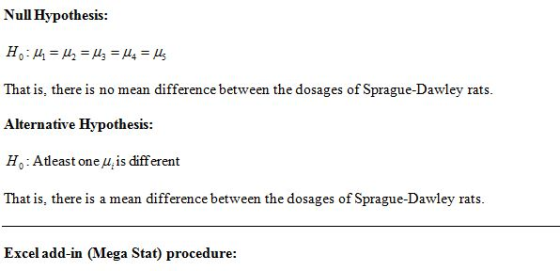
What is the null hypothesis?
What is the alternative hypothesis?
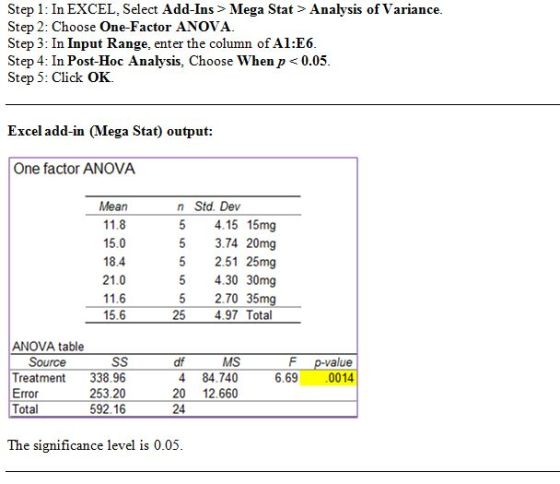
Perform the analysis manually or using Excel or r. What is the significance value?
Show the ANOVA summary table
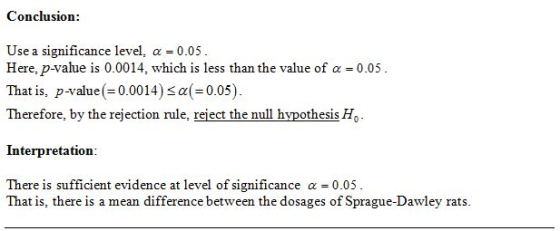
Is there is significant difference? Explain.
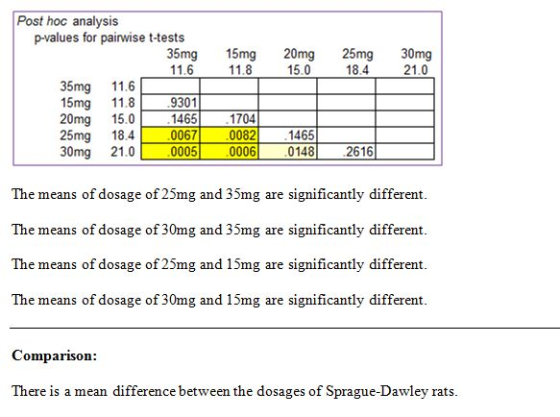
Perform a post-hoc comparison, either manually or using r. Which post hoc differences are significant?
What do you conclude based on the primary and post-hoc analyses?
Homework Answers
Add Answer to:
You are interested in studying the neurological effects of
dehydrogenated brominate oil, a food additive. You...
please answer all the questions and explain and write clearly what do you mean this is...
 please answer all the questions and explain and write
clearly
what do you mean this is all the complete question I have
there is nothing else
You are interested in studying the neurological effects of dehydrogenated brominate oil, a food additive. You randomly select 25 Sprague-Dawley rats and add a dosage to their drinking water. Because the additive is odorless and colorless, the rats readily consume it. After six months you sacrifice the rats, microsection their brains and count the...
please answer all the questions and explain and write
clearly
what do you mean this is all the complete question I have
there is nothing else
You are interested in studying the neurological effects of dehydrogenated brominate oil, a food additive. You randomly select 25 Sprague-Dawley rats and add a dosage to their drinking water. Because the additive is odorless and colorless, the rats readily consume it. After six months you sacrifice the rats, microsection their brains and count the...
QUESTION 13 Which of the following would occur if a mutation caused Kinase 1 to be...
 QUESTION 13
Which of the following would occur if a mutation caused Kinase 1
to be unable to be phosphorylated? (Select all)
RTK would bind VEGF
RTK would phosphorylate itself
RAS would become active
The phosphorylation cascade would occur
The endothelial cell would divide
0.2 points
QUESTION 14
Imagine that an endothelial cell has a mutation in several of
the enzymes that perform mismatch repair. The endothelial cell
replicates its DNA and then divides into two cells. The resulting...
QUESTION 13
Which of the following would occur if a mutation caused Kinase 1
to be unable to be phosphorylated? (Select all)
RTK would bind VEGF
RTK would phosphorylate itself
RAS would become active
The phosphorylation cascade would occur
The endothelial cell would divide
0.2 points
QUESTION 14
Imagine that an endothelial cell has a mutation in several of
the enzymes that perform mismatch repair. The endothelial cell
replicates its DNA and then divides into two cells. The resulting...
Can you please explain in simple terms the methods of this experiment? I'm having difficulty visualizing...
Can you please explain in simple terms the methods of this experiment? I'm having difficulty visualizing and understanding what is being done. I have copied and pasted some of the text from the article. Thank you! Abstract : Obesity, high-fat diets, and subsequent type 2 diabetes (T2DM) are associated with cognitive impairment. Moreover, T2DM increases the risk of Alzheimer's disease (AD) and leads to abnormal elevation of brain beta-amyloid levels, one of the hallmarks of AD. The psychoactive alkaloid caffeine...
 please answer all the questions and explain and write
clearly
what do you mean this is all the complete question I have
there is nothing else
You are interested in studying the neurological effects of dehydrogenated brominate oil, a food additive. You randomly select 25 Sprague-Dawley rats and add a dosage to their drinking water. Because the additive is odorless and colorless, the rats readily consume it. After six months you sacrifice the rats, microsection their brains and count the...
please answer all the questions and explain and write
clearly
what do you mean this is all the complete question I have
there is nothing else
You are interested in studying the neurological effects of dehydrogenated brominate oil, a food additive. You randomly select 25 Sprague-Dawley rats and add a dosage to their drinking water. Because the additive is odorless and colorless, the rats readily consume it. After six months you sacrifice the rats, microsection their brains and count the...
 QUESTION 13
Which of the following would occur if a mutation caused Kinase 1
to be unable to be phosphorylated? (Select all)
RTK would bind VEGF
RTK would phosphorylate itself
RAS would become active
The phosphorylation cascade would occur
The endothelial cell would divide
0.2 points
QUESTION 14
Imagine that an endothelial cell has a mutation in several of
the enzymes that perform mismatch repair. The endothelial cell
replicates its DNA and then divides into two cells. The resulting...
QUESTION 13
Which of the following would occur if a mutation caused Kinase 1
to be unable to be phosphorylated? (Select all)
RTK would bind VEGF
RTK would phosphorylate itself
RAS would become active
The phosphorylation cascade would occur
The endothelial cell would divide
0.2 points
QUESTION 14
Imagine that an endothelial cell has a mutation in several of
the enzymes that perform mismatch repair. The endothelial cell
replicates its DNA and then divides into two cells. The resulting...
Most questions answered within 3 hours.
-
Where is the error in this code sequence?
String s1 = "Hello";
String s2 = "ello";...
asked 10 months ago -
Financial data for Joel de Paris, Inc., for last year
follow:
Joel de Paris, Inc.
Balance...
asked 10 months ago -
Consider this reaction:
Al2(SO4)3 (aq)+ BaCl3
(aq) Al2Cl6 (aq)- +
3BaSO4(s) . What is the...
asked 10 months ago -
Suppose that Savneet is considering increasing her
recent random sample from 20 car rentals to 40...
asked 10 months ago -
Trucks arrive at an unloading terminal at an average rate of 120
per hour.
Trucks arrive...
asked 10 months ago -
Why are methanol and ethanol completely soluble in water while
octanol is not very little soluble....
asked 10 months ago -
A facilities manager at a university reads in a research report
that the mean amount of...
asked 10 months ago -
When the CuSO4 is rehydrated by adding water to the anhydrous
compound, is this an endothermic...
asked 10 months ago -
A ray of sunlight is passing from diamond into crown glass; the
angle of incidence is...
asked 10 months ago -
A block of mass 0.249 kg is placed on top of a light, vertical
spring of...
asked 10 months ago -
how do the kidneys compensate in the presences of acidosis
a) trigger hyperventilate
b) reserve acid...
asked 10 months ago -
Question 501 pts
The rental rate of capital to the firm increases. Which of the
following...
asked 10 months ago