Which of the following describes the differences of adjacent
list (e.g., vector of vectors) from adjacent matrix (e.g., array of
arrays) correctly (More than one answer may be selected)?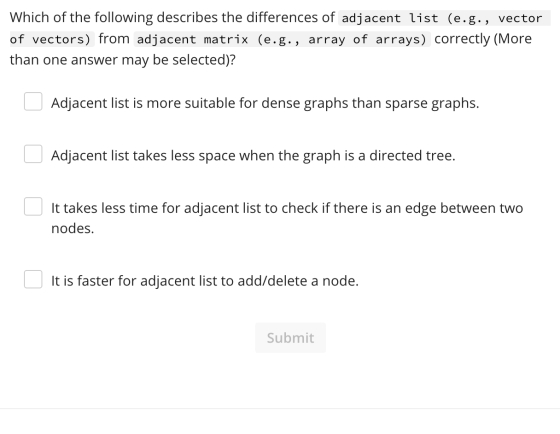
Homework Answers
Answer - adjacent list takes less space when the graph is a directed tree.
See first option is wrong because matrix representation is better in case of dense graphs.
Third option is wrong because it is easier to check if there an edge between two nodes in matrix representation. In adjacency list in worse case it may take O(n) time to check an edge between two nodes. While in matrix representation it is always O(1).
It is easier to delete a node in matrix representation than in adjacent list.
Now when graph is a directed tree then in that case number of edges will be less . So using adjacent list representation will save space. Thats why option B is correct.
Add Answer to:
Which of the following describes the differences of adjacent
list (e.g., vector of vectors) from adjacent...
Using the following parallel array and array of vectors: // may be declared outside the main...
Using the following parallel array and array of vectors: // may be declared outside the main function const int NUM_STUDENTS =3; // may only be declared within the main function string Students[NUM_STUDENTS] = {"Tom","Jane","Jo"}; vector <int> grades[NUM_STUDENTS] {{78,98,88,99,77},{62,99,94,85,93}, {73,82,88,85,78}}; Write a C++ program to run a menu-driven program with the following choices: 1) Display the grades 2) Add grade 3) Remove grade for all students for a selected assignment 4) Display Average for each student 5) Display the name of...
Creating linked list data structure Overview The purpose of this assignment is for you to write...
Creating linked list data structure Overview The purpose of this assignment is for you to write a data structure called a Linked List, which utilizes templates (similar to Java’s generics), in order to store any type of data. In addition, the nature of a Linked List will give you some experience dealing with non-contiguous memory organization. This will also give you more experience using pointers and memory management. Pointers, memory allocation, and understand how data is stored in memory will...
Instructions Write a C++ program that performs the following: Accept a list of floating point values...
Instructions Write a C++ program that performs the following: Accept a list of floating point values on a single line (separated by spaces). This is vector A. The user may enter as many values as they desire. Accept a second list of floating point values on a single line (separated by spaces). This is vector B. The user may enter as many values as they desire. There is no requirement that the two vectors have the same number of elements....
Project Description: In this project, you will combine the work you’ve done in previous assignments to...
Project Description: In this project, you will combine the work you’ve done in previous assignments to create a separate chaining hash table. Overview of Separate Chaining Hash Tables The purpose of a hash table is to store and retrieve an unordered set of items. A separate chaining hash table is an array of linked lists. The hash function for this project is the modulus operator item%tablesize. This is similar to the simple array hash table from lab 5. However, the...
C++ Assignment - Only Implementation file( VectorDouble.cpp file) required. The header file is already given. Please help, thumbs up guaranteed. Chapter 8 discussed vectors, which are like arrays that...
C++ Assignment - Only Implementation file( VectorDouble.cpp file) required. The header file is already given. Please help, thumbs up guaranteed. Chapter 8 discussed vectors, which are like arrays that can grow in size. Suppose that vectors were not defined in C++. Define a class called VectorDoublethat is like a class for a vector with base type double. Your class VectorDoublewill have a private member variable for a dynamic array of doubles. It will also have two member variables of type...
complete in C++ code Lists Many programming languages have some kind list data structure, which allows...
complete in C++ code Lists Many programming languages have some kind list data structure, which allows for insertion and deletion of elements, essentially an array that changes size. C++ has vectors, Java has the ArrayList, Python has lists (which is what they're called generically anyway). But how do they really work? All of these actually use arrays, which naturally have immutable lengths. Your Task Your task is to write a function, insert, which inserts a new item into an existing...
C++ Linked List Implementation Motivation As we discussed in class, the data structures that you use...
C++ Linked List Implementation Motivation As we discussed in class, the data structures that you use to implement your program can have a profound impact on it's overall performance. A poorly written program will often need much more RAM and CPU time then a well-written implementation. One of the most basic data structure questions revolves around the difference between an array and a linked list. After you finish this assignment you should have a firm understanding of their operation. Problem...
A method called linearSearch(), which takes as parameters an array of int followed by three values...
A method called linearSearch(), which takes as parameters an array of int followed by three values of type int, and returns a value of type int. The first int parameter represents a key, the second int parameter represents a starting position, and the third int parameter represents an end position. If the key occurs in the array between the start position (inclusive) and the end position (exclusive), the method returns the position of the first occurrence of the key in...
java Create the following classes: DatabaseType: an interface that contains one method 1. Comparator getComparatorByTrait(String trait)...
 java
Create the following classes: DatabaseType: an interface that contains one method 1. Comparator getComparatorByTrait(String trait) where Comparator is an interface in java.util. Database: a class that limits the types it can store to DatabaseTypes. The database will store the data in nodes, just like a linked list. The database will also let the user create an index for the database. An index is a sorted array (or in our case, a sorted ArrayList) of the data so that searches...
java
Create the following classes: DatabaseType: an interface that contains one method 1. Comparator getComparatorByTrait(String trait) where Comparator is an interface in java.util. Database: a class that limits the types it can store to DatabaseTypes. The database will store the data in nodes, just like a linked list. The database will also let the user create an index for the database. An index is a sorted array (or in our case, a sorted ArrayList) of the data so that searches...
k-d tree Background One generalization of binary trees is the k-d tree, which stores k-dimensional data....
k-d tree Background One generalization of binary trees is the k-d tree, which stores k-dimensional data. Every internal node of a k-d tree indicates the dimension d and the value v in that dimension that it discriminates by. An internal node has exactly two children, containing data that is less-than-or-equal and data that is greater than v in dimension d. For example, if the node distinguishes on dimension 1, value 107, then the left child is for data with y...
 java
Create the following classes: DatabaseType: an interface that contains one method 1. Comparator getComparatorByTrait(String trait) where Comparator is an interface in java.util. Database: a class that limits the types it can store to DatabaseTypes. The database will store the data in nodes, just like a linked list. The database will also let the user create an index for the database. An index is a sorted array (or in our case, a sorted ArrayList) of the data so that searches...
java
Create the following classes: DatabaseType: an interface that contains one method 1. Comparator getComparatorByTrait(String trait) where Comparator is an interface in java.util. Database: a class that limits the types it can store to DatabaseTypes. The database will store the data in nodes, just like a linked list. The database will also let the user create an index for the database. An index is a sorted array (or in our case, a sorted ArrayList) of the data so that searches...
Most questions answered within 3 hours.
-
Where is the error in this code sequence?
String s1 = "Hello";
String s2 = "ello";...
asked 10 months ago -
Financial data for Joel de Paris, Inc., for last year
follow:
Joel de Paris, Inc.
Balance...
asked 10 months ago -
Consider this reaction:
Al2(SO4)3 (aq)+ BaCl3
(aq) Al2Cl6 (aq)- +
3BaSO4(s) . What is the...
asked 10 months ago -
Suppose that Savneet is considering increasing her
recent random sample from 20 car rentals to 40...
asked 10 months ago -
Trucks arrive at an unloading terminal at an average rate of 120
per hour.
Trucks arrive...
asked 10 months ago -
Why are methanol and ethanol completely soluble in water while
octanol is not very little soluble....
asked 10 months ago -
A facilities manager at a university reads in a research report
that the mean amount of...
asked 10 months ago -
When the CuSO4 is rehydrated by adding water to the anhydrous
compound, is this an endothermic...
asked 10 months ago -
A ray of sunlight is passing from diamond into crown glass; the
angle of incidence is...
asked 10 months ago -
A block of mass 0.249 kg is placed on top of a light, vertical
spring of...
asked 10 months ago -
how do the kidneys compensate in the presences of acidosis
a) trigger hyperventilate
b) reserve acid...
asked 10 months ago -
Question 501 pts
The rental rate of capital to the firm increases. Which of the
following...
asked 10 months ago