A CPA is engaged in the audit of the financial statements of a large manufacturing company...
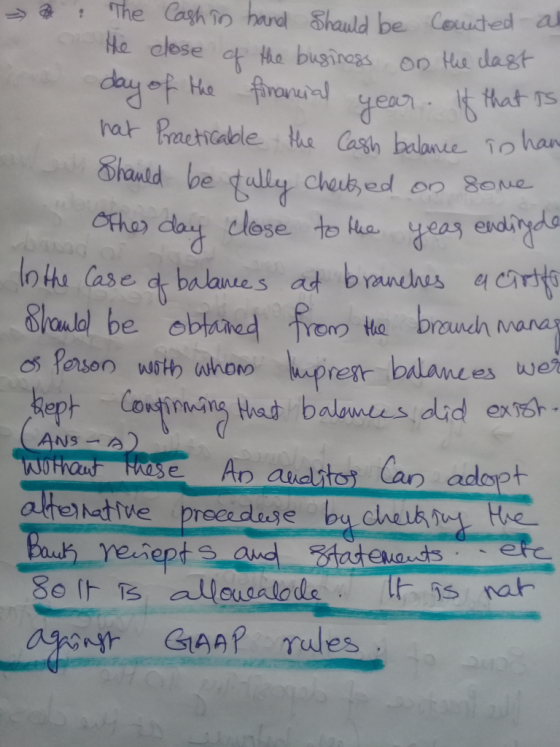
A CPA is engaged in the audit of the financial statements of a large manufacturing company with branch offices in many widely separated cities. The CPA was not able to count the substantial undeposited cash receipts at the close of business on the last day of the fiscal year at all branch offices.
As an alternative to this auditing procedure used to verify the accurate cutoff of cash receipts, the CPA observed that deposits in transit as shown on the year-end bank reconciliation appeared as credits on the bank statement on the first business day of the new year. He was satisfied as to the cutoff of cash receipts by the use of the alternative procedure.
a. State the condition (either change in accounting principle, failure to follow GAAP, none, reporting involving other auditors, or scope of the audit has been restricted)
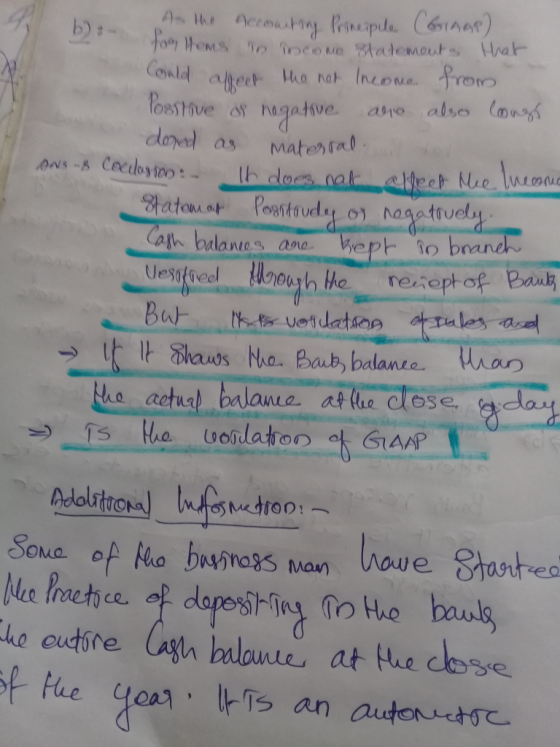
b. State the materiality level (either Material, immaterial, highly material, material or highly material, or not applicable)
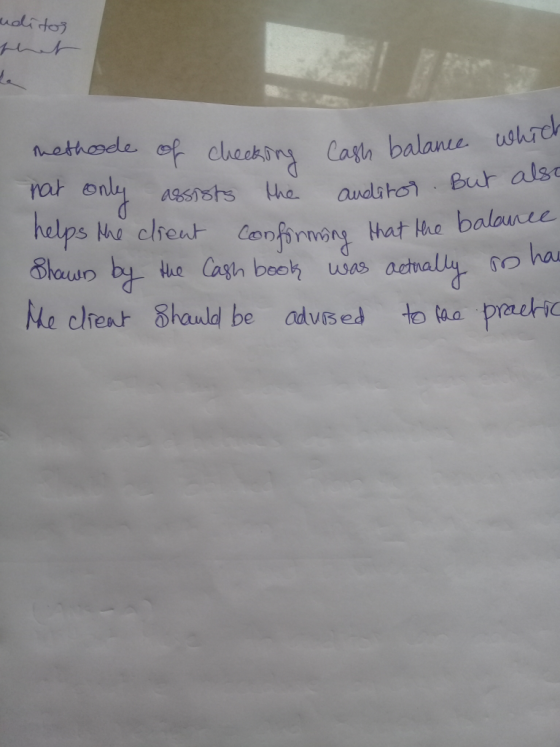
c. List any additional information needed (either amount of loss, auditor's preliminary judgement, client explanation in a memo, or the size of the misstatement)
Homework Answers
Add Answer to:
A CPA is engaged in the audit of the financial statements of a
large manufacturing company...
A CPA has completed her audit of the financial statements of a bus company for the...
A CPA has completed her audit of the financial statements of a bus company for the year ended December 31, 2019. Prior to 2019, the company depreciated its buses over a 10-year period. During 2019, the company determined that a more realistic estimated life for its buses was 12 years and computed the 2019 depreciation on the basis of the revised estimate. The CPA has satisfied herself that the 12-year life is reasonable. The company has adequately disclosed the change...
The following are independent situations for which you will recommend an appropriate audit report Subsequent to...
 The following are independent situations for which you will recommend an appropriate audit report Subsequent to the date of the financial statements as part of his post-balance sheet date audit procedures, a CPA learned that a recent fire caused heavy damage to one of a client's two plants; the loss will not be reimbursed by insurance. The newspapers described the event in detail. The financial statements and footnotes as prepared by the client did not disclose the loss caused by...
Circumstances prevent you from being able to observe the counting of inventory at Brentwood Industries. The...
Circumstances prevent you from being able to observe the counting of inventory at Brentwood Industries. The inventory amount is material in relation to Brentwood Industries' financial statements. But, you were able to perform alternative procedures to support the existence and valuation of the inventory at year-end. a. State the condition (either change in accounting principle, failure to follow GAAP, none, reporting involving other auditors, or scope of the audit has been restricted) b. State the materiality level (either Material, immaterial,...
12 UM LapurdULY 13) Unmodified opinion-nonstandard report limitation wording (6) Disclaimer (4) Qualified opinion only GAAP...
 12 UM LapurdULY 13) Unmodified opinion-nonstandard report limitation wording (6) Disclaimer (4) Qualified opinion only GAAP departure (7) Adverse" 2.27 (OBJECTIVES 3-4, 3-5, 3-6, 3-7, 3-6) The following are independent situations for which ou will recommend an appropriate audit report: 1. Subsequent to the date of the financial statements as part of his post-balance sheet date audit procedures, a CPA learned that a recent fire caused heavy damage to one of a client's two plants; the loss will not be...
On January 2, 2020, the Retail Auto Parts Company received a notice from its primary supplier...
On January 2, 2020, the Retail Auto Parts Company received a notice from its primary supplier that effective immediately, all wholesale prices will be increased by 10 percent. On the basis of the notice, Retail Auto Parts revalued its December 31, 2019, inventory to reflect the higher costs. The inventory constituted a material proportion of total assets; however, the effect of the revaluation was material to current assets but not to total assets or net income. The increase in valuation...
Assume that you are the audit partner on the engagement. During the audit at A company,...
Assume that you are the audit partner on the engagement. During the audit at A company, the client prevented you from being able to observe the counting of fixed asset. The fixed asset amount is material in the client's financial statements. But, you were able to perform alternative procedures to support the existence and valuation of fixed assets at the year end 1. Identify which of the condition requiring a deviation from a standard unmodified opinion audit report is applicable,...
Ringer. CPA, has been engaged to audit Tech Co., a publicly traded company. In planning the...
 Ringer. CPA, has been engaged to audit Tech Co., a publicly traded company. In planning the audit, Ringer uses 3% of income before taxes as an overall materiality threshold and 50% of overall materiality as the tolerable misstatement. If, as a result of substantive testing. Tech Co.'s pretax earnings of $20 million are found to be overstated by 4% due to errors in revenue recognition, Ringer would likely take all of the following actions when evaluating the audit findings, except...
Requirements: Identify which of the conditions requiring a deviation from a standard unmodified opinion audit report...
 Requirements: Identify which of the conditions requiring a deviation from a standard unmodified opinion audit report is applicable, if any. Then, state the level of materiality as immaterial, material, or highly material. If you cannot decide the level of materiality, state the additional information needed to make a decision. (If a box is not used in the table leave the box empty; do not select a label.) For each situation, do the following: a. Identify which of the conditions requiring...
For the following independent situations, assume that you are the audit partner on the engagement: A...
For the following independent situations, assume that you are the audit partner on the engagement: A number of frozen yogurt stores have opened in the last few years and your client, YogurtLand, has experienced a noticeable decline in customer traffic over the past several months that has caused you to have substantial doubt about YogurtLand’s ability to continue as a going concern. Intelligis Electronics is a manufacturer of advanced electrical components. During the year, changes in the market resulted in...
6. While performing an audit, the auditor should allow for some misstatement of lessor value than...
6. While performing an audit, the auditor should allow for some misstatement of lessor value than the assessed materiality level so in total the misstatements might not result in a material misstatement to the financial statements. In order to do so, the auditor sets which of the following lower than the materiality level (s)? a. Test of controls. b. Difference in comparison of current year amounts to prior-year amounts. c. Performance materiality. d....
 The following are independent situations for which you will recommend an appropriate audit report Subsequent to the date of the financial statements as part of his post-balance sheet date audit procedures, a CPA learned that a recent fire caused heavy damage to one of a client's two plants; the loss will not be reimbursed by insurance. The newspapers described the event in detail. The financial statements and footnotes as prepared by the client did not disclose the loss caused by...
 12 UM LapurdULY 13) Unmodified opinion-nonstandard report limitation wording (6) Disclaimer (4) Qualified opinion only GAAP departure (7) Adverse" 2.27 (OBJECTIVES 3-4, 3-5, 3-6, 3-7, 3-6) The following are independent situations for which ou will recommend an appropriate audit report: 1. Subsequent to the date of the financial statements as part of his post-balance sheet date audit procedures, a CPA learned that a recent fire caused heavy damage to one of a client's two plants; the loss will not be...
 Ringer. CPA, has been engaged to audit Tech Co., a publicly traded company. In planning the audit, Ringer uses 3% of income before taxes as an overall materiality threshold and 50% of overall materiality as the tolerable misstatement. If, as a result of substantive testing. Tech Co.'s pretax earnings of $20 million are found to be overstated by 4% due to errors in revenue recognition, Ringer would likely take all of the following actions when evaluating the audit findings, except...
 Requirements: Identify which of the conditions requiring a deviation from a standard unmodified opinion audit report is applicable, if any. Then, state the level of materiality as immaterial, material, or highly material. If you cannot decide the level of materiality, state the additional information needed to make a decision. (If a box is not used in the table leave the box empty; do not select a label.) For each situation, do the following: a. Identify which of the conditions requiring...
Most questions answered within 3 hours.
-
Where is the error in this code sequence?
String s1 = "Hello";
String s2 = "ello";...
asked 11 months ago -
Financial data for Joel de Paris, Inc., for last year
follow:
Joel de Paris, Inc.
Balance...
asked 11 months ago -
Consider this reaction:
Al2(SO4)3 (aq)+ BaCl3
(aq) Al2Cl6 (aq)- +
3BaSO4(s) . What is the...
asked 11 months ago -
Suppose that Savneet is considering increasing her
recent random sample from 20 car rentals to 40...
asked 11 months ago -
Trucks arrive at an unloading terminal at an average rate of 120
per hour.
Trucks arrive...
asked 11 months ago -
Why are methanol and ethanol completely soluble in water while
octanol is not very little soluble....
asked 11 months ago -
A facilities manager at a university reads in a research report
that the mean amount of...
asked 11 months ago -
When the CuSO4 is rehydrated by adding water to the anhydrous
compound, is this an endothermic...
asked 11 months ago -
A ray of sunlight is passing from diamond into crown glass; the
angle of incidence is...
asked 11 months ago -
A block of mass 0.249 kg is placed on top of a light, vertical
spring of...
asked 11 months ago -
how do the kidneys compensate in the presences of acidosis
a) trigger hyperventilate
b) reserve acid...
asked 11 months ago -
Question 501 pts
The rental rate of capital to the firm increases. Which of the
following...
asked 11 months ago