
Homework Answers

Add Answer to:
4 What is the molar mass of a nonelectrolyte if a solution containing 45.0 g of...
The second question is either true or false. Dinitrogen tetraoxide is a colorless gas that dissociates...
 The second question is either true or false.
Dinitrogen tetraoxide is a colorless gas that dissociates into nitrogen dioxide, a reddish brown gas. N204(g) 2NO2(g) At equilibrium: 1. The forward reaction, N204g)2NO (g) A. Continues to happen B. Stops. C. Cannot tell without additional information. 2. Change in the concentration of N204 A. Continues to happen. B. Stops. C. Cannot tell without additional information. n tetraoxide, colorless gas, exists in equilibrium with nitrogen dioxide, a reddish brown gas. a One...
The second question is either true or false.
Dinitrogen tetraoxide is a colorless gas that dissociates into nitrogen dioxide, a reddish brown gas. N204(g) 2NO2(g) At equilibrium: 1. The forward reaction, N204g)2NO (g) A. Continues to happen B. Stops. C. Cannot tell without additional information. 2. Change in the concentration of N204 A. Continues to happen. B. Stops. C. Cannot tell without additional information. n tetraoxide, colorless gas, exists in equilibrium with nitrogen dioxide, a reddish brown gas. a One...
At 100°C the equilibrium constant for the following reaction is 0.48. N,0.9) = 2NO, (g) a...
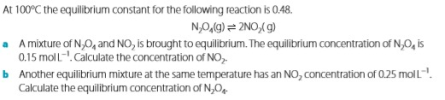 At 100°C the equilibrium constant for the following reaction is 0.48. N,0.9) = 2NO, (g) a A mixture of NO and No, is brought to equilibrium. The equilibrium concentration of N, O, is 0.15 molt-Calculate the concentration of NO, b Another equilibrium mixture at the same temperature has an NO, concentration of 0.25 moll". Calculate the equilibrium concentration of N,00
Dinitrogen tetraoxide, a colorless gas, exists in equilibrium with nitrogen dioxide, a reddish brown gas. One...
 Dinitrogen tetraoxide, a colorless gas, exists in equilibrium with nitrogen dioxide, a reddish brown gas. One way to represent this equilibrium is: N204(0) 2NO2(g) Indicate whether each of the following statements is true, T, or false, F. AT EQUILIBRIUM we can say that: _ 1. The concentration of NO2 is equal to the concentration of N204. _ 2. The rate of the dissociation of N2O4 is equal to the rate of formation of N204. 3. The rate constant for the...
16. For the system CO + CO2(g) → CaCO(s) the equilibrium constant expression is a. [CO]...
 16. For the system CO + CO2(g) → CaCO(s) the equilibrium constant expression is a. [CO] b. 1/[CO] c. COCO/CaCO, d. Cacos/CaoCO 17. The value of K, for the reaction 2NOH). N204) is 1.52 at 319 K. What is the value of ko at this temperature for the reaction N04() → 2NOR ? b. 1.23 c. 5.74 x 10 d. 0.658 18. The value of Ke for the reaction C() + COX() -----2CO(g) is 1.6. What is the equilibrium concentration...
1. Consider the following system at equilibrium where H° = -198 kJ/mol, and Kc = 34.5...
1. Consider the following system at equilibrium where H° = -198 kJ/mol, and Kc = 34.5 , at 1150 K. 2 SO2(g) + O2(g) 2 SO3(g). When 0.11 moles of SO3(g) are added to the equilibrium system at constant temperature:The value of Kc Increases, Decreases, remains the same The value of Qc is greater than, is equal to, is less than kc. The reaction must run in the forward direction to restablish equilibrium. run in the reverse direction to restablish equilibrium....
9. What does it mean if Keq < 1, at equilibrium? The concentration of reactants is...
 9. What does it mean if Keq < 1, at equilibrium? The concentration of reactants is greater than the concentration of products. b. The concentration of products is greater than the concentration of reactants. The rate of the forward reaction is greater than the rate of the reverse reaction. c. d. The rate of the reverse reaction is greater than the rate of the forward reaction. e. The concentration of products and reactants are about the same. Which of the...
1) 2) 3) A proposed mechanism for the reaction 2NO(g) +2H2(g) → N2(g) + 2H2O(g): Step...
 1)
2)
3)
A proposed mechanism for the reaction 2NO(g) +2H2(g) → N2(g) + 2H2O(g): Step 1: 2NO(g) + N2O2(g) (very fast, reversible) Step 2: N2O2(g) + H2(g) N20(g) + H20(g) (slow) Step 3: N2O(g) + H2(g) →N2(g) +H2O(g) (fast) What is the rate law for the overall reaction? Ok[NO2 Ok[NO]2[H212 O k[NO]2[H2] Ok[N20][H2] k[NO]1/2[H2] 2NO(g) +Cl2 (g) → NOCI (8) Experiment concentration of NO (M) 0.09 0.045 0.045 concentration of Cl2(M) Rate (M/s) 0.01 3.40 x 10⁻⁴ 8.50 x...
1)
2)
3)
A proposed mechanism for the reaction 2NO(g) +2H2(g) → N2(g) + 2H2O(g): Step 1: 2NO(g) + N2O2(g) (very fast, reversible) Step 2: N2O2(g) + H2(g) N20(g) + H20(g) (slow) Step 3: N2O(g) + H2(g) →N2(g) +H2O(g) (fast) What is the rate law for the overall reaction? Ok[NO2 Ok[NO]2[H212 O k[NO]2[H2] Ok[N20][H2] k[NO]1/2[H2] 2NO(g) +Cl2 (g) → NOCI (8) Experiment concentration of NO (M) 0.09 0.045 0.045 concentration of Cl2(M) Rate (M/s) 0.01 3.40 x 10⁻⁴ 8.50 x...
The equilibrium constant, K. for the following reaction is 1.80X10⁻² at 698 K: 2HI(g) P H2(g)...
 The equilibrium constant, K. for the following reaction is 1.80X10⁻² at 698 K: 2HI(g) P H2(g) +1,2) Calculate the equilibrium partial pressures of all species when HI(g) is introduced into an evacuated flask at a pressure of 1.83 atm at 698 K PH The equilibrium constant, K, for the following reaction is 1.04x10⁻² at 548 K: NHCI() NH3(g) + HCl(g) Calculate the equilibrium partial pressure of HCl when 0.579 moles of NH CI(s) is introduced into a 1.00 L vessel...
Consider the following system at equilibrium at 350 K: 2CH2Cl2(g) CH4(g) + CCl4(g) When some CH4(g)...
Consider the following system at equilibrium at 350 K: 2CH2Cl2(g) CH4(g) + CCl4(g) When some CH4(g) is removed from the equilibrium system at constant temperature: The reaction must: A. Run in the forward direction to restablish equilibrium. B. Run in the reverse direction to restablish equilibrium. C. Remain the same. Already at equilibrium. The concentration of CCl4 will: A. Increase. B. Decrease. C. Remain the same.
5. The equilibrium constants for the following reactions are known 2NO(g) N(g)+ O(g) Ki-2.4x 100 2NO(g)+...
 5. The equilibrium constants for the following reactions are known 2NO(g) N(g)+ O(g) Ki-2.4x 100 2NO(g)+ O:(g) in 2NO:(g) K2=2.4 102 a) Sum these reactions to obtain the reaction. (10p) N2(g)+20(g) 2NO (g) b) Use the equilibrium constants of the first two reactions to determine the equilibrium. constant for the last reaction. (10p) oitei mundil Some Formulas K,-Peosbesto P(reactants) K= [products [reactants Rate = k[A]"[B]T R 0.08206 L atm/K mol R-8.314 J/mol K CHEM-1043-PO02
 The second question is either true or false.
Dinitrogen tetraoxide is a colorless gas that dissociates into nitrogen dioxide, a reddish brown gas. N204(g) 2NO2(g) At equilibrium: 1. The forward reaction, N204g)2NO (g) A. Continues to happen B. Stops. C. Cannot tell without additional information. 2. Change in the concentration of N204 A. Continues to happen. B. Stops. C. Cannot tell without additional information. n tetraoxide, colorless gas, exists in equilibrium with nitrogen dioxide, a reddish brown gas. a One...
The second question is either true or false.
Dinitrogen tetraoxide is a colorless gas that dissociates into nitrogen dioxide, a reddish brown gas. N204(g) 2NO2(g) At equilibrium: 1. The forward reaction, N204g)2NO (g) A. Continues to happen B. Stops. C. Cannot tell without additional information. 2. Change in the concentration of N204 A. Continues to happen. B. Stops. C. Cannot tell without additional information. n tetraoxide, colorless gas, exists in equilibrium with nitrogen dioxide, a reddish brown gas. a One...
 At 100°C the equilibrium constant for the following reaction is 0.48. N,0.9) = 2NO, (g) a A mixture of NO and No, is brought to equilibrium. The equilibrium concentration of N, O, is 0.15 molt-Calculate the concentration of NO, b Another equilibrium mixture at the same temperature has an NO, concentration of 0.25 moll". Calculate the equilibrium concentration of N,00
 Dinitrogen tetraoxide, a colorless gas, exists in equilibrium with nitrogen dioxide, a reddish brown gas. One way to represent this equilibrium is: N204(0) 2NO2(g) Indicate whether each of the following statements is true, T, or false, F. AT EQUILIBRIUM we can say that: _ 1. The concentration of NO2 is equal to the concentration of N204. _ 2. The rate of the dissociation of N2O4 is equal to the rate of formation of N204. 3. The rate constant for the...
 16. For the system CO + CO2(g) → CaCO(s) the equilibrium constant expression is a. [CO] b. 1/[CO] c. COCO/CaCO, d. Cacos/CaoCO 17. The value of K, for the reaction 2NOH). N204) is 1.52 at 319 K. What is the value of ko at this temperature for the reaction N04() → 2NOR ? b. 1.23 c. 5.74 x 10 d. 0.658 18. The value of Ke for the reaction C() + COX() -----2CO(g) is 1.6. What is the equilibrium concentration...
 9. What does it mean if Keq < 1, at equilibrium? The concentration of reactants is greater than the concentration of products. b. The concentration of products is greater than the concentration of reactants. The rate of the forward reaction is greater than the rate of the reverse reaction. c. d. The rate of the reverse reaction is greater than the rate of the forward reaction. e. The concentration of products and reactants are about the same. Which of the...
 1)
2)
3)
A proposed mechanism for the reaction 2NO(g) +2H2(g) → N2(g) + 2H2O(g): Step 1: 2NO(g) + N2O2(g) (very fast, reversible) Step 2: N2O2(g) + H2(g) N20(g) + H20(g) (slow) Step 3: N2O(g) + H2(g) →N2(g) +H2O(g) (fast) What is the rate law for the overall reaction? Ok[NO2 Ok[NO]2[H212 O k[NO]2[H2] Ok[N20][H2] k[NO]1/2[H2] 2NO(g) +Cl2 (g) → NOCI (8) Experiment concentration of NO (M) 0.09 0.045 0.045 concentration of Cl2(M) Rate (M/s) 0.01 3.40 x 10⁻⁴ 8.50 x...
1)
2)
3)
A proposed mechanism for the reaction 2NO(g) +2H2(g) → N2(g) + 2H2O(g): Step 1: 2NO(g) + N2O2(g) (very fast, reversible) Step 2: N2O2(g) + H2(g) N20(g) + H20(g) (slow) Step 3: N2O(g) + H2(g) →N2(g) +H2O(g) (fast) What is the rate law for the overall reaction? Ok[NO2 Ok[NO]2[H212 O k[NO]2[H2] Ok[N20][H2] k[NO]1/2[H2] 2NO(g) +Cl2 (g) → NOCI (8) Experiment concentration of NO (M) 0.09 0.045 0.045 concentration of Cl2(M) Rate (M/s) 0.01 3.40 x 10⁻⁴ 8.50 x...
 The equilibrium constant, K. for the following reaction is 1.80X10⁻² at 698 K: 2HI(g) P H2(g) +1,2) Calculate the equilibrium partial pressures of all species when HI(g) is introduced into an evacuated flask at a pressure of 1.83 atm at 698 K PH The equilibrium constant, K, for the following reaction is 1.04x10⁻² at 548 K: NHCI() NH3(g) + HCl(g) Calculate the equilibrium partial pressure of HCl when 0.579 moles of NH CI(s) is introduced into a 1.00 L vessel...
 5. The equilibrium constants for the following reactions are known 2NO(g) N(g)+ O(g) Ki-2.4x 100 2NO(g)+ O:(g) in 2NO:(g) K2=2.4 102 a) Sum these reactions to obtain the reaction. (10p) N2(g)+20(g) 2NO (g) b) Use the equilibrium constants of the first two reactions to determine the equilibrium. constant for the last reaction. (10p) oitei mundil Some Formulas K,-Peosbesto P(reactants) K= [products [reactants Rate = k[A]"[B]T R 0.08206 L atm/K mol R-8.314 J/mol K CHEM-1043-PO02
Most questions answered within 3 hours.
-
Where is the error in this code sequence?
String s1 = "Hello";
String s2 = "ello";...
asked 11 months ago -
Financial data for Joel de Paris, Inc., for last year
follow:
Joel de Paris, Inc.
Balance...
asked 11 months ago -
Consider this reaction:
Al2(SO4)3 (aq)+ BaCl3
(aq) Al2Cl6 (aq)- +
3BaSO4(s) . What is the...
asked 11 months ago -
Suppose that Savneet is considering increasing her
recent random sample from 20 car rentals to 40...
asked 11 months ago -
Trucks arrive at an unloading terminal at an average rate of 120
per hour.
Trucks arrive...
asked 11 months ago -
Why are methanol and ethanol completely soluble in water while
octanol is not very little soluble....
asked 11 months ago -
A facilities manager at a university reads in a research report
that the mean amount of...
asked 11 months ago -
When the CuSO4 is rehydrated by adding water to the anhydrous
compound, is this an endothermic...
asked 11 months ago -
A ray of sunlight is passing from diamond into crown glass; the
angle of incidence is...
asked 11 months ago -
A block of mass 0.249 kg is placed on top of a light, vertical
spring of...
asked 11 months ago -
how do the kidneys compensate in the presences of acidosis
a) trigger hyperventilate
b) reserve acid...
asked 11 months ago -
Question 501 pts
The rental rate of capital to the firm increases. Which of the
following...
asked 11 months ago